


Brand: MOTU
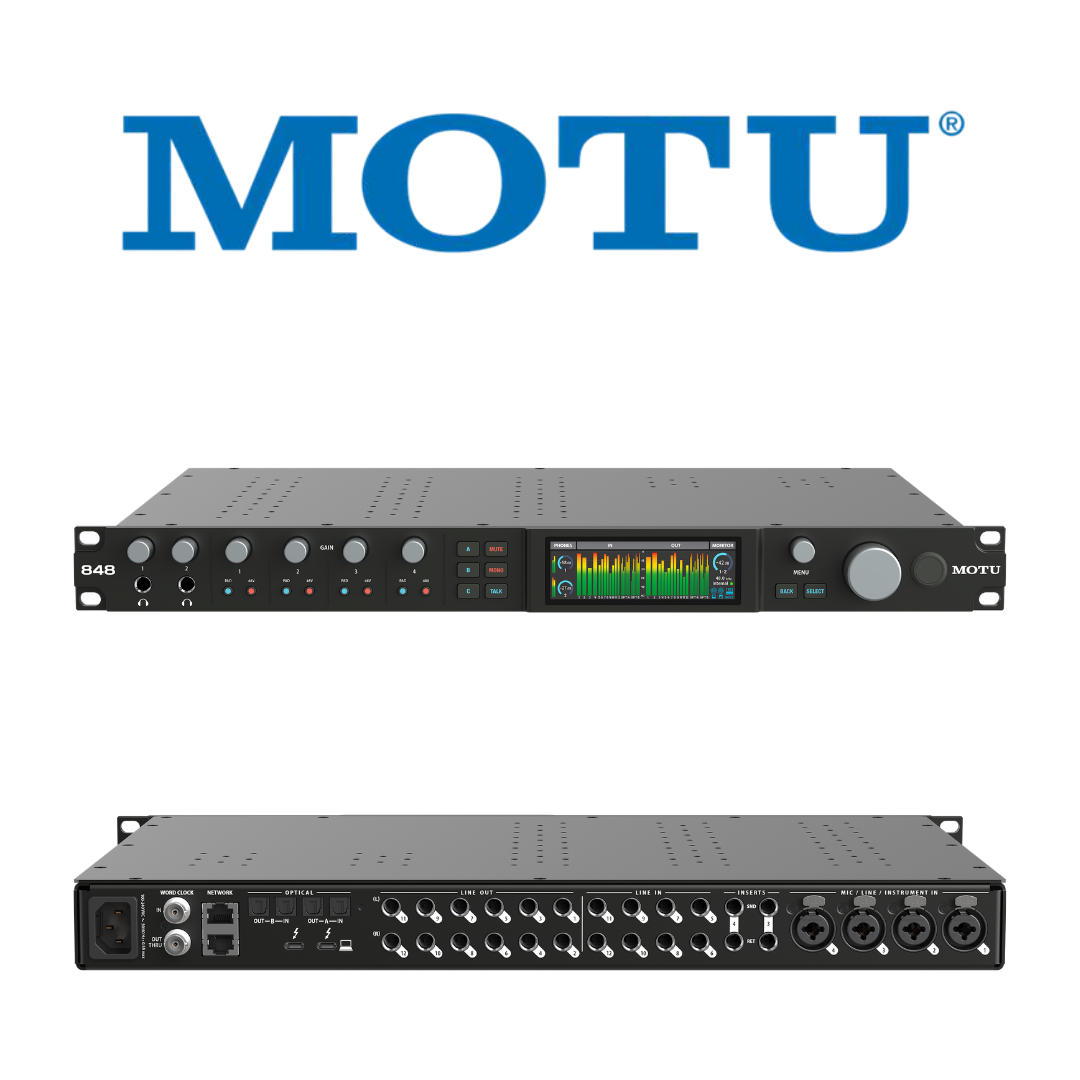
MOTU 848
Category: Audio Interfaces
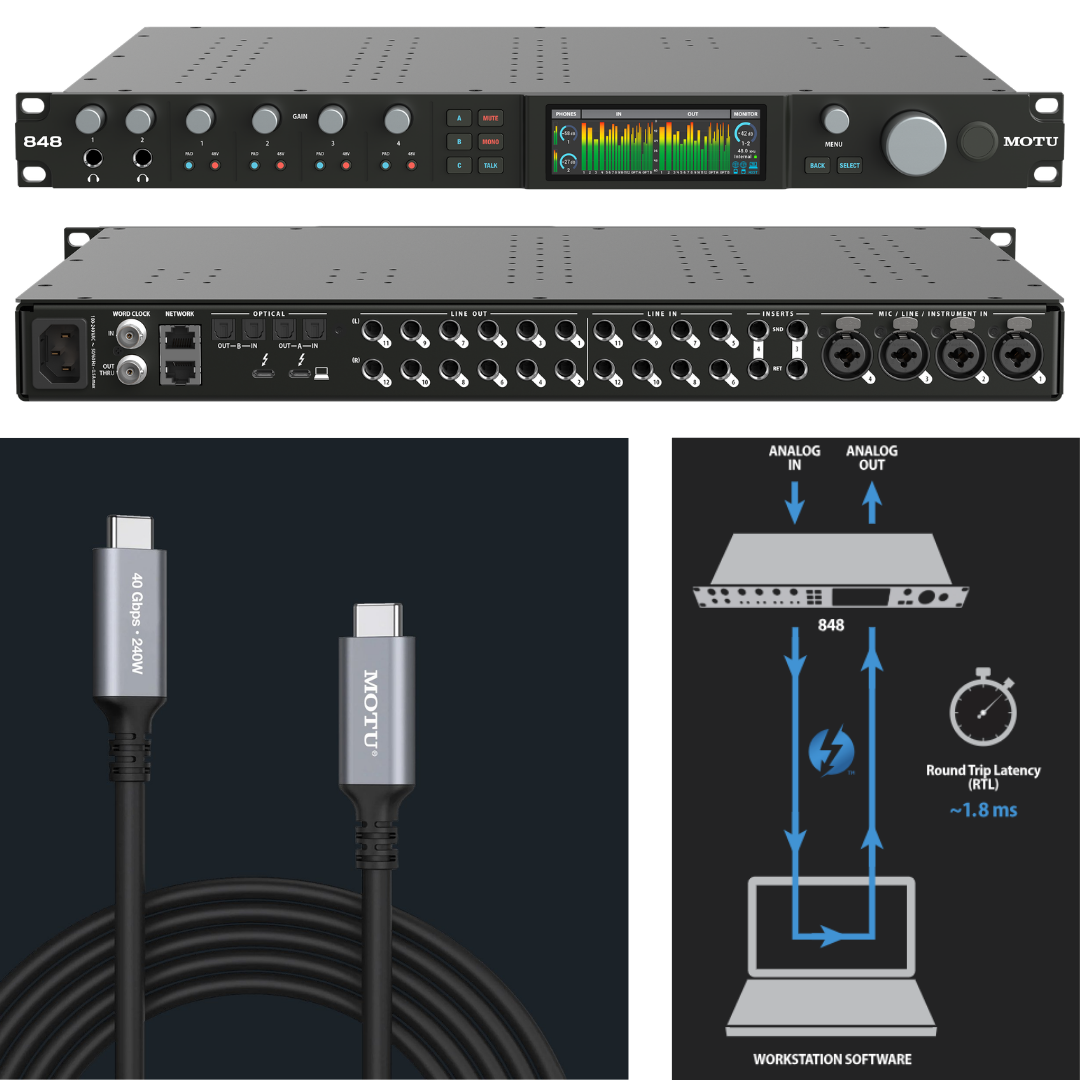
28-in/32-out Thunderbolt 4 / USB4 / AVB Rack Interface • 4 Mic Preamps • 60 Channels • On-Board DSP • 125 dB Dynamic Range • —114 dB THD + N • —129 dBu EIN • Equipped with Renowned ESS Sabre32™ DAC Technology • CueMix Pro • 64-Channel DSP Mixer • AVB Gigabit Networking • Dual Headphone Outputs
 Get 5% OFF on Prepaid Orders
Copied!
Get 5% OFF on your First Purchase.
Copied!
Buy 2 and GET 10% OFF
Copied!
Get 5% OFF on Prepaid Orders
Copied!
Get 5% OFF on your First Purchase.
Copied!
Buy 2 and GET 10% OFF
Copied!
GENERAL / FORM FACTOR
| SPECIFICATIONS | DETAILS |
|---|---|
|
Product Name |
MOTU 848 |
|
Manufacturer |
MOTU (Mark of the Unicorn), Cambridge, MA, USA |
|
Product Category |
Professional Thunderbolt 4 / USB4 Audio Interface |
|
Rack Format |
1U, 19-inch (standard EIA 310-D) |
|
Dimensions (W × D × H) |
19 × 12.25 × 1.75 inches / 48.26 × 31.1 × 4.44 cm |
|
Weight |
11 lbs / 5 kg |
|
Power Supply |
Internal universal auto-switching; 100–240V, 50–60 Hz, 1.0A max |
|
Downstream USB Power |
15W to connected peripheral (upstream = 0W from host) |
SAMPLE RATE SUPPORT
| SPECIFICATIONS | DETAILS |
|---|---|
|
Supported Sample Rates |
44.1 / 48 / 88.2 / 96 / 176.4 / 192 kHz |
|
Word Clock Range |
44.1 to 192 kHz |
|
Internal Clock Accuracy |
Crystal-based master; sub-sample accuracy via AVB gPTP |
COMPUTER CONNECTIVITY
| SPECIFICATIONS | DETAILS |
|---|---|
|
Host Ports |
2 x Thunderbolt 4 / USB 4.1 Gen 3 Type-C (40 Gbps) |
|
Backward Compatibility |
Thunderbolt 3, USB3, USB2 (auto-negotiated) |
|
Included Cable |
2-metre Thunderbolt-compatible USB4 GEN3 C-to-C; 40 Gbps / 240W |
|
Class Compliant |
USB Audio Class 2.0; plug-and-play on macOS, Windows, iOS (no driver) |
|
Round-Trip Latency |
~1.8 ms at 96 kHz, 32-sample host buffer (Thunderbolt, digital performer) |
|
Second Thunderbolt Port Use |
Daisy-chain peripherals, USB hub, Thunderbolt dock |
|
iOS Connection |
USB-C direct; Lightning via optional adapter kit (sold separately) |
TOTAL AUDIO I/O
| SPECIFICATIONS | DETAILS |
|---|---|
|
At 44.1 / 48 kHz (1x) |
28 in / 32 out (60 channels simultaneous) |
|
At 88.2 / 96 kHz (2x) |
20 in / 24 out (44 channels simultaneous) |
|
At 176.4 / 192 kHz (4x) |
12 in / 16 out (28 channels simultaneous) |
MICROPHONE PREAMPS
| SPECIFICATIONS | DETAILS |
|---|---|
|
Count |
4 (channels 1–4, XLR/TRS combo on front panel) |
|
Preamp Gain |
+74 dB maximum, in 1 dB increments |
|
Phantom Power |
+48V DC (independent per channel) |
|
Pad |
-20 dB (independent per channel) |
|
Phase Invert |
Yes (per channel, software-controlled) |
|
EIN |
-129 dBu |
|
THD+N |
-114 dB (unweighted) |
|
Dynamic Range |
118 dB (A-weighted) |
|
Max Level (no pad) |
0 dBu |
|
Max Level (pad engaged) |
+20 dBu |
|
Insert Points |
Channels 3–4: dedicated balanced TRS send/return |
|
Hi-Z Impedance |
1 MΩ (instrument/guitar input on TRS) |
|
Remote Control |
All preamp settings controllable via CueMix Pro |
ANALOGUE LINE INPUTS
| SPECIFICATIONS | DETAILS |
|---|---|
|
Count |
8 x 1/4-inch TRS (rear panel); + 2 x insert returns (ch 3–4) |
|
Connector |
1/4-inch TRS, balanced (tip hot); unbalanced compatible |
|
Max Level |
+21 dBu |
|
Dynamic Range |
120 dB (A-weighted) |
|
THD+N |
-114 dB (0.0002%), unweighted |
|
Digital Gain Trim |
+20 dB per input (via CueMix Pro) |
|
Phase Invert |
Yes (per input, software-controlled) |
ANALOGUE LINE OUTPUTS
| SPECIFICATIONS | DETAILS |
|---|---|
|
Count |
12 x 1/4-inch TRS (rear panel) |
|
Connector |
1/4-inch TRS, balanced, DC-coupled (tip hot) |
|
Max Level |
+21 dBu |
|
Dynamic Range |
125 dB (A-weighted) |
|
THD+N |
-114 dB (0.0002%), unweighted |
|
DC Coupling |
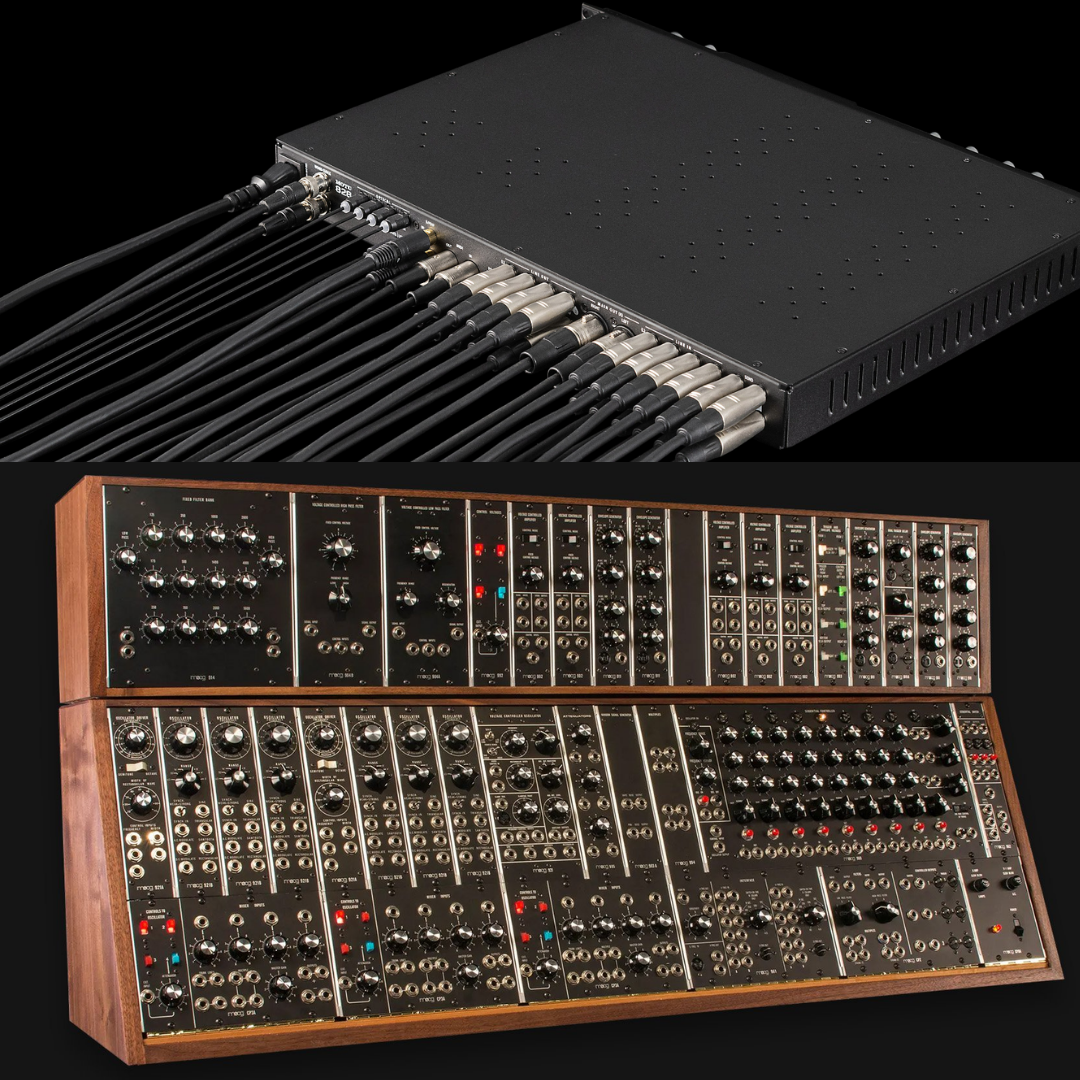
Yes — enables CV/modular synthesiser control |
|
Digital Trim |
-99 dB per output (via CueMix Pro) |
|
Surround Capability |
Up to 7.1.4 Dolby Atmos (12 outputs) |
|
Monitor Group |
Any outputs; single main fader; A/B/C select |
HEADPHONE OUTPUTS
| SPECIFICATIONS | DETAILS |
|---|---|
|
Count |
2 x 1/4-inch TRS stereo (front panel) |
|
Max Output Level |
13.3 dBu |
|
Output Impedance |
<1 Ohm |
|
Dynamic Range |
118 dB (A-weighted) |
|
THD+N |
-110 dB (0.0003%), unweighted |
|
Volume Control |
Independent encoder per output (front panel) |
|
Source Flexibility |
Any output pair, mixer bus, or custom cue mix |
DIGITAL I/O
| SPECIFICATIONS | DETAILS |
|---|---|
|
Optical Banks |
2 (Bank A and Bank B) — TOSLINK connectors |
|
ADAT @ 1x rates |
8 ch per bank = 16 ch total in/out |
|
S/MUX @ 2x rates |
4 ch per bank = 8 ch total in/out |
|
TOSLink (optical S/PDIF) |
Bank A: switchable; stereo; up to 96 kHz |
|
Word Clock In |
1 x BNC; all sample rates 44.1–192 kHz |
|
Word Clock Out/Thru |
1 x BNC; all sample rates 44.1–192 kHz |
AVB NETWORKING
| SPECIFICATIONS | DETAILS |
|---|---|
|
Ethernet Ports |
2 x Gigabit (integrated AVB switch) |
|
AVB Streams @ ≤96 kHz |
16 in / 16 out (1–8 ch per stream; up to 128 ch total) |
|
AVB Streams @ 176.4/192 kHz |
8 in / 8 out |
|
Network Latency |
2 ms (fixed, end-to-end) |
|
Max Cable Length |
100 m per segment (CAT-5e/6) |
|
Control Protocol |
IEEE 1722.1 (AVDECC) via CueMix Pro |
|
Stream Formats |
AAF; legacy AM8-24 (configurable per stream) |
|
Clock Sync |
IEEE 802.1AS gPTP (generalised Precision Time Protocol) |
|
Backwards Compatibility |
All MOTU AVB devices (16A, 8M, 112D, 1248, etc.) |
DSP MIXER & EFFECTS
| SPECIFICATIONS | DETAILS |
|---|---|
|
Channel Count |
64 inputs / 32 output buses |
|
Processing Precision |
32-bit floating-point |
|
EQ Precision |
64-bit double-precision (coefficient computation) |
|
EQ per Channel/Bus |
4-band parametric (all rates to 96 kHz) |
|
Compressor |
All channels and buses; threshold/ratio/attack/release/gain |
|
High-Pass Filter |
Input channels |
|
Gate |
Input channels |
|
Reverb |
Shared send/return effect |
|
Aux Buses |
26 |
|
Total Buses |
32 (26 aux + main + reverb + monitor + solo) |
|
Standalone Operation |
Full mixer functional without computer |
INCLUDED SOFTWARE & ACCESSORIES
| SPECIFICATIONS | DETAILS |
|---|---|
|
Control Software |
CueMix Pro (macOS, Windows, iOS) — free download |
|
Included DAW |
MOTU Performer Lite (macOS and Windows) |
|
Sample Content |
6 GB loops and sounds from Big Fish Audio, LucidSamples, Loopmasters |
|
Included Cable |
Thunderbolt 4 / USB4 GEN3 C-to-C; 40 Gbps / 240W; 2 metres |
|
Rack Mount Hardware |
Standard rack ears included (1U EIA 310-D) |
|
Documentation |
Electronic manual; Getting Started guide; online resources at motu.com |
SYSTEM REQUIREMENTS SUMMARY
| SPECIFICATIONS | DETAILS |
|---|---|
|
Mac |
Apple Silicon or Intel; macOS 12+; 8+ GB RAM; Thunderbolt 3+ or USB |
|
Windows |
x86-64 or ARM Snapdragon; Windows 11 23H2+; 8+ GB RAM; Thunderbolt 3+ or USB |
|
iOS |
iOS 17.5+; low-latency Thunderbolt driver for M-series iPad only |
|
Class Compliant |
macOS, Windows, iOS — no driver installation required |
1. PRODUCT OVERVIEW
The MOTU 848 is a professional Thunderbolt 4 / USB4 audio interface representing the latest generation of MOTU's flagship studio product line. Occupying the top of MOTU's rack-mount interface range, the 848 delivers 28 inputs and 32 outputs — 60 simultaneous audio channels — in a standard 1U rackmount chassis, combining cutting-edge converter technology, a built-in 64-channel DSP mixer, onboard AVB audio networking, and universal Thunderbolt 4 / USB4 connectivity. The 848 is designed for professional recording studios, post-production facilities, broadcast environments, houses of worship, educational institutions, and live sound applications where channel count, audio quality, and system flexibility are paramount.
MOTU has been a pioneer in professional audio interface technology since 1986, and the 848 carries forward decades of proven driver engineering and system design. Its headline feature is the adoption of Thunderbolt 4 and USB4 (USB 4.1 Gen 3) connectivity, operating at up to 40 Gbps — delivering 256 channels of computer I/O (128 in / 128 out) over a single cable at sample rates up to 96 kHz. This positions the 848 as one of the highest-bandwidth audio interfaces available to working professionals. The included 40 Gbps USB-C cable negotiates the fastest connection speed supported by the host computer, providing backward compatibility with Thunderbolt 3, USB3, and USB2 hosts without any hardware reconfiguration.
At the heart of the 848's audio performance is ESS Sabre32 DAC technology — the same converter architecture found in reference-grade digital-to-analogue converters used in high-end audiophile and broadcast equipment. ESS Sabre32 converters are renowned for their use of Hyperstream modulation and time-domain jitter elimination, producing a measured dynamic range of 125 dB (A-weighted) on the line outputs, THD+N of -114 dB (0.0002%) on both line inputs and outputs, and an equivalent input noise (EIN) of -129 dBu on the four microphone preamp channels. These figures place the 848 at or near the top of its class in any objective measurement.
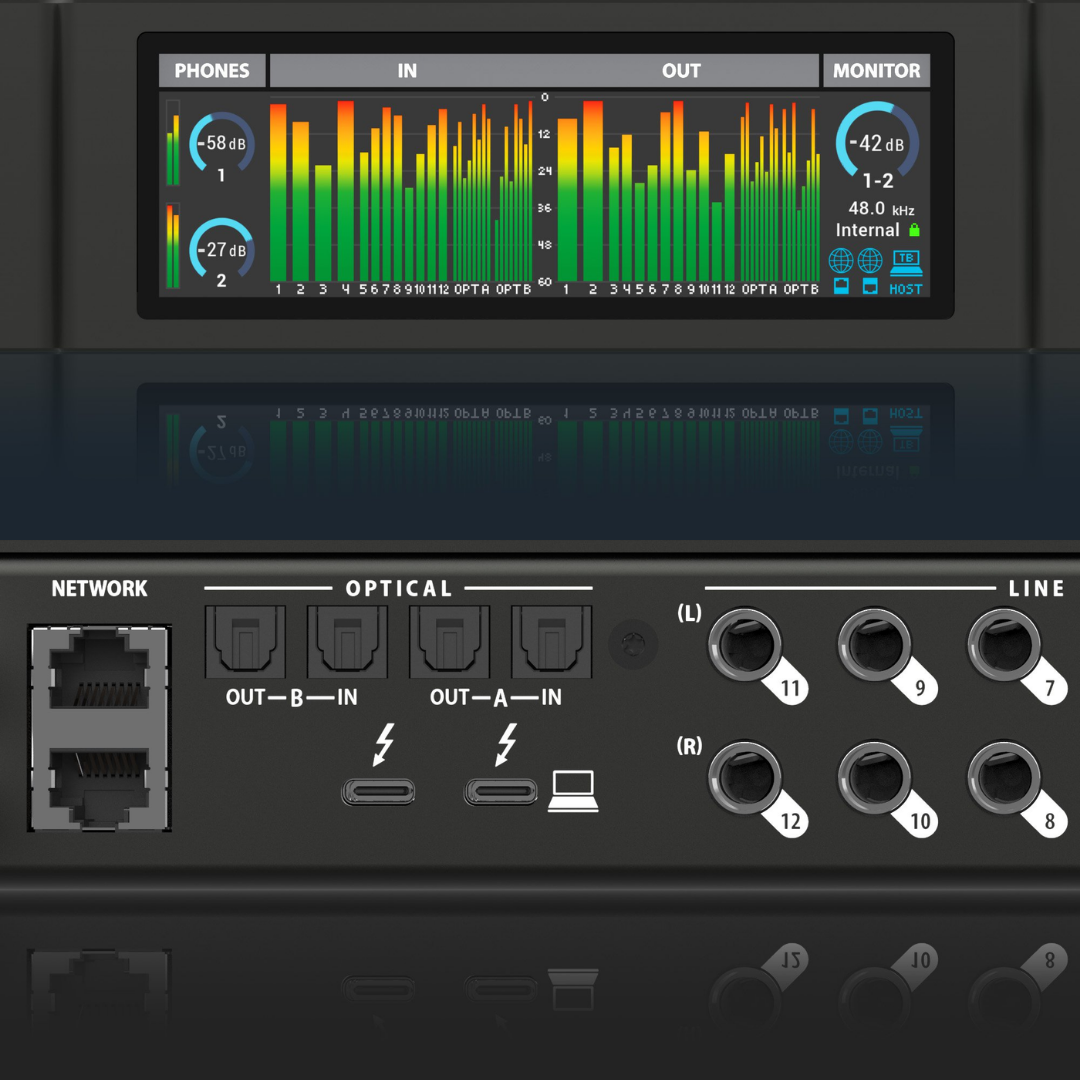
Beyond raw audio performance, the 848 integrates a 64-channel 32-bit floating-point DSP mixer with 4-band double-precision parametric EQ, high-pass filters, gate, and compression on every channel and bus — all controllable via the CueMix Pro application on macOS, Windows, and iOS. Onboard AVB networking through dual Gigabit Ethernet ports allows multiple 848 and compatible MOTU AVB devices to be networked together across a facility, with AVB's guaranteed 2 ms network latency and support for up to 128 channels per device. A 3.9-inch 480×128-pixel 24-bit RGB TFT display on the front panel provides at-a-glance metering, signal status, and hardware configuration access.
2. COMPUTER CONNECTIVITY
2.1 Thunderbolt 4 / USB4 Universal Interface
The 848 features two Thunderbolt 4 / USB4 Type-C ports, each capable of operating at up to 40 Gbps. This is not merely a USB-C interface with Thunderbolt branding — the 848 fully implements the Thunderbolt 4 specification, including Intel's guaranteed minimum bandwidth allocation, daisy-chaining support for up to six Thunderbolt devices, and compatibility with Thunderbolt 3 hosts. The second Thunderbolt port is available for daisy-chaining peripherals such as additional MOTU interfaces, external storage, USB hubs, or Thunderbolt docks, all sharing the 40 Gbps pipe.
The included cable is a 2-metre, 40 Gbps / 240W USB-C cable that is Thunderbolt-compatible. This single cable connection carries all audio I/O data to and from the host computer while also delivering up to 15W of power downstream for compatible peripherals. When connected to a USB3 host (without Thunderbolt), the 848 automatically negotiates USB3 operation, delivering 128 channels of host I/O at 44.1/48 kHz or 88.2/96 kHz. USB2 class-compliant operation (no driver required) delivers 64 channels at 44.1/48 kHz. The ability to operate as a USB audio class-compliant device means the 848 works immediately with any macOS or iOS host without installing any drivers — an important advantage for touring and rental applications.
Round-trip latency (RTL) is measured at approximately 1.8 ms at 96 kHz with a 32-sample host buffer in a high-performance DAW such as Digital Performer. This figure represents the total latency from analogue input through the ADC, through the host computer's audio engine, through the DAC, to analogue output — the most relevant latency measurement for live monitoring and overdubbing applications. At 44.1 kHz or 48 kHz with larger buffers, the 848 delivers stable, glitch-free operation even on complex sessions with many plug-ins.
Host Audio Channel Count by Connection Type
|
SPECIFICATIONS |
DETAILS |
|---|---|
Thunderbolt 4 / USB4 @ 44.1/48 kHz |
128 channels (in & out) |
Thunderbolt 4 / USB4 @ 88.2/96 kHz |
128 channels (in & out) |
Thunderbolt 4 / USB4 @ 176.4/192 kHz |
64 channels (in & out) |
USB3 Driver @ 44.1/48 kHz |
128 channels (in & out) |
USB3 Driver @ 88.2/96 kHz |
64 channels (in & out) |
USB3 Driver @ 176.4/192 kHz |
32 channels (in & out) |
USB3 Class Compliant @ 44.1/48 kHz |
128 channels (in & out) |
USB3 Class Compliant @ 88.2/96 kHz |
64 channels (in & out) |
USB2 Driver @ 44.1/48 kHz |
64 channels (in & out) |
USB2 Driver @ 88.2/96 kHz |
32 channels (in & out) |
USB2 Class Compliant @ 44.1/48 kHz |
64 channels (in & out) |
USB2 Class Compliant @ 88.2/96 kHz |
32 channels (in & out) |
3. ANALOGUE AUDIO QUALITY & CONVERTER TECHNOLOGY
3.1 ESS Sabre32 DAC Architecture
The 848 employs ESS Technology's Sabre32 converter architecture for its digital-to-analogue conversion. ESS Sabre32 converters utilise a 32-bit Hyperstream DAC modulator — a proprietary multi-bit sigma-delta topology that processes audio at 32 bits of internal resolution before noise-shaping and filtering. Unlike conventional multi-bit or single-bit sigma-delta DACs, Hyperstream minimises noise across the entire audio band by distributing quantisation energy far outside the audible range. The result is a measured dynamic range of 125 dB (A-weighted) on the line outputs — a figure that approaches the theoretical limit of 24-bit audio (nominally ~144 dB at 0 dBFS) while reflecting the real-world limits of analogue circuit noise floors.
Total Harmonic Distortion plus Noise (THD+N) on both line inputs and outputs is specified at -114 dB, equivalent to 0.0002%. This is an exceptionally low distortion figure that can only be achieved through careful circuit design: shielded power supply topologies, matched differential input stages, precision voltage references, and thermally stable gain stages. The microphone preamps achieve the same -114 dB THD+N figure, which combined with an Equivalent Input Noise (EIN) of -129 dBu places them among the quietest preamps in any interface product at any price point.
The analogue-to-digital converters (ADC) for the line inputs achieve a dynamic range of 120 dB (A-weighted) — 5 dB below the DAC figure, which is typical and physically expected, as ADC noise floors are constrained by the thermal noise of the input circuitry preceding the converter. The +21 dBu maximum signal level on all analogue inputs and outputs provides approximately 21 dB of headroom above a nominal 0 dBu operating level, ensuring the 848 can accommodate the hot output levels common in professional-grade outboard gear and mixing consoles without clipping.
Analogue I/O Specifications
|
SPECIFICATIONS |
DETAILS |
|---|---|
Line Input Dynamic Range |
120 dB (A-weighted) |
Line Input THD+N |
-114 dB (0.0002%), unweighted |
Line Input Max Level |
+21 dBu |
Line Input Connector |
1/4-inch TRS, balanced, tip hot |
Line Output Dynamic Range |
125 dB (A-weighted) |
Line Output THD+N |
-114 dB (0.0002%), unweighted |
Line Output Max Level |
+21 dBu |
Line Output Connector |
1/4-inch TRS, balanced, DC-coupled, tip hot |
Mic Input Dynamic Range |
118 dB (A-weighted) |
Mic Input THD+N |
-114 dB (unweighted) |
Mic Input EIN |
-129 dBu |
Mic Input Max Level |
0 dBu (without pad); pad engaged = +20 dBu |
Headphone Dynamic Range |
118 dB (A-weighted) |
Headphone THD+N |
-110 dB (0.0003%), unweighted |
Headphone Max Output |
13.3 dBu |
Headphone Output Impedance |
<1 Ohm |
Converter Technology |
ESS Sabre32 (DAC); multi-bit sigma-delta (ADC) |
4. MICROPHONE PREAMPS & HI-Z INPUTS
4.1 Four Ultra-Transparent Mic Channels
The 848 provides four microphone preamp channels on front-panel XLR/TRS combination jacks (channels 1–4). Each preamp delivers +74 dB of gain range in 1 dB increments — an unusually wide range that accommodates everything from hot line-level sources (gain near minimum) to passive ribbon microphones requiring 60–70 dB of clean gain. The -20 dB pad on each channel extends the effective input range to handle signals up to +20 dBu without engaging the preamp's gain structure, useful for high-output condenser microphones placed close to loud sources.
The EIN of -129 dBu is the critical figure for evaluating microphone preamp transparency. EIN is the noise voltage at the preamp input referred back to a theoretical noise-free measurement point, expressed in dBu. A value of -129 dBu means that with maximum gain applied and the input terminated with a standard 150-ohm source impedance, the preamp adds less self-noise than the Johnson-Nyquist thermal noise generated by the source impedance itself. In practical terms, this means ribbon and passive dynamic microphones — notoriously challenging loads requiring 60–70 dB of gain — will be amplified with inaudible self-noise even in quiet studio environments.
Each XLR/TRS combo jack alternatively accepts a 1/4-inch TS high-impedance (hi-Z) guitar input on the TRS insert, with an input impedance of 1 MΩ on the line/instrument inputs. This allows direct injection (DI) recording of electric guitar or bass without an active DI box — the high impedance correctly loads the guitar's passive pickups, preserving the instrument's natural tonal character. Microphone inputs 3 and 4 each include a dedicated send/return insert loop for outboard gear: patch a hardware compressor, EQ, or noise gate into the signal chain before the ADC, operating via balanced TRS connections. When mic inputs 3–4 are not in use, their insert returns serve as two additional balanced TRS line inputs.
All four preamp channels include 48V phantom power (independently switchable), -20 dB pad (independently switchable), and phase invert — all remotely controllable from CueMix Pro running on a connected Mac, PC, or iOS device. This remote control capability is practically valuable in studio environments where the engineer is seated at a mixing position away from the rack-mounted 848.
Microphone Preamp Specifications
|
SPECIFICATIONS |
DETAILS |
|---|---|
Preamp Count |
4 (channels 1–4) |
Connector Type |
XLR/TRS "combo" jack (XLR balanced; TRS balanced; TS hi-Z) |
Gain Range |
+74 dB in 1 dB increments (remote controllable) |
Pad |
-20 dB (independent per channel, remote controllable) |
Phantom Power |
+48V DC (independent per channel, remote controllable) |
Phase Invert |
Yes, per channel (remote controllable via CueMix Pro) |
EIN (Equivalent Input Noise) |
-129 dBu |
Mic Input THD+N |
-114 dB (unweighted) |
Mic Input Dynamic Range |
118 dB (A-weighted) |
Max Level (no pad) |
0 dBu |
Max Level (pad engaged) |
+20 dBu |
Hi-Z Input Impedance |
1 MΩ (line/instrument input) |
Insert Points |
Channels 3–4: dedicated send/return, balanced TRS |
Insert Return as Line Input |
Yes — when mic input unused, returns = balanced line inputs |
Remote Control |
Via CueMix Pro on macOS, Windows, iOS (over Wi-Fi or USB) |
5. ANALOGUE INPUTS & OUTPUTS
5.1 Line Inputs and Outputs
Beyond the four microphone/instrument combo inputs, the 848 provides eight balanced 1/4-inch TRS line inputs on the rear panel, accepting signals up to +21 dBu. A +20 dB digital gain trim is available on each input channel from CueMix Pro, allowing calibration for sources operating at different nominal levels (e.g., +4 dBu professional gear versus -10 dBV consumer equipment). Combined with the four mic/instrument channels, the 848 offers a total of 12 discrete analogue inputs (plus two additional insert returns), providing flexible connectivity for mixing consoles, outboard processors, synthesisers, drum machines, and other line-level sources.
The 848 features 12 balanced 1/4-inch TRS analogue outputs, all DC-coupled. DC coupling — the absence of an output coupling capacitor — is normally reserved for laboratory and test equipment, where it allows measurement of signals down to DC (0 Hz). In a professional audio context, DC coupling serves a different purpose: it permits the 848's line outputs to be used as Control Voltage (CV) sources for Eurorack and other modular synthesiser systems. By routing DAW automation data to an output channel, a user can transmit precise voltage signals that modulate oscillator pitch, filter cutoff, envelope timing, or any other voltage-controlled parameter in a modular system — without any additional hardware. A -99 dB digital trim is available on each output channel for fine-level calibration. The twelve outputs support configurations up to 7.1.4 Dolby Atmos, making the 848 directly compatible with immersive audio production workflows.
Analogue I/O Configuration
|
SPECIFICATIONS |
DETAILS |
|---|---|
Analogue Inputs (line) |
8 × 1/4-inch TRS balanced/unbalanced (rear panel) |
Analogue Inputs (mic/instr) |
4 × XLR/TRS combo (front panel; mic, line, hi-Z) |
Insert Returns as Line In |
2 × balanced TRS (when mic inputs 3–4 unused) |
Total Analogue Inputs |
12 discrete (14 with insert returns) |
Input Max Level |
+21 dBu |
Input Digital Gain |
+20 dB per input (via CueMix Pro) |
Analogue Outputs (line) |
12 × 1/4-inch TRS balanced, DC-coupled (rear panel) |
Output Max Level |
+21 dBu |
Output Digital Trim |
-99 dB per output (via CueMix Pro) |
DC Coupling |
Yes — all 12 line outputs; enables CV/modular synthesis |
Monitor Group |
Any combination of analogue outputs (up to 12); single fader control |
Surround Support |
Up to 7.1.4 (Dolby Atmos); 12 outputs = front/rear/height/LFE |
A/B/C Monitor Select |
Front-panel switches; 3 monitor sets; instant A/B/C comparison |
Talkback |
Front-panel latching talkback switch |
6. HEADPHONE OUTPUTS
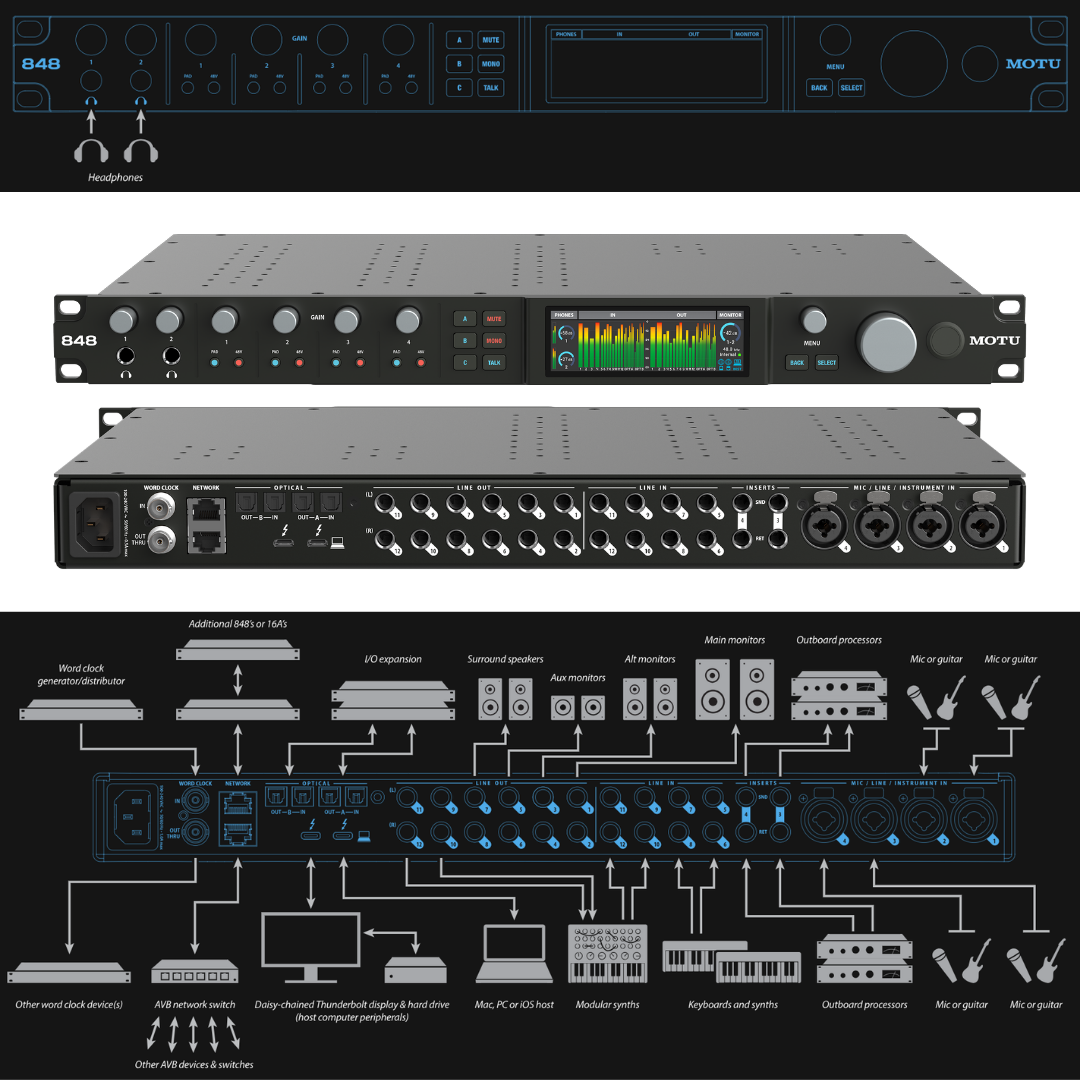
The 848 provides two independent 1/4-inch TRS stereo headphone outputs on the front panel, each with a dedicated encoder for independent volume control. The headphone outputs deliver a maximum of 13.3 dBu into a standard headphone load, with an output impedance of less than 1 Ohm. A sub-1-ohm output impedance is significant: it ensures that the headphone driver can accurately control the headphone transducer regardless of the headphone's own nominal impedance (whether 32 Ohm consumer-grade or 250 Ohm professional studio headphones), preventing the "damping factor" degradation that causes headphones to sound loose or resonant when driven from high-impedance sources.
Each headphone output can be independently assigned to any audio source: the main stereo output pair, any other analogue output pair, any mixer bus, any computer output channel pair, or a completely custom mix created in CueMix Pro — including live microphone feeds with built-in reverb for comfortable monitoring during tracking. This flexibility makes both headphone outputs genuinely independent monitor mixes rather than a simple split of the main output, enabling simultaneous cue mixes for different performers during recording sessions.
Headphone Specifications
|
SPECIFICATIONS |
DETAILS |
|---|---|
Headphone Outputs |
2 × 1/4-inch TRS stereo (front panel) |
Max Output Level |
13.3 dBu |
Output Impedance |
<1 Ohm (ensures accurate transducer control) |
Dynamic Range |
118 dB (A-weighted) |
THD+N |
-110 dB (0.0003%), unweighted |
Volume Control |
Independent encoder per output (front panel) |
Source Assignment |
Any output pair, mixer bus, or custom mix (via CueMix Pro) |
Independent Mixes |
Yes — completely different mix per headphone output |
7. DIGITAL I/O
7.1 Optical I/O — ADAT, S/MUX and TOSLink
The 848 provides two optical I/O banks (Bank A and Bank B), each with a dedicated TOSLINK transmitter and receiver. At 1x sample rates (44.1/48 kHz), each bank carries 8 channels of ADAT Lightpipe audio, for a total of 16 ADAT channels in and 16 out. ADAT Lightpipe is the industry-standard optical protocol for digital audio expansion, supported by a vast ecosystem of devices including outboard AD/DA converters, digital mixing consoles, optical expanders, and other audio interfaces. At 2x sample rates (88.2/96 kHz), each ADAT bank switches to S/MUX (Sample Multiplexing) mode, which carries 4 channels per bank (8 total) by interleaving adjacent sample frames across adjacent ADAT channels. This halving of channel count at double sample rate is a fundamental property of the S/MUX protocol and is reflected in the 848's total channel count figures.
Bank A additionally supports optical S/PDIF (TOSLink) I/O, switchable via CueMix Pro. This allows the 848 to connect to consumer DAT recorders, CD players, optical-equipped mixing consoles, and any other TOSLink device — at sample rates up to 96 kHz. The Word Clock I/O via BNC connectors enables the 848 to lock to an external master clock or to act as master clock for an entire digital audio system, supporting all sample rates from 44.1 to 192 kHz. Proper word clock synchronisation between multiple digital devices is essential to prevent the sample-rate discontinuities and jitter-induced noise artefacts that result when converters operate on unsynchronised clocks.
Digital I/O Specifications
|
SPECIFICATIONS |
DETAILS |
|---|---|
Optical Banks |
2 (Bank A and Bank B) |
ADAT Channels @ 44.1/48 kHz |
8 ch per bank = 16 ch total in & out |
S/MUX Channels @ 88.2/96 kHz |
4 ch per bank = 8 ch total in & out |
TOSLink / Optical S/PDIF |
Bank A: switchable to stereo TOSLink up to 96 kHz |
Optical Connector Type |
TOSLINK (JIS F05; standard optical audio) |
Word Clock In |
1 × BNC, all sample rates 44.1–192 kHz |
Word Clock Out / Thru |
1 × BNC, all sample rates 44.1–192 kHz |
Word Clock Sync |
Locks entire digital system to external master clock |
Internal Clock |
Crystal-based; acts as master clock for connected digital devices |
8. DSP MIXER & EFFECTS PROCESSING
8.1 64-Channel 32-Bit Floating-Point Mixing Engine
The 848 incorporates a fully featured 64-channel DSP mixing engine operating at 32-bit floating-point precision. Unlike host-based mixing (which consumes CPU resources and adds latency proportional to the DAW buffer size), the 848's onboard DSP mixer operates independently of the connected computer. This means the mixer is fully functional even in standalone mode — at power-up without a computer — and introduces negligible additional latency compared to pure hardware bypass. The 32-bit floating-point processing format provides over 1,500 dB of theoretical headroom, ensuring that even complex mix matrices with multiple summed channels never clip internally.
The 64-channel mixer accepts inputs from any combination of sources: the 848's physical analogue inputs, its optical digital inputs, computer playback channels (DAW tracks routed to the interface), and AVB audio network streams from other connected devices. All 64 inputs can be routed to any combination of the mixer's 32 output buses. The bus architecture includes 26 auxiliary buses for headphone cue mixes, monitor feeds, and effects sends, plus dedicated main, reverb, monitor, and solo buses. This is equivalent to the busing architecture of a mid-size hardware mixing console.
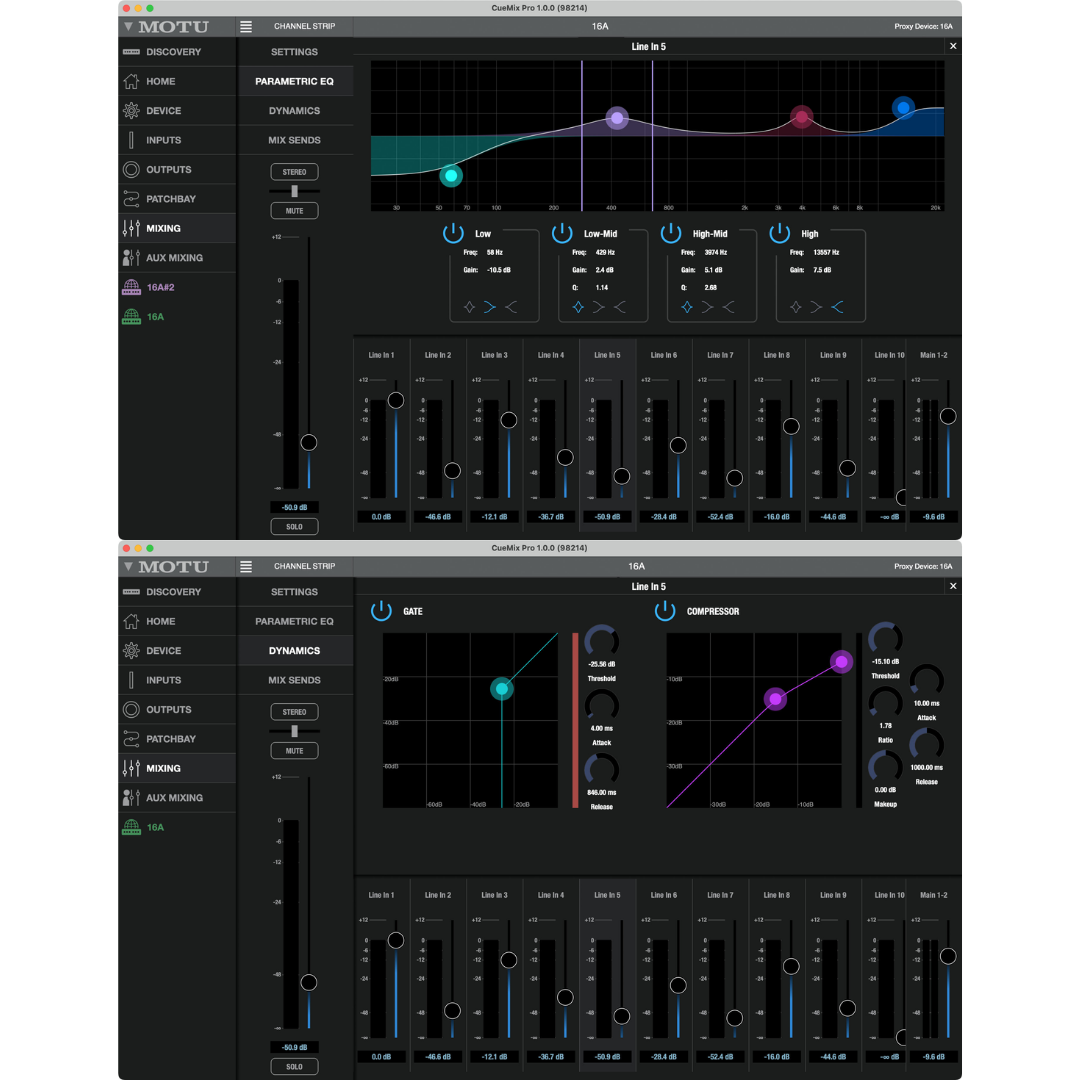
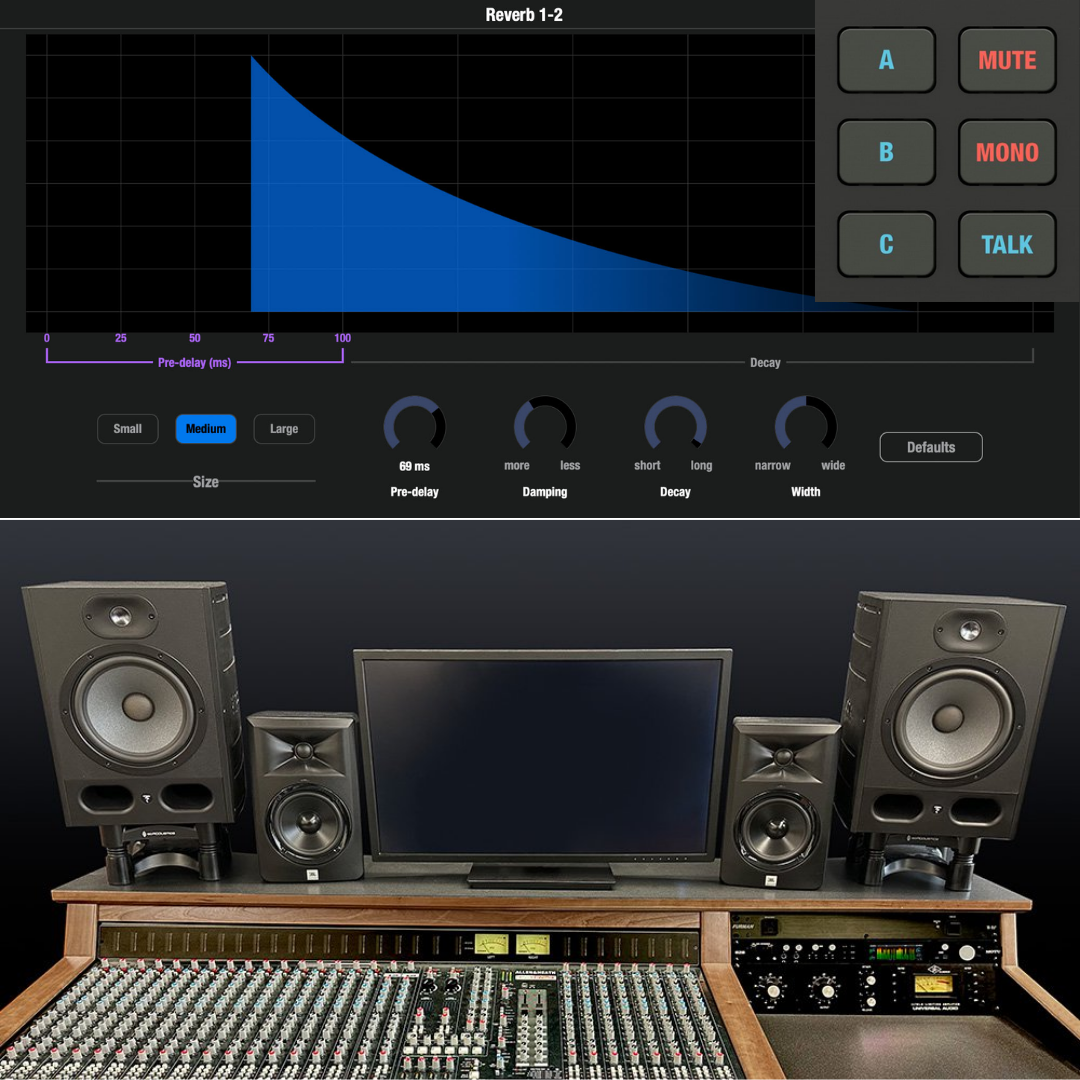
Every input channel and every output bus in the 64-channel mixer includes a four-band double-precision parametric EQ. "Double-precision" in DSP terms means that the EQ computations are performed at 64-bit floating-point resolution internally, preventing the coefficient rounding errors and limit cycles that can cause subtle artefacts in 32-bit-only EQ implementations, particularly in high-Q filter configurations at low frequencies. Input channels additionally include a high-pass filter and a gate. All channels and buses also include a compressor with threshold, ratio, attack, release, and gain controls. The reverb processor is a separate send effect available to all channels.
DSP Mixer Specifications
|
SPECIFICATIONS |
DETAILS |
|---|---|
Mixer Architecture |
64-channel, large-format console design |
Processing Precision |
32-bit floating-point (internal arithmetic) |
EQ Precision |
64-bit double-precision (EQ coefficient computation) |
Total Inputs |
64 (physical, computer, network sources combined) |
Aux Buses |
26 auxiliary buses |
Additional Buses |
Main, Reverb, Monitor, Solo buses |
Total Bus Count |
32 output buses |
EQ per Channel |
4-band double-precision parametric EQ (all sample rates to 96 kHz) |
Compressor |
Yes — all inputs and buses; threshold, ratio, attack, release, gain |
High-Pass Filter |
Yes — input channels |
Gate |
Yes — input channels |
Reverb |
Yes — send/return effect accessible from all channels |
Sample Rate Support |
Full DSP features up to 96 kHz (per MOTU specification) |
Standalone Operation |
Yes — full mixer functional without computer connection |
Remote Control |
CueMix Pro on macOS, Windows, iOS (Wi-Fi or USB) |
9. PATCHBAY, ROUTING & ROUTING GRID
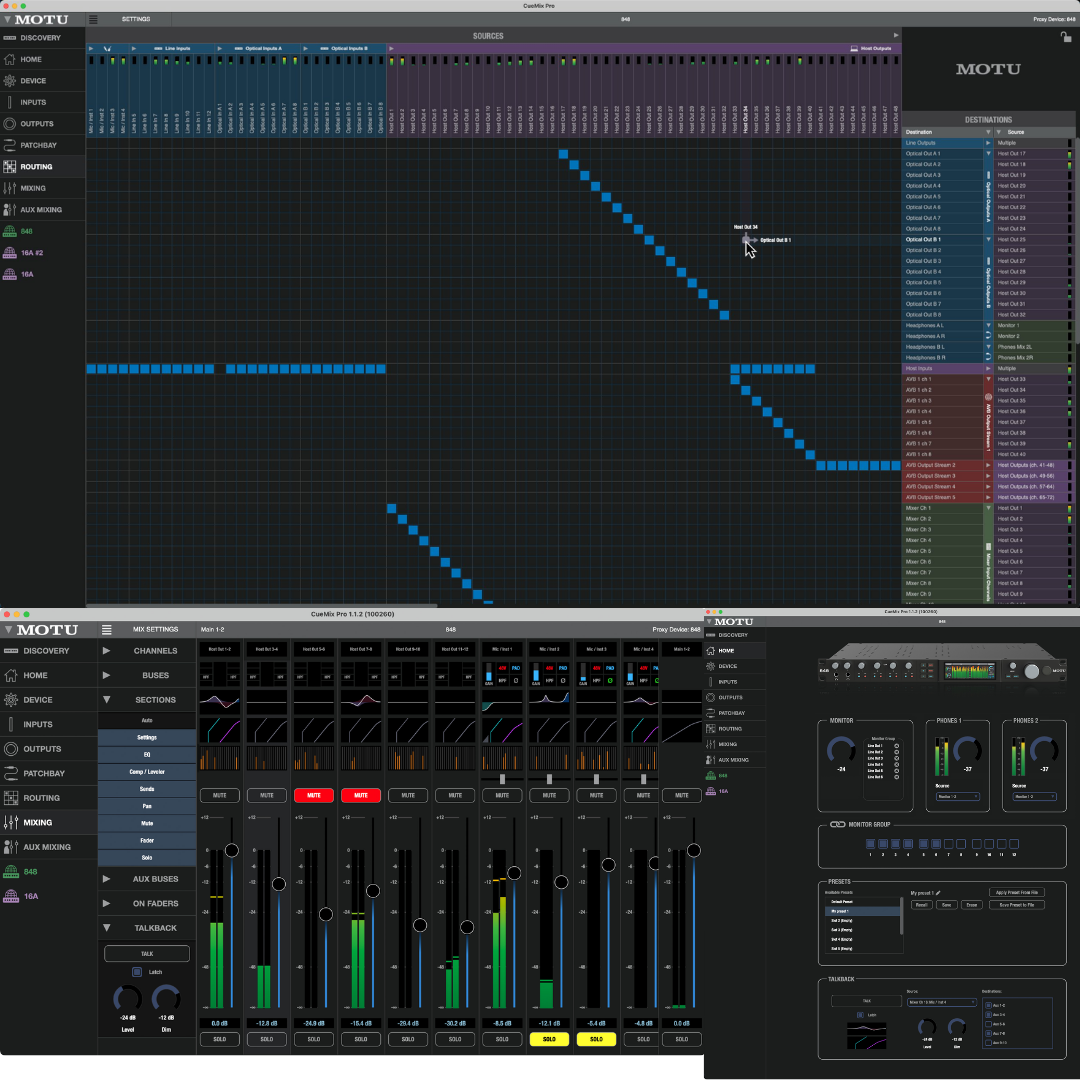
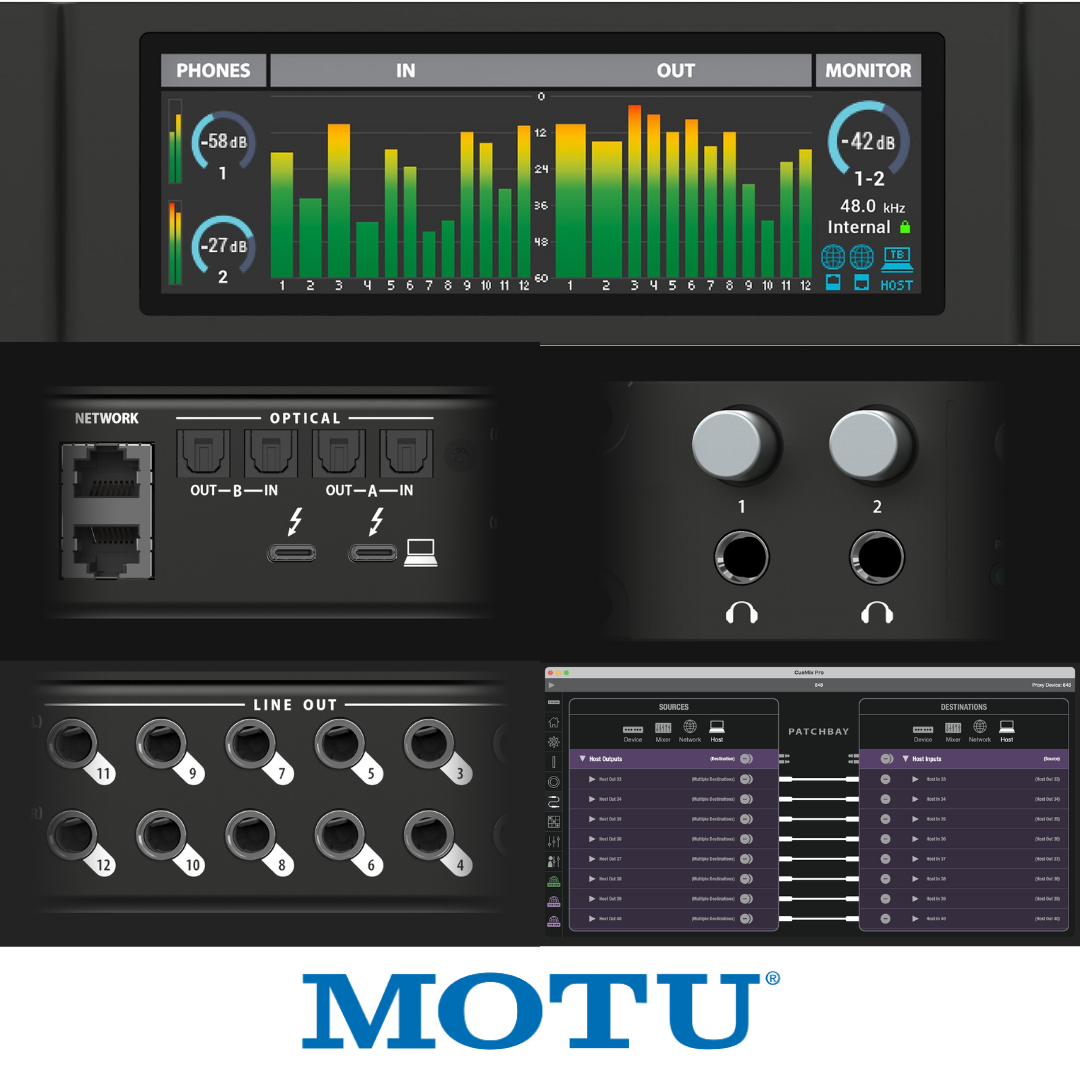
CueMix Pro's Patchbay view provides a visual, virtual patch-cord interface for routing any signal source to any destination in the 848 system. Sources include the 848's analogue inputs, optical digital inputs, computer playback channels, mixer bus outputs, and AVB network audio streams. Destinations include analogue outputs, headphone outputs, optical digital outputs, computer record inputs, mixer inputs, and AVB network streams. Unlike a fixed mixer architecture, the Patchbay allows arbitrary point-to-point connections and — critically — source splitting: a single mono source or stereo pair can be simultaneously routed to an unlimited number of destinations without any signal degradation, since digital splits are arithmetically lossless.
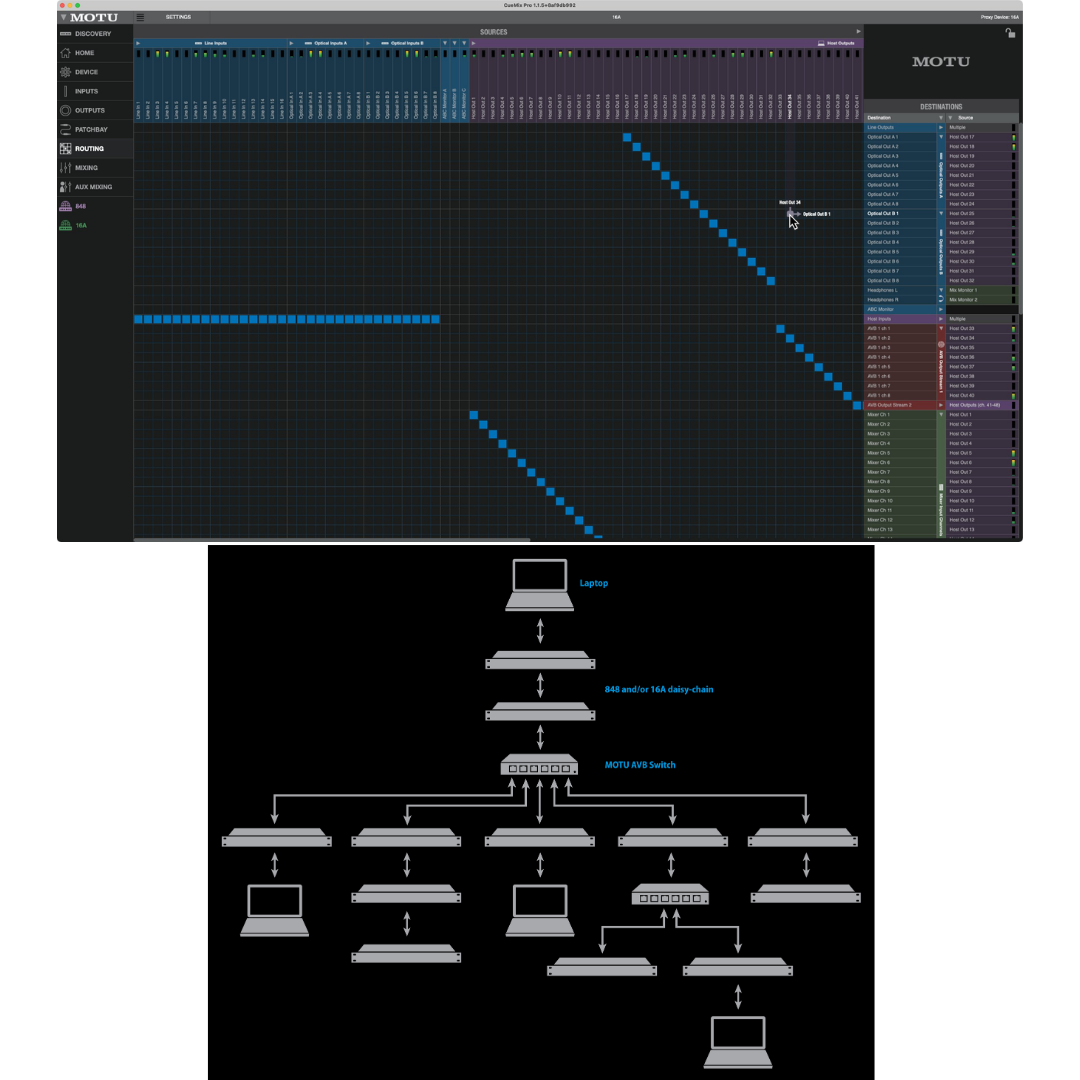
The Routing Grid provides a matrix-style "bird's-eye" overview of all signal routing in the system, displaying all sources and destinations in a two-dimensional grid. Activity meters on each grid intersection allow engineers to verify signal presence without returning to individual channel views. The Routing Grid is particularly valuable when managing large channel-count sessions where multiple optical banks, computer channels, and network streams are all active simultaneously — a session topology common in broadcast studios, post-production facilities, and large educational institutions.
10. AVB AUDIO NETWORKING
10.1 IEEE 802.1 Audio Video Bridging
Audio Video Bridging (AVB) is a suite of IEEE 802.1 network protocols designed specifically for real-time audio and video transport over standard Gigabit Ethernet infrastructure. Unlike standard Ethernet, which operates on a best-effort delivery model, AVB allocates guaranteed bandwidth reservations on the network — ensuring that audio streams are never delayed or interrupted by competing network traffic. The 848 implements a fully compliant AVB stack with two built-in Gigabit Ethernet ports that function as an integrated two-port AVB switch, enabling daisy-chaining of up to eight AVB-compatible devices without external switching hardware.
AVB network latency — the point-to-point audio transmission delay — is fixed at 2 ms throughout the network, regardless of cable length (up to 100 metres per segment with standard CAT-5e or CAT-6 cable, or far longer with fibre-optic cable), the number of daisy-chained devices, or the number of AVB switches in the signal path. This deterministic latency is a fundamental property of AVB's Credit-Based Shaper mechanism, which paces audio packet transmission to prevent buffer overflow. A 2 ms network latency is imperceptible in live monitoring applications and well within the tolerances required for synchronous multiroom recording.
Each 848 can transmit and receive up to 128 audio channels to and from the AVB network at sample rates up to 96 kHz, organised as 16 configurable streams of 1–8 channels each. At 176.4/192 kHz, the stream count reduces to 8 streams. The 848 is fully compatible with all previous-generation MOTU AVB devices (16A, 8M, 112D, 1248, etc.), enabling mixed-generation networks where older devices expand a new 848 installation. CueMix Pro's 1722.1 controller functionality also allows management of third-party AVB devices on the same network.
AVB Networking Specifications
|
SPECIFICATIONS |
DETAILS |
|---|---|
Ethernet Ports |
2 × Gigabit Ethernet (integrated 2-port AVB switch) |
AVB Streams In |
16 streams at up to 96 kHz; 8 streams at 176.4/192 kHz |
AVB Streams Out |
16 streams at up to 96 kHz; 8 streams at 176.4/192 kHz |
Channels per Stream |
1–8 (configurable per stream) |
Total AVB Network Channels |
Up to 128 in / 128 out at up to 96 kHz |
Network Latency |
2 ms (fixed, point-to-point, regardless of topology) |
Maximum Cable Run |
100 metres per segment (CAT-5e/6); longer with fibre |
Daisy-Chain Limit |
Up to 8 devices (no external switch) |
External Switch Support |
Yes — AVB-compatible switches for larger networks |
AVB Protocol Standard |
IEEE 802.1Qat (stream reservation), 802.1Qav (bandwidth shaping) |
Control Protocol |
IEEE 1722.1 (AVDECC) — also controls third-party AVB devices |
Stream Formats |
AAF (AVTP Audio Format); legacy AM8-24 (configurable per stream) |
Clock Synchronisation |
Sub-sample accuracy across all devices (nanosecond phase lock) |
Backwards Compatibility |
MOTU 16A, 8M, 112D, 1248, and other previous MOTU AVB devices |
Network Coexistence |
Shares standard Ethernet; compatible with routers, switches, Wi-Fi |
11. FRONT PANEL, DISPLAY & CONTROL ROOM FEATURES
11.1 3.9-Inch 480 × 128 TFT Display
The 848's front panel is dominated by a 3.9-inch 480×128-pixel 24-bit RGB TFT LCD display — an unusually large, high-resolution display for a professional audio interface. This display provides real-time metering for all analogue and digital I/O simultaneously, with customisable meter views that can show analogue I/O only, digital I/O only, or any combination. The 24-bit colour depth allows the display to use colour-coded signal status indicators (e.g., green for nominal levels, amber for approaching clip, red for clip) with full colour fidelity rather than the limited palettes typical of OLED or character-LCD displays.
The front panel provides extensive hardware control: four encoders for preamp gain (one per mic channel), two encoders for headphone volume, one large encoder for main output volume, one encoder and two switches for menu navigation, four switches for -20 dB pad (one per mic channel), four switches for 48V phantom power (one per mic channel), and six control room switches. The control room switches include A/B/C monitor select (for switching between three monitor sets), mute, mono (sum to mono), and talkback. A latching power button with LED status indicator completes the front-panel control set.
Front Panel Controls and Display
|
SPECIFICATIONS |
DETAILS |
|---|---|
Display Type |
3.9-inch 480 × 128 pixel 24-bit RGB TFT LCD |
Metering |
All analogue and digital I/O; customisable meter views |
Preamp Gain Encoders |
4 (one per mic channel; 1 dB increment control) |
Headphone Volume Encoders |
2 (independent per headphone output) |
Main Volume Encoder |
1 (large encoder; controls Monitor Group output) |
Menu Navigation |
1 encoder + 2 switches (hardware settings access) |
Pad Switches |
4 (-20 dB per mic channel, individually illuminated) |
Phantom Power Switches |
4 (48V per mic channel, individually illuminated) |
Control Room Switches |
6: A/B/C monitor select, mute, mono, talkback |
A/B/C Monitor Select |
Instant front-panel switching between 3 monitor sets |
Talkback |
Latching front-panel talkback switch |
Mono / Sum |
Sum-to-mono button for phase and translation checking |
Power Button |
Latching with LED status indicator |
Headphone Jacks |
2 × 1/4-inch TRS stereo (front panel) |
12. CUEMIX PRO SOFTWARE & INCLUDED APPLICATIONS
12.1 CueMix Pro — Universal Control Application
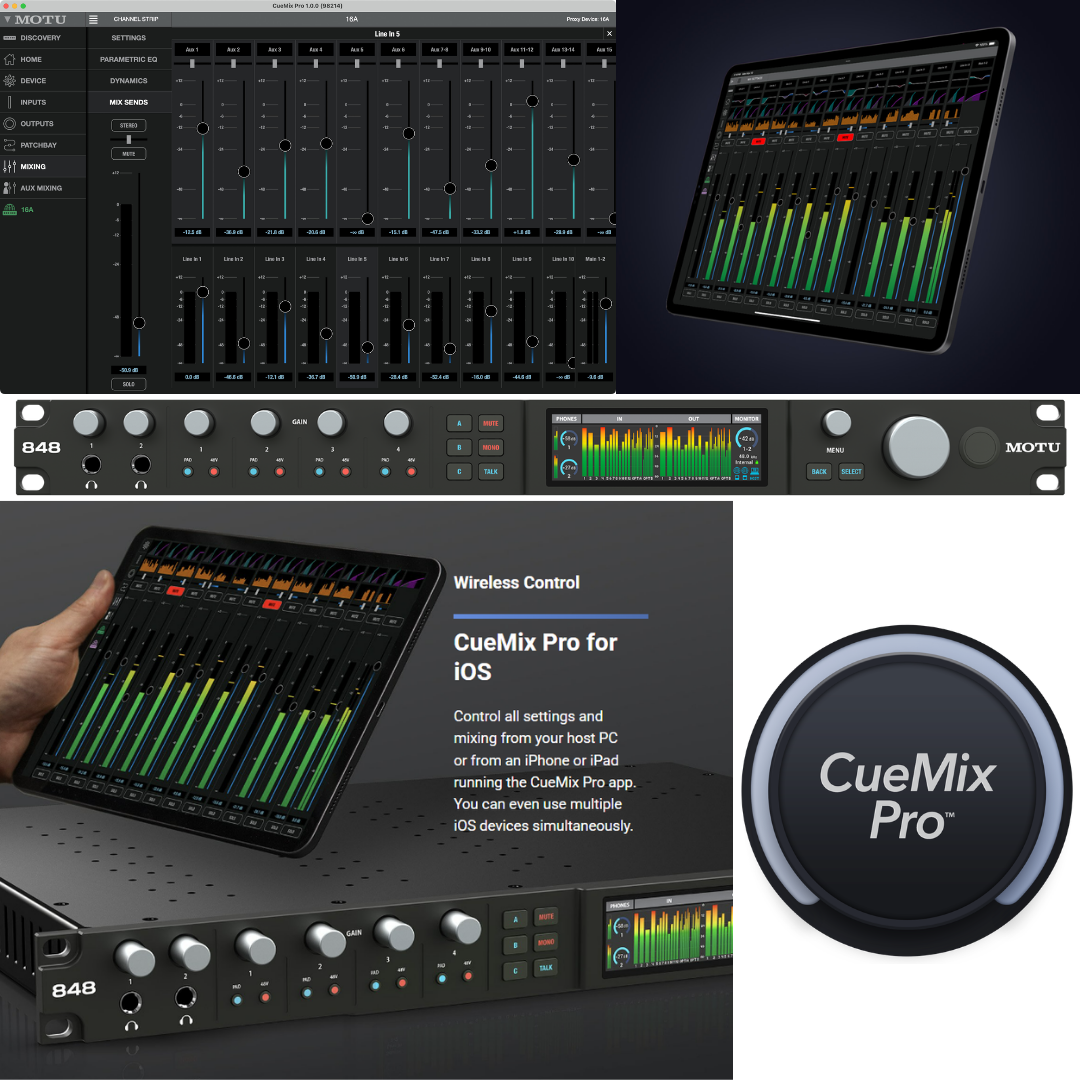
CueMix Pro is the dedicated control application for the 848, available for macOS, Windows, and iOS. It provides complete access to every 848 function: device settings, preamp gain and phantom power control, signal routing in both Patchbay and Routing Grid views, the full 64-channel mixer with EQ, dynamics, and effects, and AVB network management. CueMix Pro can run simultaneously on multiple devices — for example, an engineer at a macOS workstation and a musician with an iPhone can both access the mixer at the same time, with changes from either device reflected immediately on all connected CueMix Pro instances.
The 848 is controllable over Wi-Fi through CueMix Pro, provided the controlling device and the 848 (connected to the same computer on the network) share a common Wi-Fi network. This wireless control capability is particularly valuable in live performance, education, and large-facility scenarios where walking to the rack to adjust a preamp gain or monitor mix is impractical. The iOS version of CueMix Pro supports iPad models with M-series processors for full low-latency Thunderbolt operation, extending the 848's utility to iPad-based professional audio workflows.
Included software also comprises MOTU Performer Lite — a full digital audio workstation based on Digital Performer technology — providing multitrack recording, editing, mixing, and mastering capability immediately upon unboxing. Six gigabytes of royalty-free loops and sounds from Big Fish Audio, LucidSamples, and Loopmasters are included, spanning multiple musical genres and production styles.
Software & System Requirements
|
SPECIFICATIONS |
DETAILS |
|---|---|
Control Application |
CueMix Pro (macOS, Windows, iOS) |
Wi-Fi Control |
Yes — CueMix Pro on any networked device (iOS, Mac, PC) |
Multi-Device Control |
Yes — multiple CueMix Pro instances simultaneously |
AVB Network Management |
IEEE 1722.1 controller built into CueMix Pro |
Third-Party AVB Control |
Yes — CueMix Pro manages third-party 1722.1 AVB devices |
Included DAW |
MOTU Performer Lite (macOS and Windows) |
Included Content |
6 GB loops and sounds (Big Fish Audio, LucidSamples, Loopmasters) |
Mac Requirements |
Apple Silicon or Intel; macOS 12 or later; 8+ GB RAM |
Windows Requirements |
x86-64 or ARM (Snapdragon); Windows 11 23H2 or later; 8+ GB RAM |
iOS Requirements |
iOS 17.5 or later; low-latency Thunderbolt driver for M-series iPad |
Driver Types (Mac) |
Core Audio (with driver); USB Audio Class Compliant (no driver) |
Driver Types (Windows) |
ASIO + Wave (with driver); USB Audio Class Compliant (no driver) |
Class Compliant |
Yes — plug-and-play on macOS, Windows, iOS (no driver required) |
13. BUILD QUALITY & FORM FACTOR
The MOTU 848 is housed in a standard 1U, 19-inch rack-mount chassis — the universal form factor for professional audio equipment that mounts in standard EIA 310-D equipment racks. At 1U height (1.75 inches / 4.44 cm), the 848 occupies the minimum possible rack space while providing 28 inputs and 32 outputs. The chassis depth of 12.25 inches (31.1 cm) is compatible with standard 14-inch and deeper equipment racks. At 11 lbs (5 kg), the 848 is a solid, road-worthy unit suitable for both permanent studio installation and touring racks.
The chassis is constructed from steel with a powder-coat finish typical of MOTU's professional product line. The rear panel carries all permanent signal connections — TRS line inputs, TRS line outputs, optical I/O banks, BNC word clock connectors, and dual Gigabit Ethernet ports — allowing the unit to be rack-mounted with all cabling at the rear in a tidy, professional installation. The internal power supply is a universal auto-switching unit (100–240V, 50–60 Hz), eliminating the need for a voltage converter when deploying the unit in international environments, a common requirement for touring and broadcast production.
Physical Specifications
|
SPECIFICATIONS |
DETAILS |
|---|---|
Rack Height |
1U (1.75 inches / 4.44 cm) |
Rack Width |
19 inches / 48.26 cm (standard EIA 310-D) |
Depth (enclosure only) |
12.25 inches / 31.1 cm |
Weight |
11 lbs / 5 kg |
Power Supply |
Internal; universal auto-switching 100–240V, 50–60 Hz, 1.0A max |
Power Consumption |
Max 100–240V × 1.0A = up to ~240W draw (actual significantly lower) |
Downstream Power (USB) |
15W to connected downstream USB peripheral |
Front Panel Connections |
4 × combo XLR/TRS; 2 × 1/4" TRS headphone; display; encoders; switches |
Rear Panel Connections |
8 × 1/4" TRS line in; 12 × 1/4" TRS line out; 2 × ADAT optical I/O; 2 × BNC word clock; 2 × Gigabit Ethernet; 2 × USB-C (Thunderbolt 4/USB4) |
14. LOOPBACK, LIVE STREAMING & ADVANCED FEATURES
14.1 Loopback Recording and Live Streaming
The 848 supports loopback routing — the ability to route the computer's own audio output back into the computer as a record input. This is the fundamental requirement for live streaming and podcast production workflows where the engineer needs to mix computer audio (backing tracks, software instruments, remote guest audio via VoIP) together with live microphone inputs and present the combined signal to streaming software such as OBS Studio, StreamYard, or Zoom. The 848's patchbay makes loopback routing fully configurable: any number of computer output channels can be looped back as computer input channels, mixed with live sources in any proportion.
14.2 Guitar Re-Amping
The hi-Z inputs on the 848's combo jacks are designed for professional re-amping workflows. During a recording session, the guitarist connects directly to the 848's hi-Z input, and CueMix Pro routes the signal through the near-zero-latency DSP mixer to a line output connected to a guitar amplifier, while simultaneously recording the dry DI signal to the DAW. The guitarist monitors through the amplifier in real time with negligible latency. After the session, the dry DI track can be routed back through the same line output to a different amplifier — or through amp modelling software — for tonal experimentation without re-recording the performance. A re-amp box (impedance adapter) may be inserted in the signal path when required for proper impedance matching.
14.3 CV / Modular Synthesis Integration
DC coupling on all 12 line outputs means the 848's analogue outputs can pass signals from 0 Hz (DC) through 20 kHz without attenuation. Eurorack modular synthesiser systems use control voltages typically in the range of 0–10V or ±5V to control pitch (1V per octave), filter cutoff, amplitude, and other parameters. By routing DAW automation lanes or dedicated CV generator plug-ins to the 848's line outputs and connecting those outputs to a Eurorack system via appropriate voltage-scaling hardware, a composer or sound designer can drive modular systems with precise, repeatable, time-aligned control voltages synchronised to the DAW session clock.
15. IDEAL APPLICATIONS & USE CASES
- Professional Recording Studio: 28-input/32-output capability with 125 dB dynamic range and -129 dBu EIN preamps for multi-microphone, multi-source tracking sessions
- Post-Production and Audio-for-Picture: Atmos 7.1.4 monitoring via 12 line outputs, ultra-low 1.8 ms RTL for ADR and Foley work, loopback for picture lock mixing
- Broadcast and Radio Studio: AVB networking for facility-wide audio distribution, four ultra-transparent mic preamps with remote control, talkback integration
- Live Sound and Monitor Mixing: AVB stage box functionality networked to front-of-house, 64-channel DSP mixer for stage monitor mixes, standalone operation
- House of Worship: Multi-microphone recording, live stream output via loopback, wireless CueMix Pro control from front-of-house position, AVB multiroom distribution
- Music Education: Thunderbolt connectivity for teaching workstations, class-compliant operation for guest laptops, 16-channel ADAT optical expansion for student interfaces
- Electronic Music Production: DC-coupled outputs for CV/modular synthesis integration, 64-channel DSP mixer for complex hardware synthesiser setups
- Immersive Audio Production: 12 DC-coupled outputs for Dolby Atmos 7.1.4 monitoring, full sample-rate support to 192 kHz for mastering
- Audio Rental and Touring: Universal 100–240V power supply, class-compliant USB operation for guest computers, AVB networking for scalable live production
- Multi-Room Facility Networking: AVB daisy-chain or switched network for interconnecting multiple studios, control rooms, and live spaces
16. PRODUCT CONTEXT: MOTU 848 VS. SIBLING MODELS
Within MOTU's current professional interface range, the 848 sits above the 828 (which offers a similar I/O footprint with USB/Thunderbolt connectivity but without the 848's Thunderbolt 4/USB4 bandwidth tier) and above the 16A (an AVB-primary interface designed for networked expansion rather than direct computer hosting). The 848's defining advantage over both is the combination of Thunderbolt 4/USB4 at 40 Gbps with the ESS Sabre32 DAC technology's 125 dB dynamic range — specifications not previously available together in a single-rackspace MOTU interface. The 848 retains the 828's operational model (direct USB/Thunderbolt host connection with full standalone mixing capability) while adding the next generation of conversion quality and connectivity bandwidth.
Compared to competitor interfaces at a similar channel count and price point, the 848's distinguishing features are the integrated AVB networking (unusual in this class), the DC-coupled outputs (enabling modular synthesis without add-on hardware), the 64-channel onboard DSP mixer with full dynamics processing (reducing dependence on host CPU resources), and the 3.9-inch colour TFT display (providing real-time visual feedback without opening a software application). The combination of all these features in a single 1U chassis positions the 848 as one of the most comprehensively featured professional audio interfaces available at any price.
HOW TO READ THIS DOCUMENT
This document is the operational companion to the MOTU 848 Product Description and Technical Specifications. Where that document answers the question "What does the 848 do and how is it measured?", this document answers the question "How do I actually deploy the 848 in my specific working environment?" Every section in this guide describes a concrete, real-world deployment scenario with physical setup, signal routing, CueMix Pro configuration, and identification of which specific 848 features are most critical for that application.
Each workflow section is structured consistently: a scenario description of 2–4 paragraphs explains the physical and operational context, followed by a Routing / Configuration Summary Table that serves as a practitioner's checklist — a quick reference for the engineer setting up the system. Sub-scenarios within a workflow cover related but distinct deployment variations within the same environment (e.g., within a recording studio workflow, separate sub-scenarios cover permanent installation, outboard gear integration, and large ensemble recording).
Three workflow advantages of the MOTU 848 appear repeatedly across all deployment scenarios and are worth understanding upfront. First, the onboard 64-channel DSP mixer with full dynamics and EQ operates independently of the host computer, meaning monitor mixes, headphone cues, and effects processing are available at near-zero latency regardless of the DAW session size or CPU load. Second, the dual Gigabit AVB Ethernet ports allow the 848 to simultaneously act as a direct computer interface and an AVB network node, enabling facility-wide audio distribution without additional hardware. Third, the DC-coupled outputs and USB/iOS class-compliant operation give the 848 unusual flexibility across production contexts — from Eurorack modular synthesis to iPad-native recording to guest-computer operation in educational settings.
WORKFLOW 1 — THE PROFESSIONAL RECORDING STUDIO
Scenario A: Permanent Studio Installation with Full I/O Integration
In a permanent professional recording studio, the MOTU 848 is rack-mounted in the machine room or the back of the control room rack, connected to the primary workstation via the included Thunderbolt 4 / USB4 cable. The studio's patchbay — a centralised normalised or half-normalised patch panel — receives the 848's 12 TRS line outputs and 8 TRS line inputs on dedicated patchbay rows, giving the engineer instant access to all I/O routing without touching the rack unit itself. The four front-panel XLR combo inputs are routed directly to patchbay rows for microphone assignments, and the two optical banks connect to outboard AD/DA converters or an ADAT-equipped digital console for expanded channel counts.
The 848's CueMix Pro application runs persistently on the recording workstation, providing the engineer with immediate access to preamp gain adjustments (controllable from the seated mix position without approaching the rack), phantom power switching for condenser microphones, and real-time input metering. The front-panel A/B/C monitor select buttons allow the engineer to switch between primary monitors (on outputs 1–2), secondary monitors (on outputs 3–4), and a translation reference speaker (on outputs 5–6) without touching any hardware — a workflow efficiency that experienced engineers depend on when A/B checking mixes across different speaker systems.
During recording sessions, the DSP mixer in CueMix Pro provides the tracked musicians with independent headphone cue mixes on the 848's two headphone outputs. Headphone A carries a full-band mix with added reverb (via the 848's onboard reverb engine) for the vocalist, while Headphone B carries a drums-heavy, dry mix for the drummer or session musicians. Both cue mixes are configured entirely within CueMix Pro and are completely independent from the DAW, meaning the engineer can adjust DAW buffer sizes or load plug-ins without affecting the musicians' monitoring experience.
Routing / Configuration Summary — Permanent Studio Installation
| WORKFLOW ELEMENTS | DETAILS / CONFIGURATIONS |
|---|---|
Host Connection |
Thunderbolt 4 / USB4 to recording workstation Mac/PC; 40 Gbps cable |
Monitor Set A (primary) |
Analogue outputs 1–2 → main studio monitors; A button on front panel |
Monitor Set B (secondary) |
Analogue outputs 3–4 → secondary monitors; B button on front panel |
Monitor Set C (translation ref) |
Analogue outputs 5–6 → small reference speaker; C button on front panel |
Patchbay integration |
All 8 TRS line inputs and 12 TRS line outputs normalised through patchbay |
Microphone inputs |
Channels 1–4 XLR/TRS combo → patchbay rows → microphone looms |
ADAT Bank A |
Optical out → ADAT-equipped outboard converter (e.g. MOTU 16A) for 8 additional channels |
ADAT Bank B |
Optical in → digital returns from console or analog summing bus |
Headphone A |
Custom vocal cue mix with onboard reverb; independent volume encoder |
Headphone B |
Custom drum/band mix; dry, no reverb; independent volume encoder |
Preamp control |
Remotely via CueMix Pro on Mac; all 4 preamp gains, phantom, pad, phase |
Insert usage (ch 3–4) |
Hardware compressor patched into mic ch 3 (lead vocal) send/return insert |
Word Clock |
848 as internal master; word clock out → ADAT expander for synchronisation |
Talkback |
Front-panel talkback switch; routed to all headphone outputs via CueMix Pro |
CueMix Pro instances |
1 on recording Mac; 1 on engineer's iPhone for session mobility |
Scenario B: Large Ensemble Recording (Drums, Band, Orchestra Tracking)
For large ensemble sessions requiring more than 12 simultaneous microphone inputs, the 848's ADAT optical I/O provides a direct, high-quality expansion path. Two optical banks provide 16 additional ADAT channels — connecting, for example, a MOTU 16A AVB interface or any ADAT-equipped converter as a transparent 16-channel expansion module. The 848 acts as word clock master for the entire system, distributing its internal clock to the ADAT expanders via word clock output (or ADAT sync) to ensure all converters sample at exactly the same rate. Combined with the 848's own four mic preamps and eight line inputs, the full system provides access to up to 28 analogue inputs for tracking an entire live band or chamber ensemble simultaneously.
CueMix Pro's Routing Grid view becomes essential in this scenario, providing a comprehensive matrix overview of all 28 input channels, all 32 output channels, and any AVB network streams. The engineer assigns each microphone channel to the appropriate DAW track input and configures per-channel gain, phantom power, and EQ in a single CueMix Pro session, then saves the configuration as a project preset for recall in future sessions with the same ensemble.
Routing / Configuration Summary — Large Ensemble Recording
| WORKFLOW ELEMENTS | DETAILS / CONFIGURATIONS |
|---|---|
848 mic preamps (ch 1–4) |
Drum overheads (1–2), kick drum (3), snare (4) |
848 line inputs (ch 5–12) |
Close mic outputs from mic splitter or stage box |
ADAT Bank A optical in |
8 ch from outboard preamp 1 (strings, brass section) |
ADAT Bank B optical in |
8 ch from outboard preamp 2 (woodwinds, piano) |
Total analogue inputs |
28 (4 mic + 8 line + 8+8 ADAT) |
Word clock routing |
848 internal master → word clock out BNC → expander inputs |
DAW session |
All 28 inputs presented as discrete channels at host (128-ch Thunderbolt I/O) |
Monitor output (main) |
Analogue out 1–2 → control room monitors |
Headphone A (booth) |
Full band mix with conductor click track; CueMix Pro custom bus |
Headphone B (control room) |
Main mix for producer and client listening |
CueMix Pro routing view |
Routing Grid mode for overview of all 28-in / 32-out connections |
Session recall |
CueMix Pro project saved with all routing, gains, and EQ for recall |
WORKFLOW 2 — POST-PRODUCTION AND AUDIO-FOR-PICTURE
Scenario: ADR, Foley, Voiceover, and Dolby Atmos Final Mix Suite
The MOTU 848 is well-suited to professional post-production environments where low latency, precision monitoring, and immersive audio support are essential. In an ADR (Automated Dialogue Replacement) or Foley stage, the 848 is connected to a Pro Tools HDX or Ultimate workstation via Thunderbolt. The recording engineer uses one of the four mic preamp channels — with the -129 dBu EIN ensuring the chosen studio microphone (ribbon or large-diaphragm condenser) is captured with absolute transparency — while the picture is locked to the DAW via timecode. The actor monitors the original production dialogue in one headphone mix while simultaneously hearing their own replacement take in real time through a separate headphone mix, enabled by the two independent headphone outputs with independent source assignment.
For Dolby Atmos final mix delivery, the 848's 12 DC-coupled line outputs directly drive a 7.1.4 speaker array: Left, Centre, Right, Left Surround, Right Surround, Left Side Surround, Right Side Surround, LFE (subwoofer), plus four height speakers (Left Top Front, Right Top Front, Left Top Rear, Right Top Rear). This twelve-speaker configuration exactly matches the Dolby Atmos minimum requirements for a full home theatre rendering monitor environment, making the 848 one of the most cost-effective ways to implement an Atmos monitoring system in a mid-scale post-production suite. The Monitor Group function in CueMix Pro applies a single master volume fader to all 12 outputs simultaneously — a critical operational requirement for trimming overall monitoring level without disturbing the relative balance of the surround bus.
The 848's round-trip latency of approximately 1.8 ms at 96 kHz / 32-sample buffer ensures that ADR takes and Foley recordings feel synchronised to picture within the threshold of human temporal perception (~3–5 ms for audio-visual synchrony). Post-production professionals routinely request the lowest achievable buffer sizes precisely for ADR work, where latency in the monitoring chain creates an unnatural double-echo effect for performers trying to match picture. The 848's Thunderbolt bandwidth comfortably supports the 96 kHz, 28-channel sessions common in high-end post-production without buffer glitches.
Routing / Configuration Summary — Post-Production / Atmos Suite
| WORKFLOW ELEMENTS | DETAILS / CONFIGURATIONS |
|---|---|
Host connection |
Thunderbolt 4 to Pro Tools / Nuendo workstation at 96 kHz |
ADR microphone |
XLR into mic ch 1 (or 2); +48V phantom; gain set remotely via CueMix Pro iPad |
Buffer size |
32 samples at 96 kHz; ~1.8 ms RTL for real-time ADR monitoring |
Headphone A (actor) |
Original production dialogue mix + reverb (room match); custom cue mix |
Headphone B (engineer) |
Full ADR recording monitor mix; current take + picture sync |
Atmos 7.1.4 monitoring |
All 12 TRS line outputs → 7.1.4 speaker array; Monitor Group = single fader |
Speaker assignments |
Out 1–2 LR, Out 3 C, Out 4 LFE, Out 5–6 Ls/Rs, Out 7–8 Lss/Rss, Out 9–12 height |
Monitor Group |
All 12 outputs assigned to Monitor Group; master fader on 848 front panel |
Talkback |
Front-panel talkback to ADR booth via CueMix Pro routing to booth output |
Word clock |
848 as master; or receiving word clock from AES/EBU master clock on BNC |
Sample rate |
96 kHz (common post-production standard for ADR and final mix) |
Loopback routing |
Computer return channels looped to print bus for stem bounce monitoring |
WORKFLOW 3 — BROADCAST AND RADIO STUDIO
Scenario: Multi-Presenter Live Radio Studio with Remote Guests
A broadcast radio studio deploying the MOTU 848 benefits from its combination of four ultra-transparent microphone preamps, independent headphone mixes, low-latency DSP mixing, and AVB networking for facility distribution. In a typical multi-presenter studio, each presenter microphone connects to one of the four XLR inputs (with 48V phantom power if using condenser mics, or phantom off for dynamic microphones). The studio producer, sitting at a connected Mac running CueMix Pro, adjusts preamp levels remotely without entering the live studio — a standard broadcast operational practice to prevent noise during on-air segments.
The 64-channel DSP mixer in CueMix Pro handles the programme mix: presenter microphones are assigned to individual mixer channels, IFB (Interrupted Fold-Back — the talkback feed to presenters from the producer) is routed through a separate aux bus to headphone outputs, and the broadcast programme output is routed to analogue output 1–2 for connection to the station's on-air console. Remote guest audio arriving via VoIP (a hybrid telephone coupler, Skype, or an IP codec such as a Tieline or Comrex) connects to one of the 848's TRS line inputs and is mixed into the programme bus in CueMix Pro with appropriate level and EQ. The loopback routing capability routes the programme mix back to the presenter headphones without any additional hardware summing.
AVB networking integrates the studio 848 with the facility's central router and other studio units across the building. The production suite's MOTU 848 or 16A receives programme streams from the on-air studio over AVB Ethernet, and studio outputs can be distributed to monitor speakers in any connected room with a fixed 2 ms end-to-end latency — acceptable for facility monitoring, though not for live performance monitoring.
Routing / Configuration Summary — Broadcast / Radio Studio
| WORKFLOW ELEMENTS | DETAILS / CONFIGURATIONS |
|---|---|
Host connection |
USB3 / Thunderbolt to broadcast workstation (DAW or playout software) |
Presenter mics |
4 x XLR/TRS combo ch 1–4; dynamic mics (phantom off); condenser (48V on) |
Preamp control |
Producer adjusts all 4 gains remotely via CueMix Pro; no studio entry required |
Programme output |
Analogue out 1–2 → broadcast console / on-air router |
Headphone A |
Full programme mix + IFB (Interrupted Fold-Back talkback from producer) |
Headphone B |
Second presenter or engineer monitor; same or different mix via CueMix Pro |
Remote guest input |
TRS line input (ch 5) → hybrid coupler / Skype / IP codec output |
Guest level in mix |
CueMix Pro input fader on ch 5; 4-band EQ for telephone freq correction |
IFB routing |
Separate aux bus in CueMix Pro; talkback mic → aux → headphone feeds only |
Loopback for streaming |
Programme mix looped to streaming computer; mixed with on-air source |
AVB to facility |
Programme bus streamed via AVB to production suite and other rooms at 2 ms |
Word clock |
848 internal master; word clock out to any connected digital devices |
Talkback |
Producer talkback via CueMix Pro soft talkback to headphone aux bus |
WORKFLOW 4 — LIVE SOUND AND STAGE PRODUCTION
Scenario A: AVB Stage Box with Multitrack Recording
The MOTU 848's AVB networking transforms it into a distributed live production system when paired with one or more MOTU 16A AVB interfaces. In this deployment, a MOTU 16A is positioned on stage as a digital stage box, capturing 16 microphone inputs and transmitting them over a standard CAT-6 cable to the 848 at front-of-house. The 848 at FOH connects to a live sound DAW via Thunderbolt, receiving all 16 stage channels (via AVB) plus its own analogue and optical I/O — providing the mixing engineer with a full multitrack recording capability alongside the live mix. A single Cat-6 cable run of up to 100 metres replaces the traditional multicore snake, with zero signal degradation and fixed 2 ms latency from stage to FOH.
The 848's 64-channel DSP mixer handles the stage monitor mix independently of the connected DAW, with each monitor mix derived from AVB-received stage channels routed through CueMix Pro's aux bus architecture. Musicians on stage receive their individual monitor mixes via the 848's analogue outputs connected to stage monitor amplifiers (or in-ear monitoring systems), with the entire mix structure controllable from an iPad running CueMix Pro at front-of-house or even by a monitor engineer walking the stage. The fixed 2 ms AVB network latency adds to the 848's own ~1.8 ms processing latency for a total stage-to-monitors round-trip of approximately 3.8 ms — well within the 10 ms threshold generally considered imperceptible by performing musicians.
Routing / Configuration Summary — AVB Stage Box / Live Multitrack
| WORKFLOW ELEMENTS | DETAILS / CONFIGURATIONS |
|---|---|
Stage unit |
MOTU 16A at stage position; 16 mic preamps; AVB out via CAT-6 |
FOH unit (848) |
Receives 16 AVB channels from 16A; Thunderbolt to live DAW |
Cable run |
Single CAT-6 Ethernet; up to 100 metres stage to FOH |
AVB network latency |
2 ms stage to FOH (fixed; independent of cable length to 100m) |
Multitrack recording |
All 16 stage channels + 848 local inputs recorded in DAW; 28-in total |
Monitor mixes |
CueMix Pro aux buses → analogue outputs 1–12 → stage monitor amps |
Monitor channels |
Up to 6 stereo or 12 mono monitor mixes from 12 analogue outputs |
iPad control |
Monitor engineer carries iPad running CueMix Pro; Wi-Fi control of all mixes |
Main PA output |
Analogue out 1–2 → main PA drive; controlled by FOH engineer in DAW |
Total latency (stage to monitors) |
~3.8 ms (2 ms AVB + ~1.8 ms 848 processing) |
Word clock |
848 as network master clock; all AVB devices phase-locked automatically |
Standalone (no laptop) |
CueMix Pro mixer operates standalone if FOH laptop not in use |
Scenario B: Front-of-House Interface for Venue Production
When used as a standalone FOH interface without AVB stage boxes, the 848 connects directly to a venue's analogue or digital stage snake outputs. With 8 TRS line inputs on the rear panel, four mic/instrument combo inputs on the front, and two banks of 16-channel ADAT optical inputs, the system can receive up to 28 simultaneous channels from the stage — sufficient for club, corporate event, and theatre productions. The engineer runs a DAW for virtual soundcheck (playing back a multitrack recording from a previous date to set mixes before the band arrives) and switches to the 848's live inputs at showtime via a simple CueMix Pro routing change.
Routing / Configuration Summary — Direct FOH Operation
| WORKFLOW ELEMENTS | DETAILS / CONFIGURATIONS |
|---|---|
Stage snake |
Analogue multicore → rear TRS line inputs 1–8; ADAT optical for digital snake |
Mix engine |
DAW (e.g. Reaper, Nuendo) via Thunderbolt as primary FOH mix platform |
Virtual soundcheck |
Multitrack playback routed through 848 outputs; mixes dialled before band arrives |
Live switch |
CueMix Pro routing changes snake inputs from DAW playback to live sources |
Headphone monitor |
Engineer headphone out on 848; pre-fader listen from any CueMix channel |
Talkback to stage |
Front-panel talkback; routed to stage monitor output bus via CueMix Pro |
Recording |
All inputs recorded simultaneously to DAW for post-event reference or release |
WORKFLOW 5 — HOUSE OF WORSHIP
Scenario: Sunday Service — Live Mix, Multi-Zone Distribution, and Live Stream
A house of worship deploying the MOTU 848 benefits most from the combination of its multi-channel I/O, AVB networking for distributed audio throughout the building, loopback capability for live streaming, and wireless CueMix Pro control for volunteer operation. In a typical church main auditorium, the 848 is rack-mounted at the front-of-house mixing position. Podium microphones (typically 2–4 condenser or dynamic capsules) connect directly to the four mic preamp inputs. Additional inputs from a digital stage box (via ADAT optical) handle the full band — drums, guitars, keys, bass, backing vocals — providing 16 or more additional channels. The engineer or a trained volunteer manages the mix in a DAW or directly in CueMix Pro's onboard 64-channel mixer.
The second ADAT optical bank connects to a distribution amplifier or zone processor for lobby, overflow room, and side chapel distribution, feeding those zones with the main programme mix routed to an ADAT-digital output. Simultaneously, the 848's loopback function routes the final main programme mix back to the computer, where it combines with slides, video, and other digital content in OBS Studio or a church streaming platform for YouTube or Facebook live streams. The Wi-Fi control capability of CueMix Pro allows a technician to walk the auditorium during service, adjusting monitor mixes and checking levels from an iPad — without returning to the mix position.
Routing / Configuration Summary — House of Worship
| WORKFLOW ELEMENTS | DETAILS / CONFIGURATIONS |
|---|---|
Host connection |
USB3 or Thunderbolt to church media computer; CueMix Pro running |
Podium mics |
Ch 1–2: pastor/speaker mic (XLR, +48V if condenser); ch 3–4 for choir |
Band inputs |
ADAT Bank A optical in: 8 ch from stage box (keys, guitar, bass, drum OH) |
Additional band |
ADAT Bank B optical in: 8 ch from stage box (drums close, BGV, FX return) |
Total input channels |
28 (4 mic + 8 line + 8+8 ADAT) |
Main programme output |
Analogue out 1–2 → main PA amplifiers or powered top speakers |
Subwoofer output |
Analogue out 3 → sub amplifier; LFE assigned in Monitor Group |
Overflow room / lobby |
Analogue out 5–6 → lobby amplifier; mixed at -6 dB via CueMix trim |
AVB distribution |
Main mix stream via AVB to second 848 or 16A in overflow hall |
Live stream output |
Loopback: programme mix routed to OBS Studio input; computer output mixed with slides |
Volunteer control |
CueMix Pro on iPad; tech operator adjusts levels, mutes, EQ from auditorium |
Recording |
All 28 inputs to DAW simultaneously; post-service archive and podcast export |
Monitor mix (stage) |
Aux bus 1 → analogue out 7–8 → stage wedge amplifier |
Talkback |
Front-panel talkback to stage bus; operator communicates with stage during service |
WORKFLOW 6 — MUSIC EDUCATION (UNIVERSITIES & AUDIO SCHOOLS)
Scenario: Educational Recording Studio — Teaching Sessions and Student Sessions
In a music technology faculty or audio engineering school, the MOTU 848 provides an ideal balance of professional specification, operational robustness, and pedagogical flexibility. The interface is permanently installed in the teaching control room connected to the faculty's primary Mac or PC workstation. The 848's four mic preamp channels serve as the primary microphone connection points for the teaching studio's mic locker, while the eight TRS line inputs accommodate synthesiser, keyboard, and line-level instrument connections for arrangement and production classes. The class-compliant USB operation allows guest lecturers or visiting engineers to plug their own laptops directly into the 848's second USB-C port and have the interface immediately available — no driver installation, no IT support required.
The 848's broad sample rate support (up to 192 kHz) and full analogue specification (-114 dB THD+N, 125 dB dynamic range) means that the same interface used for first-year recording fundamentals classes is also fully adequate for final-year and postgraduate mastering and critical listening sessions — removing the need for a separate, higher-specification device in an advanced suite. The front-panel 3.9-inch TFT display is particularly valuable in a teaching context: students can immediately see input levels and signal presence on the large display without opening software, which accelerates the understanding of gain-staging concepts during introductory sessions.
AVB networking allows the teaching studio's 848 to distribute audio to a satellite studio or practice room across the building over standard Ethernet, enabling simultaneous multi-room sessions where students in different rooms hear the same programme material. This is particularly useful in ensemble recording exercises where microphone placement and sound manipulation is evaluated in real time by both the student engineer (at the workstation) and the course tutor (in an adjacent monitoring suite).
Routing / Configuration Summary — Educational Studio
| WORKFLOW ELEMENTS | DETAILS / CONFIGURATIONS |
|---|---|
Primary workstation |
Thunderbolt 4 to main teaching Mac/PC; 256 channels (128 in / 128 out) at ≤96 kHz |
Guest laptop connection |
USB-C class compliant (no driver) to second Thunderbolt port on 848 |
Teaching mic inputs |
4 x XLR combo ch 1–4; phantom individually controlled per student exercise |
Instrument inputs |
TRS line in ch 5–12 → synthesisers, keyboards, DI box outputs |
Headphone A (student) |
Cue mix: live inputs + DAW playback; CueMix Pro custom mix |
Headphone B (tutor) |
Separate mix; tutor listens without affecting student experience |
Monitor output |
Analogue out 1–2 → control room monitor amp; A/B/C select used in lessons |
Secondary monitor |
Analogue out 3–4 → second reference speaker; B select for translation exercise |
ADAT expansion |
Bank A optical to student practice room converter for 8 extra I/O |
AVB to satellite room |
848 streams main programme mix via AVB to tutor listening suite; 2 ms latency |
Display usage |
3.9" TFT front panel: gain staging lesson tool; students observe input meters live |
Class compliant demo |
Guest laptop connected; 848 immediately available; demonstrates plug-and-play |
Sample rate exercises |
192 kHz enabled for high-rate A/B comparison listening exercises |
WORKFLOW 7 — ELECTRONIC MUSIC PRODUCTION AND MODULAR SYNTHESIS
Scenario: Hardware-Centric Studio with Eurorack Integration
The MOTU 848's DC-coupled line outputs make it uniquely capable as the central hub of a hardware-centric studio incorporating Eurorack modular synthesisers. In this environment, all 12 DC-coupled TRS line outputs are assigned to a combination of audio and control voltage (CV) functions. Outputs 1–2 carry the final stereo mix to monitor speakers. Outputs 3–4 carry stereo effects returns from external hardware processors (reverb, delay). Outputs 5–10 carry CV signals generated by the DAW — pitch sequences (V/oct), gate signals, modulation LFOs, and envelope triggers — connecting via appropriate signal-level adapters (or a dedicated CV-to-Eurorack interface) to the modular system. Output 11–12 carry aux bus signals for a headphone mix.
In the DAW, CV data is written to audio tracks as DC-offset audio waveforms using CV generation plug-ins (such as Expert Sleepers Silent Way, VCV Rack Bridge, or Ableton's CV Tools). The DAW's sample-accurate playback ensures that pitch, gate, and modulation CVs are delivered to the Eurorack modules in precise synchrony with the session clock, allowing composers to combine the infinitely programmable audio engine of a modern DAW with the unique analogue sound sources and processing of a modular system. The 848's hi-Z guitar inputs (on the combo jacks) simultaneously capture the modular system's audio output for recording, completing a real-time synthesis-and-recording loop in a single interface.
For synthesiser integration beyond the Eurorack, the eight TRS line inputs of the 848 accept polyphonic synthesisers, drum machines, groove boxes, and analogue processors directly at +21 dBu maximum level — more than sufficient for the +14 to +18 dBu output levels of most professional-grade hardware synthesisers. The 64-channel DSP mixer in CueMix Pro provides an always-on zero-latency monitoring path for all hardware inputs, allowing the producer to hear the entire hardware rig in real time through the studio monitors without any DAW processing.
Routing / Configuration Summary — Electronic Music / Modular Studio
| WORKFLOW ELEMENTS | DETAILS / CONFIGURATIONS |
|---|---|
Host connection |
Thunderbolt 4 to production Mac; CueMix Pro and DAW running simultaneously |
Monitor output |
Analogue out 1–2 (DC-coupled): stereo mix bus → studio monitors |
FX return |
Analogue out 3–4 (DC-coupled): hardware reverb/delay return → outputs |
CV outputs (pitch) |
Analogue out 5–6 (DC-coupled): V/oct pitch CV → Eurorack oscillators via ES-3 or similar |
CV outputs (gate/mod) |
Analogue out 7–10 (DC-coupled): gate, LFO, envelope CV → Eurorack modules |
CV signal level |
DAW CV plug-in scales signals; adapter or Eurorack CV interface translates levels |
Hardware synth inputs |
TRS line in ch 5–12: drum machine, polyphonic synth, bass synth outputs |
Modular audio capture |
XLR/TRS combo ch 1–4: modular audio output via DI → preamp (gain +20 dB typical) |
Zero-latency monitoring |
CueMix Pro DSP mixer: all hardware inputs monitored at <1 ms via onboard DSP |
DAW sync |
MIDI clock / transport from DAW keeps Eurorack and drum machines in sync |
Loopback for streaming |
Programme mix looped to streaming channel; share production sessions live |
DC coupling verification |
All 12 line outputs confirmed DC-coupled; suitable for 0 Hz CV signals |
WORKFLOW 8 — PODCAST STUDIO AND LIVE STREAMING PRODUCTION
Scenario: Multi-Host Podcast with Remote Guests and Live Stream
The MOTU 848 is well-suited to a professional multi-host podcast and live streaming studio. With four XLR microphone preamp channels providing -129 dBu EIN performance, each podcast host has a dedicated, identical signal path — ensuring consistent audio quality across all channels without the gain-matching inconsistencies that arise when hosts share a mixed preamp platform. The four independent phantom power switches allow condenser and dynamic microphones to coexist on the same interface without phantom power interference affecting the dynamic microphones.
Remote guests connect via standard VoIP applications (Zoom, Riverside.fm, SquadCast, Source-Connect) running on the host computer. The 848's loopback function routes the computer's playback output — including remote guest audio from VoIP — back into the computer as a record input, where the DAW or podcast software captures it as a separate stem alongside the local microphone recordings. This "mix-minus" architecture, configured in CueMix Pro, ensures that local host microphones are routed to the computer for outgoing VoIP transmission while the remote guest hears all local hosts but not their own returned signal (avoiding the double-echo feedback loop that afflicts improperly configured podcast setups). The two independent headphone outputs allow the hosts and the producer to monitor different mixes simultaneously.
OBS Studio integration for live streaming is accomplished via the 848's loopback routing, which feeds a fully mixed programme audio stream (combining all local mics, remote guests, music beds, and sound effects) to an OBS audio input. The final Reaper or Adobe Audition recording session captures each local microphone as a separate, unprocessed channel for post-production editing, alongside a stereo mix-down of the complete session for immediate distribution if required.
Routing / Configuration Summary — Podcast / Live Streaming
| WORKFLOW ELEMENTS | DETAILS / CONFIGURATIONS |
|---|---|
Host mics |
4 x XLR ch 1–4; dynamic or condenser; phantom individually controlled per mic |
Preamp gain |
CueMix Pro remote control; optimal levels set for each host's voice level |
Remote guest |
VoIP (Zoom/Riverside) running on host computer; audio received as computer input |
Mix-minus (outgoing) |
CueMix Pro: local mics routed to computer input (send to VoIP); NOT looped back to hosts |
Remote guest monitoring |
VoIP output (computer playback) routed to hosts' headphone mix via CueMix Pro |
Headphone A (hosts) |
All local mics + remote guest + music bed; individual volume encoder |
Headphone B (producer) |
Full programme mix; producer monitors and directs session |
OBS live stream audio |
Loopback: programme mix → OBS audio source; combined with screen capture |
DAW multitrack |
Each local mic recorded as separate DAW track; remote guest on separate track |
Music beds / SFX |
Computer playback channels from DAW → CueMix Pro mix bus → programme |
EQ per mic |
CueMix Pro 4-band parametric EQ per input channel (high-pass, presence boost) |
Post-production export |
Unprocessed individual mic tracks exported for episode editing in Audition/Logic |
WORKFLOW 9 — VIDEO PRODUCTION AND FILM / DOCUMENTARY AUDIO
Scenario: Multi-Camera Studio Interview and Documentary Recording
In video production environments — studio interview sets, documentary recording, corporate video — the MOTU 848 provides the audio backbone for multi-microphone capture synchronised to video. A typical studio interview setup uses lavalier condenser microphones on each interview subject (requiring 48V phantom power) and a directional microphone on a boom overhead, occupying three or four of the 848's XLR inputs. The audio is captured in a DAW (Reaper, Pro Tools, Adobe Audition) at 48 kHz — the universal video post-production standard — with all channels time-aligned at the 848's sample-accurate clock.
For multi-camera shoots with a picture lock workflow, the 848's BNC word clock output distributes the interface's master sample clock to any connected digital audio devices (such as external recorders or digital consoles), ensuring all audio devices capture at exactly the same sample rate and phase. This eliminates the sample-rate drift that causes audio and video to drift apart over long recordings. The 848's eight TRS line inputs accommodate wireless receiver outputs and field recorder returns, centralising all audio capture at the edit station. The two headphone outputs provide separate monitoring for the audio director (full uncompressed mix) and a video director (programme mix with natural sound).
Routing / Configuration Summary — Video Production Studio
| WORKFLOW ELEMENTS | DETAILS / CONFIGURATIONS |
|---|---|
Sample rate |
48 kHz (universal video post standard; also supports 96 kHz for high-end production) |
Lavalier mics |
XLR ch 1–3: lavalier condensers on interview subjects; +48V phantom each |
Boom mic |
XLR ch 4: directional condenser on boom; +48V phantom; -20 dB pad if close |
Wireless receiver outputs |
TRS line in ch 5–8: diversity receiver audio outputs (typically -10 dBV or +4 dBu) |
Field recorder return |
ADAT optical in: 8 ch from Sound Devices recorder or similar via optical bridge |
Word clock master |
848 internal → BNC word clock out → external recorders and video sync devices |
DAW session |
All inputs recorded as discrete channels; 48 kHz / 24-bit minimum |
Headphone A (audio director) |
All input channels; pre-fader listen; full gain structure visible on display |
Headphone B (video director) |
Programme mix (mix-down of all inputs); separate source assignment |
Monitor output |
Analogue out 1–2 → reference monitors or video reference speaker |
IFB (talkback) |
Talkback to floor via CueMix Pro routing to wireless IFB transmitter input |
Post-production handoff |
DAW session file exported with all discrete channels; sent to picture editor |
WORKFLOW 10 — MULTI-ROOM AVB FACILITY NETWORKING
Scenario: Multi-Studio Facility with Centralised Routing
In a professional recording facility or broadcast complex with multiple studios, control rooms, and live spaces, the MOTU 848's AVB networking enables a fully digital, low-latency audio distribution fabric using standard Gigabit Ethernet infrastructure. Each studio or control room has its own MOTU 848 or compatible device (16A, 1248) connected to a central Gigabit AVB-compatible switch (such as the MOTU AVB Switch). The switch interconnects all devices with IEEE 802.1 AVB-guaranteed bandwidth, allowing any studio to route its outputs to any other studio's inputs with a fixed 2 ms end-to-end latency — regardless of the facility size, cable runs, or number of intermediate switch hops.
A five-studio facility, for example, might deploy four MOTU 848 units (one per control room) and two MOTU 16A units on stage areas, all connected via a central AVB switch. Studio A's mixing session can simultaneously feed studio monitor audio to a lounge area via an AVB stream, receive additional tracking channels from a remote recording booth's 848, and send a rough mix to the mastering suite — all without any additional hardware, patch cables, or signal conversion. CueMix Pro's 1722.1 AVDECC controller manages stream connections between devices from any device on the network, visible from a single iPad.
Routing / Configuration Summary — Multi-Room AVB Facility
| WORKFLOW ELEMENTS | DETAILS / CONFIGURATIONS |
|---|---|
Network topology |
Star topology: all 848 and 16A units → Gigabit AVB switch (MOTU or third-party) |
Cable type |
CAT-6 Ethernet between all devices and switch; up to 100 m per run |
Network latency |
2 ms device-to-device (fixed, guaranteed by AVB bandwidth reservation) |
Control |
CueMix Pro on central facility Mac or iPad; manages all devices via 1722.1 AVDECC |
Studio A output stream |
Configured as AVB stream 1 (stereo or 8-ch); received by any other device |
Stage box (16A) |
MOTU 16A at stage: 16 mic ch → AVB stream to control room 848 |
Mastering suite monitor |
Control room 848 sends master output stream to mastering 848 at 2 ms latency |
Lounge / lobby audio |
Programme stream received by lobby MOTU device; routed to background speaker amp |
Clock sync |
Single 848 as network gPTP grandmaster; all other devices sync sub-sample accuracy |
Fibre extension |
Media converter (copper to fibre) extends AVB network beyond 100 m; hundreds of metres possible |
Total network channels |
Up to 128 in / 128 out per device; hundreds of channels across the full network |
Backwards compatibility |
All previous MOTU AVB devices (1248, 8M, 112D) interoperate on the same network |
WORKFLOW 11 — IMMERSIVE AUDIO AND MASTERING
Scenario: Dolby Atmos Mix Suite and High-Resolution Mastering
For immersive audio production — Dolby Atmos music, cinema, or broadcast mixes — the MOTU 848's 12 DC-coupled analogue outputs form the physical foundation of a 7.1.4 or 9.1.2 speaker array. The Dolby Atmos Renderer (running as a plug-in within a Pro Tools or Nuendo session, or as a standalone application) assigns speaker feeds across the 12 outputs via the 848's Thunderbolt I/O, with each output individually calibrated via CueMix Pro's per-output digital trim to match the acoustic levels of each monitor speaker. The Monitor Group function applies a single volume fader to all 12 outputs simultaneously, preserving the relative calibration across all speakers while trimming overall listening level.
For two-channel mastering sessions, only outputs 1–2 are active, and the full 125 dB dynamic range and -114 dB THD+N performance of the ESS Sabre32 DAC is the relevant metric. At this performance level, the 848's converters are transparent to all commercially released audio, and the remaining limiting factor in a mastering chain is the quality of the monitoring speakers and the acoustic treatment of the room. The 848 supports sample rates up to 192 kHz, accommodating high-resolution DXD (352.8 / 384 kHz is not supported, as that exceeds 192 kHz) and DSD-to-PCM conversion workflows where the source material is processed at rates above 96 kHz.
Routing / Configuration Summary — Immersive / Mastering
| WORKFLOW ELEMENTS | DETAILS / CONFIGURATIONS |
|---|---|
Sample rate |
96 kHz (Atmos mix) or 192 kHz (high-res mastering) |
Atmos speaker assignments |
Out 1–2: L/R front; Out 3: C; Out 4: LFE; Out 5–6: Ls/Rs; Out 7–8: Lss/Rss; Out 9–12: height (LTF, RTF, LTR, RTR) |
Dolby Atmos Renderer |
Runs in Pro Tools / Nuendo session; outputs assigned via Thunderbolt I/O to 848 |
Monitor calibration |
Per-output digital trim in CueMix Pro; matches acoustic SPL across all speakers |
Monitor Group |
All 12 outputs in group; single main encoder controls overall SPL; A/B/C for format switching |
Mastering stereo mode |
Outputs 1–2 only; 125 dB dynamic range; -114 dB THD+N; transparent to source |
High-res support |
192 kHz (4x) mode: 12 in / 16 out; sufficient for stereo mastering chain |
Headphone A |
Binaural Atmos fold-down; Dolby Headphone or similar binaural renderer output |
Word clock master |
848 or external atomic / GPS-disciplined master clock via BNC word clock in |
Thunderbolt bandwidth |
40 Gbps (Thunderbolt 4); 64 host channels at 176.4/192 kHz — ample for stereo mastering |
A/B monitor comparison |
A button: main studio monitors; B button: NS-10 or equivalent translation reference |
WORKFLOW 12 — AUDIO RENTAL AND TOURING PRODUCTION
Scenario: Mobile Recording and Event Production
For a professional audio rental company or touring production crew, the MOTU 848's universal connectivity is its primary asset. The class-compliant USB operation means that any computer — a client's MacBook, a Windows laptop provided by a venue, or a freshly formatted machine — can connect to the 848 and have it operational within seconds, without driver downloads or reboots. The 848's universal 100–240V auto-switching power supply eliminates any country-specific power concerns on international tours. The steel chassis and 11 lb weight make it road-worthy and suitable for rack mounting in a touring stage rack.
The 848's two-port AVB switch enables the rental company to offer scalable system configurations from a single interface to a multi-device AVB network as the event size demands. A two-day corporate conference might use a single 848 with four mic inputs and eight line inputs. A multi-stage festival deployment might network two 848 units and a MOTU 16A into a distributed system via AVB, all managed by a single CueMix Pro session on the production company's laptop. The seamless transition between these configurations — without replacing the core interface — represents a significant operational and capital efficiency for a rental business.
Routing / Configuration Summary — Rental / Touring Production
| WORKFLOW ELEMENTS | DETAILS / CONFIGURATIONS |
|---|---|
Host computer |
Client's Mac or PC; class-compliant USB — no driver installation required |
Power supply |
Universal 100–240V auto-switching; no voltage converter required internationally |
Chassis |
1U steel; rack-mounted in touring stage rack or rolling production case |
Solo small event |
Single 848: 4 mic + 8 line inputs; 12 outputs; fully self-contained |
Scalable AVB expansion |
Add MOTU 16A for 16 additional mic ch; single CAT-6 between units; no additional hardware |
Multi-stage festival |
2× 848 + 1× 16A networked via AVB switch; 60-ch+ distributed system |
CueMix Pro session |
Saved preset loaded at each event; instant configuration recall |
Client handover |
CueMix Pro on client's iOS device; client can adjust own monitor mix independently |
Standalone operation |
If laptop fails: 848 reverts to standalone DSP mix mode; show continues |
Recording |
All inputs to DAW simultaneously; post-event deliverable to client (stems, mix-down) |
Word clock |
848 internal master for all connected digital devices on the event |
WORKFLOW 13 — IOS AND IPAD PRO MOBILE PRODUCTION
Scenario: iPad-Native Recording with Full Low-Latency Operation
The MOTU 848 supports a professional iPad-native production workflow when connected to an iPad with an M-series processor (M1, M2, M3, or later). M-series iPads support the full MOTU Thunderbolt driver for low-latency operation — the same driver used on Mac and Windows hosts — delivering the full 28-in/32-out channel count at 44.1/48 kHz and the ~1.8 ms RTL performance at 96 kHz. Non-M-series iPads connect via USB-C and operate in class-compliant mode with the full class-compliant channel count. A Lightning-to-USB-C adapter kit (sold separately) extends this compatibility to older iPad models.
This iPad workflow is particularly relevant in the Indian professional audio market, where iPad-based DAW applications (Cubasis 3, GarageBand, AUM, Ferrite) are increasingly used in on-location recording and post-production sessions, and where the iPad's portability and long battery life make it a practical choice for temple recordings, outdoor event documentation, and field interview capture. The CueMix Pro app on iOS provides full access to all 848 settings — preamp gain, phantom power, mix routing, EQ, and dynamics — from the same device serving as the DAW host, eliminating the need for a separate control computer.
Routing / Configuration Summary — iPad / iOS Production
| WORKFLOW ELEMENTS | DETAILS / CONFIGURATIONS |
|---|---|
iPad connection |
USB-C direct (M-series: full Thunderbolt driver; other models: class compliant) |
M-series iPad channel count |
Full 28 in / 32 out at 44.1/48 kHz; low-latency Thunderbolt driver |
Other iPad / iPhone |
Class-compliant USB; iOS 17.5+; channel count per class-compliant table |
DAW on iPad |
Cubasis 3, GarageBand, AUM, or any Core Audio-compatible app |
CueMix Pro on same iPad |
Full mixer/routing control; runs concurrently with DAW app on iPad |
Location recording |
4 mic inputs: interviews, acoustic instruments, field capture; 48V phantom available |
Headphone output |
1/4" TRS headphone out on 848 front panel; no iPad headphone adapter needed |
Power for 848 |
External USB power supply (100–240V) at location; 848 provides no bus power to iPad |
Monitoring |
Analogue outputs 1–2 → field monitors or powered reference speakers on location |
Wi-Fi control |
Second iOS device (iPhone) controls CueMix Pro wirelessly on same network |
Session save |
CueMix Pro project saved on iPad; configuration recalled at next session |
FEATURE-TO-WORKFLOW CROSS-REFERENCE MATRIX
The following matrix maps each major MOTU 848 feature to the workflow environments where it delivers the most operational value. This serves as a quick reference for engineers and purchasers evaluating the 848 for a specific deployment scenario.
| 848 FEATURES | MOST RELEVANT WORKFLOWS |
|---|---|
Thunderbolt 4 / USB4 (40 Gbps) |
Recording Studio (all scenarios); Post-Production; Electronic Music; Mobile/Touring; iOS/iPad Production |
USB Class Compliant (no driver) |
Education (guest laptops); Rental & Touring (client computers); Broadcast (guest connections); iOS/iPad Production |
~1.8 ms Round-Trip Latency |
ADR & Foley (Post-Production); Overdubbing (Recording Studio); Live Sound Monitoring; Electronic Music (real-time hardware monitoring) |
ESS Sabre32 DAC — 125 dB DR |
Mastering & Reference Monitoring; Immersive Audio Mix Suite; Post-Production Final Mix; Professional Recording Studio |
-129 dBu EIN Mic Preamps |
Recording Studio (ribbon and passive mics); Post-Production ADR; Broadcast (low-output dynamic mics); Documentary / Field Recording |
+74 dB Preamp Gain |
Recording Studio (passive ribbon mics); Broadcast (dynamic mics); Live Sound (low-sensitivity dynamics); Education (diverse mic types) |
4 x Mic Preamps |
Small-to-mid ensemble recording; Multi-presenter broadcast; Multi-host podcast; ADR / voiceover; Multi-camera video interview |
Insert Points on Ch 3–4 |
Recording Studio (outboard compressor on lead vocal); Post-Production (hardware de-esser); Broadcast (hardware processing insert) |
DC-Coupled Line Outputs |
Electronic Music / Modular Synthesis (CV control); Immersive Audio (accurate LFE monitoring); Mastering (full-bandwidth reference) |
12 x Analogue Outputs |
Immersive Audio / Dolby Atmos 7.1.4; Live Sound Stage Monitors (6 stereo mixes); Multi-room zone distribution; Recording Studio A/B/C monitoring |
16-Channel ADAT Optical I/O |
Large Ensemble Recording (optical expansion); Live Sound (digital snake return); Education (satellite room expansion); Broadcast (digital console interface) |
Word Clock In/Out |
Multi-device recording (synchronisation master); Post-Production (ProTools HDX sync); Broadcast (house clock lock); Large Ensemble (ADAT expander sync) |
64-Channel DSP Mixer |
Recording Studio (cue mixes independent of DAW); Live Sound (stage monitor mixes); House of Worship (volunteer-operated mix); Podcast (zero-latency monitoring); Broadcast (programme mix without DAW) |
32-Bit Floating-Point DSP |
Complex mix sessions (no internal clipping regardless of signal count); Live Sound (no DSP overflow under pressure); Broadcast (24/7 operation stability) |
4-Band Parametric EQ (onboard) |
Podcast (mic EQ without DAW CPU load); Broadcast (presenter mic coloration control); Live Sound (feedback control on monitor mixes); Education (EQ demonstration) |
Onboard Compressor + Gate |
Podcast (level control and background noise gating); Broadcast (presenter mic dynamics); Live Sound (monitor bus dynamics); Recording Studio (tracking chain) |
Onboard Reverb |
Recording Studio (vocalist cue mix reverb); Live Sound (vocal monitor reverb); Podcast (studio atmosphere for guests); Education (effects demonstration) |
26 Aux Buses + Main/Monitor |
Live Sound (up to 26 monitor mixes); Recording Studio (complex headphone cue matrix); Broadcast (IFB + programme + effects buses); House of Worship (multi-zone distribution) |
AVB Networking (dual GbE) |
Multi-Room Facility Networking; Live Sound AVB Stage Box; Broadcast Facility Distribution; House of Worship Multi-Zone; Education Satellite Studio |
2 ms AVB Network Latency |
Live Sound (stage to FOH timing); House of Worship (stage to lobby sync); Multi-Room Facility (control room to recording room); Broadcast (studio to gallery) |
Up to 128 AVB Network Channels |
Large-scale AVB facility networks; Multi-stage festival production; Broadcast complex distribution; University music school multi-room |
CueMix Pro iOS App |
Live Sound (engineer walks stage); House of Worship (volunteer from auditorium); Recording Studio (engineer approaches musicians); Broadcast (remote preamp control) |
Wi-Fi Remote Control |
Live Sound (cordless monitor engineer); House of Worship (auditorium control); Recording (producer in tracking room); Education (instructor walks studio) |
A/B/C Monitor Select |
Recording Studio (3 monitor sets); Post-Production Mastering (reference comparisons); Education (monitor switching lesson); Broadcast (control room A/B check) |
Loopback Routing |
Podcast / Live Streaming (OBS integration); Broadcast (programme return); Video Production (computer audio blend with live mics); House of Worship (live stream) |
DC Coupling for CV |
Electronic Music / Eurorack; Modular Synthesis automation; Hardware synth sequencing; DAW-to-CV-to-modular integration |
Two Independent Headphone Outputs |
Recording Studio (engineer and vocalist separate mixes); ADR (actor and engineer); Podcast (hosts and producer); Education (student and tutor) |
3.9-inch TFT Display |
Live Sound (at-a-glance metering without laptop); Education (gain staging visualisation); Recording (rack-mounted quick status); Standalone operation monitoring |
Standalone DSP Operation |
Live Sound (backup if laptop fails); Rental & Touring (pre-show standalone mix); House of Worship (simple service without computer); Education (demonstration without workstation) |
Universal 100–240V Power Supply |
Rental & Touring (international events); Live Sound (venue-agnostic power); Education (multi-facility deployment); Broadcast (outside broadcasts internationally) |
Performer Lite DAW (included) |
Education (out-of-box recording capability); Home Studio / Project Studio (immediate start); Podcast (no additional DAW purchase); Content Creation (entry-level production) |