


Brand: MOTU
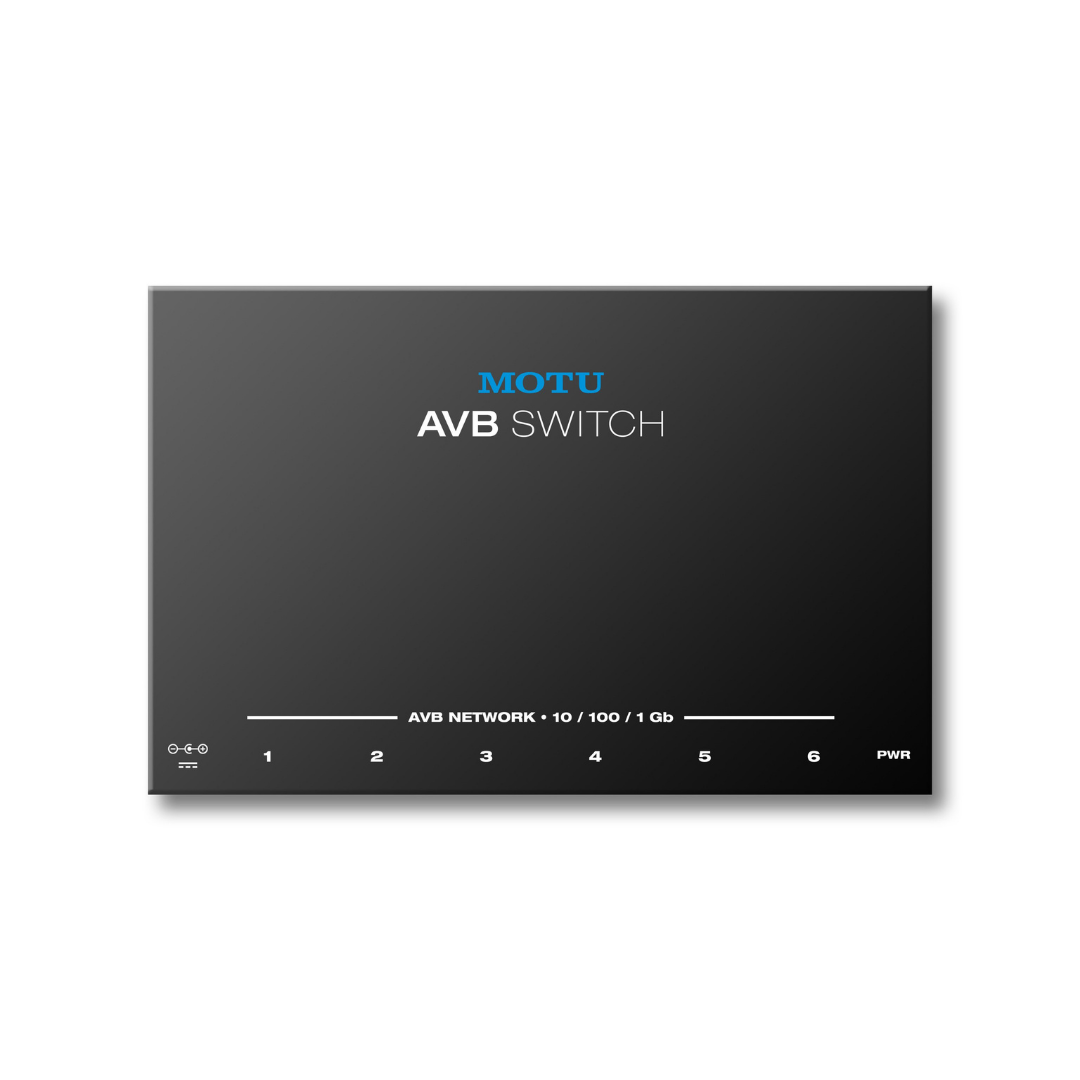
MOTU AVB Switch
Category: Gigabit Switches
Six-Port Gigabit AVB Ethernet Switch — IEEE 802.1 Compliant • 512 Simultaneous Streams • Plug-and-Play • Unlimited Network Scale for Professional Audio and Video
 Get 5% OFF on Prepaid Orders
Copied!
Get 5% OFF on your First Purchase.
Copied!
Buy 2 and GET 10% OFF
Copied!
Get 5% OFF on Prepaid Orders
Copied!
Get 5% OFF on your First Purchase.
Copied!
Buy 2 and GET 10% OFF
Copied!
GENERAL CLASSIFICATION
| SPECIFICATIONS | DETAILS |
|---|---|
|
Product Name |
MOTU AVB Switch |
|
Manufacturer |
MOTU (Mark of the Unicorn, Inc.) |
|
MOTU Part Number |
9305 |
|
Product Category |
IEEE 802.1 AVB Gigabit Ethernet Switch |
|
Product Type |
Dedicated professional audio networking switch |
|
Manufacturer’s Tagline |
The six-port Gigabit AVB Ethernet switch that turbocharges your ethernet network for audio and video |
|
Country of Manufacturer |
Not specified by manufacturer |
|
Warranty |
MOTU standard limited hardware warranty (see MOTU documentation for current terms) |
NETWORKING STANDARDS AND PROTOCOLS
| SPECIFICATIONS | DETAILS |
|---|---|
|
Primary Standard |
IEEE 802.1 Audio Video Bridging (AVB) |
|
Physical Layer Standard |
IEEE 802.3ab (1000BASE-T, Gigabit Ethernet over copper) |
|
Precision Time Protocol |
IEEE 802.1AS (gPTP — generalised Precision Time Protocol) |
|
Stream Reservation Protocol |
IEEE 802.1Qat (SRP — Stream Reservation Protocol) |
|
Credit-Based Shaping |
IEEE 802.1Qav (CBS — Credit-Based Shaper) |
|
AVB Transport Protocol |
IEEE 1722 (AVTP — Audio Video Transport Protocol) |
|
AVB Device Control |
IEEE 1722.1 (AVDECC — AV Device Enumeration, Discovery and Control) |
|
Standard Ethernet Compliance |
IEEE 802.3 (standard Ethernet, all speeds) |
PORT SPECIFICATIONS
| SPECIFICATIONS | DETAILS |
|---|---|
|
Total Port Count |
6 (six) |
|
AVB Ports |
5 (five) — dedicated AVB operation by default; all configurable as standard Ethernet |
|
Standard Ethernet Port |
1 (one) — dedicated standard Ethernet by default; configurable as AVB |
|
Port Type |
RJ-45 (8P8C) |
|
Supported Link Speeds |
10 Mbit/s / 100 Mbit/s / 1,000 Mbit/s (1 Gigabit) — auto-negotiating |
|
Gigabit Specification |
IEEE 802.3ab (1000BASE-T) |
|
Duplex Mode |
Full-duplex |
|
Auto-MDI/MDIX |
Yes — supports both straight-through and crossover cables |
|
Per-Port AVB/Non-AVB Config |
Yes — each port independently configurable via MOTU Discovery application |
|
Cable Type |
Shielded CAT-5e or CAT-6 Ethernet cable |
|
Maximum Cable Length |
100 metres (328 feet) per segment (IEEE 802.3ab standard maximum) |
AVB NETWORK CAPACITY
| SPECIFICATIONS | DETAILS |
|---|---|
|
Maximum AVB Streams |
512 simultaneous AVB audio streams across the network |
|
Maximum Audio Channels (8-ch) |
4,096 channels (512 streams × 8 channels per stream) |
|
Maximum Audio Channels (16-ch) |
8,192 channels (512 streams × 16 channels per stream) |
|
Maximum Connected Devices |
Up to 150 MOTU AVB devices using 37 MOTU AVB switches (theoretical) |
|
Clock Sync Accuracy |
Nanosecond-level accuracy (IEEE 802.1AS gPTP) |
|
Clock Sync Method |
Network-wide via IEEE 802.1AS Best Master Clock Algorithm (BMCA) |
|
QoS Mechanism |
Credit-Based Shaping (IEEE 802.1Qav) — guaranteed bandwidth for all active AVB streams |
|
Mixed Traffic |
AVB and standard Ethernet simultaneously on same network, with QoS protecting AVB streams |
SYNCHRONISATION
| SPECIFICATIONS | DETAILS |
|---|---|
|
Sync Protocol |
IEEE 802.1AS (gPTP) |
|
Timing Accuracy |
Nanosecond-level across all connected devices |
|
Sync Establishment |
One-click via MOTU Discovery application in a MOTU AVB system |
|
Clock Hierarchy |
IEEE 802.1AS BMCA (Best Master Clock Algorithm) — automatic grandmaster election |
|
Phase Lock |
Better-than-sample-accurate phase lock across all connected AVB devices |
|
Clock Distribution |
Over standard CAT-5e/CAT-6 — no dedicated word clock cabling required |
FRONT PANEL INDICATORS
| SPECIFICATIONS | DETAILS |
|---|---|
|
Total LEDs |
12 activity LEDs (2 per port) + 1 PWR (power) LED |
|
Per-Port LED — Left |
1 Gbit/s link indicator: solid = link established; blink = data activity |
|
Per-Port LED — Right |
100 Mbit/s link indicator: solid = link established; blink = data activity |
|
PWR LED |
Power / operational status indicator |
|
Rear Panel Controls |
None (all configuration via MOTU Discovery software) |
POWER
| SPECIFICATIONS | DETAILS |
|---|---|
|
Power Supply |
External DC (included) |
|
Included Supply Voltage |
15V DC |
|
Accepted Voltage Range |
12V DC to 18V DC (minimum 12V; included supply is 15V DC) |
|
Current Requirement |
0.5A maximum |
|
Polarity |
Tip positive |
|
Connector Type |
DC barrel connector |
|
Cooling |
Passive (no internal fan) — silent operation |
|
Approximate Max Power Draw |
~9W (18V × 0.5A maximum) |
SOFTWARE AND CONFIGURATION
| SPECIFICATIONS | DETAILS |
|---|---|
|
Configuration Application |
MOTU Discovery (macOS and Windows) |
|
Discovery Protocol |
IEEE 1722.1 AVDECC (automatic, plug-and-play) |
|
Device Configuration |
Per-port AVB/non-AVB assignment, network topology view, device identification |
|
Firmware Updates |
Over-the-network via MOTU Discovery application |
|
Third-Party Control |
IEEE 1722.1 AVDECC — compatible with any AVDECC-compliant controller |
|
IT Expertise Required |
None — automatic device discovery and bandwidth management |
COMPATIBILITY
| SPECIFICATIONS | DETAILS |
|---|---|
|
MOTU AVB Interfaces |
1248, 16A, 8M, 112D, UltraLite-mk5 AVB (legacy model only — the current gen5 UltraLite-mk5 is USB-only and not AVB-compatible), 828es, 624, and all MOTU AVB-enabled devices |
|
Third-Party AVB Devices |
IEEE 802.1 AVB compliant switches and devices (interoperability not guaranteed for all) |
|
Standard Ethernet Devices |
All standard IEEE 802.3 Ethernet devices (routers, hubs, computers, Wi-Fi access points) |
|
Cable Compatibility |
Standard CAT-5e or CAT-6 shielded Ethernet cable (no proprietary cabling required) |
PHYSICAL SPECIFICATIONS
| SPECIFICATIONS | DETAILS |
|---|---|
|
Form Factor |
Compact desktop enclosure (not 19″ rack-mount) |
|
Enclosure Material |
Metal |
|
Dimensions |
Not published by manufacturer — contact Shivansh Electronics for confirmed measurements |
|
Weight |
Not published by manufacturer — contact Shivansh Electronics for confirmed measurements |
|
Mounting |
Desktop / shelf / equipment bay |
|
Operating Temperature |
Not specified by manufacturer |
|
Humidity |
Not specified by manufacturer |
INCLUDED ACCESSORIES
| SPECIFICATIONS | DETAILS |
|---|---|
|
Power Supply |
15V DC external power supply (included) |
|
Documentation |
MOTU AVB Switch User Guide (printed or downloadable PDF from motu.com) |
|
Cables |
Ethernet cables not included — standard CAT-5e or CAT-6 required (purchased separately) |
1. PRODUCT OVERVIEW
The MOTU AVB Switch is a dedicated six-port Gigabit Audio Video Bridging (AVB) Ethernet switch, occupying a unique and essential role in MOTU’s professional AVB networking ecosystem. Rather than a conventional audio interface with analogue inputs and outputs, the AVB Switch is a pure-networking infrastructure device — its purpose is to interconnect multiple MOTU AVB audio interfaces and other AVB-capable devices into a single, seamlessly synchronised, high-channel-count network. It sits in the MOTU product line as the connective tissue between devices such as the 1248, 16A, 8M, UltraLite-mk5 AVB (legacy AVB model), 828es, and any third-party AVB-compliant hardware.
Audio Video Bridging (AVB) is a suite of IEEE 802.1 standards specifically engineered to extend standard Gigabit Ethernet for real-time, deterministic streaming of audio and video. Where ordinary Ethernet operates on a best-effort delivery model — packets may arrive out of order or be delayed — AVB introduces three critical enhancements: IEEE 802.1AS for network-wide precision time synchronisation (accurate to nanoseconds), IEEE 802.1Qav for Credit-Based Shaping (prioritised bandwidth reservation), and IEEE 802.1Qat for Stream Reservation Protocol (guaranteed resource allocation per stream). The net result is a network that can simultaneously carry hundreds of audio channels with deterministic, ultra-low latency and rock-solid phase coherence across every connected device.
The MOTU AVB Switch provides six 1-Gigabit Ethernet ports, all of which are full AVB-compliant ports. In practice, five ports are typically deployed as AVB audio networking ports — connecting MOTU AVB interfaces, other MOTU AVB switches, or third-party AVB equipment — while the sixth port is used for bridging to a standard Ethernet network, enabling internet access or wireless router connectivity alongside the professional audio network. Crucially, every port on the device can be independently configured for either AVB or standard Ethernet operation via the MOTU Discovery application, offering complete flexibility in network architecture. The switch supports operational bandwidths of 10, 100, and 1,000 Mbit/s, auto-negotiating the link speed to match each connected device.
The device was introduced alongside MOTU’s first generation of AVB audio interfaces and has been maintained and firmware-updated continuously. At its street price (typically in the USD 200–300 range internationally), the MOTU AVB Switch represents a highly cost-effective entry point into professional AVB networking compared to enterprise-grade AVB switches from vendors such as Cisco, Netgear, or Extreme Networks — which are not optimised for professional audio discovery protocols such as IEEE 1722 (AVTP) or MOTU’s own Discovery application. For any facility deploying two or more MOTU AVB interfaces, or for any engineer requiring studio-to-stage audio routing over Ethernet, the MOTU AVB Switch is the purpose-built, manufacturer-endorsed solution.
2. AVB TECHNOLOGY: THE ENGINEERING FOUNDATION
2.1 IEEE 802.1AS — Precision Time Protocol (gPTP)
The cornerstone of AVB’s advantage over standard Ethernet for audio is its implementation of IEEE 802.1AS, a generalised Precision Time Protocol (gPTP) that establishes a network-wide time base shared by every device on the switch. The MOTU AVB Switch acts as a grandmaster clock — or participates in an IEEE 802.1AS Best Master Clock Algorithm (BMCA) to elect the grandmaster — and distributes timing information to all connected devices with nanosecond-level accuracy. In a MOTU AVB system, MOTU’s documentation states that network-wide synchronisation can be established with a single click via the MOTU Discovery application.
To appreciate why nanosecond accuracy matters in audio, consider that at a sample rate of 96 kHz, one sample occupies approximately 10.4 microseconds (10,400 nanoseconds). Even at the most demanding professional tolerances, sample-accurate synchronisation requires timing precision well within this window. AVB’s gPTP protocol achieves synchronisation accuracy far tighter than a single sample period, ensuring that all devices on the network maintain phase-coherent clocking. This eliminates the subtle comb-filtering artifacts and inter-channel phase errors that arise when multiple audio interfaces are clocked independently or via word clock distributed over cable runs subject to propagation delay variance.
2.2 IEEE 802.1Qav — Credit-Based Shaping (CBS)
IEEE 802.1Qav defines a Credit-Based Shaping (CBS) algorithm that prioritises AVB audio and video streams over standard Ethernet traffic at the hardware level of each switch port. The AVB Switch maintains a ‘credit’ counter for each stream class: Class A streams (lowest latency, typically 125 μs presentation time) and Class B streams (2 ms presentation time). By metering transmission of AVB frames and accumulating credits during idle periods, CBS guarantees that AVB streams can always claim their reserved bandwidth share regardless of burst traffic from standard Ethernet devices on the same network. An engineer running the MOTU AVB Switch alongside a standard office network can therefore be confident that audio streams will never be starved by a large file transfer or video stream on the non-AVB portion of the network.
2.3 IEEE 802.1Qat — Stream Reservation Protocol (SRP)
Stream Reservation Protocol (SRP) is the mechanism by which AVB devices advertise the bandwidth they require and negotiate with the switch to reserve it. When a MOTU 1248, for example, announces that it will be transmitting a stream of 8 audio channels at 96 kHz, the AVB Switch evaluates whether sufficient bandwidth is available across every hop of the intended network path and, if so, reserves it. This reservation persists for the duration of the stream. The result is that the MOTU AVB Switch provides guaranteed Quality of Service (QoS) for all active audio and video streams — a property that is architecturally impossible to achieve with standard unmanaged switches, regardless of how much headroom exists in their nominal bandwidth specification.
3. PORT ARCHITECTURE AND PHYSICAL INTERFACE
3.1 Six 1-Gigabit Ethernet Ports
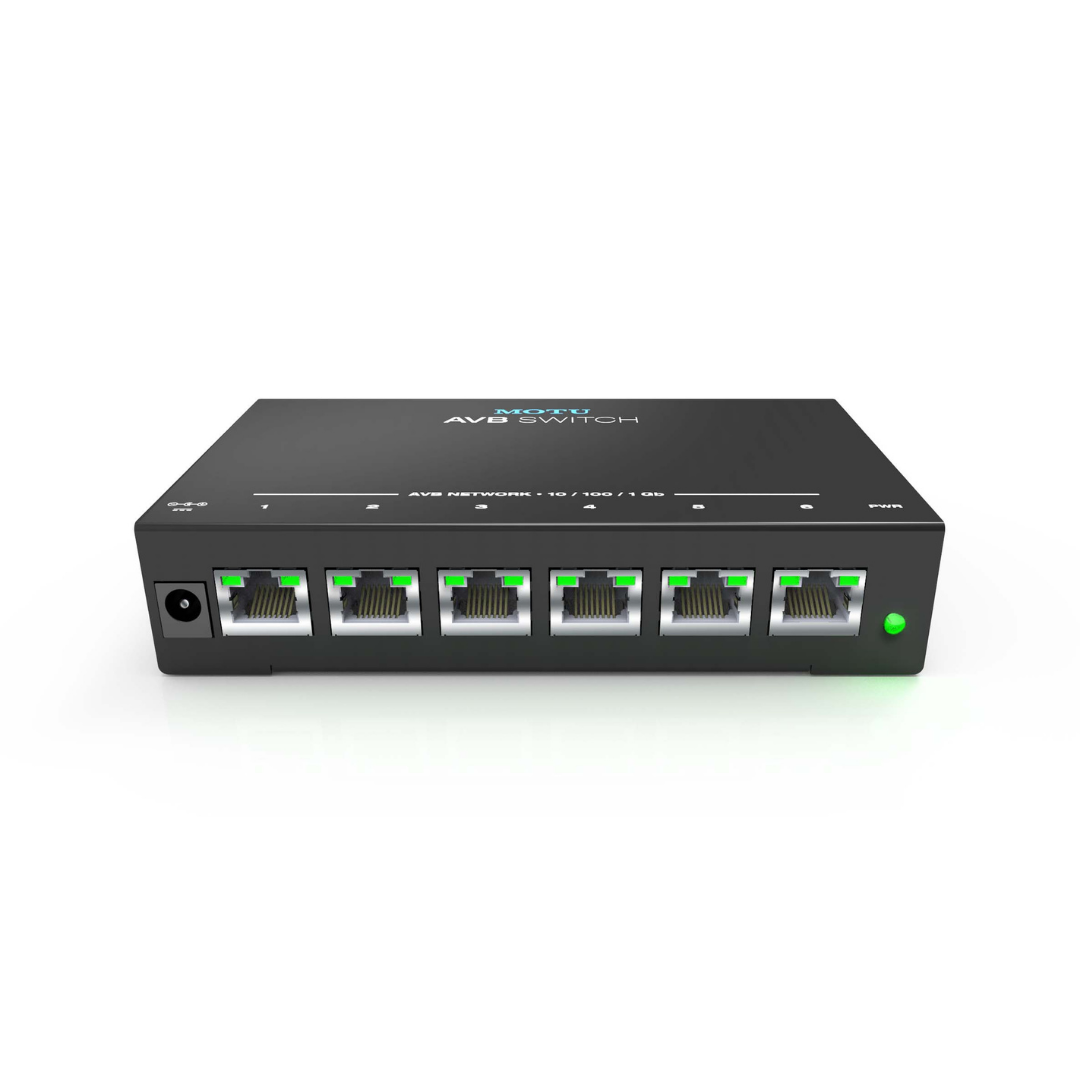
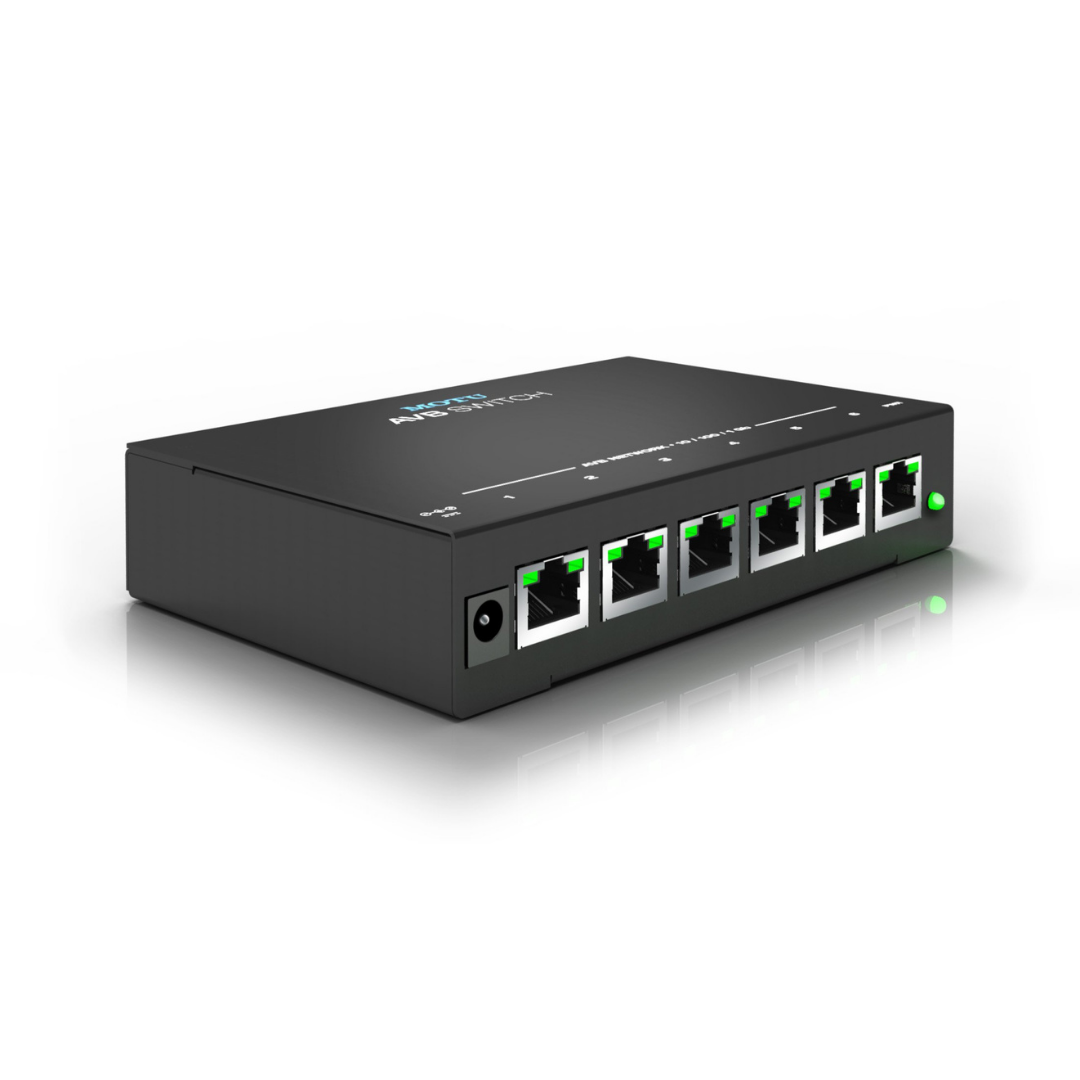
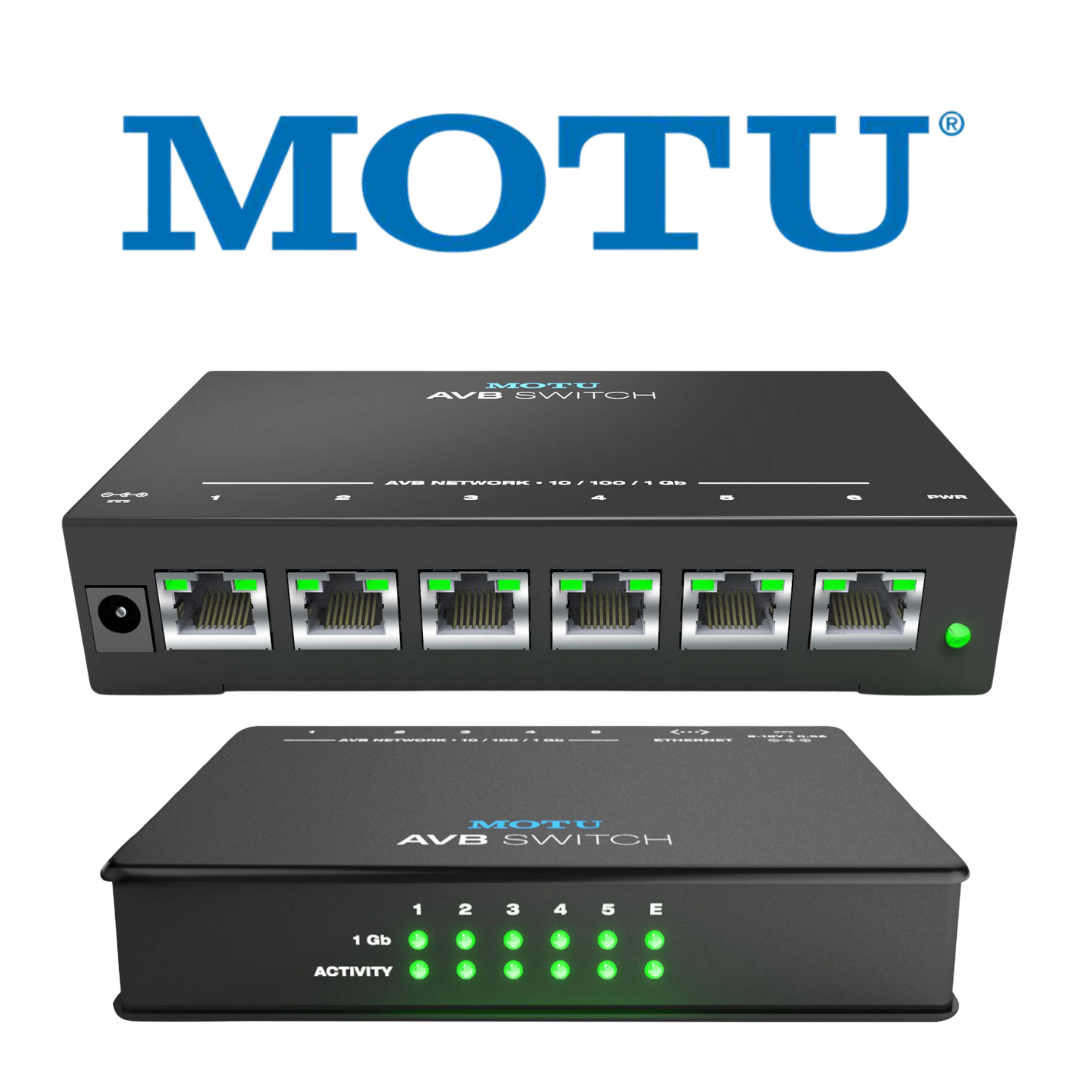
The MOTU AVB Switch provides six RJ-45 Ethernet ports on its rear panel, all operating at 1 Gigabit per second (1,000 Mbit/s). All six ports are full AVB-capable ports, meaning any of them can carry AVB audio streams, participate in the gPTP clock hierarchy, and implement SRP bandwidth reservation. In a typical deployment, five ports are used for AVB device connectivity — connecting MOTU audio interfaces, additional MOTU AVB switches, or third-party AVB devices — while the sixth port is bridged to a standard Ethernet network for router, Wi-Fi access point, or internet uplink connectivity. However, this is a configuration choice rather than a hardware constraint: the MOTU Discovery application allows each port to be independently configured as AVB or non-AVB.
All six ports support auto-negotiation of link speed (10/100/1000 Mbit/s), which means they are backward-compatible with older 100 Mbit/s Ethernet devices. However, for full AVB performance — especially for high channel-count audio networks — MOTU recommends operating all AVB ports at 1 Gigabit to maximise bandwidth and minimise latency. The ports comply with IEEE 802.3ab (1000BASE-T) for Gigabit operation over copper cabling.
3.2 Cabling Requirements
The MOTU AVB Switch requires standard shielded CAT-5e or CAT-6 Ethernet cables. The maximum supported cable run between the switch and any connected device or switch is 100 metres (328 feet), which is the standard IEEE 802.3ab limit for 1000BASE-T. This is a significant practical advantage over coaxial word clock distribution (typically limited to 10–15 metres without active buffering), legacy AES3 digital audio (limited to approximately 100 metres at standard impedance), and analogue audio (subject to signal degradation with length). In a large venue or multi-room studio, a single CAT-6 cable run of up to 100 metres can carry dozens or hundreds of audio channels simultaneously while delivering nanosecond-accurate clock sync.
3.3 Front Panel LED Metering
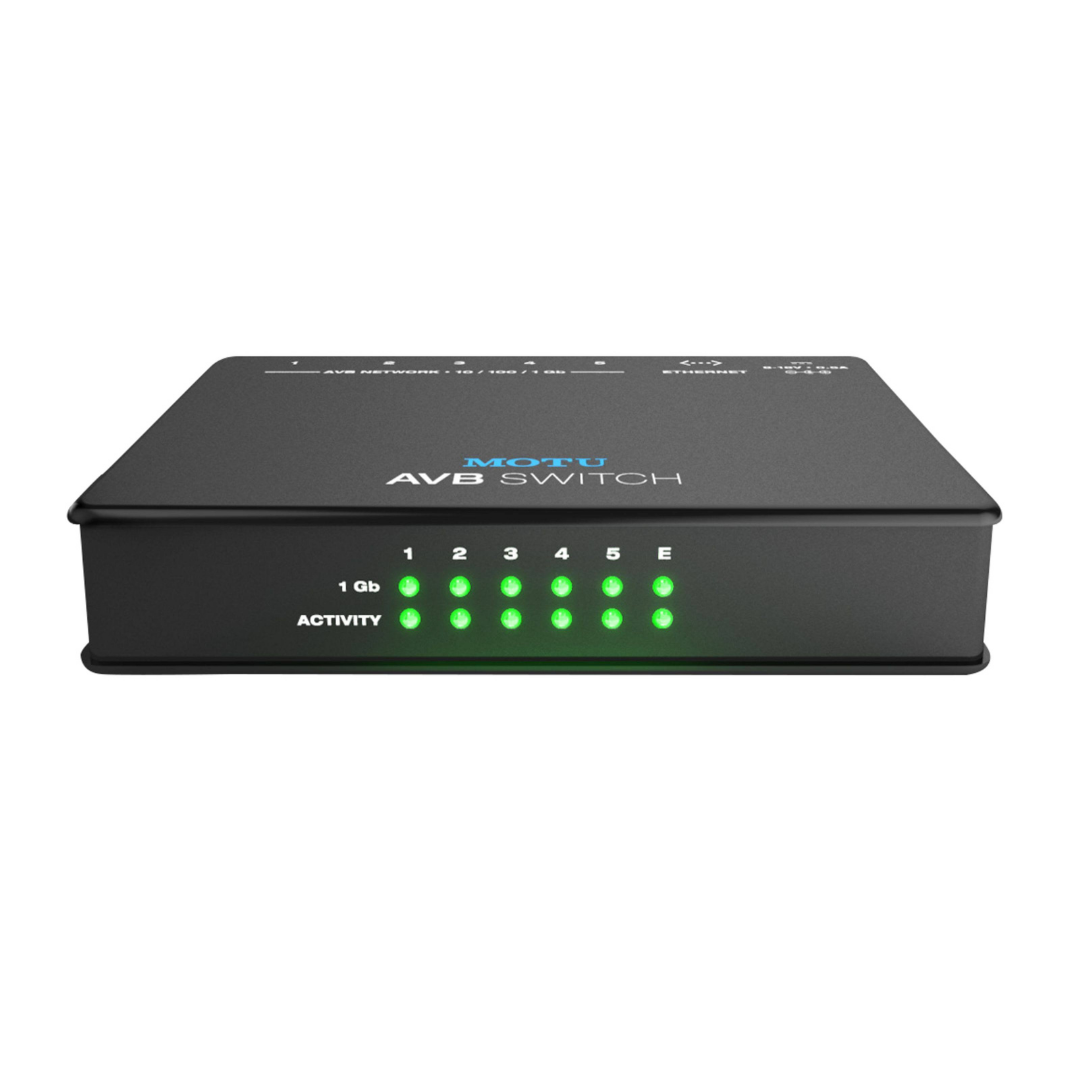
The front panel of the MOTU AVB Switch carries 12 activity LEDs, providing two indicators per port. The left-hand LED for each port indicates a 1 Gbit/s connection, glowing solid when the link is established and blinking with network activity. The right-hand LED indicates a 100 Mbit/s connection, following the same solid/blink convention. This dual-LED system allows an engineer to verify at a glance both the link speed of each connection and whether data is actively flowing on that port, which is invaluable during network commissioning, troubleshooting, and live event operation. A separate PWR (power) LED confirms that the unit is energised and operating.
4. NETWORK CAPACITY AND SCALABILITY
4.1 Maximum Simultaneous Audio Streams
The MOTU AVB Switch supports up to 512 simultaneous AVB audio streams across the network at any given time. Each AVB stream can carry 1 to 8 (Class A) or 1 to 8 (Class B) audio channels, depending on the stream configuration. With 8-channel streams, 512 simultaneous streams equates to 4,096 simultaneous audio channels. With 16-channel streams (available on MOTU interfaces that support extended stream formats), the theoretical maximum rises to 8,192 simultaneous audio channels. MOTU notes that actual network performance may vary depending on the specific topology, number of connected devices, and other factors; these figures represent the theoretical upper bound of AVB’s IEEE-defined architecture.
4.2 Multi-Switch Scaling
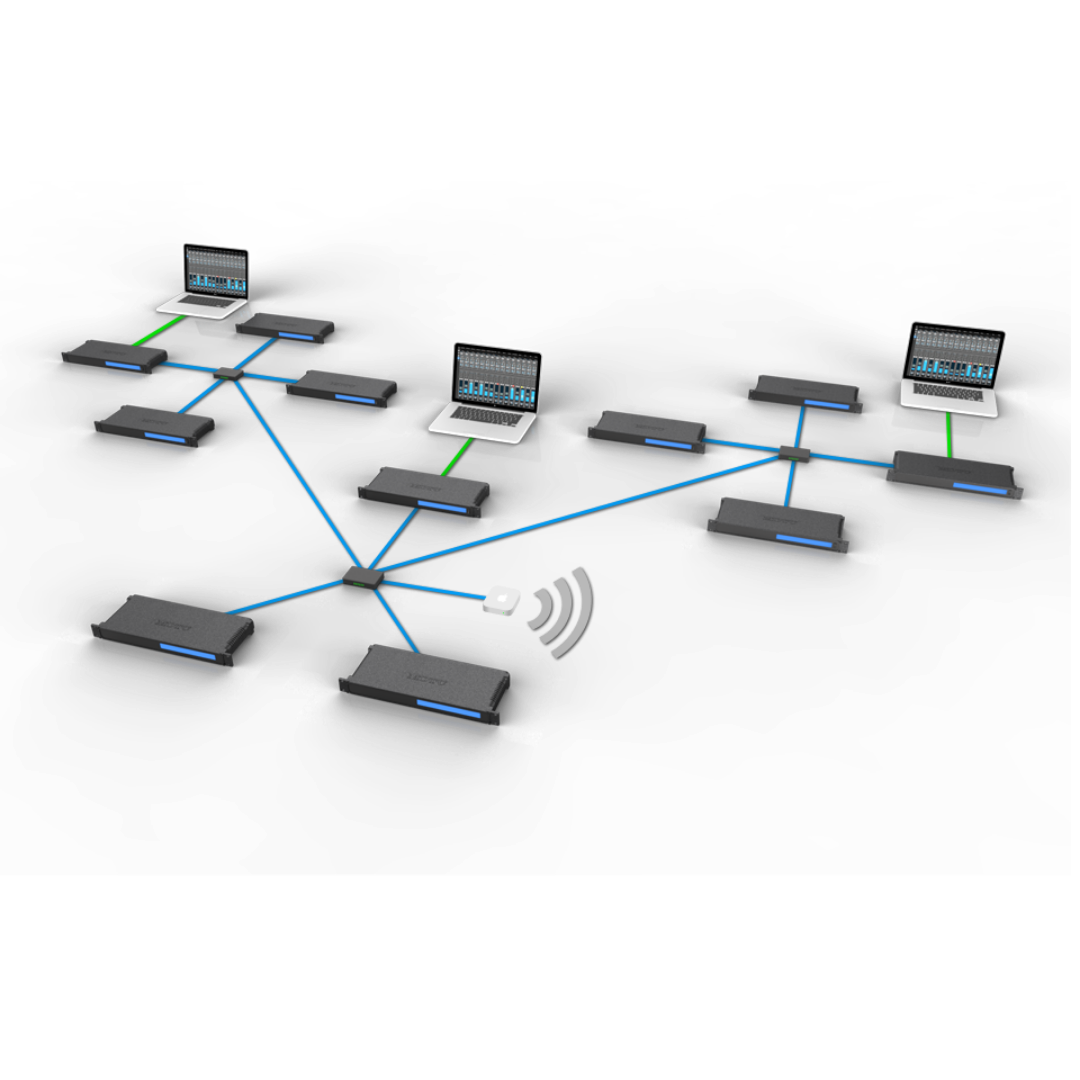
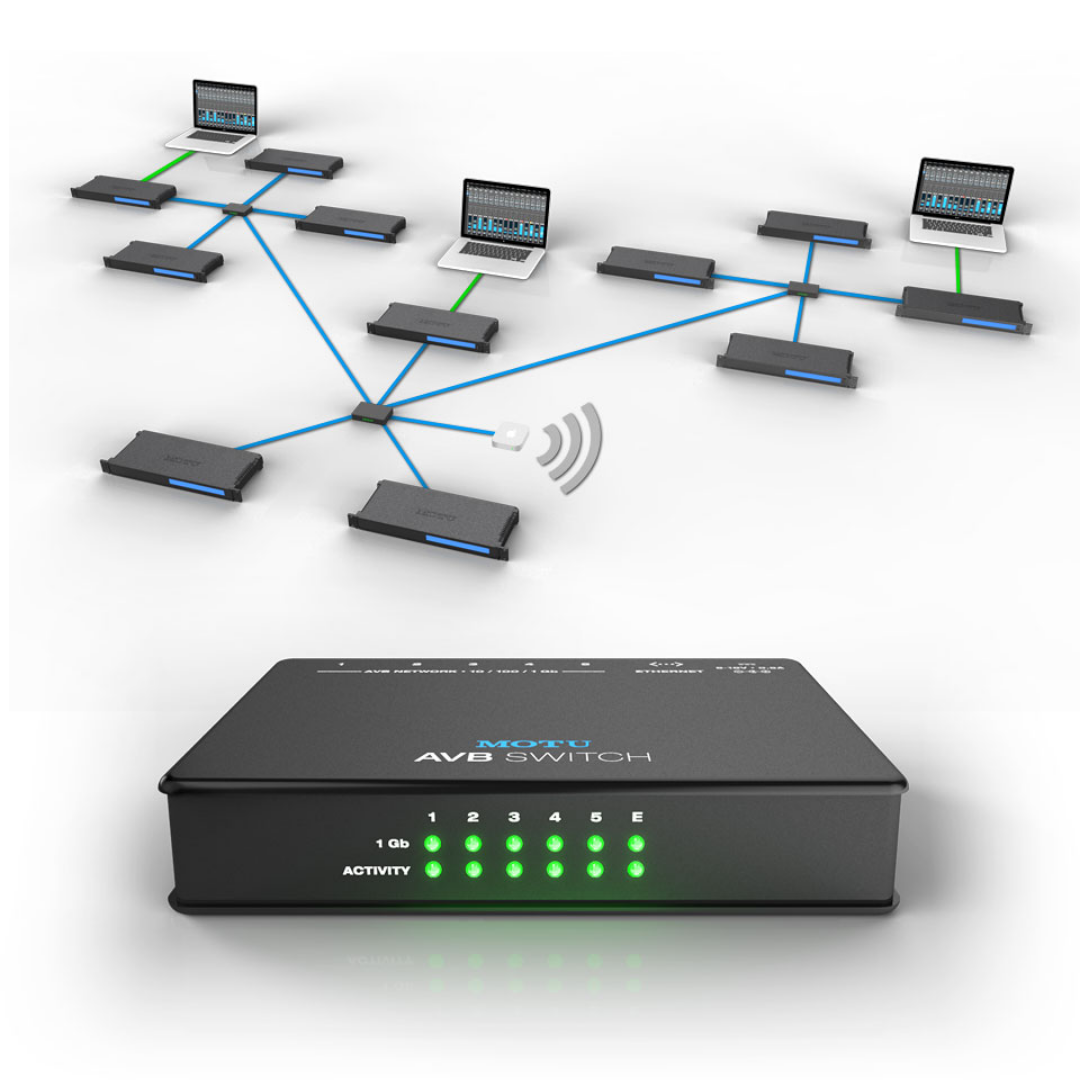
The MOTU AVB Switch is designed to be cascaded. By connecting MOTU AVB switches to one another through their AVB ports, engineers can extend the network to accommodate more devices. MOTU’s published topology guidance states that theoretically, up to 150 MOTU AVB devices can be interconnected using 37 MOTU AVB switches. In practice, the maximum network diameter (the longest chain of switches between any two endpoints) is constrained by the IEEE 802.1AS timing budget: each switch hop adds propagation delay, and the protocol specifies a maximum number of bridge hops to preserve synchronisation integrity. For most real-world professional audio deployments — even large live events with multiple stage boxes, front-of-house, monitor world, and recording truck connections — a topology of two to four cascaded switches is sufficient.
4.3 Mixed AVB and Standard Ethernet
A defining architectural feature of the MOTU AVB Switch is its ability to carry both AVB audio streams and standard Ethernet traffic on the same physical network simultaneously. The Credit-Based Shaping algorithm (IEEE 802.1Qav) ensures that AVB streams always receive their reserved bandwidth share, so standard Ethernet traffic — including internet browsing, file transfers, or remote control of MOTU devices via a tablet or laptop — cannot interrupt or degrade the audio streams. This coexistence is a substantial operational advantage in venues and studios where separate networks for audio and IT are impractical or prohibitively expensive to maintain.
5. MOTU DISCOVERY APPLICATION AND CONFIGURATION
5.1 Automatic Device Discovery
When MOTU AVB interfaces are connected to the MOTU AVB Switch and powered on, the MOTU Discovery application (available for macOS and Windows) automatically detects all connected devices and presents them in a graphical network view. Discovery operates using IEEE 1722.1 (AVDECC — AV Device Enumeration, Discovery and Control), the standard AVB control protocol, meaning it will also discover and display third-party AVB devices that implement AVDECC. No manual IP address assignment, no subnet configuration, and no VLAN management is required by the user. From the engineer’s perspective, the experience is plug-and-play: connect the cables, open the Discovery app, and the network is ready to configure.
5.2 Per-Port AVB/Non-AVB Configuration
Through the MOTU Discovery application’s switch settings interface, each of the six ports on the MOTU AVB Switch can be independently configured as an AVB port or a non-AVB (standard Ethernet) port. This configurability is important in installations where, for example, one port must connect to a corporate network switch that does not support AVB, or where a specific port is reserved for a control laptop that uses standard TCP/IP networking. Configuring a port as non-AVB excludes it from AVB stream reservation and clock distribution, ensuring that the non-AVB device cannot disrupt the timing or bandwidth budget of the audio network.
5.3 Firmware Updates
The MOTU AVB Switch supports over-the-network firmware updates delivered through the MOTU Discovery application. This is significant because MOTU has periodically released firmware updates that expand AVB channel counts, improve synchronisation performance, and add compatibility with newer MOTU audio interfaces. An engineer who purchased an AVB Switch at initial release has access to the same firmware capabilities as a unit purchased today, ensuring long-term investment protection.
6. COMPATIBLE MOTU AVB DEVICES
6.1 MOTU AVB Audio Interfaces
The MOTU AVB Switch is fully compatible with all current and legacy MOTU AVB audio interfaces. The primary compatible interfaces include the 1248 (48 channels, 12 mic preamps), 8M (eight mic/line channels with integral AVB switch), 16A (16-channel analogue interface with integral dual-port AVB switch), 112D (112 channels via AVB and USB), UltraLite-mk5 AVB (legacy AVB model — the current gen5 UltraLite-mk5 uses USB only and does not support AVB), 828es, 624, and other interfaces from MOTU’s AVB and USB/AVB product lines. Third-party AVB devices that comply with the IEEE 802.1 AVB standard and implement IEEE 1722.1 AVDECC are also discoverable and configurable through the MOTU ecosystem, though MOTU does not guarantee interoperability with all third-party AVB hardware.
6.2 Third-Party AVB Compatibility
The MOTU AVB Switch is an IEEE 802.1 compliant device. It will interoperate at the switching level with any AVB-compliant third-party switch or device. For audio stream exchange between MOTU and third-party AVB interfaces, the relevant protocols are IEEE 1722 (AVTP audio transport) and IEEE 1722.1 (AVDECC device control). Many third-party professional audio devices supporting AVB use these standard protocols, including certain Avid, Focusrite, and other manufacturer products. However, stream format compatibility and control application integration may vary; engineers should verify specific third-party device compatibility with MOTU’s current technical notes prior to deploying in a production environment.
7. BUILD QUALITY AND FORM FACTOR
The MOTU AVB Switch is housed in a compact, desktop-form-factor metal enclosure designed for use on a tabletop, equipment shelf, or rack-adjacent positioning. It is not a standard 19-inch rackmount unit, but its compact dimensions make it easy to position near a rack, at a stage box location, or in a control room equipment bay. The front panel presents the 12 activity LEDs and the power LED in a clean, uncluttered layout, providing at-a-glance network status without requiring a display or menu system. The rear panel provides the six RJ-45 ports and the DC power inlet.
Power is supplied via the included external 15V DC power supply (the unit accepts 12–18V DC at 0.5A with tip-positive polarity), making it compatible with a range of third-party DC power supplies and in-rack DC distribution systems for touring and install applications. The low power consumption (maximum approximately 9 watts at 18V/0.5A) and the absence of internal cooling fans make the MOTU AVB Switch silent in operation — an important consideration for studio environments and broadcast facilities where fan noise is unacceptable. Exact physical dimensions and weight are not published on the MOTU product page; engineers requiring precise enclosure dimensions should contact MOTU or their authorised distributor directly.
8. IDEAL APPLICATIONS AND USE CASES
- Multi-interface professional recording studio requiring phase-coherent audio routing between two or more MOTU AVB interfaces (e.g., 1248 + 16A + 8M in a large tracking room)
- Live sound reinforcement with MOTU AVB stage boxes connected to front-of-house and monitor world positions over long CAT-6 cable runs — replacing heavy analogue multicore or expensive digital snakes
- Broadcast studio requiring precisely synchronised audio-over-IP networking between multiple MOTU AVB interfaces in different rooms or racks
- House of worship audio systems requiring high channel counts across nave, choir loft, and production suite, all synchronised on a single network
- Post-production facility with MOTU AVB interfaces in edit suites connected to a shared routing network
- University and conservatory audio teaching facilities requiring a scalable, configurable multi-device audio network for student learning
- Mobile recording and event production rigs where a compact, self-contained AVB network must be deployed and struck rapidly
- Touring production systems using multiple MOTU AVB stage boxes at different positions in a venue, interconnected over standard CAT-6 infrastructure
- Audio rental companies requiring a single switch device that interoperates with any combination of MOTU AVB hardware in their inventory
- Studio installations requiring both AVB audio networking and standard internet connectivity on the same cabling infrastructure
- Immersive audio production environments (Dolby Atmos, Auro-3D) requiring large channel counts across multiple MOTU AVB interfaces
9. MATHEMATICAL AND TECHNICAL VALIDATION
9.1 Bandwidth Validation: Audio Streams vs. Gigabit Capacity
A useful cross-check is to verify that the claimed audio stream capacity is consistent with the available 1 Gigabit bandwidth. Consider 512 simultaneous AVB streams, each carrying 8 channels at 96 kHz, 24-bit. The data rate per channel is 96,000 samples/sec × 24 bits = 2.304 Mbit/s. For 8 channels per stream: 8 × 2.304 = 18.432 Mbit/s per stream. For 512 streams: 512 × 18.432 = 9,437.2 Mbit/s total, which substantially exceeds a single 1 Gigabit link. This indicates that the 512-stream figure applies to the aggregate network capacity across all ports simultaneously, not through a single port. Each individual 1 Gigabit port can carry approximately 54 audio channels at 96 kHz/24-bit within the AVB bandwidth reservation budget (typically 75% of total link bandwidth is reservable for AVB streams by the CBS specification: 0.75 × 1,000 Mbit/s = 750 Mbit/s / 18.432 Mbit/s per 8-ch stream ≈ 40 streams × 8 channels = ~320 channels per port). The 512-stream total reflects the full switching capacity across all ports of the device.
9.2 Clock Sync: Nanosecond Accuracy vs. Sample Period
At 192 kHz (MOTU’s maximum supported sample rate on many interfaces), one sample period is 1 / 192,000 = approximately 5,208 nanoseconds. IEEE 802.1AS gPTP typically achieves synchronisation accuracy in the range of 10–100 nanoseconds in well-constructed local networks. This places the synchronisation error at approximately 0.002% to 0.02% of a single sample period at 192 kHz — confirming that the ‘better-than-sample-accurate’ claim in MOTU’s documentation is technically supported and not marketing hyperbole. The nanosecond-level precision is achieved by compensating for known propagation delays, residence times in switch buffers, and asymmetric path delays using the IEEE 802.1AS path delay measurement protocol.
9.3 Power Budget Verification
The MOTU AVB Switch accepts 12–18V DC at 0.5A maximum. At the nominal 15V supply: P = V × I = 15V × 0.5A = 7.5W maximum at nominal supply voltage. At the maximum accepted voltage: P = 18V × 0.5A = 9W absolute maximum. This is a very low power consumption for a six-port managed Gigabit switch, consistent with the use of a purpose-designed AVB switch ASIC (such as those produced by Aquantia, Marvell, or a similar vendor) operating in a fanless thermal design. No mathematical discrepancy is observed in the published power specification.
10. MOTU AVB ECOSYSTEM CONTEXT
The MOTU AVB Switch is most valuable when understood as a component of MOTU’s broader AVB ecosystem, rather than as a standalone product. MOTU began shipping AVB-enabled audio interfaces with the 1248 in 2014, and the AVB Switch was introduced concurrently to support multi-device AVB networks from the outset. Since then, MOTU has progressively expanded the AVB ecosystem to include the 16A, 8M, 112D, UltraLite-mk5 AVB (legacy), 828es, 624, and other interfaces, all sharing the same underlying AVB networking architecture and all configurable through a unified MOTU Discovery software environment.
A distinctive feature of several MOTU AVB interfaces — including the 8M and 16A — is the inclusion of an integral two-port or multi-port AVB switch embedded within the audio interface itself. This allows limited daisy-chaining of MOTU AVB interfaces without a separate external switch. For larger networks requiring more than two or three devices, or for deployments where the network topology benefits from a centralised switching point, the MOTU AVB Switch is the appropriate solution. The external switch enables star-topology networks (every device connects to a single central switch), which offers superior synchronisation accuracy and simpler troubleshooting compared to daisy-chain topologies.
For engineers comparing AVB to Dante (the competing AoIP protocol from Audinate) or to AES67/RAVENNA: AVB is a deterministic, IEEE-standardised Layer 2 protocol with guaranteed Quality of Service built into the hardware, while Dante and AES67 are Layer 3 protocols running over standard IP networks. AVB’s hardware-level QoS guarantees and nanosecond synchronisation accuracy represent fundamental engineering advantages for applications demanding absolute timing integrity. The primary trade-off is that AVB requires AVB-capable switches at every network hop, whereas Dante can run over standard unmanaged switches. The MOTU AVB Switch’s competitive pricing and plug-and-play operation substantially reduce this deployment barrier for MOTU ecosystem users.
HOW TO READ THIS DOCUMENT
This document is the operational companion to the MOTU AVB Switch Product Description and Technical Specifications, available from Shivansh Electronics. While the specifications document answers the question ‘what is the MOTU AVB Switch and how is it measured?’, this document answers a different and equally important question: ‘how do I actually deploy it in my specific professional environment?’ Each workflow section describes a concrete, real-world scenario — the physical setup, the signal routing, the configuration, and the specific AVB Switch features that make the workflow efficient, reliable, and scalable.
Three defining workflow advantages of the MOTU AVB Switch appear repeatedly across almost every deployment scenario in this document. First, its plug-and-play operation via MOTU Discovery eliminates the IT expertise that professional-grade managed Ethernet switches normally demand, making complex multi-device audio networks accessible to audio engineers rather than network administrators. Second, its nanosecond-accurate IEEE 802.1AS clock synchronisation ensures sample-accurate phase coherence across every device on the network — a property that no standard Ethernet switch, regardless of cost, can replicate. Third, its mixed AVB-and-standard-Ethernet coexistence means that a single network infrastructure can simultaneously carry professional audio streams and standard internet or control traffic, reducing cabling cost and complexity in virtually every installation type.
Each workflow section follows a consistent structure: a description of the physical environment and its requirements, an explanation of how the MOTU AVB Switch is physically positioned and connected, the specific signal routing and configuration employed, and a summary configuration table. Engineers should read the workflow sections most relevant to their deployment context and use the summary tables as practical commissioning checklists. The Feature-to-Workflow Cross-Reference Matrix at the end of this document provides a quick look-up for engineers evaluating which AVB Switch capabilities are most critical for a given environment.
WORKFLOW 1 — THE PROFESSIONAL RECORDING STUDIO
Scenario: Permanent Multi-Interface Installation with Centralised AVB Routing
A professional recording studio typically operates with multiple MOTU AVB interfaces distributed across different physical spaces: mic preamps and converters in the machine room, a submix interface near the recording console, additional interfaces for overdub booth and isolation room coverage, and potentially a separate monitoring interface for the control room. In a large tracking room configuration — for example, a combination of a MOTU 1248 (for the main console feeds and monitor outputs), a MOTU 16A (for additional analogue returns and live room sends), and a MOTU 8M (for the overdub booth microphone inputs) — the MOTU AVB Switch is positioned as the central hub in the machine room, connecting all three interfaces via Gigabit CAT-6 cable runs.
In this topology, all three interfaces are connected to dedicated AVB ports on the MOTU AVB Switch. The sixth port is connected to the studio’s LAN router, providing internet access for the studio’s control surface, connected computers, and tablet-based remote control of MOTU CueMix FX. The MOTU Discovery application is launched on the DAW workstation, which is connected to any one of the MOTU interfaces via standard USB or Thunderbolt; the application discovers all three interfaces across the AVB network and presents them as a unified routing matrix. The engineer can then route any analogue input on the 16A to any output on the 1248, or send stems from the 8M directly to a record bus on the DAW workstation, all with sample-accurate synchronisation across the entire system and without a single additional metre of analogue cable.
The key AVB Switch feature in this scenario is its IEEE 802.1AS nanosecond clock synchronisation, which ensures that signals from microphones in the overdub booth (connected to the 8M) and signals from the live room (connected to the 16A) arrive at the DAW with zero inter-channel phase error. Without this level of synchronisation, multi-room recording sessions are compromised by subtle but measurable phase differences that arise when interfaces are clocked independently or through analogue word clock, which is subject to cable propagation delays and jitter.
| WORKFLOW ELEMENTS | DETAILS / CONFIGURATIONS |
|---|---|
|
Studio Configuration |
3 MOTU AVB interfaces: 1248 (main console), 16A (live room), 8M (overdub booth) |
|
MOTU AVB Switch Position |
Central machine room, all interface connections star-topology |
|
Port 1 |
MOTU 1248 — AVB mode, 1 Gigabit |
|
Port 2 |
MOTU 16A — AVB mode, 1 Gigabit |
|
Port 3 |
MOTU 8M — AVB mode, 1 Gigabit |
|
Port 4 |
Available for expansion (additional interface or second AVB Switch) |
|
Port 5 |
Available for expansion |
|
Port 6 (Standard Ethernet) |
Studio LAN router — internet and tablet remote control access |
|
Cabling |
Shielded CAT-6, all runs under 100 metres |
|
Clock Sync |
IEEE 802.1AS gPTP, established via MOTU Discovery (one click) |
|
Audio Routing |
Configured via MOTU Discovery routing matrix (CueMix Pro for current-gen devices; CueMix FX for legacy interfaces such as 1248 and 8M) |
|
DAW Connection |
DAW workstation connected to any one interface via USB/Thunderbolt; all interfaces accessible via AVB |
|
Key Advantage |
Nanosecond sync across all rooms; unified routing matrix; no dedicated word clock cabling required |
WORKFLOW 2 — LIVE SOUND AND STAGE PRODUCTION
Scenario A: Multi-Position Stage Network with FOH, Monitor World, and Stage Box
Live sound reinforcement represents one of the most compelling use cases for the MOTU AVB Switch, because it directly replaces the most expensive and physically cumbersome element of a traditional live sound rig: the analogue or digital audio multicore (snake). In a typical deployment, a MOTU 1248 or 16A functions as a stage box at the performer positions, capturing all microphone and DI feeds. The AVB Switch is positioned at stage left or in the stage rack, with CAT-6 cable runs to the front-of-house (FOH) mix position (up to 100 metres) where a second MOTU AVB interface connects to the FOH mixing console, and optionally to the monitor world position where a third interface feeds stage monitor amplifiers.
The MOTU AVB Switch provides two critical advantages in the live sound context. The first is the guaranteed Quality of Service provided by IEEE 802.1Qav Credit-Based Shaping: once the audio streams are reserved via SRP, no competing network traffic — including stage automation, lighting control, or even a Wi-Fi router connected to the standard Ethernet port — can interrupt or cause dropouts in the audio streams. In live performance, a single audio dropout is unacceptable, and this hardware-level guarantee is architecturally impossible with standard Ethernet switches. The second advantage is the elimination of heavy, expensive analogue or AES3 multicore cable, replacing it with a single CAT-6 run that carries all audio channels simultaneously. For touring productions, this represents a significant reduction in cable weight, flight case space, and setup time.
A practical note on topology for live sound: for large productions with both FOH and monitor world positions requiring separate AVB interfaces, the recommended topology is to connect both the stage interface and the FOH/monitor interfaces directly to the MOTU AVB Switch (star topology), rather than daisy-chaining them through one another’s integral AVB ports. Star topology minimises the clock propagation path and simplifies troubleshooting if a single link fails.
| WORKFLOW ELEMENTS | DETAILS / CONFIGURATIONS |
|---|---|
|
Deployment Environment |
Live stage production, indoor or outdoor venue |
|
Stage Interface |
MOTU 1248 or 16A at stage rack — captures all mics, DI, playback |
|
FOH Interface |
MOTU 1248 or 16A at FOH position — feeds FOH console |
|
Monitor Interface |
MOTU 8M or 16A at monitor world — feeds stage monitors |
|
AVB Switch Position |
Stage rack, adjacent to stage interface |
|
Stage → FOH Cable |
Single CAT-6, up to 100 metres, carrying all mic feeds to FOH |
|
Stage → Monitor Cable |
Single CAT-6, up to 100 metres, carrying monitor mix sends |
|
Port 6 (Standard Ethernet) |
Wi-Fi router for tablet-based remote control of MOTU CueMix FX |
|
QoS |
IEEE 802.1Qav CBS — audio streams guaranteed regardless of control traffic |
|
Key Advantage |
Eliminates analogue/digital snake; single CAT-6 per position; zero-dropout guarantee |
Scenario B: Festival Multi-Stage System with Cascaded Switches
For large-scale festival productions with multiple stages, the MOTU AVB Switch can be cascaded to extend the network to any number of stage positions. Each stage has its own MOTU AVB Switch connected to the local stage interface; the switches are then connected to one another through their AVB ports. A centralised AVB Switch at the production office or FOH hub routes all streams to the appropriate destinations. With a theoretical capacity of up to 150 connected MOTU AVB devices across 37 cascaded switches, this topology can service even the largest festival productions. Engineers should allow adequate headroom in stream count and carefully plan the network topology to stay within IEEE 802.1AS propagation delay budgets.
WORKFLOW 3 — BROADCAST AND RADIO STUDIO
Scenario: Multi-Presenter Studio with Network-Wide Synchronisation
Broadcast environments — radio studios, television gallery suites, and podcast production facilities with multiple simultaneous presenters — present a specific challenge: multiple audio interfaces must operate with absolute sample-accuracy across the entire signal chain to prevent phase errors, comb filtering, and the subtle double-image artifacts that arise when presenter microphone signals from different interfaces are summed. A broadcast facility running three MOTU AVB interfaces — one per presenter position, each providing mic preamps, headphone monitoring, and caller interface — requires all three to be clocked from a single, ultra-precise reference. The MOTU AVB Switch provides exactly this, distributing nanosecond-accurate gPTP clocking to all three interfaces simultaneously.
In the broadcast context, the standard Ethernet port on the MOTU AVB Switch is particularly valuable. Broadcast facilities almost always require internet connectivity for live streaming, VOIP caller integration, and remote guest feeds. By connecting the facility’s standard network infrastructure to the sixth port of the MOTU AVB Switch, engineers can maintain a fully operational audio-over-IP network for the MOTU interfaces while simultaneously providing internet access for streaming software and communication tools, all on the same physical cabling. The AVB QoS mechanisms ensure that the audio streams are completely protected from internet-related network fluctuations.
| WORKFLOW ELEMENTS | DETAILS / CONFIGURATIONS |
|---|---|
|
Studio Configuration |
3 MOTU AVB interfaces, one per presenter position |
|
AVB Switch Position |
Equipment rack in the technical room |
|
Presenter Interface Role |
Mic preamp input, headphone monitoring, call hybrid return per seat |
|
Clock Sync |
IEEE 802.1AS gPTP via MOTU AVB Switch — all interfaces phase-locked |
|
Port 6 (Standard Ethernet) |
Facility internet router — live streaming, VOIP, remote guest feeds |
|
DAW/Playout Connection |
Studio playout workstation via USB/Thunderbolt to primary interface; audio accessible network-wide |
|
Key Advantage |
Nanosecond sync prevents comb filtering on summed presenter mics; internet and audio coexist on single network |
WORKFLOW 4 — HOUSE OF WORSHIP
Scenario: Multi-Zone Worship Space with Stage, Nave, and Production Suite
Houses of worship represent one of the fastest-growing markets for professional AVB networking, driven by the combination of high channel counts (a full worship band plus choir plus spoken word often requires 48 or more discrete inputs), physically distributed recording positions (stage, choir loft, spoken word podium, production suite, and often a secondary venue for overflow broadcast), and tight budget constraints that make expensive proprietary digital snake systems difficult to justify. The MOTU AVB Switch allows a house of worship to build a professional-grade, fully synchronised audio network using standard CAT-6 cabling that may already be present in the building from a conventional IT infrastructure installation.
A typical deployment positions the MOTU AVB Switch in the production suite or technical room, with MOTU AVB interfaces at the stage (capturing the full band and worship leader positions), the choir loft (capturing choir mics and additional MIDI instruments), and the production suite itself (where the mixing engineer operates with direct access to all channels). All routing between positions is configured via MOTU CueMix FX, allowing the production engineer to create independent monitor mixes for in-ear monitors, foldback speakers, and overflow speaker zones without requiring additional analogue infrastructure. The sixth port connects to the church’s standard IT network for live streaming to YouTube or Facebook, and for remote control of MOTU devices via an iPad from the worship floor.
| WORKFLOW ELEMENTS | DETAILS / CONFIGURATIONS |
|---|---|
|
Venue Zones |
Stage, choir loft, production suite, overflow / broadcast zone |
|
Stage Interface |
MOTU 1248 — full band + worship leader mics (up to 12 mic preamps) |
|
Choir Interface |
MOTU 8M — choir mics and additional instruments |
|
Production Interface |
MOTU 16A — engineer’s monitoring, stems, and streaming outputs |
|
AVB Switch Position |
Production suite / technical room |
|
Monitor Mixes |
In-ear monitors and foldback via MOTU CueMix FX independent mix buses |
|
Streaming Output |
Direct from production interface to streaming encoder / broadcast PC |
|
Port 6 (Standard Ethernet) |
Church IT network for iPad remote control and live stream internet |
|
Key Advantage |
All zones on single CAT-6 infrastructure; no proprietary snake hardware; iPad control for non-technical operators |
WORKFLOW 5 — POST-PRODUCTION AND AUDIO-FOR-PICTURE
Scenario: Multi-Room Post-Production Facility with Shared Audio Routing
A post-production facility housing multiple edit suites, a dubbing stage, a Foley room, and a voiceover booth faces an infrastructure challenge that the MOTU AVB Switch is well-positioned to solve: how to share audio I/O resources — particularly expensive high-end converters and microphone preamps — across multiple rooms without installing dedicated point-to-point analogue or digital audio wiring between every pair of rooms. With a MOTU AVB Switch at the facility’s core, each room requires only a single CAT-6 connection to gain access to the entire audio network. A MOTU 1248 in the machine room provides the facility’s primary converter bank, accessible by any edit suite on the network; a MOTU 8M in the Foley room provides dedicated close-mic capture; a MOTU 16A in the dubbing stage provides the primary monitoring outputs and surround speaker feeds.
For audio-for-picture work, the critical requirement is synchronisation with video timecode. MOTU AVB interfaces support word clock input and can lock to house sync, and with all interfaces synchronised via the MOTU AVB Switch’s IEEE 802.1AS gPTP network clock, a single house sync reference distributed to one interface is effectively propagated to all interfaces on the network through the AVB timing hierarchy. This ensures that all audio recorded in ADR, Foley, and voiceover sessions is perfectly synchronised with the video reference, eliminating the frame-rate conversion errors and audio drift problems that arise when multiple interfaces are independently clocked.
| WORKFLOW ELEMENTS | DETAILS / CONFIGURATIONS |
|---|---|
|
Facility Rooms |
Machine room, 2–3 edit suites, dubbing stage, Foley room, voiceover booth |
|
Machine Room Interface |
MOTU 1248 — primary converter bank, accessible by all rooms via AVB |
|
Foley Room Interface |
MOTU 8M — Foley mic capture, direct to machine room via AVB |
|
Dubbing Stage Interface |
MOTU 16A — surround monitoring outputs, stem returns |
|
AVB Switch Position |
Machine room or central technical bay |
|
Sync Reference |
House word clock to primary interface; propagated to all via IEEE 802.1AS gPTP |
|
Per-Room Access |
Single CAT-6 from each room to MOTU AVB Switch — full network audio I/O in each room |
|
Port 6 |
Facility IT network for DAW licensing servers and project file sharing |
|
Key Advantage |
Shared converter resources across rooms; single CAT-6 per room; house sync propagated via AVB clock hierarchy |
WORKFLOW 6 — UNIVERSITY AND CONSERVATORY AUDIO PROGRAMME
Scenario: Multi-Station Teaching Facility with Centralised Network
University audio programmes and conservatories face a unique set of requirements: student workstations must be individually configurable yet collectively accessible for demonstrations, student work must be easily routable to instructor monitoring positions, and the entire system must be maintainable and expandable by academic staff who may not have deep networking expertise. The MOTU AVB Switch’s plug-and-play operation — with automatic device discovery via MOTU Discovery and no requirement for manual IP configuration or VLAN management — makes it an ideal backbone for educational audio facilities.
A typical conservatory studio teaching facility might deploy eight student workstations, each with a MOTU 16A or 848 connected via Thunderbolt to the student computer (these units also connect to the MOTU AVB Switch via their built-in Gigabit Ethernet ports for shared routing). The instructor workstation connects both directly to a MOTU 1248 (for reference monitoring and microphone access during demonstrations) and to the MOTU AVB Switch. From the instructor’s MOTU Discovery application, all student interfaces are visible and any student’s audio stream can be routed to the instructor’s monitoring system for feedback and critique. The instructor can mute, solo, or re-route any student’s signal without interrupting the other students’ work.
| WORKFLOW ELEMENTS | DETAILS / CONFIGURATIONS |
|---|---|
|
Facility Layout |
8 student workstations + 1 instructor workstation |
|
Student Interface |
MOTU AVB-capable interface per workstation (e.g., 16A, 848, or 10pre) |
|
Instructor Interface |
MOTU 1248 for monitoring, demonstration, and reference monitoring |
|
AVB Switch Position |
Central equipment rack in control room or server room |
|
Per-Station Cabling |
Single CAT-6 from each workstation to AVB Switch |
|
Instructor Visibility |
All student interfaces visible in MOTU Discovery; any stream routable to instructor monitors |
|
Port 6 |
Campus IT network for student workstation computers and file servers |
|
Key Advantage |
No IT expertise required; plug-and-play discovery; instructor can monitor any student stream; easily expandable |
WORKFLOW 7 — MOBILE RECORDING AND EVENT PRODUCTION
Scenario: Compact Road Rig with Multi-Interface AVB Network
Mobile recording engineers and event production companies require gear that is compact, fast to deploy, and robust under the physical stresses of regular transport. The MOTU AVB Switch’s small desktop form factor and low power consumption (under 9 watts, with passive cooling) make it easily rack-mountable alongside MOTU AVB interfaces in a standard fly-away case or touring rack. For a mobile recording rig based on two MOTU 1248 units — providing a combined 24 microphone preamps and 48 channels of I/O — the MOTU AVB Switch connects both units in a star topology, ensuring they operate as a single synchronised system accessible to the recording laptop or workstation.
The practical deployment workflow at an event site is simple: rack the MOTU AVB Switch and interfaces, connect CAT-6 cables, power on, and open MOTU Discovery. The network is ready within seconds of boot. No static IP assignment, no subnet configuration, and no driver installation beyond the MOTU interfaces’ own USB/Thunderbolt drivers is required. For a mobile engineer who may be deploying in a different venue every night, this rapid commissioning time is a genuine operational advantage.
| WORKFLOW ELEMENTS | DETAILS / CONFIGURATIONS |
|---|---|
|
Rig Configuration |
2 × MOTU 1248 (24 mic preamps, 48 channels I/O combined) |
|
AVB Switch Position |
Standard road rack, adjacent to MOTU 1248 units |
|
Port 1 |
MOTU 1248 (unit 1) — AVB mode |
|
Port 2 |
MOTU 1248 (unit 2) — AVB mode |
|
Port 6 |
Recording laptop LAN — standard Ethernet for internet and cloud backup |
|
Deploy Time |
Under 2 minutes from power-on to fully configured network |
|
Cabling |
CAT-6 patch cables, all within rack enclosure |
|
Power |
15V DC from rack PDU or included power supply |
|
Key Advantage |
Passive cooling — silent in studio environments; rapid deploy/strike; compact size |
WORKFLOW 8 — IMMERSIVE AUDIO PRODUCTION (DOLBY ATMOS / SURROUND)
Scenario: High-Channel-Count Immersive Mixing Suite
Immersive audio formats such as Dolby Atmos, Auro-3D, and DTS:X require significantly more simultaneous audio output channels than conventional stereo or 5.1 monitoring. A full 9.1.6 Atmos mix environment, for example, requires at least 16 discrete analogue outputs to feed separate amplifier channels for bed speakers and height speakers. No single MOTU AVB interface provides all 16 outputs required for a full Atmos speaker layout; however, the combination of a MOTU 1248 (16 analogue outputs) and a MOTU 16A (16 analogue outputs) connected via the MOTU AVB Switch provides 32 discrete analogue outputs from a single synchronised system, which is more than sufficient for any current immersive audio monitoring format.
The critical requirement in an immersive mixing suite is that all speaker feeds are absolutely phase-coherent. Even sub-sample phase differences between the bed layer and height layer speakers create audible localisation errors in object-based mixing. The MOTU AVB Switch’s IEEE 802.1AS nanosecond synchronisation ensures all outputs across both interfaces are sample-accurate, making it one of the most cost-effective paths to a fully phase-coherent 16-output immersive monitoring system at this price point in the professional audio market.
| WORKFLOW ELEMENTS | DETAILS / CONFIGURATIONS |
|---|---|
|
Monitoring Format |
Dolby Atmos (up to 9.1.6), Auro-3D, or any immersive format requiring 16+ output channels |
|
Interface 1 |
MOTU 1248 — bed layer speakers (L, C, R, Ls, Rs, LFE, etc.) |
|
Interface 2 |
MOTU 16A — height layer speakers (Ltf, Rtf, Ltb, Rtb, etc.) |
|
AVB Switch Function |
Phase-locks both interfaces via IEEE 802.1AS gPTP |
|
Total Analogue Outputs |
32 discrete channels (16 per interface) — covers any current immersive format |
|
Phase Coherence |
Nanosecond-accurate across all 32 outputs — no localisation errors between layers |
|
DAW Integration |
Both interfaces present as unified I/O in DAW via AVB routing |
|
Key Advantage |
32 phase-coherent outputs at significantly lower cost than dedicated immersive monitoring hardware |
WORKFLOW 9 — THEATRE AND PERFORMING ARTS
Scenario: Multi-Zone Theatre Production with Pit, Stage, and Front-of-House
Theatre sound design involves one of the most complex signal routing requirements in professional audio: simultaneous management of pit orchestra microphones, actor radio microphones (often 30 or more in a large musical), practical sound effects sources, and the FOH reinforcement mix — all of which must be accessible from both the mix position and the production offices for programming and rehearsal. The MOTU AVB Switch provides a scalable backbone for this environment by allowing MOTU AVB interfaces at each position in the theatre to be interconnected without requiring separate audio multicore infrastructure for each link.
For a mid-scale theatrical production, a MOTU 1248 in the orchestra pit captures the live orchestra feeds and wireless receiver outputs; a second MOTU 1248 at the FOH position provides the mixer’s audio I/O; a MOTU 8M at the production table enables the sound designer to monitor all sources independently during tech rehearsals. All three are connected to the MOTU AVB Switch via individual CAT-6 runs. The MOTU Discovery application allows the sound designer to reassign routing between rehearsal positions at any time, providing a level of flexibility that would require a full patch bay to replicate in an analogue system.
| WORKFLOW ELEMENTS | DETAILS / CONFIGURATIONS |
|---|---|
|
Theatre Positions |
Orchestra pit, FOH mix position, production table (tech rehearsal) |
|
Pit Interface |
MOTU 1248 — orchestra mics + wireless receiver feeds |
|
FOH Interface |
MOTU 1248 — main FOH mix I/O |
|
Production Table Interface |
MOTU 8M — monitoring all sources during tech and rehearsal |
|
AVB Switch Position |
Stage management/technical room or FOH rack |
|
Routing Flexibility |
Any source routable to any destination via MOTU Discovery; reconfigurable without hardware changes |
|
CAT-6 Runs |
Individual run from each position to AVB Switch (up to 100 metres each) |
|
Key Advantage |
Full routing reconfiguration without patch bay or analogue rewiring; single CAT-6 per position |
WORKFLOW 10 — MULTI-ROOM STUDIO COMPLEX
Scenario: Facility-Wide AVB Network with Multiple Independent Studios
A multi-room studio complex — where several independent studios operate simultaneously with the option of sharing tracking rooms, isolation booths, and production suites between sessions — represents the architectural ideal for an AVB network. The MOTU AVB Switch, or a cascade of switches, provides the switching fabric that makes any resource on the network available to any room at any time, without requiring physical recabling. A MOTU AVB interface in each room connects to the facility-wide AVB network; the facility’s master MOTU Discovery installation shows all interfaces simultaneously and allows the facility manager to route audio resources to any room based on the current booking schedule.
In a four-studio facility, for example, the main tracking room’s 24-microphone capacity (provided by two MOTU 1248 units) can be shared with the adjacent mixing suite when the tracking room is not in use. The isolation booth’s dedicated vocal mic preamps can be assigned to whichever studio is currently conducting a vocal overdub session. This dynamic resource sharing reduces the total hardware investment required for the facility, since expensive high-quality preamp and converter channels do not need to be duplicated in each room.
| WORKFLOW ELEMENTS | DETAILS / CONFIGURATIONS |
|---|---|
|
Facility Configuration |
4 studios + 2 shared tracking rooms + 1 production suite |
|
Per-Studio Interface |
MOTU AVB interface in each studio for local I/O |
|
Tracking Room Interfaces |
2 × MOTU 1248 per tracking room for shared high-channel-count capture |
|
AVB Switch Count |
2 cascaded MOTU AVB switches for full facility coverage (12 physical ports total; up to 10 usable device connections when one port per switch is used for the inter-switch link) |
|
Resource Assignment |
Dynamic routing via MOTU Discovery — any interface assignable to any room |
|
Isolation Booth |
Single CAT-6 to AVB Switch; preamps accessible by any studio on the network |
|
Simultaneous Studios |
All studios independent; AVB QoS ensures no cross-studio interference |
|
Key Advantage |
Dynamic resource sharing; eliminates duplicate hardware per room; reconfigurable without physical recabling |
WORKFLOW 11 — PODCAST AND STREAMING PRODUCTION STUDIO
Scenario: Multi-Host Studio with Remote Guests and Live Stream Integration
Modern podcast and streaming production studios require a surprisingly high channel count for what might appear to be a straightforward application. A professional four-host podcast studio typically requires four dedicated microphone channels with independent headphone monitoring mixes per host, a reference mix for remote guest communications, return channels from the recording software and streaming encoder, and a monitor output for the studio director. A MOTU 8M connected to the MOTU AVB Switch provides eight microphone channels for a four-host setup (two mics per host position), while a MOTU 16A connected to the same switch provides the headphone distribution, remote guest returns, and monitoring outputs.
The standard Ethernet port on the MOTU AVB Switch is particularly important in this workflow: it connects the streaming computer’s standard network interface to the facility LAN, providing internet access for the streaming encoder (OBS Studio, Streamlabs, or a hardware encoder) while keeping the audio network completely isolated from internet-related bandwidth fluctuations. A separate dedicated MOTU audio routing path from the MOTU 16A to the streaming computer’s DAW ensures that stream audio is captured at full professional quality, independent of the internet connection quality.
| WORKFLOW ELEMENTS | DETAILS / CONFIGURATIONS |
|---|---|
|
Studio Configuration |
4-host recording studio with 1 remote guest channel |
|
Microphone Interface |
MOTU 8M — 8 mic preamps for 4 hosts |
|
Monitoring Interface |
MOTU 16A — 4 headphone mixes + remote guest return + stream output |
|
AVB Switch Position |
Rack-mounted in technical room or below the studio desk |
|
Port 6 |
Streaming computer LAN — internet for stream upload; audio via DAW |
|
Headphone Mixes |
Independent per-host via MOTU CueMix FX — each host hears their own mix |
|
Remote Guest Integration |
VOIP return via DAW I/O, routed to all host headphone mixes via CueMix FX |
|
Key Advantage |
Professional headphone monitoring and stream integration at low hardware cost; internet and audio on single network |
WORKFLOW 12 — CORPORATE EVENTS AND CONFERENCE FACILITIES
Scenario: Multi-Room Conference Centre with Centralised Audio Infrastructure
Conference centres and corporate event venues face a recurring challenge: their audio infrastructure must be flexible enough to support a single large-room general session (requiring a high channel-count PA system) and multiple simultaneous breakout sessions (each requiring independent audio) within the same facility and often within hours of each other. Hardwired analogue infrastructure is inherently inflexible in this context; reconfiguring it between formats requires significant cabling labour. The MOTU AVB Switch provides a software-reconfigurable audio routing network that can transition between configurations without physical rewiring.
A practical implementation uses MOTU AVB interfaces at each major room position — main hall stage, main hall FOH, breakout room A, and breakout room B — all connected to the MOTU AVB Switch. For a plenary session, all microphone feeds from the main hall stage are routed to the FOH interface; for breakout sessions, the routing is reconfigured in MOTU Discovery to send each room’s local interface only the signals relevant to that room. This reconfiguration takes minutes rather than hours and requires no physical patching.
| WORKFLOW ELEMENTS | DETAILS / CONFIGURATIONS |
|---|---|
|
Venue Zones |
Main hall (stage + FOH), breakout room A, breakout room B |
|
Main Hall Stage Interface |
MOTU 1248 or 16A — panel mics, podium, presentations |
|
Main Hall FOH Interface |
MOTU 16A — FOH mix outputs to main PA and recording |
|
Breakout Room Interfaces |
MOTU 8M per breakout room — local mic + PA routing |
|
AVB Switch Position |
Central AV rack in technical room |
|
Plenary Configuration |
All stage feeds routed to main FOH interface via MOTU Discovery |
|
Breakout Configuration |
Routing reconfigured in software; each room’s interface receives only local feeds |
|
Reconfiguration Time |
Minutes — software routing only, no physical patching |
|
Port 6 |
Corporate IT network for laptop presentations and conference management software |
|
Key Advantage |
Software-reconfigurable routing between session formats; no physical recabling required |
FEATURE-TO-WORKFLOW CROSS-REFERENCE MATRIX
The following matrix maps every major feature of the MOTU AVB Switch to the workflow categories where that feature provides the most direct operational benefit. Engineers evaluating the MOTU AVB Switch for a specific deployment context can use this table to identify which capabilities are most relevant to their environment.
| AVB SWITCH FEATURES | MOST RELEVANT WORKFLOWS |
|---|---|
|
IEEE 802.1AS gPTP Nanosecond Synchronisation |
Workflows 1, 3, 5, 8, 10 — any application requiring phase-coherent multi-interface operation (recording studio, broadcast, post-production, immersive mixing, multi-room) |
|
Guaranteed QoS via IEEE 802.1Qav Credit-Based Shaping |
Workflows 2, 7, 11, 12 — applications where audio dropouts are unacceptable alongside other network traffic (live sound, mobile recording, podcast streaming, corporate events) |
|
IEEE 802.1Qat Stream Reservation Protocol (SRP) |
Workflows 2, 5, 8, 10 — applications with high stream counts and strict bandwidth allocation requirements (live sound, post-production, immersive, multi-room) |
|
Five 1-Gigabit AVB Ports |
All workflows — provides capacity for up to 5 simultaneous AVB device connections from a single switch |
|
Sixth Standard Ethernet Port |
Workflows 1, 2, 3, 4, 7, 9, 11, 12 — any deployment where internet, Wi-Fi, or standard IT network access must coexist with audio networking |
|
Per-Port AVB / Non-AVB Configuration |
Workflows 3, 5, 10, 12 — facilities with mixed AVB and non-AVB devices requiring flexible port assignment |
|
Plug-and-Play via MOTU Discovery |
Workflows 4, 6, 7, 9 — deployments operated by non-IT professionals (house of worship, education, theatre, mobile production) |
|
Automatic Device Discovery (IEEE 1722.1 AVDECC) |
Workflows 6, 7, 12 — educational facilities, mobile rigs, and temporary event setups where rapid commissioning is essential |
|
Cascadable Topology (up to 37 switches) |
Workflows 2, 10 — large-scale live productions and multi-room facilities requiring more than 5 connected devices |
|
512 Simultaneous AVB Streams |
Workflows 2, 8, 10 — high-stream-count environments (large festival production, immersive audio, multi-room facility with many simultaneous sessions) |
|
Up to 8,192 Audio Channels (network-wide) |
Workflows 2, 8, 10 — large-scale live events, immersive mixing suites, multi-studio facilities |
|
100-Metre CAT-6 Cable Reach |
Workflows 2, 4, 9, 10 — any deployment where long physical distances between audio positions must be bridged (live stage, house of worship, theatre, multi-room facility) |
|
Fanless / Silent Operation |
Workflows 1, 3, 5, 8, 11 — any recording, broadcast, or mixing environment where fan noise is unacceptable |
|
Low Power Consumption (~9W max) |
Workflows 7, 12 — mobile rigs and temporary events with limited power budgets |
|
Firmware Update via MOTU Discovery |
All workflows — ensures long-term compatibility with new MOTU interfaces and improved AVB features over time |
|
Standard CAT-5e / CAT-6 Cabling |
All workflows — eliminates need for proprietary cabling; leverages existing IT infrastructure in any facility |