


Brand: MOTU
MOTU UltraLite-mk5
Category: Audio Interfaces
5th-Generation Engineering • 18-in/22-out USB-C Rack Audio-Interface — 40 Channels • On-Board DSP • 125 dB Dynamic Range • —114 dB THD + N • —129 dBu EIN • Equipped with Renowned ESS Sabre32™ DAC Technology • CueMix 5
 Get 5% OFF on Prepaid Orders
Copied!
Get 5% OFF on your First Purchase.
Copied!
Buy 2 and GET 10% OFF
Copied!
Get 5% OFF on Prepaid Orders
Copied!
Get 5% OFF on your First Purchase.
Copied!
Buy 2 and GET 10% OFF
Copied!

GENERAL
| SPECIFICATIONS | DETAILS |
|---|---|
|
Product Name |
MOTU UltraLite-mk5 |
|
Manufacturer |
MOTU (Mark of the Unicorn), Cambridge, Massachusetts, USA |
|
Generation |
5th generation UltraLite series |
|
Product Category |
18-In × 22-Out USB Audio/MIDI Interface with DSP Mixer |
|
Bit Depth |
24-bit (operational); 32-bit internal DAC processing |
|
Sample Rates |
44.1, 48, 88.2, 96, 176.4, 192 kHz |
|
USB Standard |
USB 2.0 High Speed (480 Mbps) |
|
USB Connector |
USB-C |
|
USB Audio Class |
USB Audio Class 2.0 |
|
Total Simultaneous I/O |
40 channels (18 in / 22 out) at 44.1/48 kHz |
|
Operating Systems |
macOS 12 or later, Windows 11 23H2 or later, iOS 13.5 or higher |
ANALOGUE INPUTS
| SPECIFICATIONS | DETAILS |
|---|---|
|
Total Analogue Inputs |
8 (channels 1–8) |
|
Channels 1–2 Connector |
XLR / 1/4" TRS combo jack (front panel) |
|
Channels 1–2 XLR Mode |
Microphone preamplifier (balanced, high-gain) |
|
Channels 1–2 TRS Mode |
Hi-Z instrument input (guitar/bass) |
|
Channels 3–8 Connector |
1/4" TRS balanced (rear panel) |
|
Channels 3–8 Mode |
Balanced line input |
|
EIN (Channels 1–2) |
−129 dBu (A-weighted, published by MOTU) |
|
Maximum Gain (Channels 1–2) |
+74 dB |
|
Pad (Channels 1–2) |
−20 dB (switchable, per channel) |
|
48V Phantom Power |
Yes — independent per channel (Ch 1 and Ch 2) |
|
ADC Dynamic Range |
Line Inputs (Ch 3–8): 120 dB(A) — Mic Inputs (Ch 1–2): 115 dB(A) |
|
ADC THD+N |
Line Inputs: −114 dB (0.0002%, unweighted) — Mic Inputs: −113 dB (unweighted) |
|
Trim Control (all channels) |
Digitally controlled via CueMix 5; Ch 1/2 also via front-panel encoder |
ANALOGUE OUTPUTS
| SPECIFICATIONS | DETAILS |
|---|---|
|
Number of TRS Outputs |
10 (balanced 1/4" TRS, rear panel) |
|
DAC Chip |
ESS ES9026PRO (ESS Sabre32™ Ultra) |
|
Output Dynamic Range |
125 dB(A) (measured, all ten outputs) |
|
Output THD+N |
−114 dB (0.0002%) |
|
DC Coupling |
Yes — all ten outputs |
|
Nominal Level |
+4 dBu (professional balanced) |
|
Output Routing |
Fully configurable in CueMix 5 |
|
Surround Capability |
5.1 (6 channels) and 7.1 (8 channels) via outputs 1–10 |
|
Headphone Output |
1× 1/4" TRS stereo (front panel), ESS ES9026PRO DAC chain |
|
Headphone Mix |
Independent mix bus in CueMix 5 or mirror of any output pair |
|
Headphone Volume |
Front-panel VOL encoder (push to toggle main/headphone) |
DIGITAL I/O
| SPECIFICATIONS | DETAILS |
|---|---|
|
ADAT IN |
1× TOSLINK optical (8 ch at 44.1/48 kHz; 4 ch at 88.2/96 kHz; N/A at 176.4/192 kHz) |
|
ADAT OUT |
1× TOSLINK optical (same channel count rules) |
|
Optical Alt Mode |
Stereo TOSLink (optical S/PDIF) — switchable in CueMix 5 |
|
S/PDIF IN |
1× RCA coaxial (stereo, 24-bit; N/A at 176.4/192 kHz) |
|
S/PDIF OUT |
1× RCA coaxial (stereo, 24-bit; N/A at 176.4/192 kHz) |
|
MIDI IN |
1× 5-pin DIN (rear panel) |
|
MIDI OUT |
1× 5-pin DIN (rear panel) |
|
MIDI Channels |
16 IN / 16 OUT |
|
USB-MIDI Class |
USB MIDI Class 1.0 |
DSP & CUEMIX 5
| SPECIFICATIONS | DETAILS |
|---|---|
|
DSP Mixer |
On-board dedicated DSP hardware (not host-CPU-based) |
|
Independent Mix Buses |
One per output pair (unlimited simultaneous mixes) |
|
Per-Channel EQ |
4-band parametric with graphical display in CueMix 5 |
|
Per-Channel Dynamics |
Compressor/expander with full parameter control |
|
Reverb |
On-board shared reverb (send effect, configurable per channel) |
|
Effects Routing |
Monitor only, record only, or both |
|
A/B Monitor Select |
Yes (Control Room feature) |
|
Monitor Grouping |
Yes (link output pairs to single master) |
|
Talkback |
Yes (engineer mic to performer cue) |
|
Guitar Re-Amping |
Yes (near-zero loop-thru) |
|
Loopback |
Yes (channels 9+10 default or 1+2) |
|
Standalone Operation |
Yes (non-volatile preset memory) |
|
CueMix 5 Platforms |
macOS, Windows, iOS (iPhone/iPad) |
|
Wi-Fi Remote Control |
Yes (via USB-connected computer on same network) |
|
Preset Storage |
Full device state save/load |
COMPUTER & POWER
| SPECIFICATIONS | DETAILS |
|---|---|
|
USB Interface |
USB 2.0 High Speed, USB-C connector |
|
macOS Driver |
Optional (UAC2 default; MOTU driver for lowest latency) |
|
Windows Driver |
Required (ASIO + WDM/Wave) |
|
iOS Driver |
USB Audio Class (plug-and-play) |
|
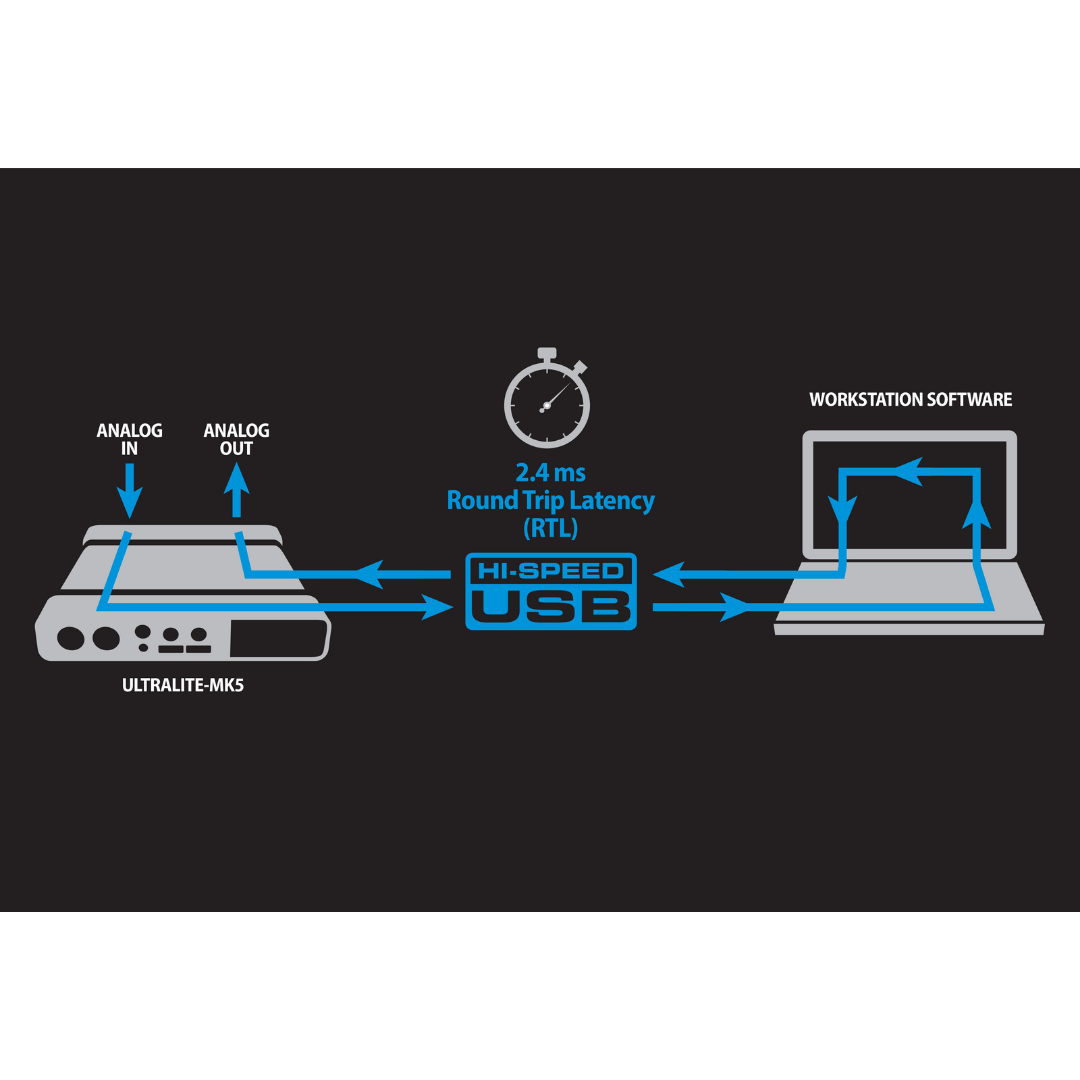
RTL |
2.4 ms at 96 kHz, 32-sample buffer (MOTU driver + high-performance DAW) |
|
Power Supply |
External 15V DC (included) |
|
Mains Input |
100–240 VAC, 50/60 Hz (universal) |
|
Bus Power |
No — external power required |
PHYSICAL
| SPECIFICATIONS | DETAILS |
|---|---|
|
Chassis |
Steel body with molded aluminium alloy end caps |
|
Form Factor |
Half-rack desktop / rack-mountable (1U with optional kit) |
|
Rack Kit |
Half-rack mounting kit (sold separately) |
|
Dual-Unit Kit |
Half-rack coupler kit (joins two units to fill 1U rack) |
|
Front Panel |
OLED display, rotary encoders, 2× combo XLR/TRS, 1× headphone TRS |
|
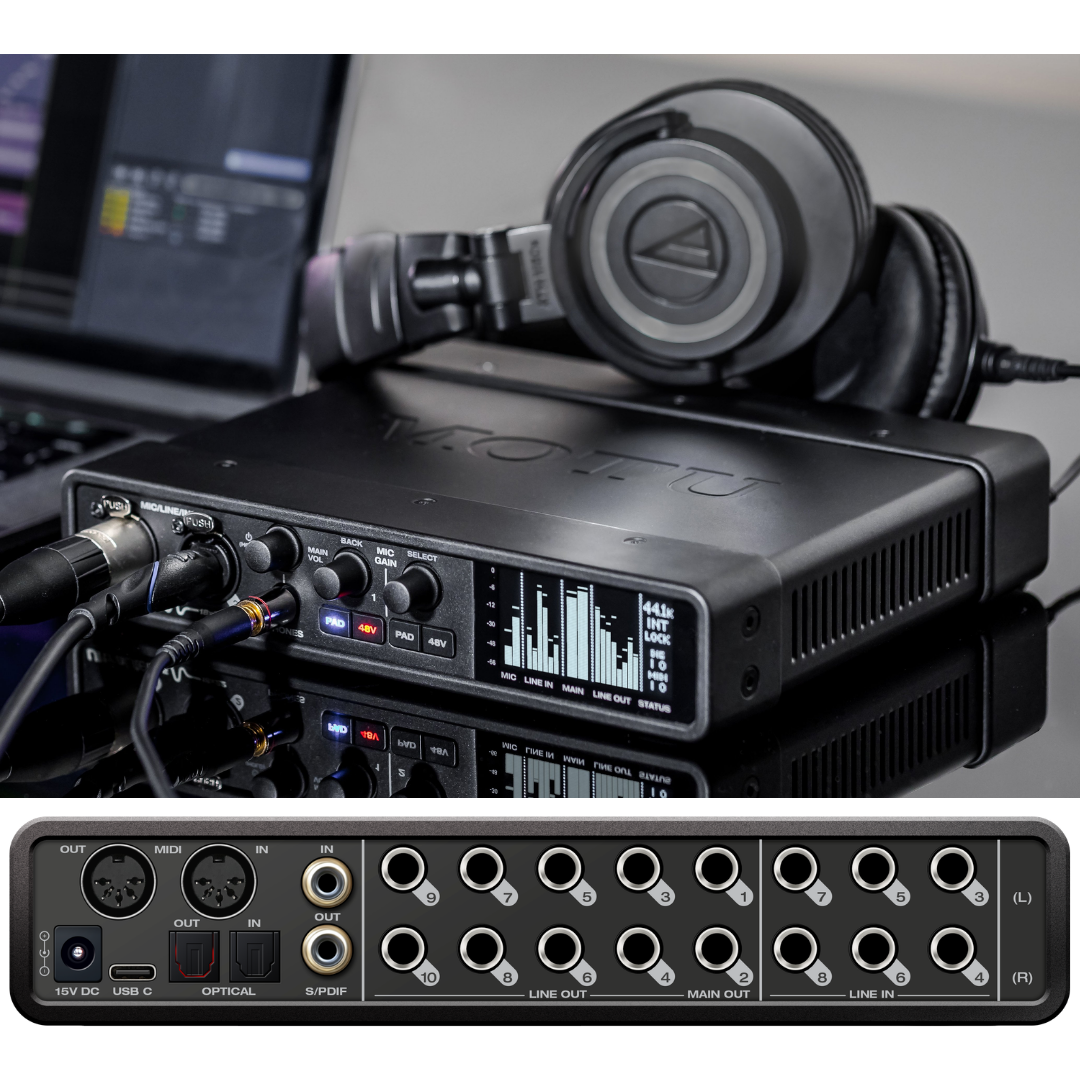
Rear Panel |
6× TRS in (Ch 3–8), 10× TRS out, 1× ADAT optical in, 1× ADAT optical out, 1× RCA S/PDIF in, 1× RCA S/PDIF out, 1× MIDI IN, 1× MIDI OUT, 1× USB-C, 1× 15V DC in |
|
Dimensions |
8.6 × 6.9 × 1.75 in / 22 × 17.5 × 4.5 cm (W × D × H, enclosure only) |
|
Weight |
2.875 lbs / 1.31 kg |
SOFTWARE BUNDLE
| SPECIFICATIONS | DETAILS |
|---|---|
|
DAW Included |
MOTU Performer Lite (multi-track recording, MIDI, mixing, mastering) |
|
Virtual Instruments |
100+ instruments (pianos, guitars, drums, synths, orchestral, etc.) |
|
Sample Content |
6+ GB loops, one-shots, sample packs |
|
Sample Providers |
MOTU, Big Fish Audio, Lucidsamples, Loopmasters |
|
DSP Control App |
CueMix 5 (free, Mac/Windows/iOS) |
|
Platform |
macOS and Windows |
SYSTEM REQUIREMENTS
| SPECIFICATIONS | DETAILS |
|---|---|
|
macOS |
macOS 12 or later (Apple Silicon and Intel supported; 8+ GB RAM recommended) |
|
Windows |
Windows 11 23H2 or later (x86-64 / ARM64 / ARM Snapdragon; 8+ GB RAM recommended) |
|
iOS |
iOS 13.5 or higher |
|
Internet Connection |
Required for driver and CueMix 5 software download |
1. PRODUCT OVERVIEW
The MOTU UltraLite-mk5 is an 18-input, 22-output desktop half-rack USB audio interface representing the fifth generation of MOTU's award-winning UltraLite series — a product lineage that has defined the standard for compact, high-channel-count professional audio interfaces since the early 2000s. Described by MOTU as a "ground-up redesign," the mk5 generation addresses every dimension of its predecessor's performance simultaneously: updated ESS Sabre32™ DAC technology delivers a measured 125 dB dynamic range on the line outputs (a significant step above the M-Series' 120 dB and well into mastering-grade territory), redesigned analogue input circuits achieve 120 dB dynamic range and −114 dB THD+N on the line input ADC path, with the mic input achieving 115 dB dynamic range and −113 dB THD+N, and an all-new MOTU driver stack delivers a round-trip latency of 2.4 ms at 96 kHz with a 32-sample host buffer — faster than the already class-leading M-Series figures.
The UltraLite-mk5 occupies the "compact professional" tier in MOTU's interface range — above the M-Series in audio performance, I/O count, and feature depth, and below the larger studio rack units (828, 16A) in raw channel count. Its 40 simultaneous I/O channels in a compact half-rack format make it uniquely versatile: the unit provides the channel count of a medium-format studio rack interface in a package small enough for desktop use, mobile recording, and road touring. The steel chassis with molded aluminium alloy end caps is robust enough for rack mounting with the optional half-rack mounting kit, and two UltraLite-mk5 units can be joined side-by-side using the optional half-rack coupler kit to fill a single 1U rack space — doubling available I/O in a single rack slot.
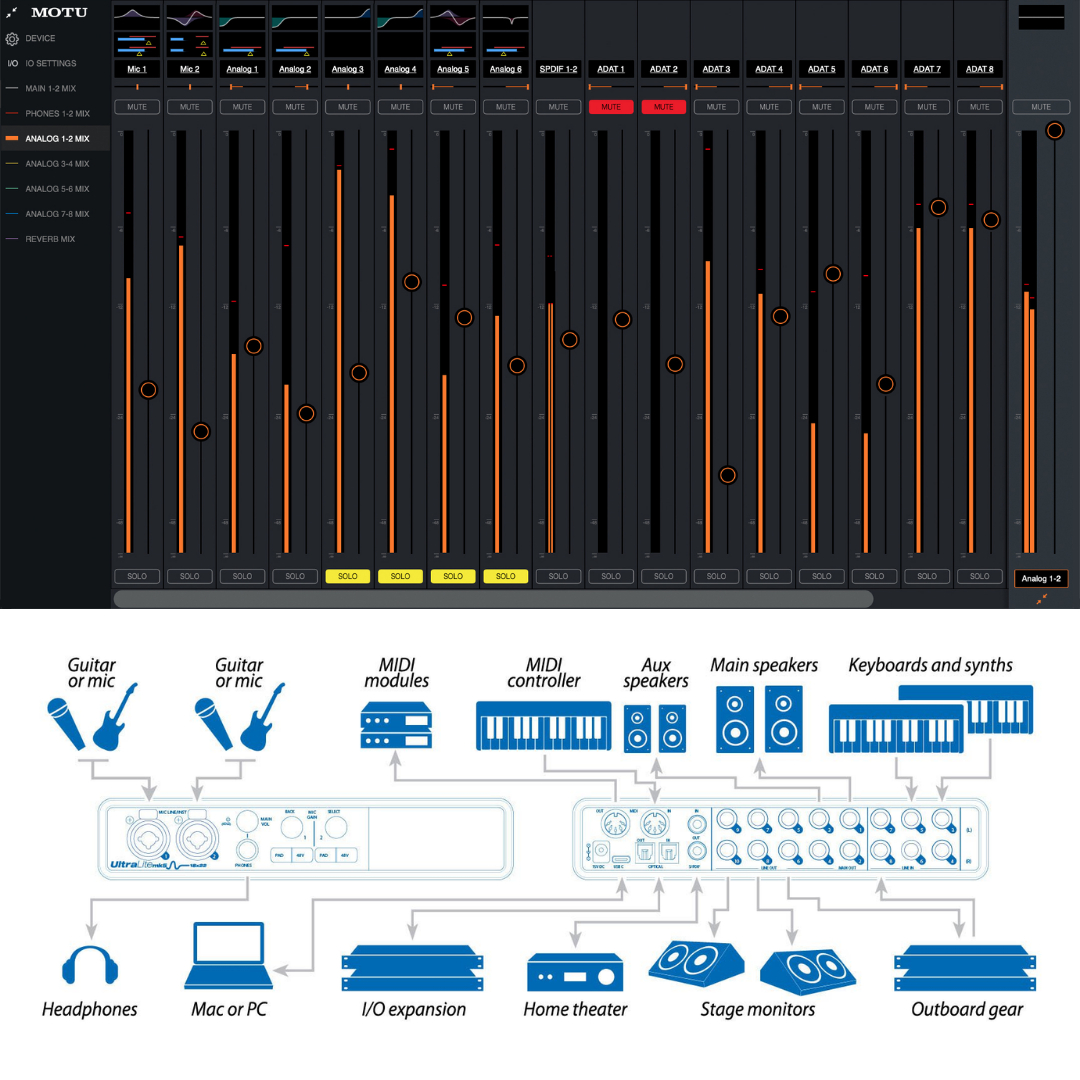
The single most important architectural difference between the UltraLite-mk5 and the M-Series is the presence of the CueMix 5 on-board DSP mixer. The CueMix 5 system is a complete hardware mixing console implemented in DSP silicon within the interface itself, controllable from the CueMix 5 application on Mac, Windows, iPhone, or iPad. It provides per-channel parametric four-band EQ, compression and dynamics processing, and reverb for every input channel, and can create fully independent mixes for every output pair simultaneously. This means the UltraLite-mk5 can operate as a full standalone digital mixer — mixing microphone inputs, line inputs, ADAT channels, and S/PDIF channels and routing them to any output — completely without a host computer. The mixer state is stored in non-volatile memory within the unit and activates immediately on power-up, enabling the UltraLite-mk5 to replace a dedicated hardware mixer in live performance and installation scenarios.
The UltraLite-mk5 requires an external 15V DC power supply (included in the box) and is not bus-powered via USB. This is a fundamental design constraint that distinguishes it from the M-Series, and it is important to state clearly: the UltraLite-mk5 cannot operate from USB bus power alone. The requirement for an external power supply is architecturally necessary given the unit's significantly higher analogue I/O count, the DSP processing requirements of CueMix 5, the OLED display, and the optical I/O circuits — all of which exceed the 900 mA current limit of USB 2.0. In exchange for this constraint, the unit delivers a level of audio performance and operational flexibility that no bus-powered interface in its price class can match.
2. COMPUTER CONNECTIVITY & LATENCY
The UltraLite-mk5 connects to the host computer via a USB-C port operating at USB 2.0 High Speed (480 Mbps). Despite the interface's 40-channel I/O count, USB 2.0 provides ample bandwidth: the simultaneous maximum of all 40 channels at 24-bit / 48 kHz represents approximately 110 Mbps, well within USB 2.0's 480 Mbps ceiling. The USB-C connector ensures physical durability in demanding road environments, and the unit is compatible with USB-C to USB-A connections for computers with USB-A ports via the included cable.
The interface is USB Audio Class 2.0 compliant, which provides two important operational benefits: on macOS and iOS, the unit operates as a plug-and-play device via Core Audio without requiring any driver installation; and on Android devices that support USB Audio Class 2.0, the unit similarly operates without drivers. On Windows, the MOTU UltraLite-mk5 ASIO and Wave driver is required for low-latency operation with professional DAWs — this driver is freely downloadable from motu.com and provides both ASIO (for all professional DAWs) and Wave/WDM (for general Windows audio applications) interfaces. The MOTU driver is optimised for Windows 11 23H2 or later.
2.1 Round-Trip Latency & Driver Performance
With MOTU's optimised driver and a high-performance host, the UltraLite-mk5 achieves a round-trip latency (RTL) of 2.4 ms at 96 kHz with a 32-sample host buffer — faster than the M-Series' 2.5 ms. This 0.1 ms difference is not the primary reason to choose the UltraLite-mk5 over the M-Series (the DSP mixer, channel count, and converter performance are far more significant differentiators), but it confirms that the increased I/O complexity of the UltraLite-mk5 has not come at any latency cost. At lower sample rates (48 kHz), RTL is higher but still competitive; at 192 kHz, RTL is lower still, though digital I/O (ADAT and S/PDIF) becomes unavailable at that sample rate.
Computer Connectivity Specifications
|
SPECIFICATIONS |
DETAILS |
|---|---|
|
USB Standard |
USB 2.0 High Speed (480 Mbps) |
|
Device Connector |
USB-C |
|
USB-A Compatibility |
Yes — via included USB-C to USB-A cable |
|
USB Audio Class |
USB Audio Class 2.0 (plug-and-play: macOS, iOS, Android) |
|
macOS Support |
macOS 12 (Monterey) or later |
|
Windows Support |
Windows 11 23H2 or later (x86-64/ARM64 and ARM Snapdragon) |
|
iOS Support |
iOS 13.5 or higher |
|
macOS Driver |
Optional (Core Audio UAC default; MOTU driver for lowest latency) |
|
Windows Driver |
Required — MOTU ASIO + Wave/WDM driver (free download) |
|
Round-Trip Latency |
2.4 ms at 96 kHz, 32-sample host buffer (with MOTU driver + high-performance DAW) |
|
Bus Power |
No — external 15V DC power supply required (included) |
|
USB Channel Count |
18 analogue/digital inputs + 22 analogue/digital outputs + loopback channels |
|
ASIO Support |
Yes (Windows, via MOTU driver) |
|
Core Audio Support |
Yes (macOS, native UAC2 + optional MOTU driver) |
3. AUDIO QUALITY & CONVERTER TECHNOLOGY
3.1 DAC: ESS ES9026PRO Sabre32™ Technology
The digital-to-analogue conversion in the MOTU UltraLite-mk5 is performed by the ESS ES9026PRO — a newer and higher-performing member of the ESS Sabre32™ Ultra family than the ES9016S used in the M-Series. The ES9026PRO is an eight-channel 32-bit Delta-Sigma DAC chip designed specifically for professional studio and reference-grade applications, featuring ESS's Hyperstream™ II modulation architecture, the Time Domain Jitter Eliminator™ circuit, and a 32-bit processing core. Compared to the ES9016S in the M-Series, the ES9026PRO achieves a notably higher dynamic range: MOTU's measurements on the UltraLite-mk5 yield 125 dB(A) on the line outputs — 5 dB above the M-Series' 120 dB(A). This 5 dB improvement corresponds to a 78% reduction in noise power at the output stage, placing the UltraLite-mk5's DAC performance unambiguously in mastering-grade territory.
The line outputs are DC-coupled — an important practical advantage for electronic music producers, as it means all ten balanced TRS outputs can transmit Control Voltage (CV) signals from DAW plugins directly to Eurorack modular synthesiser modules without any signal degradation from output filtering. The headphone output is driven by the same ES9026PRO DAC chain through a dedicated high-current headphone amplifier circuit, providing the same converter quality on headphones as on the balanced line outputs.
3.2 ADC: Input Converter Performance
The analogue-to-digital conversion path in the UltraLite-mk5 achieves a measured 120 dB(A) dynamic range on the line inputs with a THD+N of −114 dB (0.0002%), and 115 dB(A) dynamic range on the mic inputs with −113 dB THD+N. The line input ADC dynamic range of 120 dB(A) matches the M-Series' ADC performance on the line inputs, meaning the line input converters are consistent across the M-Series and UltraLite-mk5 lineups; the primary differentiation is on the DAC/output side, where the ES9026PRO delivers a 5 dB advantage. Independent measurements by Sound On Sound note a measured THD+N of approximately −113 dB on the mic input path.
3.3 Mathematical Validation: Input-to-Output Chain
Cross-validating the UltraLite-mk5's signal chain specifications: the line input ADC dynamic range of 120 dB(A) sets the upper limit on what can be captured through the analogue line inputs, and the DAC dynamic range of 125 dB(A) on the outputs means the playback path can faithfully reproduce the captured signal with 5 dB of additional headroom on the output side. The system's line-input capture dynamic range (120 dB(A) at the ADC) is correctly the limiting factor in the complete record-and-playback chain, which is the intended engineering design: the output stage should always outperform the input stage so that playback quality is never the bottleneck. The microphone preamp EIN of −129 dBu at 74 dB maximum gain means the preamp presents a signal floor at the ADC input of approximately −55 dBu at maximum gain — the mic input ADC's 115 dB(A) dynamic range remains well below the preamp noise at high gain, confirming the preamp correctly dominates the noise floor — exactly as it should in a properly designed signal chain.
Converter Technology Specifications
|
SPECIFICATIONS |
DETAILS |
|---|---|
|
DAC Chip |
ESS ES9026PRO (ESS Sabre32™ Ultra family, 8-channel, professional grade) |
|
DAC Architecture |
Hyperstream™ II 32-bit Delta-Sigma with Time Domain Jitter Eliminator™ |
|
Output Dynamic Range (measured) |
125 dB(A) — all balanced TRS line outputs |
|
THD+N (outputs) |
−114 dB (0.0002%) — per MOTU published specification |
|
Output DC Coupling |
Yes — all ten balanced TRS outputs; suitable for CV/modular synthesis |
|
ADC Architecture |
32-bit Delta-Sigma, 192 kHz capable |
|
Input Dynamic Range (measured) |
Line Input: 120 dB(A) (measured) — Mic Input: 115 dB(A) (measured) |
|
Input THD+N |
Line Input: −114 dB (MOTU published) — Mic Input: −113 dB (MOTU published) |
|
Bit Depth |
24-bit (operational); 32-bit internal DAC processing |
|
Sample Rates |
44.1 / 48 / 88.2 / 96 / 176.4 / 192 kHz |
|
Note on High Sample Rates |
ADAT and S/PDIF unavailable at 176.4 and 192 kHz; ADAT is 4-channel at 88.2/96 kHz (S/MUX) |
|
Headphone DAC Chain |
ESS ES9026PRO (same DAC as line outputs; dedicated high-current amp stage) |
4. MICROPHONE PREAMPS
The UltraLite-mk5 provides two microphone preamplifier circuits on the front-panel combo XLR/TRS inputs (channels 1 and 2). Each preamp is a high-gain, low-noise design providing +74 dB of maximum gain — a 14 dB increase over the M-Series' 60 dB maximum. This additional headroom is operationally critical for driving high-gain-requirement dynamic microphones: the Shure SM7B, for example, requires approximately 60 dB of clean gain to reach a useful recording level from a typical vocal source at 30 cm, leaving the M-Series' preamps at their absolute maximum with no headroom for variation. The UltraLite-mk5's 74 dB maximum gain provides 14 dB of additional margin, allowing the SM7B to be used comfortably at 85% of maximum gain rather than 100%, which is the correct operating point for a controlled signal chain.
MOTU publishes the UltraLite-mk5 preamp EIN as −129 dBu — identical to the M-Series figure, and representing best-in-class performance for a USB interface in this price tier. The combination of −129 dBu EIN and 74 dB maximum gain means the UltraLite-mk5 preamps can cleanly amplify microphones with self-noise as low as 4–5 dB(A) (approaching the quietest measurement microphones available) without the preamp itself becoming the audible noise source. The −20 dB pad is engaged per-channel from the front panel or via CueMix 5, allowing the preamp to accept very high-level sources such as kick drum close microphones, direct instrument feeds, or high-SPL instrument applications that would otherwise overload the input stage.
Each combo input on the front panel accepts an XLR connector (routing through the microphone preamplifier at the selected gain level) or a 1/4" TRS connector (routing through the Hi-Z instrument input path, optimised for passive electric guitar and bass). Independent 48V phantom power is switchable per channel from the front panel via rotary encoder or from CueMix 5, with phantom power activation reflected on the OLED display. The encoder also provides quick access to gain trim and pad settings directly from the hardware, without requiring the software application — which is important for live and studio use where physical hardware control is preferred over menu navigation.
Microphone Preamp Specifications
|
SPECIFICATIONS |
DETAILS |
|---|---|
|
Number of Mic Preamps |
2 (channels 1 and 2, front panel combo XLR/TRS) |
|
Connector Type |
XLR / 1/4" TRS combo jack (per channel) |
|
XLR Input Mode |
Microphone preamplifier (balanced, high-gain) |
|
TRS Input Mode |
Hi-Z instrument input (guitar/bass, unbalanced) |
|
EIN (Equivalent Input Noise) |
−129 dBu (published by MOTU, A-weighted) |
|
Maximum Gain |
+74 dB |
|
Gain Range |
Continuously variable, 0 to +74 dB (front-panel rotary encoder) |
|
Pad |
−20 dB (switchable per channel, front panel or CueMix 5) |
|
48V Phantom Power |
Yes — independent per channel; front panel or CueMix 5 |
|
Phantom Power Display |
Indicated on OLED display |
|
Trim Control |
Available via front-panel encoder and CueMix 5 |
|
Gain vs. M-Series |
+74 dB (UltraLite-mk5) vs. +60 dB (M-Series) — 14 dB more headroom |
|
SM7B Compatibility |
Yes — 74 dB gain provides comfortable margin for gain-hungry dynamics |
|
Line Input Mode (combo) |
XLR/TRS combo also accepts line-level signals when gain is reduced appropriately |
5. ANALOGUE LINE INPUTS (CHANNELS 3–8)
Channels 3 through 8 of the UltraLite-mk5 are dedicated balanced 1/4" TRS line inputs located on the rear panel — six channels of professional-grade balanced line input with the same 120 dB(A) ADC dynamic range as the front-panel combo inputs. These inputs are purpose-built for professional line-level sources at +4 dBu nominal: the balanced outputs of mixing consoles, the line outputs of external preamplifiers, the balanced outputs of hardware synthesisers and keyboards, the outputs of hardware compressors and equalisers in insert loop configurations, and the line outputs of other audio interfaces for signal routing.
Having six dedicated balanced line inputs — in addition to the two front-panel combo inputs — gives the UltraLite-mk5 a total of eight analogue inputs before any digital I/O expansion. This makes the unit a genuine eight-channel analogue interface by itself, capable of recording a drum kit (kick, snare, hi-hat, two overheads, three toms) or a full-band live recording in a single pass without any digital expansion. When the ADAT optical port is used for digital expansion (connecting eight additional channels via an external eight-channel microphone preamplifier with ADAT output), the total analogue-plus-digital analogue input chain reaches sixteen channels at 44.1 or 48 kHz — sufficient for almost any multi-microphone recording scenario.
Analogue Line Input Specifications (Channels 3–8)
|
SPECIFICATIONS |
DETAILS |
|---|---|
|
Number of Line Inputs |
6 (channels 3–8, rear panel) |
|
Connector Type |
1/4" TRS balanced (rear panel) |
|
Input Type |
Balanced line input |
|
Nominal Input Level |
+4 dBu (professional balanced) |
|
Gain Control |
Digitally controlled trim via CueMix 5 (no front-panel encoder for channels 3–8) |
|
ADC Chain |
Same ADC as channels 1–2 (120 dB(A) dynamic range) |
|
Input Dynamic Range |
120 dB(A) (measured) |
|
Suitable Sources |
External preamps, mixing consoles, hardware synths, compressors, EQs, line-level instruments |
|
Impedance |
Professional balanced line impedance (not specified by manufacturer) |
|
Total Analogue Inputs (excl. digital) |
8 (channels 1–2 combo + channels 3–8 TRS) |
6. ANALOGUE OUTPUTS
The UltraLite-mk5 provides ten balanced 1/4" TRS outputs on the rear panel, all driven by the ESS ES9026PRO DAC and all DC-coupled. Ten output channels represent a significant expansion over the M-Series' four (M4) or two (M2) outputs, and enable configurations not achievable with smaller interfaces: 5.1 surround monitoring (six channels), 7.1 surround monitoring (eight channels), multiple independent monitor pairs with simultaneous use, or routing to multiple external headphone amplifiers for multi-performer cue monitoring. A B&H customer review confirms the UltraLite-mk5 as one of the few interfaces in its price class capable of 7.1 monitoring in a professional post-production context.
The output channel assignments are fully configurable in CueMix 5: any output pair can receive any mix, any direct channel routing, or any combination of sources. For mastering engineers who work with multiple monitor pairs, outputs 1/2 can feed primary reference monitors, outputs 3/4 can feed secondary nearfields, outputs 5/6 can feed a subwoofer-enabled monitoring system, and outputs 7/8 can feed a headphone amplifier — all simultaneously active and independently controlled. This level of output routing flexibility, combined with the mastering-grade 125 dB(A) output dynamic range, makes the UltraLite-mk5 a genuinely credible mastering interface.
Analogue Output Specifications
|
SPECIFICATIONS |
DETAILS |
|---|---|
|
Number of TRS Outputs |
10 (balanced 1/4" TRS, rear panel) |
|
DAC Chip |
ESS ES9026PRO (ESS Sabre32™ Ultra, 8-channel professional grade) |
|
Output Dynamic Range (measured) |
125 dB(A) — all ten balanced TRS outputs |
|
THD+N (outputs) |
−114 dB (0.0002%) |
|
DC Coupling |
Yes — all ten outputs; suitable for CV/modular synthesis |
|
Nominal Output Level |
+4 dBu (professional balanced) |
|
Output Routing |
Fully assignable in CueMix 5 — any mix, direct, or combination to any output pair |
|
Surround Support |
Yes — outputs 1–10 support 5.1 (6-channel) and 7.1 (8-channel) monitoring configurations |
|
Multiple Monitor Pairs |
Yes — simultaneous independent monitor pairs from separate output pairs |
|
Output Volume Control |
CueMix 5 master volume or front-panel VOL encoder (affects main out pair) |
|
A/B Monitor Select |
Yes — CueMix 5 Control Room feature: switch between monitor pairs |
7. HEADPHONE OUTPUT
The UltraLite-mk5 provides a single stereo 1/4" TRS headphone output on the front panel, driven by the same ESS ES9026PRO DAC chain as the line outputs through a dedicated high-current headphone amplifier. Unlike the M-Series, the UltraLite-mk5's headphone output can mirror any output pair or carry a completely independent headphone mix configured in CueMix 5 — meaning the performer and the engineer can hear entirely different mixes from the same hardware simultaneously. In CueMix 5, the headphone output receives its own configurable mix bus, to which any combination of input channels, ADAT channels, S/PDIF channels, and DAW return channels can be routed at independent levels. Pressing the front-panel VOL encoder toggles its control between headphone volume and main output volume.
Headphone Output Specifications
|
SPECIFICATIONS |
DETAILS |
|---|---|
|
Connector |
1/4" TRS stereo (front panel) |
|
DAC Chain |
ESS ES9026PRO (same DAC as main line outputs) |
|
Volume Control |
Front-panel VOL encoder (toggle: main out or headphone level) |
|
Independent Mix |
Yes — headphone can mirror any output pair OR carry independent CueMix 5 mix |
|
Headphone Mix Routing |
Configured in CueMix 5: any channels at any levels to headphone mix bus |
8. DIGITAL I/O: ADAT OPTICAL & S/PDIF
8.1 ADAT Optical I/O
The UltraLite-mk5 provides a pair of TOSLINK optical connectors on the rear panel that support the ADAT Lightpipe protocol, delivering up to eight channels of 24-bit digital audio input and eight channels of 24-bit digital audio output simultaneously at 44.1 or 48 kHz. The ADAT protocol was developed by Alesis in the early 1990s and has since become the universal digital expansion standard for professional audio equipment: virtually every professional eight-channel microphone preamplifier (Focusrite Octopre, PreSonus DigiMax, Behringer ADA8200, API A2D, SSL Alpha VHD, and hundreds of others) includes an ADAT output, making the protocol the de facto digital bridge between expansion hardware and recording interfaces.
At higher sample rates, the ADAT I/O operates in S/MUX (Sample Multiplexing) mode: at 88.2 or 96 kHz, the ADAT carries four channels (S/MUX2) rather than eight. At 176.4 or 192 kHz, the ADAT optical I/O is unavailable entirely. This is a fundamental constraint of the ADAT standard (which was designed for 44.1/48 kHz operation) and affects all interfaces with ADAT I/O, not only the UltraLite-mk5. The practical implication for engineers who regularly work at 96 kHz is that ADAT expansion provides four additional input and output channels rather than eight. The S/PDIF coaxial I/O (described below) is similarly unavailable at 176.4 and 192 kHz.
Alternatively, the ADAT optical connectors can be configured to carry stereo TOSLink (optical S/PDIF) rather than ADAT multichannel audio, providing optical S/PDIF input and output for connection to consumer or prosumer equipment (CD players, DAT machines, digital preamps with optical S/PDIF outputs, consumer AV receivers). This is an either/or configuration: the optical ports carry either ADAT multichannel or stereo TOSLink, not both simultaneously.
8.2 S/PDIF Coaxial I/O
Two RCA connectors on the rear panel provide stereo S/PDIF input and output in the coaxial format (IEC 60958 Type II). The S/PDIF coaxial path carries two channels of 24-bit digital audio in and two channels out, supporting connection to DAT machines, digital outboard processors, consumer AV equipment, and any other device with coaxial S/PDIF connectivity. The S/PDIF coaxial I/O and the ADAT optical I/O can be used simultaneously at 44.1 and 48 kHz (contributing to the total 18-in / 22-out count), but neither is available at 176.4 or 192 kHz.
Digital I/O Specifications
|
SPECIFICATIONS |
DETAILS |
|---|---|
|
ADAT Optical IN |
1× TOSLINK optical (up to 8 channels at 44.1/48 kHz) |
|
ADAT Optical OUT |
1× TOSLINK optical (up to 8 channels at 44.1/48 kHz) |
|
ADAT at 88.2/96 kHz |
4 channels (S/MUX2 mode) |
|
ADAT at 176.4/192 kHz |
Not available |
|
Optical Alternative Mode |
Stereo TOSLink (optical S/PDIF) — switchable from ADAT in CueMix 5 |
|
S/PDIF IN |
1× RCA coaxial (stereo, 24-bit, IEC 60958) |
|
S/PDIF OUT |
1× RCA coaxial (stereo, 24-bit, IEC 60958) |
|
S/PDIF at 176.4/192 kHz |
Not available |
|
Digital Expansion (max, 44.1/48 kHz) |
8 ADAT in + 2 S/PDIF in = 10 additional digital input channels |
|
Total I/O at 44.1/48 kHz |
18 inputs / 22 outputs (8 analogue in + 8 ADAT in + 2 S/PDIF in; 10 analogue out + 1 headphone + 8 ADAT out + 2 S/PDIF out) |
|
MIDI IN |
1× 5-pin DIN (rear panel) |
|
MIDI OUT |
1× 5-pin DIN (rear panel) |
|
MIDI Channels |
16 IN / 16 OUT (standard MIDI) |
9. CUEMIX 5 DSP MIXER & ON-BOARD EFFECTS
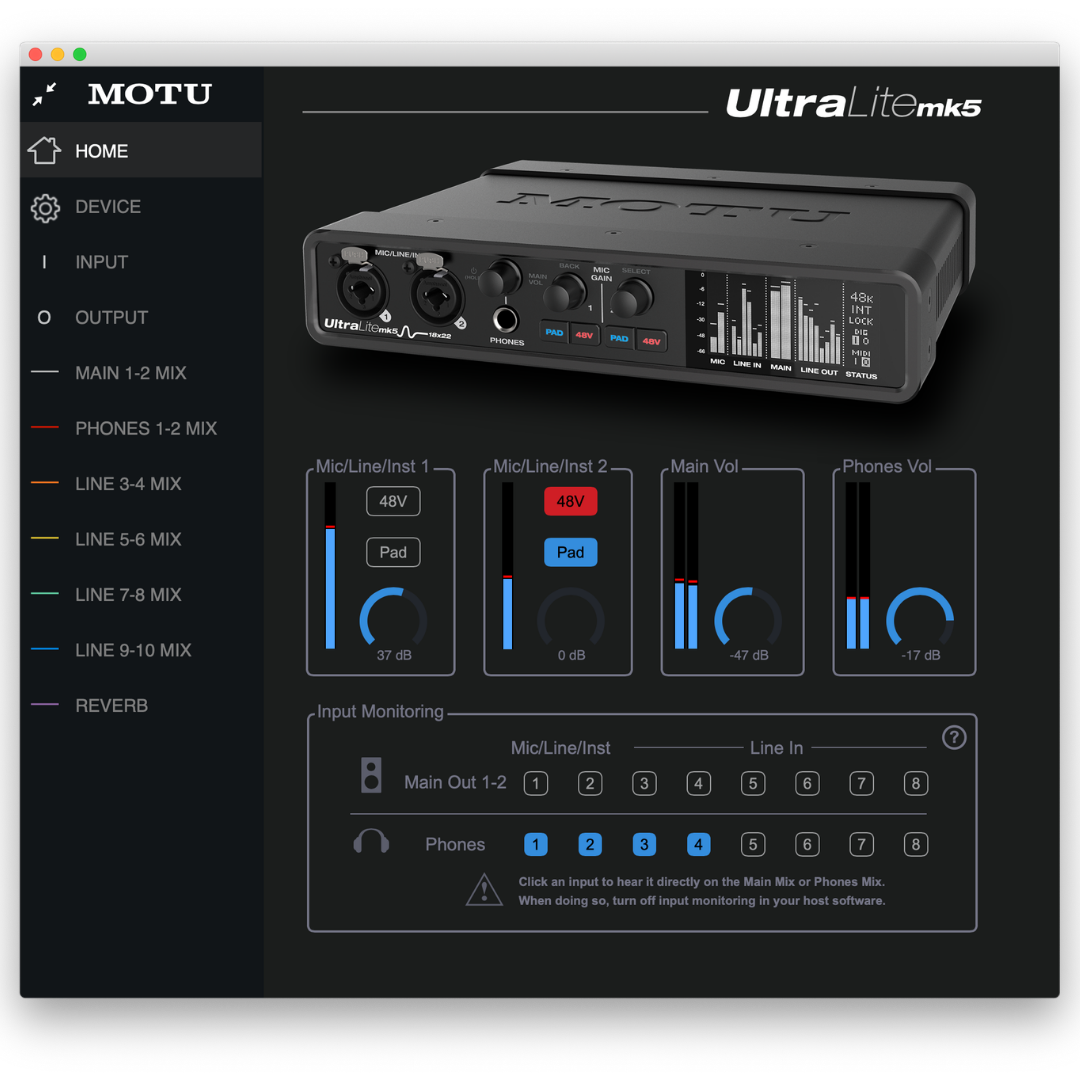
CueMix 5 is the proprietary software application through which the UltraLite-mk5's on-board DSP mixer is configured and controlled. The DSP mixer itself — implemented in dedicated digital signal processing hardware within the interface — provides a fully featured, low-latency mixing console that operates independently of the host computer. Its operation is distinct from a DAW software mixer in one critical respect: the CueMix 5 DSP mixer processes all signals inside the interface at near-zero latency, before those signals reach the host computer. This means a performer monitoring through CueMix 5 hears themselves with effectively zero latency regardless of the DAW's buffer size — the DSP mixer bypasses the USB connection and the host computer entirely for the monitoring path.
The mixer provides independent mix buses for each output pair, allowing the engineer to create a completely different mix for every pair of outputs simultaneously. A typical tracking session might have: the studio monitors (outputs 1/2) receiving the full mix of all inputs plus DAW playback; the headphone output receiving a vocalist-centred cue mix with more reverb and the vocalist's voice louder than the backing tracks; and a second headphone amplifier (connected to outputs 3/4) receiving a drummer-centred mix with the click track prominent. All three mixes are configured in CueMix 5 and processed by the DSP simultaneously, with no CPU usage on the host computer.
9.1 Per-Channel DSP Effects
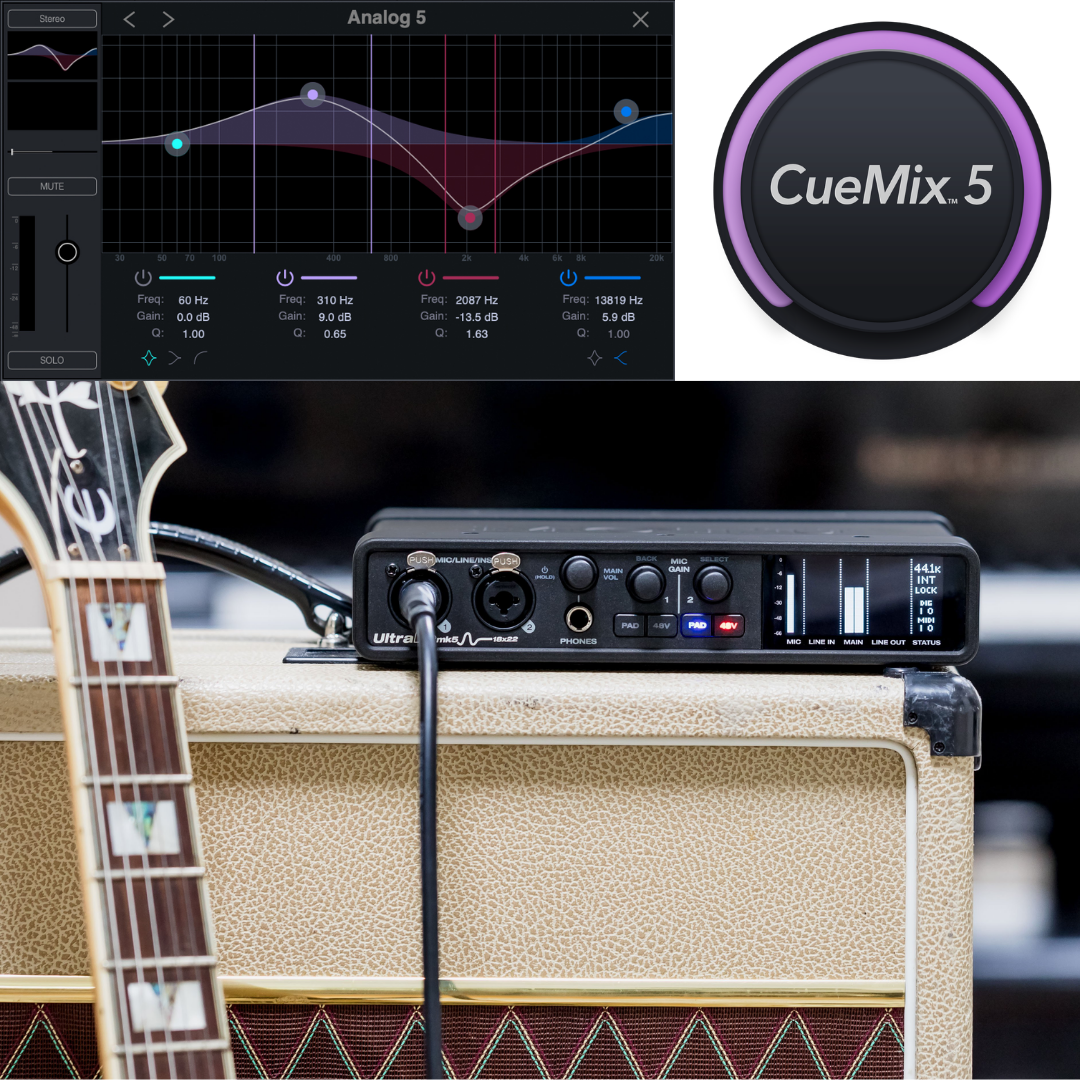
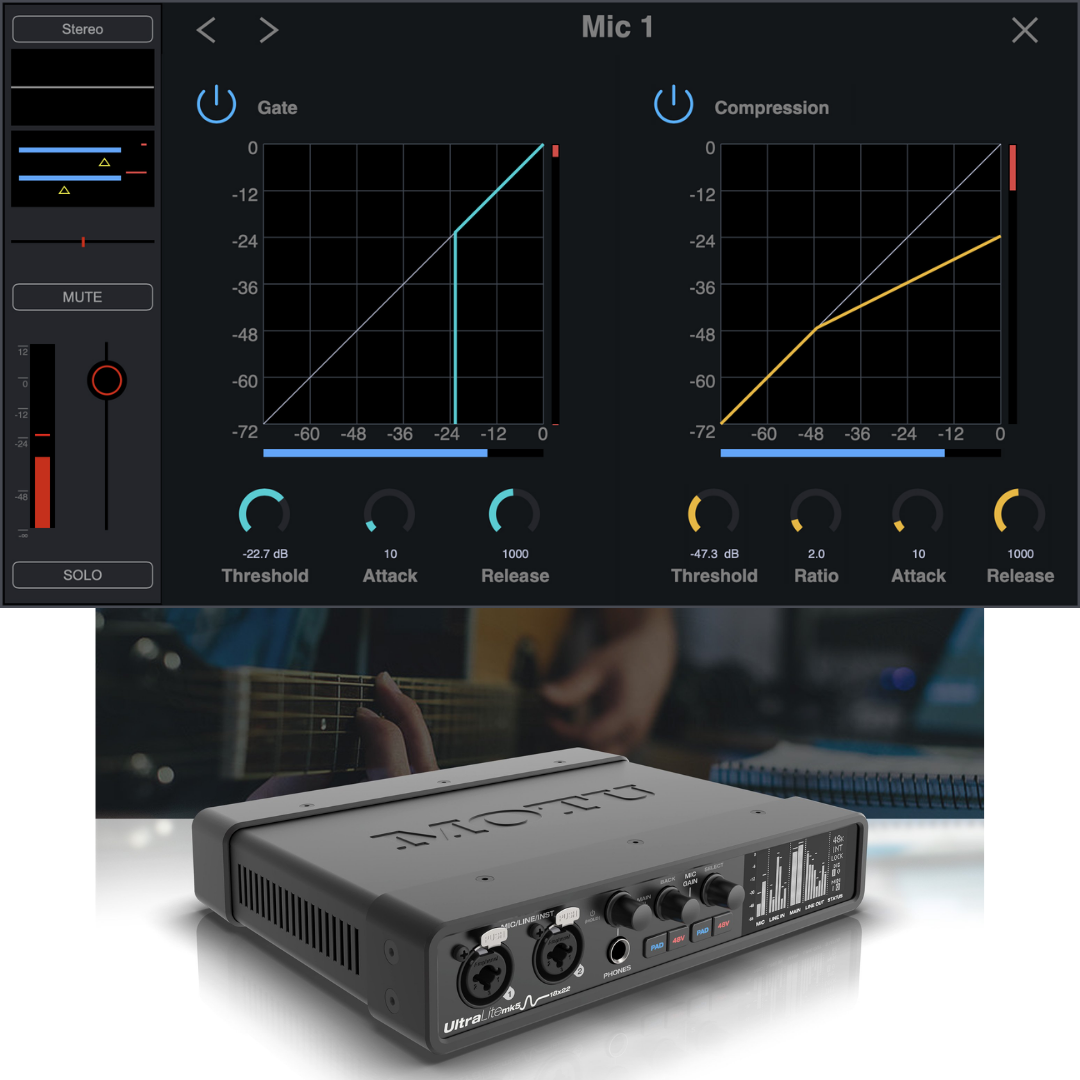
Every analogue input channel in the CueMix 5 mixer has access to on-board DSP processing: a parametric four-band equaliser with graphical frequency response display, a compressor/expander with threshold, ratio, attack, release, and gain controls, and a reverb send. These effects can be applied to the monitoring mix only (allowing the performer to hear reverb on their vocal while the dry signal is recorded), to the recorded signal only, or to both. The graphical EQ display in CueMix 5 provides a visual representation of the EQ curve — similar to the parametric EQ displays in professional DAW plug-ins — making precise tonal shaping intuitive. The reverb algorithm is a shared on-board reverb (not per-channel; it is a send effect), with the send level configurable per channel.
9.2 Control Room Features
CueMix 5 includes dedicated control room functions that distinguish the UltraLite-mk5 from the M-Series. A/B Monitor Select allows the engineer to switch between two defined monitor configurations (for example, main studio monitors on outputs 1/2 and secondary nearfields on outputs 3/4) with a single click in the software or a hardware button press. Monitor Grouping links multiple output pairs to a single master volume control, simplifying level management in multi-speaker setups. Talkback allows the engineer's microphone to be routed to the performer's headphone mix at the press of a button — without setting up a dedicated talkback routing scheme in the DAW.
9.3 Loopback, Re-Amping, and Network Control
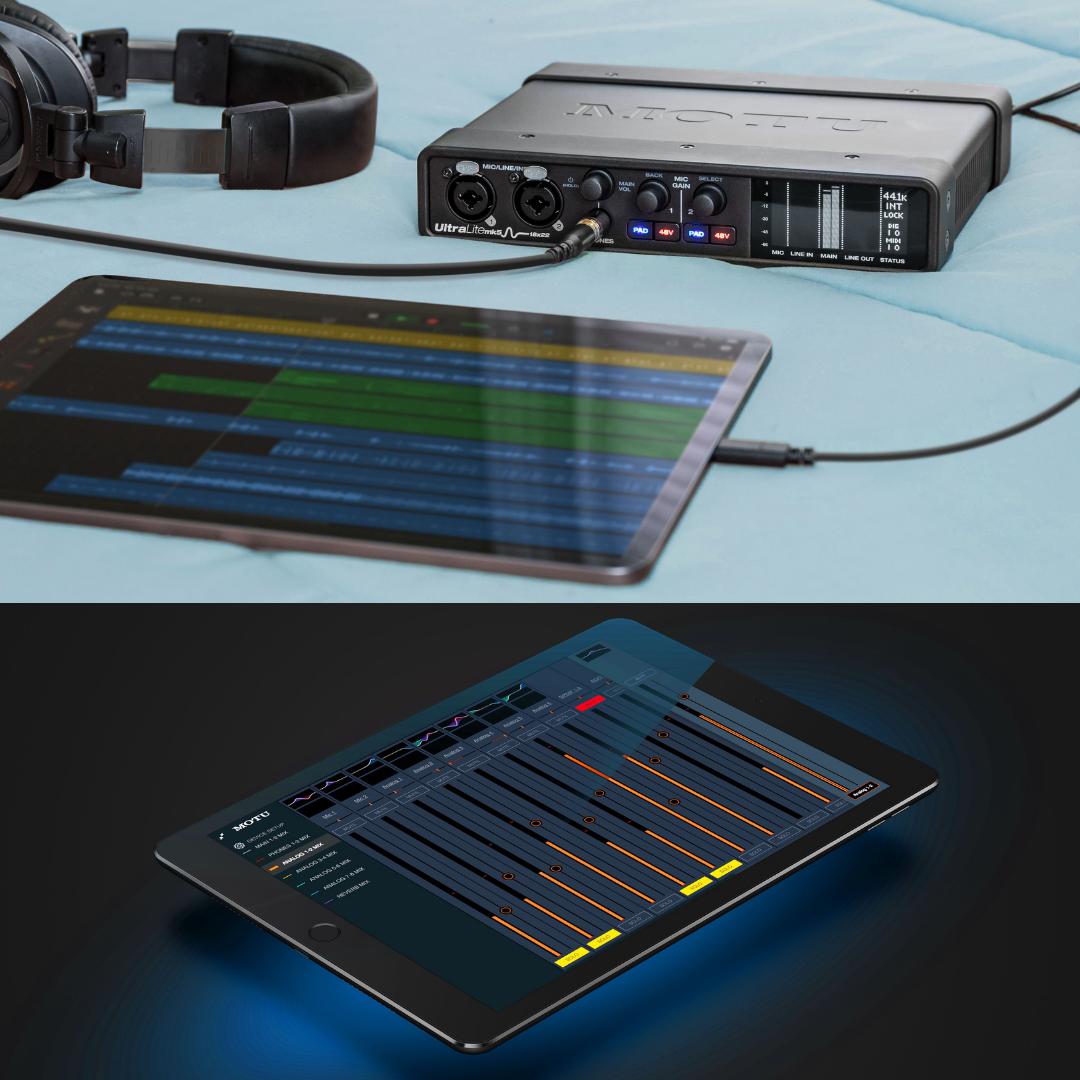
The UltraLite-mk5 provides software loopback channels that route the host computer's audio output back as an audio input in the driver — enabling podcasting, streaming, and multi-source recording workflows (detailed in Document 2). Guitar re-amping is supported via a near-zero-latency loop-thru that allows the dry DI guitar signal to be recorded simultaneously with a microphone placed in front of the guitar amplifier, with the interface looping the signal through with negligible added latency. CueMix 5 runs on Mac, Windows, iPhone, and iPad; on iOS, the app connects to the interface via a USB-connected computer on the same Wi-Fi network, allowing level adjustments, monitor switching, and mix changes from a mobile device without touching the computer.
CueMix 5 DSP Mixer Specifications
|
SPECIFICATIONS |
DETAILS |
|---|---|
|
DSP Architecture |
On-board dedicated DSP hardware (operates independently of host computer) |
|
Mixer Latency |
Near-zero (DSP bypasses USB and host computer for monitoring path) |
|
Independent Mix Buses |
One per output pair — any combination of sources at any levels |
|
Parametric EQ |
Per analogue input channel — 4-band parametric with graphical display |
|
Compressor/Dynamics |
Per analogue input channel — threshold, ratio, attack, release, gain |
|
Reverb |
On-board shared reverb algorithm — send level configurable per channel |
|
Effects Application |
Monitoring mix only, recorded signal only, or both simultaneously |
|
A/B Monitor Select |
Yes — switch between two defined monitor configurations |
|
Monitor Grouping |
Yes — link multiple output pairs to single master volume |
|
Talkback |
Yes — engineer mic routed to performer headphone mix on button press |
|
Loopback Channels |
Yes — configurable to appear on channels 9+10 (default) or 1+2 |
|
Guitar Re-Amping |
Yes — near-zero loop-thru for simultaneous dry DI + mic'd amp recording |
|
Software Platform |
CueMix 5 application: macOS, Windows, iOS (iPhone and iPad) |
|
iOS / Wi-Fi Control |
Yes — via USB-connected computer on same Wi-Fi network |
|
Preset Storage |
Yes — full device state saved / loaded as named presets in CueMix 5 |
|
Network Management |
Device discovery, password protection per device |
10. STANDALONE OPERATION (WITHOUT A COMPUTER)
One of the most operationally significant capabilities of the UltraLite-mk5 — entirely absent from the M-Series — is its ability to function as a complete standalone digital mixer and monitor controller without any host computer. The CueMix 5 mixer state is stored in non-volatile memory within the interface hardware. On power-up, the unit immediately enters its last-saved mixer configuration — routing inputs to outputs, applying DSP processing, and managing all mixes independently — with no USB connection required. The only power requirement is the 15V DC external power supply; a laptop is not needed.
Standalone operation transforms the UltraLite-mk5 into a portable, broadcast-quality stage or live mixer. A band performing live without a dedicated front-of-house engineer can connect their microphones and instruments to the UltraLite-mk5's inputs, configure the mix in CueMix 5 during soundcheck (with or without a laptop), and then remove the laptop from the stage — the interface continues to mix and route audio independently for the duration of the performance. The CueMix 5 iOS app (running on a connected iPhone or iPad on the same Wi-Fi network as the computer that initially configured the interface) can continue to provide real-time level adjustments and mix changes even in standalone mode, via the Wi-Fi control bridge. This gives the artist or a crew member a wireless remote control for the mix from anywhere in the venue.
Standalone Operation Specifications
|
SPECIFICATIONS |
DETAILS |
|---|---|
|
Computer Required |
No — full standalone operation after initial configuration |
|
Power Source (Standalone) |
15V DC external power supply (included) |
|
Mixer State Retention |
Non-volatile memory — last-saved state restored on power-up |
|
Available Functions (Standalone) |
Full CueMix 5 mixer, DSP effects, ADAT in/out, S/PDIF in/out, MIDI, all analogue I/O |
|
Remote Control (Standalone) |
CueMix 5 iOS app via Wi-Fi (through USB-connected computer on same network) |
|
Use Cases |
Live performance mixing, installation, front-of-house supplement, mobile recording without laptop |
|
Preset Recall (Standalone) |
Last-saved preset activates on power-up; preset change requires CueMix 5 app |
11. FRONT PANEL, OLED DISPLAY & CONTROLS
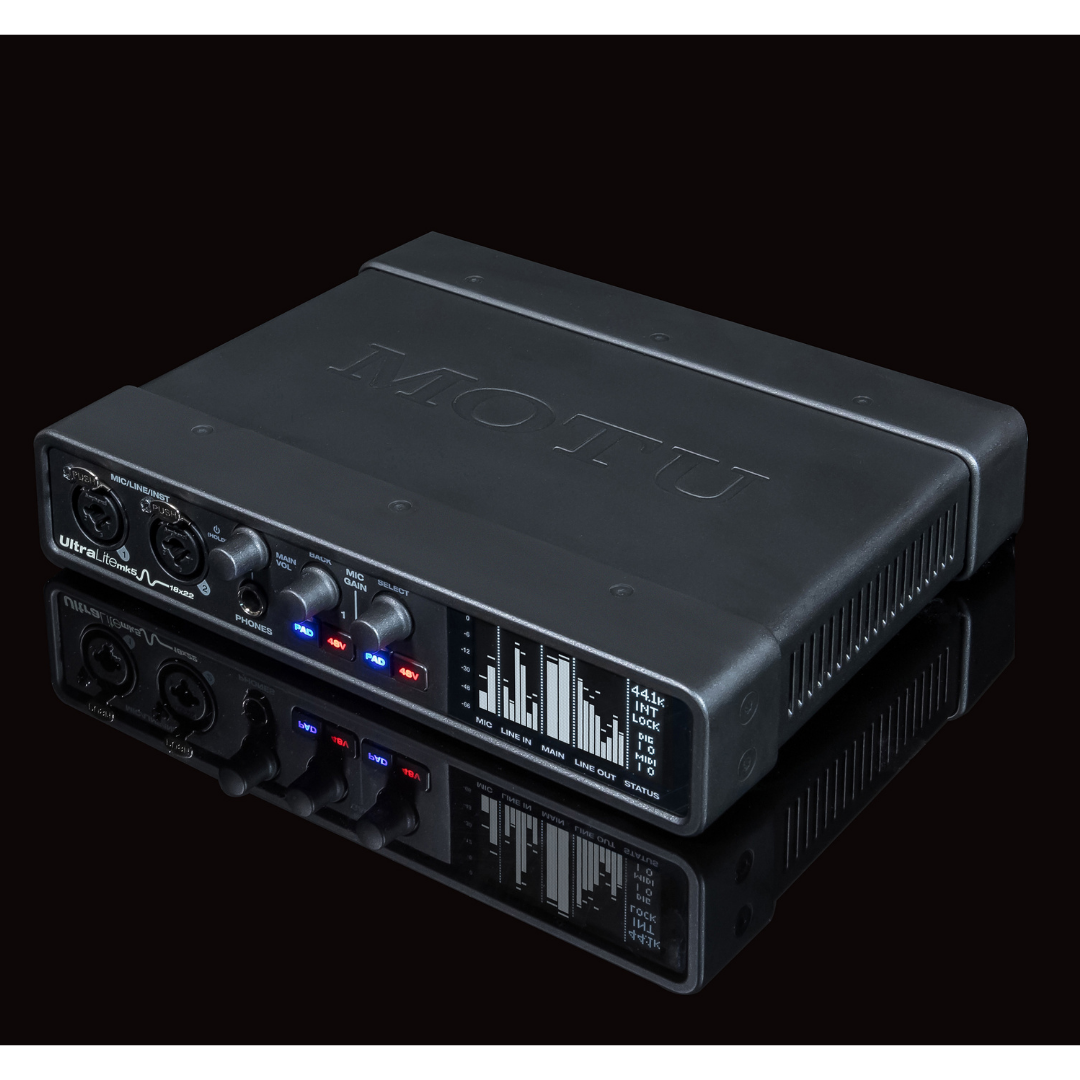
The front panel of the UltraLite-mk5 is centred around a high-resolution, high-contrast white OLED display — a notable upgrade over the smaller LCD of the M-Series. OLED (Organic Light-Emitting Diode) displays are inherently higher contrast than LCD displays because each pixel generates its own light rather than relying on a backlight, producing true blacks and significantly higher contrast ratios. MOTU describes the display as providing "long-throw metering" for all analogue I/O — meaning the meter bar-graph range is designed to be readable from a greater distance than typical LED or small LCD meters, which is directly valuable for stage and control room use.
The OLED displays continuous level metering for all analogue inputs (channels 1–8), all analogue outputs (channels 1–10), plus activity indicators for ADAT I/O, S/PDIF I/O, and MIDI I/O. This provides a complete real-time overview of the entire signal chain in a single glance. Front-panel rotary encoders provide hardware control of the two main preamp channels (gain, pad, phantom power), the main output volume, and the headphone volume — the most commonly adjusted parameters during tracking and monitoring. Less frequently adjusted settings (individual line input and line output levels, mix bus assignments, DSP parameters) are managed in CueMix 5 software.
Front Panel & Display Specifications
|
SPECIFICATIONS |
DETAILS |
|---|---|
|
Display Type |
OLED (Organic Light-Emitting Diode) — high-resolution, high-contrast, white |
|
OLED Metering |
Long-throw bar-graph metering for all analogue I/O channels simultaneously |
|
Digital I/O Indicators |
Activity indicators for ADAT, S/PDIF, and MIDI I/O on OLED |
|
Front-Panel Encoders |
Rotary encoders for Ch 1/2 gain, pad, phantom power; main output volume; headphone volume |
|
VOL Encoder (dual function) |
Push to toggle between main output volume and headphone volume control |
|
Front-Panel Connectors |
2× XLR/TRS combo input (Ch 1/2), 1× 1/4" TRS headphone |
|
OLED vs. M-Series LCD |
Higher contrast, greater visibility at distance; displays more channels simultaneously |
12. BUILD QUALITY, POWER & FORM FACTOR
The UltraLite-mk5 is housed in a fully redesigned steel enclosure with molded aluminium alloy end caps — a construction that provides substantially greater rigidity and electromagnetic shielding than the plastic or mixed-material enclosures common in competing desktop interfaces. The steel chassis is specifically noted by MOTU as "ready for serious touring," and the optional thick steel half-rack mounting kit is engineered to withstand road and touring conditions, not merely studio use. The aluminium end caps add both aesthetic refinement and thermal mass for heat dissipation.
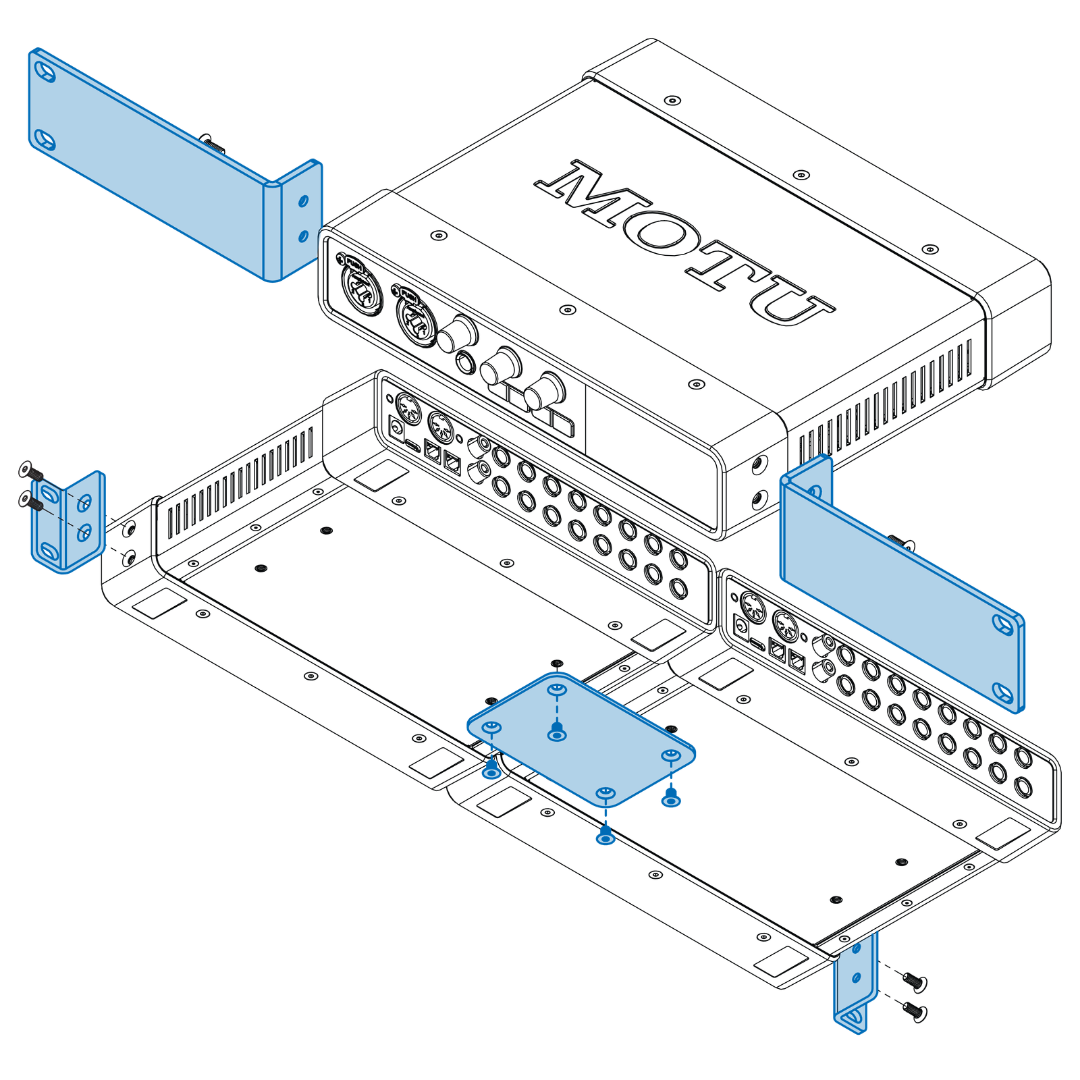
The unit is half-rack width — approximately 8.5 inches wide, occupying half of a standard 19-inch rack space. The optional half-rack mounting kit (sold separately, MOTU part number available from shivanshelectronics.in) allows the unit to be installed in a standard equipment rack as a 1U device. The optional half-rack coupler kit (also sold separately) allows two UltraLite-mk5 units to be physically joined side-by-side to fill a single 1U rack space, creating a composite 36-input, 44-output system in 1U of rack height — an exceptionally channel-dense professional installation format.
The UltraLite-mk5 requires a 15V DC external power supply. MOTU confirms the included power supply supports 100–240 VAC input (universal mains voltage), making the unit usable in India (220–240 VAC, 50 Hz) without any voltage conversion. This is confirmed by B&H Photo's product Q&A referencing MOTU engineering directly.
Physical & Power Specifications
|
SPECIFICATIONS |
DETAILS |
|---|---|
|
Chassis Material |
Steel body with molded aluminium alloy end caps |
|
Form Factor |
Half-rack desktop / half-rack mountable (1U with optional kit) |
|
Rack Mounting |
Optional half-rack mounting kit (sold separately) |
|
Dual-Unit Mounting |
Optional half-rack coupler kit — joins two units to fill 1U rack space |
|
Power Supply |
External 15V DC (included in box) |
|
Mains Compatibility |
100–240 VAC, 50/60 Hz (universal; confirmed by MOTU) |
|
Bus Power from USB |
No — external power required (not bus-powered) |
|
Front Connectors |
2× XLR/TRS combo (Ch 1/2), 1× 1/4" TRS headphone, OLED display, rotary encoders |
|
Rear Connectors |
6× TRS line in (Ch 3–8), 10× TRS line out (Ch 1–10), 1× optical in, 1× optical out, 2× RCA S/PDIF in/out, 1× MIDI IN, 1× MIDI OUT, 1× USB-C, 1× 15V DC in |
|
Dimensions |
Not specified by manufacturer on product page — verify with MOTU or product manual |
|
Weight |
Not specified by manufacturer on product page — verify with MOTU or product manual |
|
Colour |
Dark grey / black with aluminium end caps |
|
Road/Touring Rated |
Yes — steel construction; thick steel rack brackets designed for touring |
13. IDEAL APPLICATIONS & USE CASES
The MOTU UltraLite-mk5 is one of the most versatile audio interfaces available in its price tier, combining high-channel-count I/O, mastering-grade converter performance, on-board DSP mixing with full effects, ADAT expansion, standalone operation, and a road-ready chassis in a format that suits desktop, mobile, rack-installed, and stage deployments equally.
- Professional Recording Studio (Permanent Installation): Eight analogue inputs (expandable to 16 via ADAT), ten balanced outputs for multi-monitor setups, full CueMix 5 DSP mixing, and 125 dB dynamic range outputs for critical monitoring.
- Mastering & Reference Monitoring: 125 dB(A) output dynamic range competes with dedicated mastering converters; ten outputs support A/B/C monitor comparison across three monitor systems simultaneously.
- Live Performance (Stage Mixer / IEM Controller): Standalone operation without a computer, CueMix 5 DSP mixer for independent monitor mixes per performer, compact half-rack form factor for road use.
- Remote Collaboration & Mobile Recording: Half-rack form factor with robust steel chassis; 15V DC supply (universal voltage); ADAT expansion for multi-microphone location recording.
- Post-Production & Audio for Picture: 5.1 and 7.1 surround monitoring via outputs 1–10; 125 dB(A) output dynamic range for critical dialogue and music monitoring; low-latency DSP mixing for ADR and overdubbing workflows.
- Podcast & Streaming Production: Multiple microphone inputs, CueMix 5 performer monitoring with per-channel EQ and reverb in the cue mix, loopback channels for VoIP guest capture and live stream mixing.
- Electronic Music Production & Modular Synthesis: All ten outputs are DC-coupled; full CV routing capability for multiple simultaneous Eurorack CV paths alongside audio monitoring.
- House of Worship (Mid-Scale): ADAT expansion to 16 inputs for multi-microphone worship; independent CueMix 5 monitor buses for multiple performance positions; standalone mixer operation without a computer.
- Music Schools & Universities: Full DSP mixer as a teaching tool for mixing, EQ, compression, and routing principles; ADAT expansion for large ensemble recording; iOS CueMix 5 control from student devices.
- Guitar Re-Amping Studio: CueMix 5 near-zero loop-thru enables simultaneous recording of dry DI and live microphone on amp — standard professional re-amping workflow without additional hardware.
- Multi-Performer In-Ear Monitoring: CueMix 5 creates independent performer mixes on outputs 1/2, 3/4, 5/6, 7/8, and headphone simultaneously — up to five independent monitor mixes from a single unit.
- Outdoor Events & Rental Production: Steel chassis, optional rack mounting, standalone operation, universal power supply, and ADAT expansion for flexible rental deployment.
HOW TO READ THIS DOCUMENT
This document is the operational companion to the MOTU UltraLite-mk5 Product Description & Technical Specifications reference. Where the specifications document answers the questions of what the UltraLite-mk5 measures and how it is built, this document answers the more practical question that every working engineer must eventually address: "How do I physically connect, configure, and use this unit in my specific environment?" Each workflow section describes a concrete deployment scenario, covering physical signal routing, CueMix 5 mixer configuration, key operational steps, and the specific UltraLite-mk5 features that make that workflow efficient and professional-sounding.
The UltraLite-mk5 has three defining workflow advantages that appear repeatedly across every scenario in this guide. The first is the CueMix 5 on-board DSP mixer, which provides zero-latency monitoring with full per-channel EQ, compression, and reverb that operates entirely inside the hardware — independently of the host computer and without consuming any CPU. The second is the ADAT optical I/O, which allows up to eight channels of additional input (or output) to be added via any standard external eight-channel preamplifier, transforming the eight-channel analogue-input interface into a sixteen-channel recording system at 44.1/48 kHz. The third is the unit's ability to operate completely standalone — as a live mixer without any computer — which extends its application from the traditional recording interface role into live performance mixing, installation, and broadcast-without-laptop scenarios that no M-Series interface can serve.
Each workflow section is structured identically: an environment description establishes the physical setup and engineering requirements, scenario sub-sections provide specific configurations, and a Routing/Configuration Summary Table serves as a practitioner's checklist that can be used during setup without re-reading the prose sections. Engineers building complex multi-workflow systems — such as a studio that also handles live streaming, or a house of worship that records services for podcast release — should read multiple sections and cross-reference the Feature-to-Workflow Matrix at the end of this document.
WORKFLOW 1 — PROFESSIONAL RECORDING STUDIO
Scenario: Permanent Studio Installation with Multi-Microphone Tracking
In a permanent studio installation, the UltraLite-mk5 typically sits in the control room — on the desk or in a rack alongside the monitor controller and outboard gear — connected to the studio computer via USB-C. The unit's eight analogue inputs handle the studio's primary input sources: microphones on channels 1 and 2 via the front-panel combo jacks, and line-level returns from preamplifiers, channel strips, or outboard compressors on channels 3 through 8 via the rear TRS line inputs. The ten balanced TRS outputs handle the complete monitoring infrastructure: outputs 1/2 to primary reference monitors, outputs 3/4 to secondary nearfields (for translation checking), and outputs 5/6 or 7/8 to headphone amplifiers in the tracking booth.
CueMix 5 is the critical enabling technology for tracking sessions. While the engineer monitors through the DAW mix (which may have plug-in processing, virtual instruments, and reverb on the playback tracks), the performer in the tracking booth monitors through a CueMix 5 cue mix — routed to the headphone amplifier on outputs 3/4 — that is configured independently of the DAW mix. The performer hears themselves with added reverb (from the CueMix 5 on-board reverb), a comfortable balance of backing tracks and live input, and zero latency on their own voice or instrument regardless of the DAW's buffer size. This is the standard professional tracking workflow, and the UltraLite-mk5 implements it with hardware-grade simplicity.
Sub-Scenario: ADAT Expansion for Drum Recording
When tracking drums, the studio connects an external eight-channel preamplifier with ADAT output (such as the Focusrite OctoPre, PreSonus DigiMax D8, or API A2D) to the UltraLite-mk5's ADAT optical input via a Lightpipe cable. This immediately adds eight additional microphone channels — kick drum, snare top, snare bottom, hi-hat, two overheads, and two room microphones — alongside the UltraLite-mk5's own eight analogue inputs, for a total of sixteen simultaneous channels at 44.1 or 48 kHz. The DAW records all sixteen channels simultaneously. The control room engineer monitors the complete sixteen-channel mix through CueMix 5, while the drummer receives a custom cue mix in the booth headphones. This workflow — full band recording with a compact desktop interface — represents exactly the kind of high-value deployment for which the ADAT expansion capability exists.
Configuration Summary: Professional Recording Studio
| WORKFLOW ELEMENTS | DETAILS / CONFIGURATIONS |
|---|---|
Inputs 1/2 (Combo XLR) |
Lead vocal and room microphone, or premium condenser pair (48V as required) |
Inputs 3–8 (TRS line) |
External preamplifier line outputs, channel strip returns, DI boxes (balanced TRS) |
ADAT IN (Optical) |
Eight-channel external preamp (e.g. Focusrite OctoPre) — 8 additional mic inputs at 44.1/48 kHz |
Outputs 1/2 |
Primary reference monitors (main stereo bus from DAW) |
Outputs 3/4 |
Secondary nearfield monitors (translation checking) and/or performer cue headphone amp |
Outputs 5/6 |
Third monitor pair (optional) or second performer headphone amp |
Outputs 7/8 |
Fourth headphone zone or outboard processor return path |
Headphone Output |
Engineer monitoring (independent mix or mirror of main out) |
CueMix 5 Bus (Headphones) |
Performer cue mix: live input with reverb + backing tracks; configured independently from DAW mix |
DSP Reverb |
Applied to vocalist cue mix only (monitoring); recorded track is dry |
DSP EQ |
Applied to performer monitoring to taste; does not affect recorded tracks |
A/B Monitor Select |
CueMix 5: toggle between outputs 1/2 (primary) and 3/4 (secondary) from control room |
Talkback |
CueMix 5: engineer mic on any input routed to performer cue mix (outputs 3/4) |
Sample Rate |
44.1 or 48 kHz for ADAT-expanded sessions; 96 kHz for two-channel sessions without ADAT |
Buffer Size (tracking) |
64–128 samples at 48 kHz (CueMix 5 DSP provides zero-latency monitoring regardless) |
WORKFLOW 2 — MASTERING & REFERENCE MONITORING
Scenario: In-the-Box Mastering with Multi-Monitor Comparison
The UltraLite-mk5's 125 dB(A) output dynamic range places it in the company of dedicated mastering-grade DAC converters — a measured figure that exceeds many interfaces at three or four times its price. For mastering engineers and mix engineers working with precision reference monitoring, the output converter performance is the critical specification, and the UltraLite-mk5 satisfies that requirement with genuine authority. Sound On Sound's independent review measured the line output dynamic range at 124 dB(A), consistent with MOTU's published 125 dB(A) and placing the unit's DAC performance alongside the Focusrite Clarett+ and, remarkably, Prism Sound's flagship ADA-128 in the same measurement category.
In a mastering workflow, the UltraLite-mk5 sits in the mastering chain as the primary DAC, with outputs 1/2 feeding the primary mastering reference monitors. The CueMix 5 A/B Monitor Select feature allows the mastering engineer to switch instantly between the primary monitors (outputs 1/2), a secondary reference system (outputs 3/4 — perhaps a smaller speaker at a different listening distance), and a headphone reference (headphone output) without any physical reconnection or software routing change. Monitor Grouping in CueMix 5 links all active monitor outputs to the master volume encoder, so level adjustments apply simultaneously to all active monitoring systems, maintaining matched SPL levels across all references at all times.
For engineers who work with external analogue mastering hardware (compressors, equalisers, limiters in the mastering chain), the UltraLite-mk5's eight analogue inputs accept the stereo return from the hardware chain on inputs 3 and 4 (balanced TRS line inputs), while the stereo send goes from the DAW through outputs 3/4 to the hardware. This creates a hardware insert loop for the mastering chain with all ten balanced TRS outputs simultaneously available for monitoring routing.
Configuration Summary: Mastering & Reference Monitoring
| WORKFLOW ELEMENTS | DETAILS / CONFIGURATIONS |
|---|---|
Outputs 1/2 |
Primary mastering reference monitors (main stereo bus) |
Outputs 3/4 |
Secondary reference monitors (smaller nearfields, different brand for translation) |
Outputs 5/6 |
Third reference system (optional: consumer speaker simulation or mono check) |
Outputs 7/8 |
Optional: hardware mastering chain send (compressor/EQ/limiter input) |
Inputs 3/4 (TRS line) |
Hardware mastering chain return (compressor/EQ/limiter output) |
Headphone Output |
Reference headphones — configured in CueMix 5 to mirror main out or independent mix |
A/B Monitor Select |
CueMix 5: toggle between outputs 1/2, 3/4, 5/6 from software or iOS app |
Monitor Grouping |
CueMix 5: link all active monitor outputs to single master volume encoder |
DAC Dynamic Range |
125 dB(A) — mastering grade; use as primary DAC for critical listening |
Sample Rate |
44.1 or 48 kHz (match delivery format); 88.2/96 kHz for high-resolution mastering |
Buffer Size |
256–512 samples (no live tracking in mastering; CPU efficiency preferred) |
iOS Control |
CueMix 5 on iPhone/iPad: wireless monitor switching and level adjustment from listening position |
WORKFLOW 3 — LIVE PERFORMANCE STAGE MIXER
Scenario: Standalone In-Ear Monitor Mixing Without a Computer
The UltraLite-mk5's standalone operation capability — where the unit operates as a complete mixer without any host computer, powered only by its 15V DC supply — enables a professional in-ear monitor (IEM) mixing workflow that previously required a dedicated hardware digital mixer. In this configuration, the UltraLite-mk5 is physically rack-mounted with the optional half-rack mounting kit in the band's road case or monitor rack. Microphone signals from the stage box or from a front-of-house splitter connect to the unit's eight analogue inputs. The unit's ten balanced TRS outputs connect to the individual IEM transmitter packs or the stereo IEM belt packs for each performer — one stereo pair per performer, up to five performers on a single unit.
During soundcheck, the engineer (or the band members themselves) connects a laptop, opens CueMix 5, and configures the mix buses: each performer's mix is assigned to a specific output pair, with each performer's voice and instrument levels, EQ, reverb, and relative balance in the mix configured and stored as a preset. Once the preset is saved to the UltraLite-mk5's non-volatile memory, the laptop is disconnected and removed from the stage. For the duration of the performance, the UltraLite-mk5 continues mixing and routing audio to all five IEM transmitters completely independently — no computer, no DAW, no screen required. A band member or sound crew member can adjust their own mix in real time using the CueMix 5 iOS app on a smartphone connected to a mobile Wi-Fi hotspot that the laptop was bridging before it was disconnected, without interrupting the live audio.
Configuration Summary: Live Stage Mixer / IEM
| WORKFLOW ELEMENTS | DETAILS / CONFIGURATIONS |
|---|---|
Power |
15V DC from road case or power conditioner (not USB bus power) |
Inputs 1–8 (analogue) |
Stage box or splitter feeds: vocal mics, instrument DIs, click track return |
ADAT IN (optional) |
Additional 8 channels from digital stage snake at 44.1/48 kHz |
Outputs 1/2 |
Performer 1 stereo IEM transmitter (vocalist) |
Outputs 3/4 |
Performer 2 stereo IEM transmitter (guitarist / bassist) |
Outputs 5/6 |
Performer 3 stereo IEM transmitter (drummer) |
Outputs 7/8 |
Performer 4 stereo IEM transmitter (keyboard player) |
Outputs 9/10 |
FOH stereo feed or monitor wedge feed (stage monitor amplifier) |
Headphone Output |
Monitor engineer headphone check during soundcheck |
CueMix 5 Setup |
Configure all 5 performer mix buses during soundcheck; save as named preset |
Standalone Activation |
Disconnect laptop; unit recalls saved preset on power-up for show |
iOS Live Control |
CueMix 5 on iPhone: performer adjusts own mix wirelessly during show |
DSP Per Channel (Monitoring) |
Per-channel EQ and reverb on each performer's mix (e.g. more reverb on vocal for IEM feel) |
Rack Mounting |
Half-rack mounting kit (sold separately) in monitor rack or road case |
Sample Rate |
44.1 or 48 kHz (broadcast standard; ADAT available at both) |
WORKFLOW 4 — MULTI-TRACK LIVE RECORDING
Scenario: Simultaneous Front-of-House and Multi-Track Capture
Live concert recording — capturing a full band performance to a DAW for later mixing — is one of the UltraLite-mk5's strongest workflows because it combines the unit's multi-channel I/O with its standalone DSP mixer to serve two separate engineering functions simultaneously. The recording engineer connects the UltraLite-mk5 to a laptop backstage or at the front-of-house position. The unit receives up to sixteen channels of audio from a splitter on the stage box (eight analogue inputs + eight ADAT inputs from an external preamp), which the DAW records to individual tracks in real time. Simultaneously, the CueMix 5 DSP mixer creates a fully processed front-of-house or monitor mix from the same input signals — applying channel EQ, compression, and reverb independently of the DAW's recording path.
The recording and the live mix are completely decoupled: the DAW records only raw, unprocessed signals, while CueMix 5 applies live processing for the house speakers or stage monitors. After the show, the recording engineer has a sixteen-channel multi-track session of dry, clean recordings from which to build a polished studio mix — with full control over every channel independently. This is the standard workflow used by professional live recording engineers, and the UltraLite-mk5 makes it available at a fraction of the cost of traditional dedicated live recording solutions.
Configuration Summary: Multi-Track Live Recording
| WORKFLOW ELEMENTS | DETAILS / CONFIGURATIONS |
|---|---|
Inputs 1–8 (analogue) |
Stage box split feeds: kick, snare, overheads, bass DI, guitar DI, vocal mic 1, vocal mic 2 |
ADAT IN |
External eight-channel preamp outputs: tom mics, hi-hat, room mics (at 44.1/48 kHz) |
DAW Recording |
All 16 channels recorded dry to individual tracks in DAW (no processing on recorded signal) |
CueMix 5 FOH Mix (Outputs 1/2) |
Processed live mix to FOH PA amplifier: EQ + compression + reverb applied in DSP |
CueMix 5 Monitor Mix (Outputs 3/4) |
Stage monitor wedge mix: different blend and less reverb than FOH mix |
Headphone Output |
Recording engineer level monitoring and communication during show |
DSP Applied to |
CueMix 5 monitoring/output path only; DAW receives dry signal |
Post-Show Mixing |
Engineer opens DAW session with 16 dry tracks; mixes in studio at leisure |
Buffer Size |
256 samples at 48 kHz (stable for long-duration live recording) |
Sample Rate |
44.1 or 48 kHz (required for full ADAT 8-channel operation) |
Laptop Position |
FOH table, side-stage rack, or any position with USB cable run to UltraLite-mk5 |
Physical Mount |
Optional half-rack kit in road case; or desktop at FOH position |
WORKFLOW 5 — POST-PRODUCTION & AUDIO FOR PICTURE
Scenario: 5.1 / 7.1 Surround Monitoring for Film and Television
The UltraLite-mk5's ten balanced TRS outputs make it one of the very few compact interfaces in its price class capable of complete 7.1 surround sound monitoring — a fact confirmed by user reviews on B&H Photo from professional audio post-production engineers who deployed the unit specifically for Pro Tools 7.1 monitoring. In a standard 5.1 setup, outputs 1/2 carry front left and right, outputs 3/4 carry rear/surround left and right, output 5 carries centre, and output 6 carries the LFE (subwoofer) channel. Each output feeds the corresponding speaker or amplifier channel of the surround monitoring system. In 7.1, the additional two channels (rear centre left and right) use outputs 7 and 8.
For dialogue editing, ADR replacement, and Foley recording — the core post-production tasks — the UltraLite-mk5's two microphone preamplifiers handle the actor's recording microphone (input 1) and the director's or engineer's talkback microphone (input 2). The CueMix 5 talkback feature routes the engineer's microphone to the performer's headphone cue mix at the press of a button without requiring DAW intervention — the director can give direction to the ADR artist in the recording booth instantly. The 125 dB(A) output dynamic range ensures that the monitoring chain does not add any perceptible colouration to the reference playback mix, which is critical when judging very fine sonic details in dialogue editing and audio-for-picture final mix work.
Configuration Summary: Post-Production / Surround Monitoring
| WORKFLOW ELEMENTS | DETAILS / CONFIGURATIONS |
|---|---|
Outputs 1/2 |
Surround: Front Left (L) and Front Right (R) |
Outputs 3/4 |
Surround: Rear/Surround Left (Ls) and Rear/Surround Right (Rs) |
Output 5 |
Surround: Centre (C) |
Output 6 |
Surround: LFE / Subwoofer |
Outputs 7/8 |
7.1 only: Rear Centre Left (Lrs) and Rear Centre Right (Rrs) |
Output 9/10 |
Stereo fold-down monitoring or headphone amplifier feed |
Input 1 (XLR) |
ADR / voiceover / Foley recording microphone (condenser, 48V ON) |
Input 2 (XLR) |
Engineer / director talkback microphone (dynamic, 48V OFF) |
Talkback Function |
CueMix 5: route input 2 to performer headphone mix (output for booth amp) |
Inputs 3/4 (TRS line) |
Hardware mastering compressor or Dolby/DTS encoder return (if hardware insert) |
DAW |
Pro Tools / Nuendo / Logic Pro — configured for 5.1 or 7.1 surround output (outputs 1–6 or 1–8) |
Monitor Grouping |
CueMix 5: link all active surround outputs to single master volume fader |
DAC Dynamic Range |
125 dB(A) — no converter colouration on reference monitoring |
Sample Rate |
48 kHz (broadcast standard for post-production) |
WORKFLOW 6 — HOUSE OF WORSHIP PRODUCTION
Scenario: Multi-Microphone Worship Service with Live Stream and Recording
A house of worship with a growing congregation, a praise band, and a live-streaming requirement is an ideal deployment environment for the UltraLite-mk5. The interface handles the multi-microphone worship input (pastor microphone, praise team vocals, praise band instruments) via its eight analogue inputs — expanded to sixteen channels via ADAT if required for a larger ensemble — while simultaneously providing multiple independent output mixes for the house PA, the stage monitors, the live stream encoder, and the archival recording, all managed through CueMix 5.
The standout operational advantage of the UltraLite-mk5 in this environment is the combination of standalone operation and iOS remote control. A worship service A/V operator who is not a professional audio engineer can be trained to use the CueMix 5 iOS app on a tablet to adjust microphone levels, manage the monitor mix, and switch between audio presets for different service segments (sermon, congregational singing, special music) — all without touching a mixing console or a laptop. The CueMix 5 interface is sufficiently intuitive for non-specialist volunteer operators, and the preset system means that complex mix configurations prepared by a professional engineer can be recalled by a volunteer operator with a single tap.
Configuration Summary: House of Worship
| WORKFLOW ELEMENTS | DETAILS / CONFIGURATIONS |
|---|---|
Input 1 (Combo XLR) |
Pastor / speaker directional microphone (dynamic or condenser, 48V as required) |
Input 2 (Combo XLR) |
Praise team lead vocal (condenser, 48V ON) |
Inputs 3–8 (TRS line) |
Praise team backing vocals, instrument DIs, keyboard line outputs |
ADAT IN (optional) |
Additional 8 praise band microphone channels from external eight-channel preamp |
Outputs 1/2 |
House PA main amplifier feed |
Outputs 3/4 |
Stage monitor amplifier feed (different mix from house PA) |
Outputs 5/6 |
Live stream encoder audio input (broadcast-appropriate mix) |
Outputs 7/8 |
Archival recording feed or supplementary room monitoring position |
Headphone Output |
A/V operator monitoring headphones |
CueMix 5 Presets |
Configure and save presets for: Sermon, Congregational Singing, Special Music, Announcement |
iOS App Control |
Volunteer operator uses CueMix 5 on iPad: recall presets, adjust levels during service |
Standalone Mode |
Unit runs without laptop during services; iOS app provides remote control only |
DSP EQ (each input) |
Configured by professional engineer in advance; volunteer does not need to adjust |
Loopback (for stream) |
Loopback channels capture online guest speaker audio for inclusion in house mix |
Sample Rate |
48 kHz (broadcast standard for live stream and archival recording) |
WORKFLOW 7 — ELECTRONIC MUSIC PRODUCTION & MODULAR SYNTHESIS
Scenario: Full DAW-to-Eurorack Bidirectional Integration with Multiple CV Paths
The UltraLite-mk5's ten DC-coupled balanced TRS outputs represent the most capable CV routing platform available in a single desktop interface at its price point. All ten outputs can simultaneously carry either audio signals or Control Voltage signals, with the choice made entirely in software — the hardware treats both signal types identically because DC coupling means the output passes all frequencies including 0 Hz, which is the requirement for transmitting steady-state voltages. An electronic music producer can simultaneously use outputs 1/2 for studio monitor audio, outputs 3/4 for two independent pitch CV signals (sequencing two oscillators), outputs 5/6 for gate and trigger signals to envelope generators, outputs 7/8 for two independent LFO or modulation signals, and outputs 9/10 for a clock or additional CV source — all from a single UltraLite-mk5 with a single USB cable to the computer.
This level of simultaneous CV routing capability — up to eight independent CV channels alongside stereo audio monitoring — eliminates the need for a dedicated Eurorack CV interface (such as the Expert Sleepers ES-8, which costs comparably but delivers fewer analogue channels). The UltraLite-mk5's six balanced line inputs simultaneously record the Eurorack system's audio outputs, completing a bidirectional eight-channel DAW-to-modular signal flow: the DAW sequences the modular via CV, and the modular's audio output is captured back into the DAW in real time. The ADAT optical input adds a further eight digital input channels for interfacing with a digital Eurorack module (such as the Expert Sleepers ES-9 or the MOTU Audio Express) that outputs ADAT directly.
Configuration Summary: Electronic Music / Modular Synthesis
| WORKFLOW ELEMENTS | DETAILS / CONFIGURATIONS |
|---|---|
Outputs 1/2 (DC-coupled) |
Studio monitor audio (standard stereo monitoring) |
Outputs 3/4 (DC-coupled) |
CV 1+2: oscillator pitch (V/Oct) sequencing from DAW to two VCOs |
Outputs 5/6 (DC-coupled) |
Gate 1+2 / envelope trigger from DAW to two envelope generators |
Outputs 7/8 (DC-coupled) |
CV 3+4: LFO modulation, filter cutoff CV, or additional pitch sources |
Outputs 9/10 (DC-coupled) |
CV 5+6: clock, trigger, or any additional CV routing |
Inputs 3–8 (TRS line) |
Eurorack audio output L+R + hardware synths (stereo or individual channels) |
Input 1 (Combo XLR/TRS) |
Vocal microphone or external audio source for parallel recording |
ADAT IN |
Digital Eurorack module (e.g. ES-9) output: additional 8 digital channels from modular |
CV Plugin (Windows) |
Expert Sleepers Silent Way / Ableton CV Tools (Max for Live) / VCV Rack Bridge |
CV Plugin (macOS) |
Same — plus MOTU Volta |
Buffer Size |
32–64 samples at 96 kHz for minimum CV timing jitter in live performance |
Sample Rate |
96 kHz recommended: higher CV resolution; note — ADAT reduces to 4 channels at 96 kHz |
CueMix 5 Monitor Mix |
Route analogue inputs 3–8 (modular audio) to outputs 1/2 for real-time modular monitoring |
MIDI OUT (5-pin DIN) |
Hardware synthesiser or drum machine MIDI IN — DAW clock via MIDI Clock |
WORKFLOW 8 — PODCAST & LIVE STREAMING PRODUCTION
Scenario: Multi-Host Professional Podcast with Independent Monitoring
The UltraLite-mk5's eight analogue inputs, ten outputs, on-board DSP mixer, and loopback channels create a podcast production environment significantly more sophisticated than any M-Series interface can provide. A multi-host studio with up to two host microphones on the front-panel combo inputs and additional line-level sources (keyboard, DJ controller, sound effects playback) on inputs 3 through 6 can simultaneously manage the recording, the on-air live stream, and independent headphone monitoring for each host — all from CueMix 5.
The loopback channels route the computer's audio output back as audio input channels in the driver, capturing remote guest audio from Zoom, Riverside.fm, or Skype to the DAW recording simultaneously with the host microphones. This allows complete post-production editing of each voice independently: host A on track 1, host B on track 2, remote guest on the loopback stereo tracks. The CueMix 5 DSP adds compression and EQ to each host's microphone in the monitoring path, giving hosts a polished, broadcast-quality sound in their headphones even before post-production processing is applied.
For live streaming via OBS Studio, the UltraLite-mk5's multiple outputs allow a dedicated stream feed to be routed to OBS on outputs 5/6 (separate from the studio monitoring mix on outputs 1/2), so the stream level and any stream-specific processing are independent from the studio monitoring levels. The studio team can adjust their personal monitoring volumes without affecting what goes to the stream encoder.
Configuration Summary: Podcast / Live Streaming
| WORKFLOW ELEMENTS | DETAILS / CONFIGURATIONS |
|---|---|
Input 1 (Combo XLR) |
Host A microphone (dynamic or condenser, 48V as required) |
Input 2 (Combo XLR) |
Host B microphone (or co-host, 48V as required) |
Inputs 3/4 (TRS line) |
Sound effects player / music playback device (line level balanced) |
Inputs 5/6 (TRS line) |
Additional guest or instrument (balanced line level) |
Loopback (Ch 9+10) |
Remote guest audio from Zoom / Riverside.fm / Skype captured to DAW track |
DAW Track 1 |
M5 Input 1 (Host A) — mono track |
DAW Track 2 |
M5 Input 2 (Host B) — mono track |
DAW Track 3+4 |
Loopback L+R (remote guest) — stereo track |
Outputs 1/2 |
Studio monitoring (hosts’ reference monitors) |
Outputs 3/4 |
Dual headphone amplifier: both hosts receive independent level control at amp |
Outputs 5/6 |
OBS / stream encoder audio input (stream mix, separate from studio monitoring) |
Headphone Output |
Producer / director headphone monitoring |
DSP EQ + Compression |
Applied to host mics in CueMix 5 monitoring path; polished sound in headphones |
Reverb (optional) |
Small room reverb on host cue mix for presence; does not affect recorded dry signal |
OBS Audio Config |
OBS “Audio Input Capture”: M5 Outputs 5/6 (hardware output routing) or M5 loopback |
Driver Requirement |
MOTU driver on Windows/macOS for loopback channels |
WORKFLOW 9 — GUITAR RE-AMPING STUDIO
Scenario: Simultaneous Dry DI and Microphone Recording with Hardware Loop
Guitar re-amping — recording the dry DI signal of an electric guitar and later routing it back through a physical amplifier to be re-recorded with a microphone in a different acoustically treated space — is a standard professional recording technique that has historically required either a dedicated re-amping box or a specifically configured interface with very low loop-through latency. The UltraLite-mk5's CueMix 5 provides a dedicated guitar re-amping workflow with near-zero loop-thru latency, enabling simultaneous recording of both the dry DI signal and a microphone placed in front of the guitar amplifier, from the same performance take.
In this workflow, the guitarist's instrument connects to input 1 (Hi-Z TRS on the combo jack). CueMix 5 routes this signal simultaneously to: the DAW on channel 1 as a dry recording, and through the near-zero-latency loop-thru to output 3 (a TRS balanced line output on the rear panel). Output 3 connects to a re-amping box (or direct TRS-to-TS adapter with appropriate impedance matching) feeding the guitar amplifier’s input. A dynamic microphone (such as a Shure SM57) positioned in front of the amplifier speaker connects to input 2 via XLR. The DAW simultaneously records the dry guitar on track 1 (from input 1) and the microphone signal on track 2 (from input 2) — a live, simultaneous DI and mic capture with negligible latency between them due to CueMix 5's near-zero loop-through path.
Configuration Summary: Guitar Re-Amping
| WORKFLOW ELEMENTS | DETAILS / CONFIGURATIONS |
|---|---|
Input 1 (Hi-Z TRS) |
Electric guitar DI — passive guitar or active instrument |
Input 2 (Combo XLR) |
Dynamic microphone on guitar amplifier speaker (e.g. Shure SM57, no phantom power) |
CueMix 5 Loop-Through |
Input 1 routed to Output 3 at near-zero latency for simultaneous amp feed |
Output 3 (TRS balanced) |
To re-amping box → guitar amplifier instrument input |
Outputs 1/2 |
Control room studio monitors |
DAW Track 1 |
Input 1 (dry guitar DI) — recorded simultaneously with mic |
DAW Track 2 |
Input 2 (amplifier mic) — recorded simultaneously with DI |
Re-Amping Level |
Matched via CueMix 5 output trim on Output 3 — adjust to amplifier input sensitivity |
Monitoring |
Engineer monitors both DI (via DAW) and mic signal (via CueMix 5 direct monitor) during take |
48V Phantom Power |
OFF for Ch 1 (Hi-Z guitar DI); OFF for Ch 2 (dynamic mic never needs phantom power) |
Post-Session Option |
Re-amp additional takes later: play DI track from DAW → Output 3 → amplifier → mic Input 2 |
Sample Rate |
48 or 96 kHz (96 kHz recommended for highest DI quality) |
WORKFLOW 10 — BROADCAST & RADIO PRODUCTION
Scenario: Multi-Presenter Live Radio or Television Audio
Radio and television broadcast studios require precise multi-channel routing, independent monitor mixes for presenters and technical operators, clean and consistent input gain management, and — critically — the ability to add or remove audio sources mid-broadcast without introducing artefacts. The UltraLite-mk5's combination of eight analogue inputs, ten outputs, independent CueMix 5 mixer buses, and digital I/O for connection to broadcast transmission chains makes it a capable compact broadcast interface for small-to-medium radio stations, community television studios, and independent broadcast facilities.
In a typical three-presenter radio studio, each presenter's microphone connects to one of the UltraLite-mk5's analogue inputs: inputs 1 and 2 via the front-panel combo jacks, and input 3 via the rear line input (fed by an outboard preamplifier if the presenter is in a separate booth). The S/PDIF coaxial output carries the programme audio to the broadcast transmission encoder or playout system. Outputs 1/2 feed the studio monitor speakers in the presenter room. Outputs 3/4 feed the presenter headphones via a headphone amplifier. Outputs 5/6 carry the technical operator's monitoring reference in the control room. The ADAT optical input accepts return audio from a digital telephone hybrid (used for broadcasting call-in audio), adding the caller to the programme mix via CueMix 5.
Configuration Summary: Broadcast & Radio
| WORKFLOW ELEMENTS | DETAILS / CONFIGURATIONS |
|---|---|
Input 1 (Combo XLR) |
Presenter 1 microphone (broadcast dynamic: SM7B or EV RE20; 48V OFF for dynamics) |
Input 2 (Combo XLR) |
Presenter 2 microphone (as above) |
Input 3 (TRS line) |
Presenter 3 microphone via outboard preamp balanced output (line level) |
Inputs 4–6 (TRS line) |
Music playback, sound effects, interview return lines |
ADAT IN |
Digital telephone hybrid output: caller audio on ADAT channels 1–2 (remaining ADAT spare) |
S/PDIF OUT (RCA) |
Programme output to broadcast transmission encoder / playout system (digital) |
Outputs 1/2 |
Studio monitor speakers in presenter room |
Outputs 3/4 |
Presenter headphone amplifier (programme feed + IFB / talkback) |
Outputs 5/6 |
Technical operator's control room monitoring reference |
Headphone Output |
Technical operator direct headphone monitoring (independent mix) |
CueMix 5 Programme Mix |
All presenter mics + music + caller mixed in CueMix 5 for S/PDIF and monitor feeds |
Talkback |
CueMix 5: technical operator mic to presenter headphones (IFB / director communication) |
Standalone Option |
Unit can run without laptop during live broadcast; iOS app for level monitoring |
Sample Rate |
48 kHz (AES recommended broadcast standard) |
WORKFLOW 11 — EDUCATIONAL & MUSIC TECHNOLOGY FACILITY
Scenario: University Recording Studio Teaching Lab
The UltraLite-mk5 is an exceptionally capable teaching tool for music technology and audio engineering education, because its feature set encompasses virtually every major concept in the curriculum: microphone preamplification, analogue-to-digital conversion, digital-to-analogue conversion, on-board DSP mixing with EQ and dynamics, digital I/O via ADAT and S/PDIF, MIDI interface, standalone mixer operation, and multi-monitor output routing. A single UltraLite-mk5 can demonstrate all of these concepts in a single practical session, with every parameter visible and adjustable in CueMix 5 on a projected screen or individual student computers.
In a teaching lab configuration, the unit's ADAT expansion demonstrates the concept of digital I/O expansion concretely: students observe that connecting an external eight-channel preamplifier via ADAT Lightpipe immediately provides eight additional recording channels in the DAW, and the class can discuss why the ADAT protocol becomes limited to four channels at 96 kHz (the bandwidth limitations of the ADAT standard at doubled sample rates, and the S/MUX multiplexing solution). The CueMix 5 graphical EQ display provides a clear visual explanation of parametric EQ concepts, and the ability to apply EQ to the monitoring path without affecting the recorded signal teaches one of the most misunderstood concepts in audio production: the difference between monitoring processing and print processing.
Configuration Summary: Educational Studio
| WORKFLOW ELEMENTS | DETAILS / CONFIGURATIONS |
|---|---|
Input 1 (Combo XLR) |
Teaching microphone or student recording microphone (condenser, 48V ON) |
Input 2 (Combo XLR) |
Student instrument or second microphone (as required) |
Inputs 3–8 (TRS line) |
Student instruments (keyboards, drum machines) via balanced line output |
ADAT IN (Teaching) |
Eight-channel external preamp: demonstrates ADAT expansion concept in class |
Outputs 1/2 |
Primary studio reference monitors in teaching room |
Outputs 3/4 |
Secondary consumer speakers: demonstrates translation concept (reference vs. consumer) |
Headphone Output |
Student individual monitoring during exercises |
CueMix 5 EQ Demo |
Apply 4-band parametric EQ to monitoring path; explain why recorded signal remains dry |
CueMix 5 Dynamics Demo |
Show compression parameters; students hear effect in real time on live voice input |
A/B Monitor Select |
Students experience reference vs. consumer speaker translation immediately |
ADAT Demo |
Connect external preamp at 44.1/48 kHz (8 channels) then switch to 96 kHz (4 channels) |
Standalone Demo |
Disconnect laptop; show CueMix 5 mixer continuing to operate without computer |
iOS Control Demo |
Students control mixer from their own phones via CueMix 5 iOS app |
Sample Rate |
44.1, 48, and 96 kHz — demonstrated in sequence to illustrate effects on ADAT channel count |
WORKFLOW 12 — MOBILE RECORDING & LOCATION PRODUCTION
Scenario: Multi-Channel Location Recording with a Laptop and Road Kit
The UltraLite-mk5's compact half-rack form factor, steel chassis, universal power supply (100–240 VAC), and ADAT expansion capability make it an outstanding mobile recording front-end for location sessions. Rack-mounted in the optional half-rack mounting kit within a Pelican-style road case or a small rack bag, the unit can be transported safely to any recording location — a concert hall, a church, a studio apartment session, or an outdoor acoustic recording. Unlike the M-Series, which operates from USB bus power and is therefore limited to a small form-factor approach, the UltraLite-mk5 requires its DC supply but in return provides the full eight-channel analogue front-end, ADAT expansion, and on-board DSP mixing that transforms a location recording from a simple two-microphone capture into a multi-channel professional production.
For orchestral or ensemble location recording, the standard technique of a main stereo pair (AB or ORTF) supplemented by spot microphones and an ambient pair requires at least six simultaneous input channels. The UltraLite-mk5's eight analogue inputs handle this natively: main pair on inputs 1 and 2, three spot microphones on inputs 3–5, and the ambient pair on inputs 6 and 7, leaving input 8 free for a room reference or conductor communication. Connecting a portable eight-channel preamplifier via ADAT doubles this to sixteen channels, covering even the most demanding multi-microphone classical recording scenarios.
Configuration Summary: Mobile / Location Recording
| WORKFLOW ELEMENTS | DETAILS / CONFIGURATIONS |
|---|---|
Power |
15V DC from mains adapter (universal 100–240 VAC); confirm outlet availability at location |
Input 1/2 (Combo XLR) |
Main stereo microphone pair (AB, ORTF, or XY): condensers, 48V ON |
Inputs 3–5 (TRS line) |
Spot microphones via outboard portable preamps (balanced TRS output) |
Inputs 6/7 (TRS line) |
Ambient microphone pair (omni condensers, 48V via portable preamp) |
Input 8 (TRS line) |
Room reference mic or conductor communications talkback return |
ADAT IN (optional) |
Portable 8-channel preamp with ADAT out: expands to 16 simultaneous channels |
Outputs 1/2 |
Location monitor speakers or powered nearfield monitors (engineer reference) |
Outputs 3/4 |
Producer headphone amplifier (producer and client listening) |
Headphone Output |
Recording engineer in-ear monitoring (independent mix) |
Rack Mount |
Half-rack mounting kit (sold separately) in road case or rack bag |
DAW |
MOTU Performer Lite (included) or full DAW on laptop |
Laptop Power |
Laptop operates from mains or battery pack independently of the UltraLite-mk5 |
Sample Rate |
44.1 or 48 kHz for full ADAT 8-channel; 96 kHz for main pair only (no ADAT) |
Session Backup |
Redundant backup to second drive or cloud during long takes |
FEATURE-TO-WORKFLOW CROSS-REFERENCE MATRIX
The following table maps every major feature of the UltraLite-mk5 to the workflow categories where it delivers the most direct operational value. Engineers evaluating deployment scenarios can use this matrix to identify which UltraLite-mk5 capabilities are most critical to their specific context, and cross-reference with the relevant workflow section for detailed configuration guidance.
| ULTRALITE-MK5 FEATURES | MOST RELEVANT WORKFLOWS |
|---|---|
125 dB(A) Output Dynamic Range (ES9026PRO) |
Mastering & Reference Monitoring · Post-Production (5.1/7.1) · Professional Recording Studio · All mixing workflows where monitoring fidelity is critical |
120 dB(A) Input Dynamic Range (ADC) |
All recording workflows — live performance recording, location recording, studio tracking, broadcast |
−129 dBu EIN + 74 dB Gain + −20 dB Pad |
Studio Tracking (high-gain dynamics; condenser pair) · Broadcast (SM7B/RE20 gain requirement) · Location Recording · Live Performance (stage mics) |
CueMix 5 On-Board DSP Mixer |
Studio Tracking (performer cue) · Live Stage Mixer · Live Recording · House of Worship · Podcast · Broadcast · Educational (all workflows requiring independent monitoring) |
Per-Channel DSP EQ (4-band parametric) |
Studio Tracking (performer cue EQ) · Broadcast (voice EQ) · House of Worship (mic tonal correction) · Podcast (host microphone polish) |
Per-Channel DSP Compression |
Studio Tracking · Live Stage Mixer · Podcast · Broadcast · House of Worship · Live Recording |
On-Board DSP Reverb |
Studio Tracking (performer cue reverb) · Live Stage Mixer (IEM reverb) · House of Worship (vocal presence) · Podcast (room simulation) |
Standalone Operation (no computer) |
Live Stage Mixer (IEM without laptop) · House of Worship (volunteer operation) · Broadcast (reduced technical footprint) · Installation (always-on autonomous mixing) |
ADAT Optical I/O (8 ch at 44.1/48 kHz) |
Professional Studio (drum expansion) · Multi-Track Live Recording · Location Recording · House of Worship (band expansion) · Educational (ADAT concept demonstration) |
Ten DC-Coupled Balanced TRS Outputs |
Mastering (multi-monitor) · Post-Production (5.1/7.1 surround) · Modular Synthesis (CV routing) · Live IEM Mixer (5 performer mixes) · Broadcast (multi-room monitoring) |
S/PDIF Coaxial I/O |
Broadcast (programme output to transmission encoder) · Post-Production (digital hardware insert) · Studio (digital outboard connection) |
A/B Monitor Select (CueMix 5) |
Mastering · Professional Studio · Post-Production · Educational (translation demonstration) |
Monitor Grouping (CueMix 5) |
Mastering · Post-Production (surround level) · Live Stage Mixer (master level for all IEMs) |
Talkback (CueMix 5) |
Professional Studio (engineer to booth) · Post-Production (ADR direction) · Broadcast (IFB / director cue) · House of Worship (producer to presenter) |
Guitar Re-Amping (Near-Zero Loop-Thru) |
Guitar Re-Amping Studio · Professional Recording Studio (tracking sessions with guitar) |
Loopback Channels |
Podcast · Live Streaming · Broadcast (VoIP caller capture) · House of Worship (online guest) |
iOS / Wi-Fi Remote Control (CueMix 5) |
Live Stage Mixer (performer self-mix) · House of Worship (volunteer control) · Mastering (wireless monitor switching) · Educational (student interaction) |
5-pin DIN MIDI IN/OUT |
Electronic Music / Modular · Professional Studio (MIDI keyboard / controller) · Educational · Broadcast (MIDI show control) |
USB Audio Class 2.0 (iOS plug-and-play) |
Mobile Recording with iPad · Live Stage Mixer (iOS DAW recording) · Educational (school-owned iOS devices) |
Half-Rack Steel Chassis (rack-mountable) |
Live Stage Mixer · Multi-Track Live Recording · Mobile Location Recording · House of Worship · Broadcast (permanent installation) |
Universal Power Supply (100–240V) |
Mobile / Location Recording (any country mains voltage) · Live Stage Mixer (international touring) |
Included MOTU Performer Lite DAW |
Professional Studio · Educational · Location Recording · Electronic Music · All first-time setup scenarios |