

Brand: TASCAM
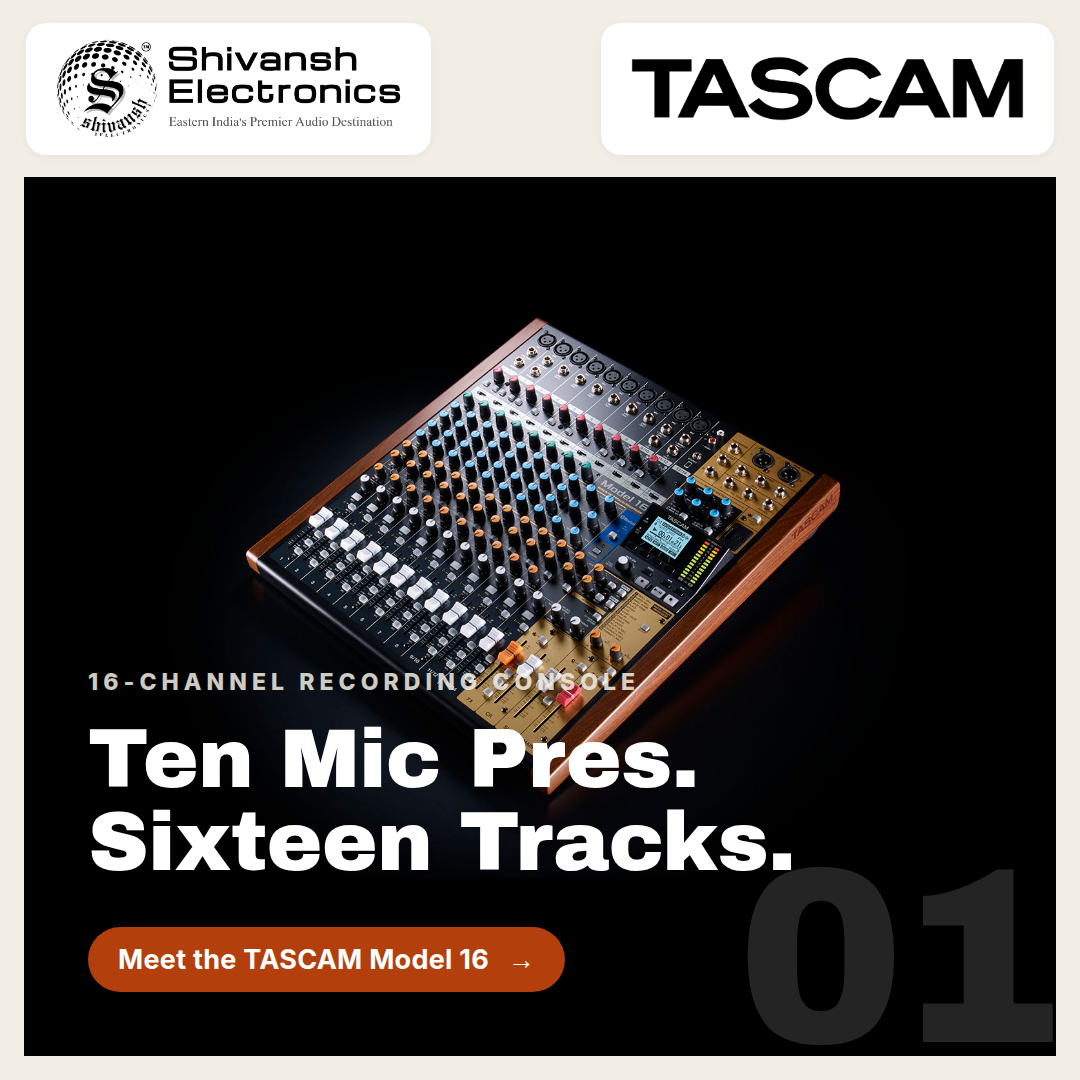
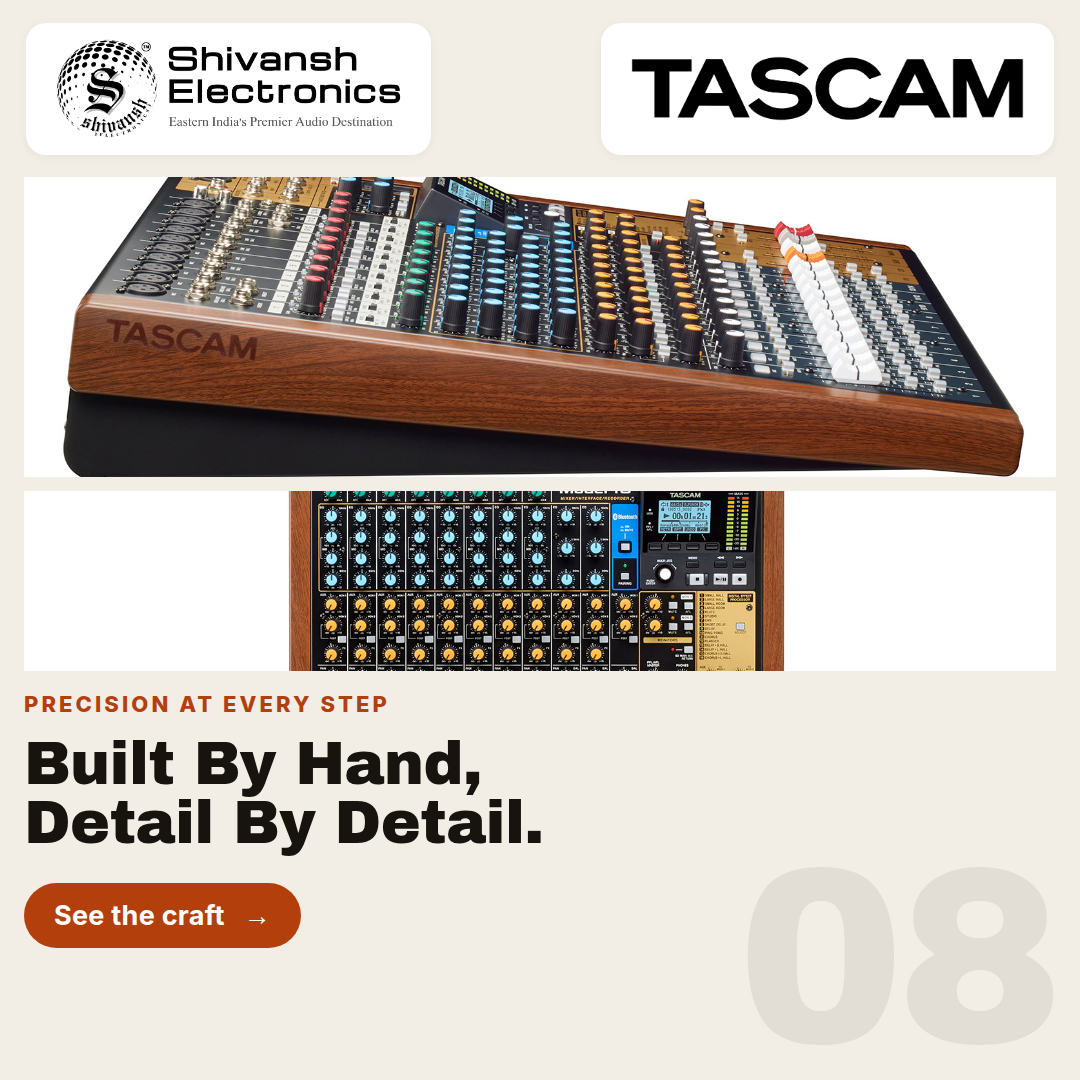
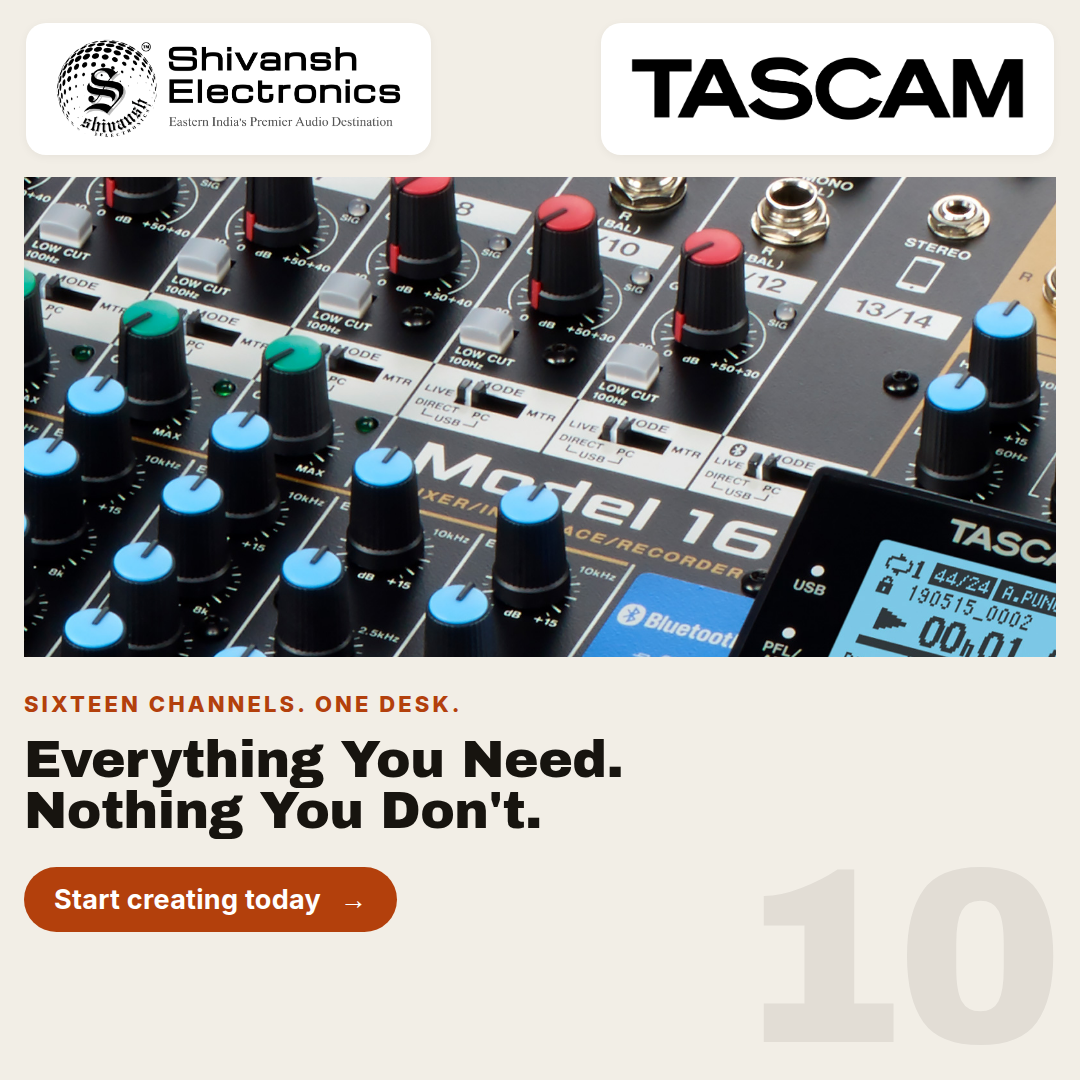
TASCAM MODEL 16
Category: Recording Mixers
16-channel hybrid mixer combining analog warmth with digital workflow — multitrack recorder, USB interface, and Bluetooth in one console.
PLEASE NOTE: Kindly contact us at +91 98316 62458 / +91 91477 00677 to confirm current availability and the best possible pricing (including any additional discount we may be able to offer) before making any payment.

GENERAL / FORM FACTOR
| SPECIFICATION | DETAILS |
|---|---|
| Product Type | Mid-format hybrid analogue mixer / 16-track digital multitrack recorder / USB audio interface |
| Dimensions | 430 mm (W) × 112.9 mm (H) × 463 mm (D) |
| Weight | 7.0 kg |
CHANNEL COUNT & I/O
| SPECIFICATION | DETAILS |
|---|---|
| Total Analog Inputs | 14 (10 mono mic/line, 2 stereo line) |
| Mic Inputs | 10 XLR (Ultra HDDA on Channels 1–8) |
| Instrument Inputs | 2 Hi-Z inputs (Channels 1 and 2) |
| Insert Points | Channels 1 and 2 (TRS Send/Return) |
| Auxiliary Inputs | Bluetooth 5.0 (A2DP), 3.5mm Stereo Mini, RCA |
| Outputs | Main L/R (XLR), Sub/Monitor/FX (TRS), Phones |
PREAMP SPECIFICATIONS
| SPECIFICATION | DETAILS |
|---|---|
| Gain Adjustable Range | 0 to 50 dB (Mic IN) |
| Maximum Input Level | +10 dBu (Mic IN) |
| Nominal Input Level | -8 dBu (Mic IN) |
| Input Impedance | 1.8 kΩ (Mic IN) |
CONVERTER SPECIFICATIONS
| SPECIFICATION | DETAILS |
|---|---|
| Sampling Rate | 44.1 kHz / 48 kHz |
| Bit Depth | 16-bit / 24-bit |
ONBOARD DSP & EQ
| SPECIFICATION | DETAILS |
|---|---|
| Channel EQ | 3-band with mid-sweep (100 Hz to 8 kHz variable) |
| Master EQ | 4-band sweepable EQ |
| Dynamics | 1-knob compressors (Channels 1–8) |
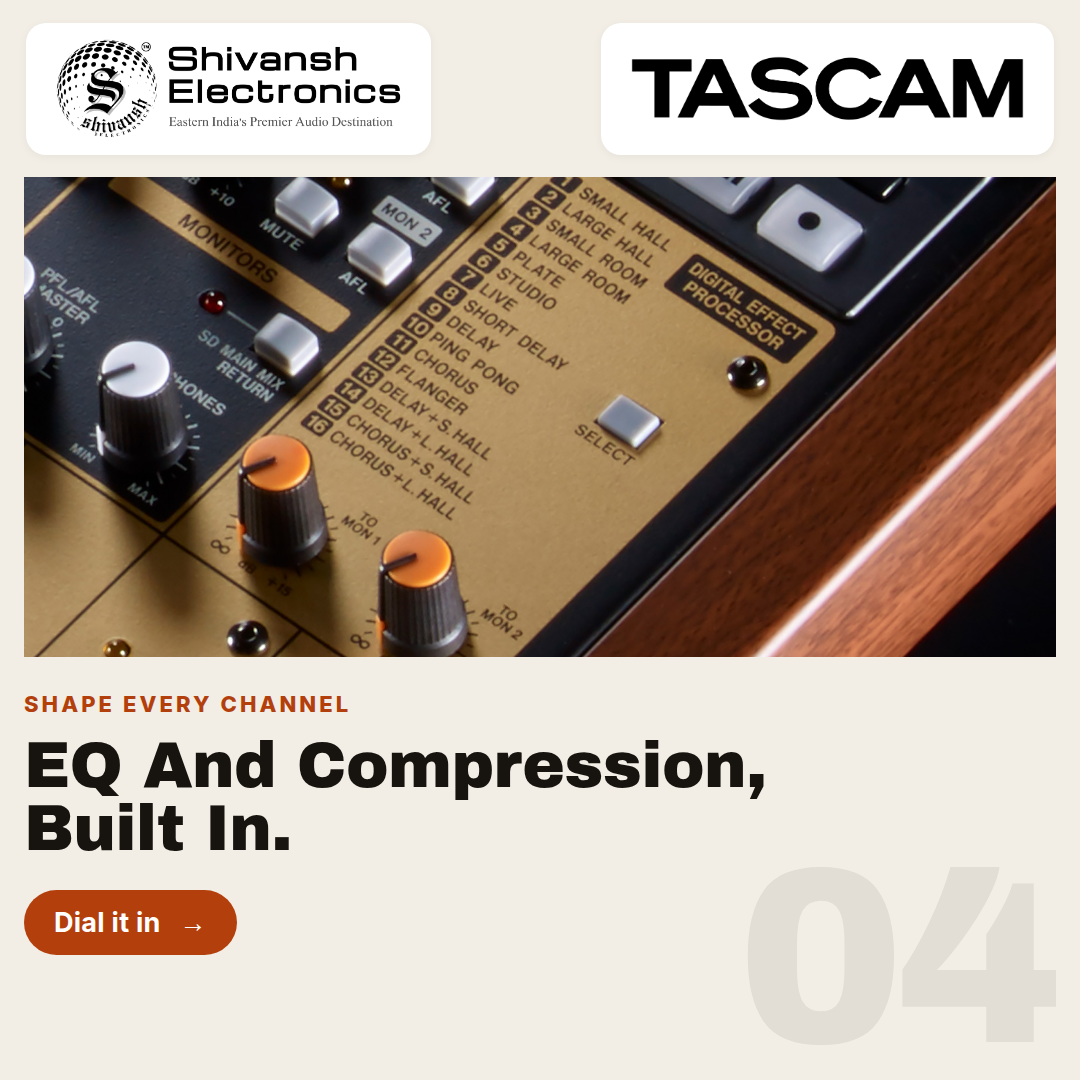
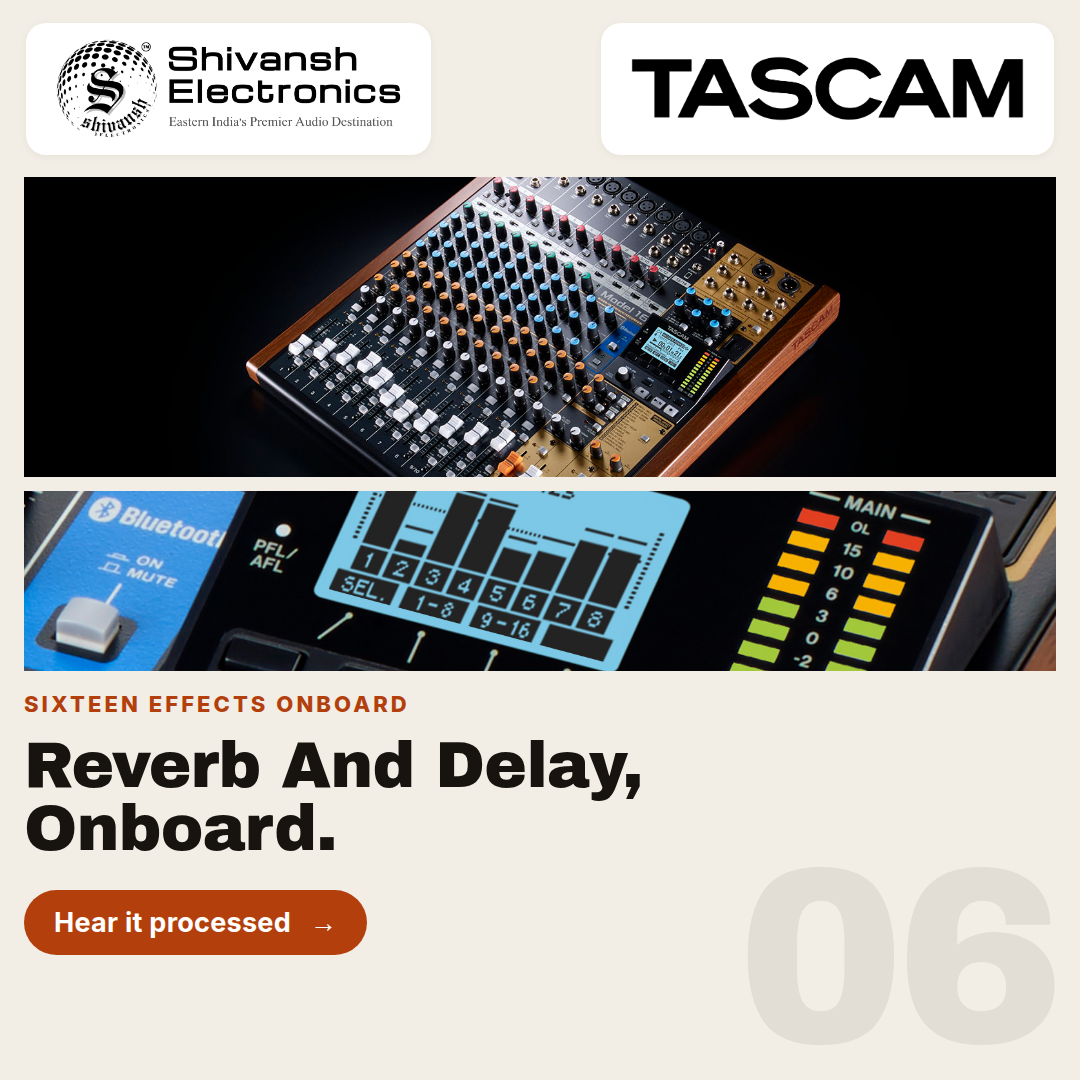
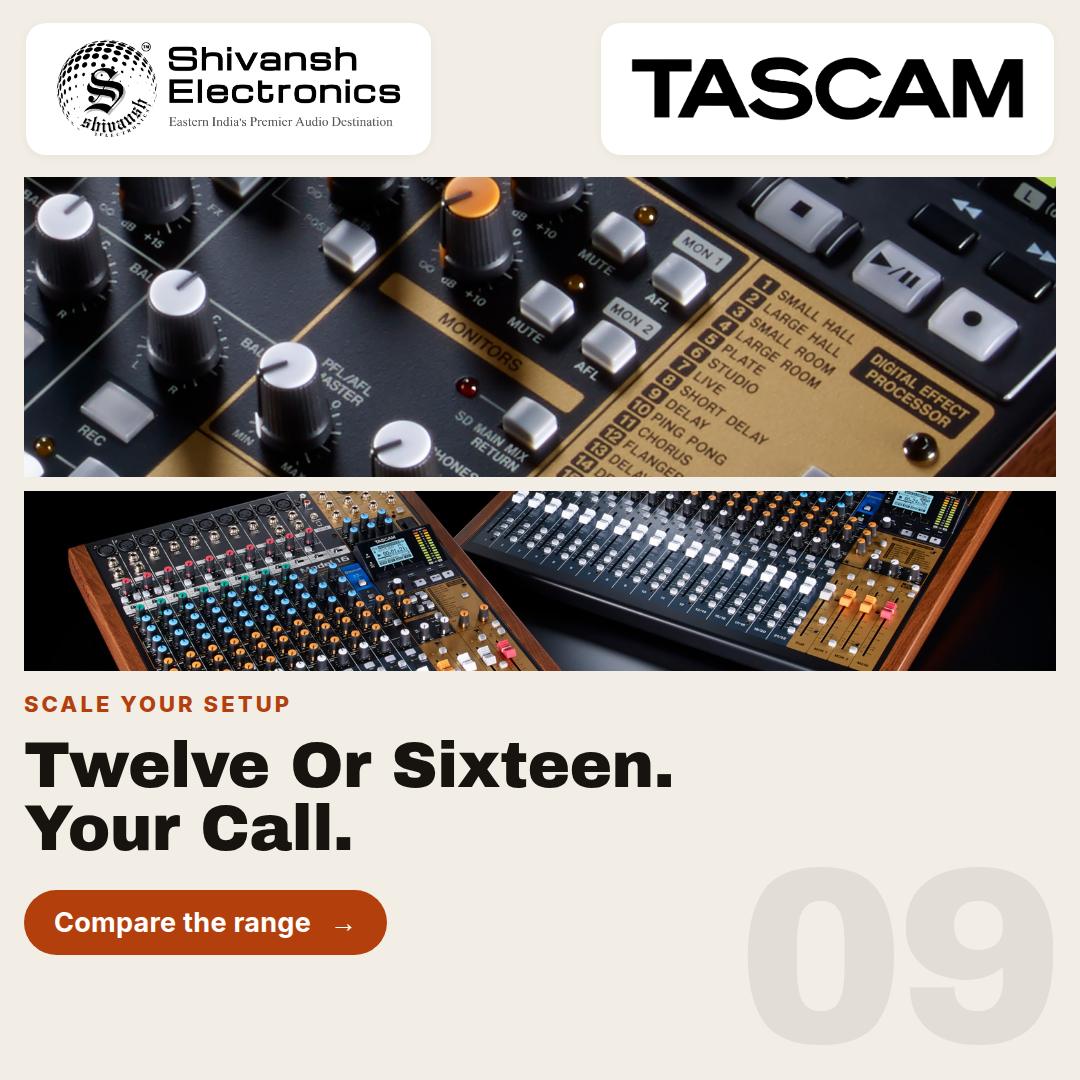
| Internal Effects | 16 editable multi-effects (Reverb, Delay, Chorus, Flange) |
RECORDING SPECIFICATIONS
| SPECIFICATION | DETAILS |
|---|---|
| Media Supported | SD, SDHC (FAT32), SDXC (exFAT) |
| Simultaneous Record | 16 tracks (14 inputs + 2 stereo mix) |
| Punch In/Out | Up to 8 tracks simultaneously |
DIGITAL AUDIO TRANSPORT
| SPECIFICATION | DETAILS |
|---|---|
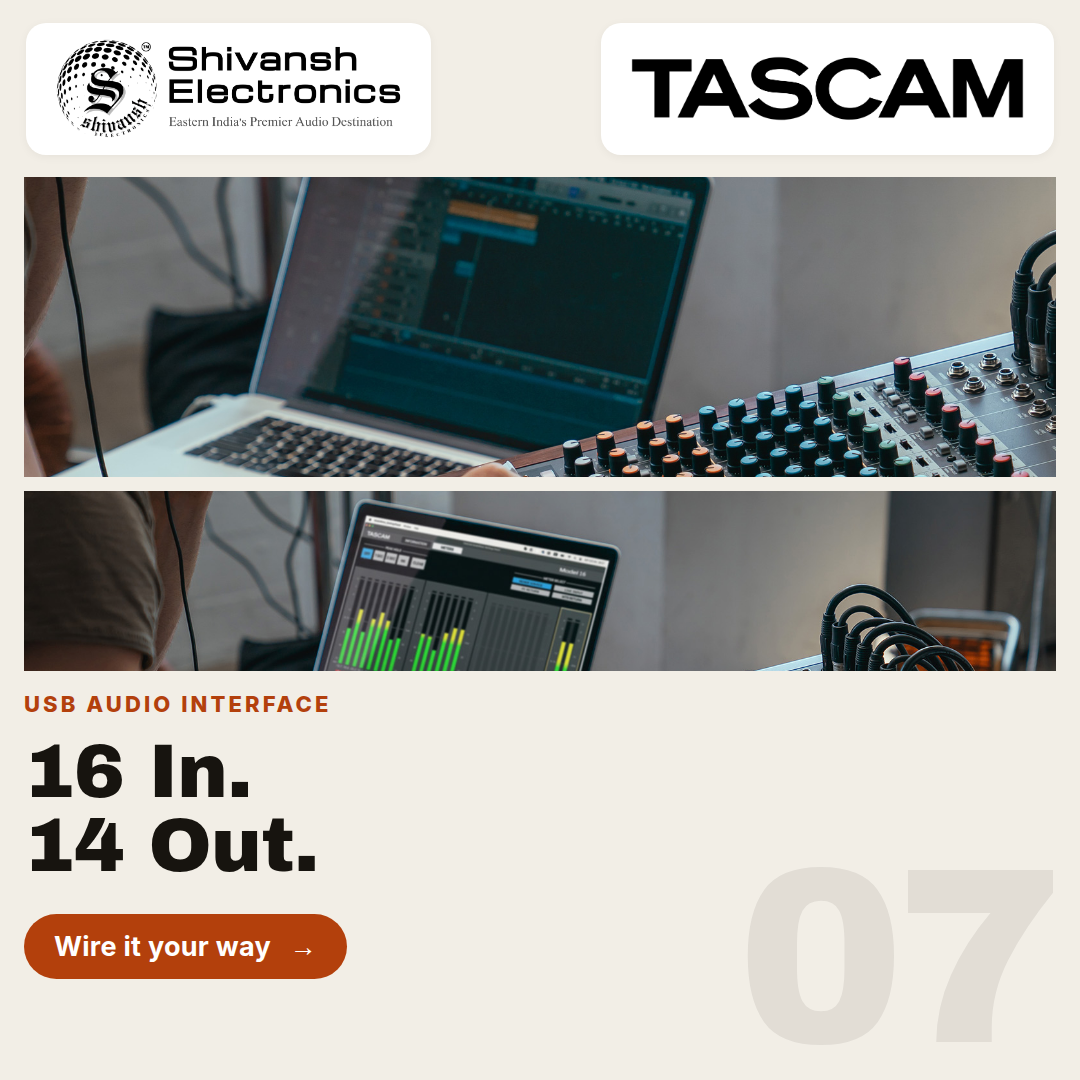
| USB Interface | 16-in / 14-out (USB 2.0 High-Speed, Audio Class 2.0) |
| Minimum Configurable Latency | 4-sample buffer (via TASCAM dedicated driver) |
| Per-Channel Mode Switch | LIVE / USB — routes USB returns through analogue EQ and faders for analogue summing |
1. PRODUCT OVERVIEW
The TASCAM Model 16 scales up the hybrid analogue-digital console concept of the Model series to accommodate a larger working band or ensemble, combining a 14-channel analogue mixer, a 16-track internal digital recorder, and a 16-in/14-out USB audio interface in a single desktop chassis. Designed for project studios, band rehearsal spaces, and small-to-medium live venues, the Model 16 makes a deliberate trade against its smaller sibling: it sets aside the Model 12's HUI/MCU DAW control features in favour of a deeper, more tactile analogue routing workflow and a substantially larger channel count.
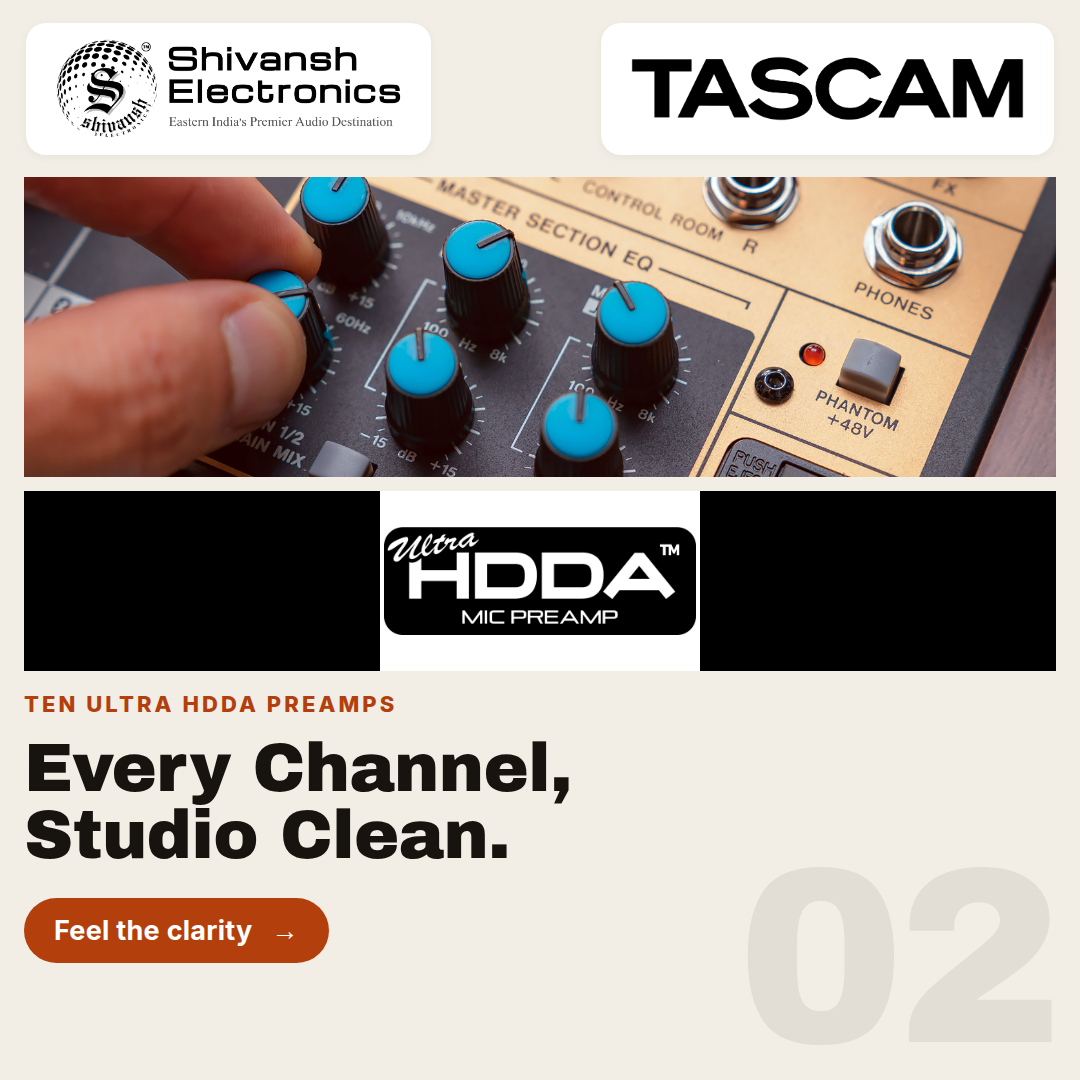
The preamplification stage is built around 10 Ultra HDDA microphone preamps — eight on Channels 1 through 8, plus two further stereo-paired preamps on Channels 9/10 and 11/12 — each characterised by very low noise and high transparency. Combined with the two stereo-paired TRS line inputs, the console's total input capacity reaches 14 analogue channels, giving a working band enough simultaneous inputs to track a full rehearsal or live set without submixing sources together before they reach the console.
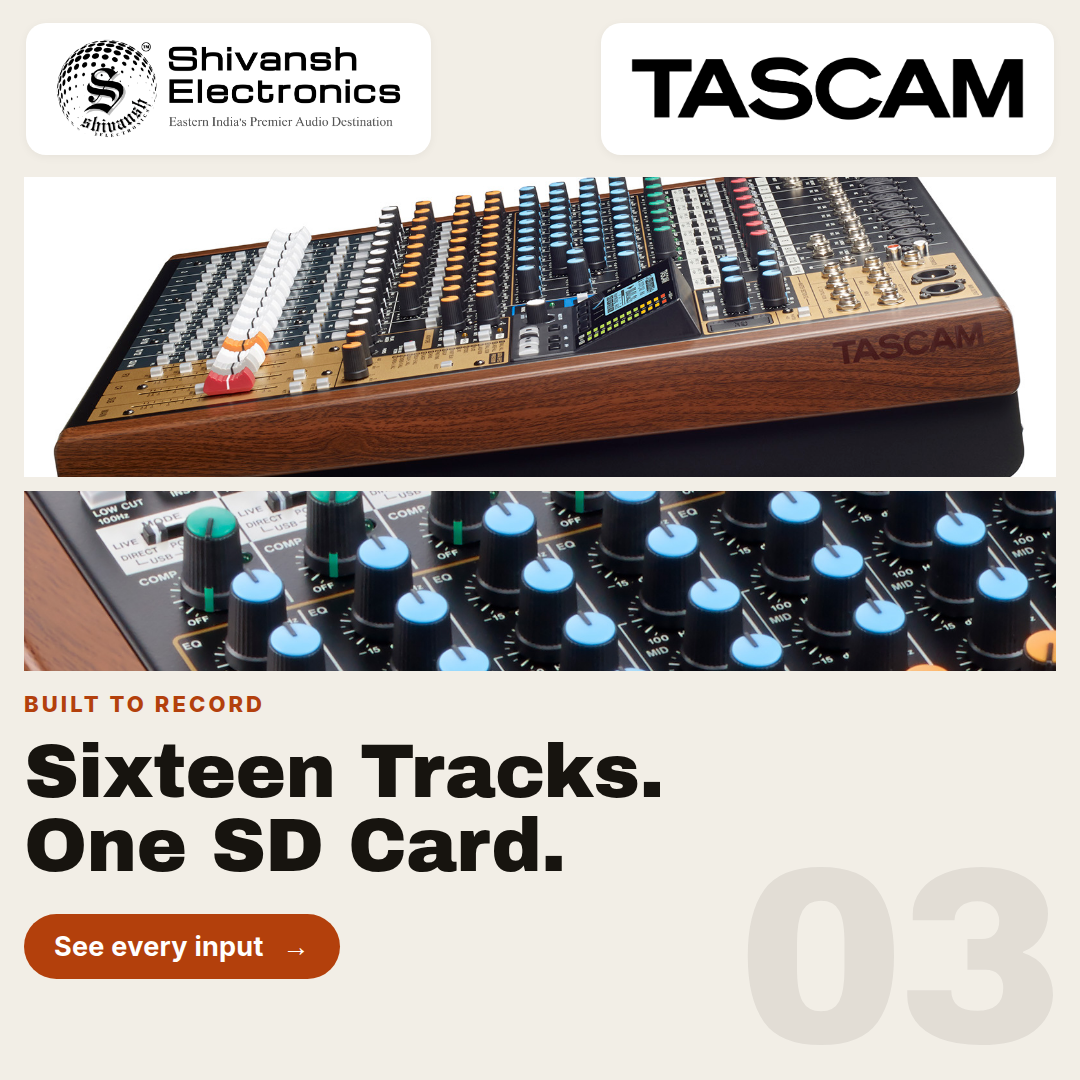
Where the Model 16 distinguishes itself most clearly is in its channel-strip processing, which is entirely analogue rather than DSP-emulated. The first eight channels carry intuitive one-knob compressors, and every channel offers a 3-band EQ with a sweepable mid-range for surgical frequency shaping — features aimed squarely at an engineer who wants to shape a mix by ear at the console rather than inside a plug-in window. This analogue processing sits ahead of a purely digital-transport back end: the internal SD card recorder captures 16 simultaneous tracks (the 14 discrete analogue inputs plus the main left/right stereo mix) directly to SDHC or SDXC media at a choice of 16-bit or 24-bit depth and 44.1 kHz or 48 kHz sample rates.
For studio integration, the Model 16's USB audio interface uses TASCAM's dedicated driver to achieve extremely low latency, configurable down to a 4-sample buffer, making it viable for real-time tracking directly into an external DAW. A per-channel Mode switch lets engineers route USB returns from a connected computer back through the console's analogue EQs and 100mm faders, enabling tactile analogue summing of digital stems — effectively turning the Model 16 into an analogue mixing surface for a DAW-based session whenever that workflow is preferred over mixing entirely in the box.
2. INPUT ARCHITECTURE & PREAMPLIFICATION
2.1 Ten Ultra HDDA Preamps Across 14 Analogue Inputs
The Model 16 provides 14 total analogue inputs: 10 monaural XLR/TRS balanced channels and two stereo-paired TRS balanced channels. Ten of these carry TASCAM's Ultra HDDA preamp circuit — eight independent mono preamps on Channels 1–8, plus the two stereo pairs on 9/10 and 11/12 — giving the console enough independently gain-staged inputs to mic a full drum kit and band without doubling sources onto a shared channel. Channels 1 and 2 additionally provide Hi-Z instrument inputs, so a bass or guitar can be plugged in directly, and the same two channels carry TRS insert send/return points for patching in outboard hardware processing ahead of the analogue-to-digital conversion stage.
Gain on the Ultra HDDA preamps is adjustable across a 0 to 50 dB range, with a maximum input level of +10 dBu and a nominal input level of -8 dBu at the mic input, and an input impedance of 1.8 kΩ. This gain range and impedance profile is tuned for a wide variety of live and studio microphones, from dynamic drum and guitar-amp mics through to condensers on vocals and overheads.
PREAMP AND CONVERTER SPECIFICATIONS
| SPECIFICATION | DETAILS |
|---|---|
| Gain Adjustable Range | 0 to 50 dB (Mic IN) |
| Maximum Input Level | +10 dBu (Mic IN) |
| Nominal Input Level | -8 dBu (Mic IN) |
| Input Impedance | 1.8 kΩ (Mic IN) |
| Sampling Rate | 44.1 kHz / 48 kHz |
| Bit Depth | 16-bit / 24-bit |
3. ANALOGUE CHANNEL PROCESSING
3.1 One-Knob Compressors and Sweepable 3-Band EQ
Every channel on the Model 16 offers a 3-band EQ with a sweepable mid-range, tunable from 100 Hz to 8 kHz, giving an engineer a genuinely surgical tool for finding and taming problem frequencies at the console rather than after the fact in software. The first eight channels add a one-knob compressor — a single-control dynamics processor designed for fast, intuitive gain control on sources like drums and vocals during a live set or a rehearsal capture, without requiring the engineer to dial in attack, release, ratio, and threshold individually under time pressure.
At the master bus level, a 4-band sweepable EQ shapes the overall mix, and an onboard bank of 16 editable multi-effects (reverb, delay, chorus, and flange) is available via a dedicated FX send bus, letting the console add polish to vocals or overall ambience without any outboard rack gear.
ONBOARD DSP AND EQ SPECIFICATIONS
| SPECIFICATION | DETAILS |
|---|---|
| Channel EQ | 3-band with mid-sweep (100 Hz to 8 kHz variable) |
| Master EQ | 4-band sweepable EQ |
| Dynamics | 1-knob compressors (Channels 1–8) |
| Internal Effects | 16 editable multi-effects (Reverb, Delay, Chorus, Flange) |
4. INTERNAL RECORDING, USB INTERFACE & ANALOGUE SUMMING
4.1 16-Track SD Recording and 4-Sample Buffer USB Latency
The internal SD card recorder writes 16 simultaneous tracks — the 14 discrete analogue inputs plus the main left/right stereo mix — directly to SDHC (FAT32) or SDXC (exFAT) media, and it supports punch-in and punch-out recording across up to 8 tracks simultaneously, a genuinely useful feature for overdub sessions where a band wants to redo a specific section without re-recording an entire take. On the digital transport side, the 16-in/14-out USB 2.0 High-Speed, Audio Class 2.0 interface uses TASCAM's dedicated driver to reach a latency figure configurable down to a 4-sample buffer, putting the Model 16 in genuinely low-latency territory for direct DAW tracking.
A per-channel Mode switch allows any of the 14 channels to be flipped between "LIVE" (accepting the physical analogue input) and "USB" (accepting a returning digital stem from the connected computer). This means an engineer can print a mix into a DAW, then route the individual stems back out through the console's own analogue EQ and compression on the way to the faders — analogue summing without needing a separate summing mixer.
RECORDING AND DIGITAL AUDIO TRANSPORT SPECIFICATIONS
| SPECIFICATION | DETAILS |
|---|---|
| Media Supported | SD, SDHC (FAT32), SDXC (exFAT) |
| Simultaneous Record | 16 tracks (14 inputs + 2 stereo mix) |
| Punch In/Out | Up to 8 tracks simultaneously |
| USB Interface | 16-in / 14-out (USB 2.0 High-Speed, Audio Class 2.0) |
5. AUXILIARY INPUTS & OUTPUTS
| SPECIFICATION | DETAILS |
|---|---|
| Auxiliary Inputs | Bluetooth 5.0 (A2DP), 3.5mm Stereo Mini, RCA |
| Outputs | Main L/R (XLR), Sub/Monitor/FX (TRS), Phones |
6. PHYSICAL FORM FACTOR
| SPECIFICATION | DETAILS |
|---|---|
| Product Type | Mid-format hybrid console mixer |
| Dimensions | 430 mm (W) × 112.9 mm (H) × 463 mm (D) |
| Weight | 7.0 kg |
7. IDEAL APPLICATIONS & USE CASES
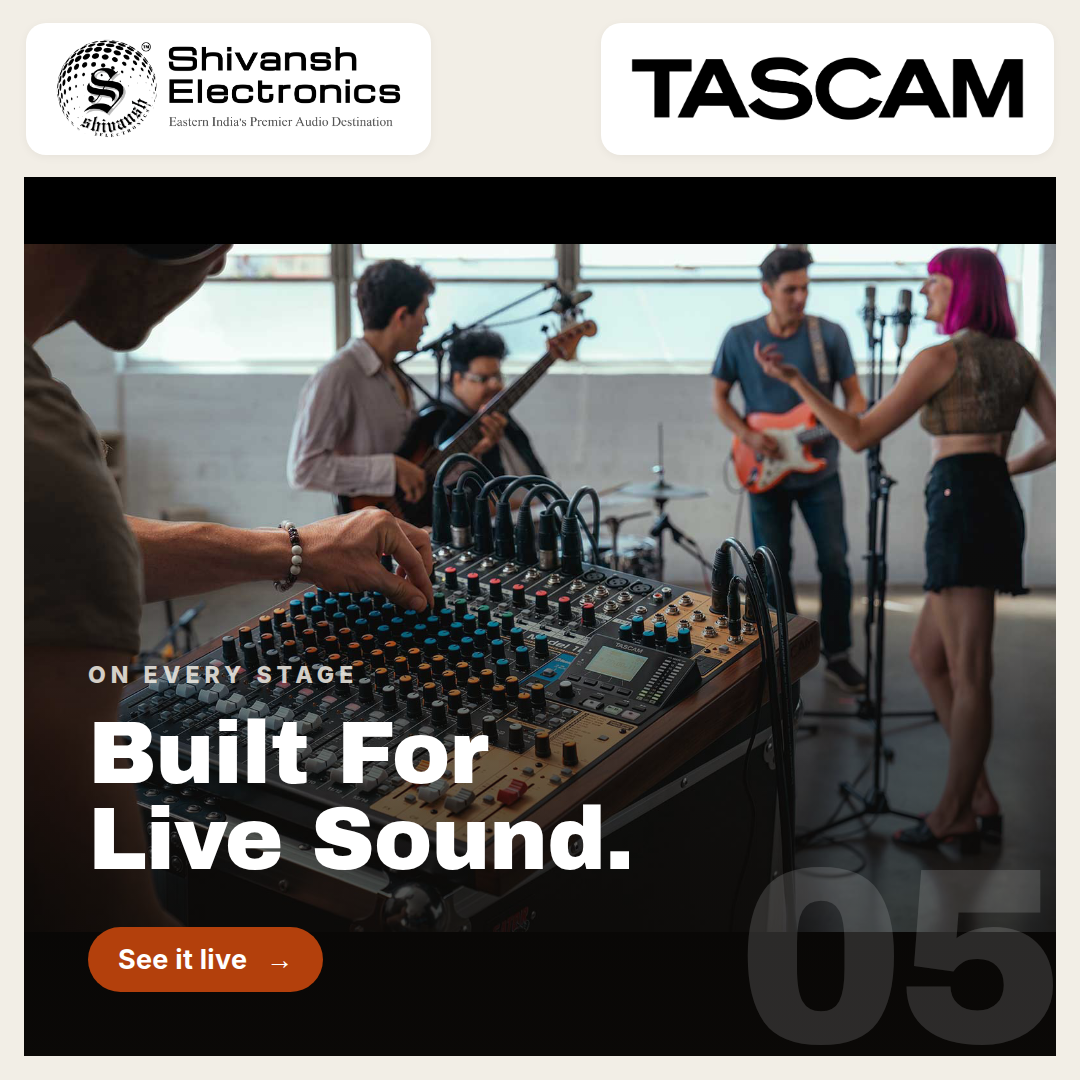
- Mid-Sized Band Rehearsal Capture: Ten mic preamps and two Hi-Z instrument inputs let drums, bass, and guitar all track live; 16-track SD recording provides fully DAWless multitrack capture
- Project Studio Analogue Summing: Per-channel Mode switch returns DAW stems through the analogue EQs and 100mm faders, glued together by the 4-band Master EQ
- House of Worship Live Sound: Integrated Bluetooth 5.0 for walk-in music; internal effects engine applies plate reverb to choir mics via the dedicated FX send bus
- Live Performance with Backing Tracks: Per-channel input selection between "LIVE" and "MTR" mixes live vocals and hardware synths with pre-recorded backing stems from the SD card
- Institutional Recording and Playback: Simple SD recording engine lets non-technical staff capture 24-bit audio safely without troubleshooting computer drivers
8. PRODUCT CONTEXT: MODEL 16 VS. SIBLING MODELS
The Model 16 sits directly between the Model 12 and the Model 24 in TASCAM's hybrid console range, and the trade-off it makes is deliberate: it sacrifices the Model 12's HUI/MCU DAW transport control to provide a substantially wider analogue footprint — 10 mic preamps and 14 analogue inputs against the Model 12's 8 preamps and 10 inputs — along with genuinely analogue channel processing (one-knob compressors, sweepable 3-band EQ) rather than the Model 12's more DAW-integration-focused feature set. Compared with the Model 24, the Model 16 offers a smaller footprint and lower channel count (16-track versus 24-track recording, 14 versus 22 analogue inputs) at a correspondingly smaller physical size and lower weight, making it the natural choice for a band or small venue that needs more inputs than the Model 12 provides but does not require the Model 24's full-band, large-ensemble I/O capacity.
HOW TO READ THIS DOCUMENT
This document is the operational companion to the TASCAM Model 16 Product Description and Technical Specifications document. Where the Specs document answers the question "what does the Model 16 do and how is it measured?", this document answers the question "how do I actually use it in a real production environment?" Each workflow below describes a concrete deployment scenario with physical setup, signal routing, and an explanation of which specific Model 16 features make that workflow efficient. The routing configuration summary table at the end of each section serves as a practical checklist for any operator setting up that scenario.
Two defining workflow advantages of the Model 16 appear repeatedly across the scenarios below. First, its analogue-first channel processing — one-knob compressors, sweepable 3-band EQ on every channel — means a band or engineer can shape a mix entirely by ear at the console, with no laptop or plug-in window required. Second, the per-channel LIVE/USB Mode switch means the Model 16 never locks an engineer into a single workflow: the same console that tracks a live rehearsal to SD card can, moments later, become an analogue summing mixer for stems returning from a DAW.
WORKFLOW 1 — MID-SIZED BAND REHEARSAL CAPTURE
Scenario: Five-Piece Rock Band Self-Recording a DAWless Rehearsal Demo
A five-piece rock band uses a rehearsal space equipped with the Model 16. The drum kit consumes six of the Ultra HDDA mic inputs, while bass and lead guitar plug directly into the Hi-Z instrument inputs on Channels 1 and 2, avoiding the need for separate DI boxes. The engineer leverages the one-knob compressors on the drum and vocal channels to tame dynamic transients aggressively before they reach the analogue-to-digital converters, keeping the recorded signal controlled without a rack of outboard compressors.
Without deploying a computer anywhere in the room, the band records a live 14-track multitrack demo directly to an SDXC card. The genuine value in this deployment is the 16-track simultaneous SD recording capability, which provides high-fidelity, fully isolated capture in a completely DAWless environment — the band can review the rehearsal on headphones immediately, or hand the card to a mixing engineer afterward with every source still separated.
Routing and Configuration Summary
| WORKFLOW ELEMENT | DETAILS / CONFIGURATION |
|---|---|
| Drum Kit | 6 Ultra HDDA mic channels |
| Bass / Lead Guitar | Direct into Hi-Z instrument inputs, Channels 1 and 2 |
| Dynamics Control | One-knob compressors on drum and vocal channels |
| Recording Path | 14-track multitrack demo direct to SDXC card, no computer |
| Sample Rate | 48 kHz / 24-bit |
WORKFLOW 2 — PROJECT STUDIO ANALOGUE SUMMING
Scenario: Returning DAW Stems Through the Console's Analogue EQ and Faders
A recording engineer tracks a full project into a DAW via the 16-in/14-out USB connection. During the final mixdown phase, the engineer switches the input mode on 14 channels to "USB," returning the digital stems from the computer back into the analogue domain rather than mixing entirely inside the software. The mix is then sculpted using the analogue 3-band EQs and tactile 100mm faders, with everything glued together by the master bus's 4-band Master EQ. The final analogue-summed stereo mix is printed back into the DAW, injecting analogue headroom and hands-on workflow into an otherwise fully digital production.
Routing and Configuration Summary
| WORKFLOW ELEMENT | DETAILS / CONFIGURATION |
|---|---|
| Tracking Stage | Full session tracked into DAW via 16-in/14-out USB |
| Mode Switch | 14 channels set to "USB" for stem return |
| Mix Sculpting | Analogue 3-band EQ + 100mm faders per stem |
| Bus Processing | 4-band sweepable Master EQ across the summed mix |
| Final Delivery | Analogue-summed stereo mix printed back into the DAW |
WORKFLOW 3 — HOUSE OF WORSHIP LIVE SOUND
Scenario: Sunday Service with Bluetooth Walk-In Music and Internal Reverb on Choir Mics
A medium-sized church deploys the Model 16 as its Front-of-House console. The praise band occupies the mic and line inputs. Prior to the service, the audio operator streams walk-in music from a tablet directly to the console via the integrated Bluetooth 5.0 connection, avoiding the need for a separate playback device patched into a spare channel. During the service, the operator uses the internal effects engine to apply a digital plate reverb to the choir microphones, sending it via the dedicated FX send bus to process the vocals without requiring any outboard rack unit.
Routing and Configuration Summary
| WORKFLOW ELEMENT | DETAILS / CONFIGURATION |
|---|---|
| Praise Band | Mic and line inputs across the analogue channels |
| Walk-In Music | Bluetooth 5.0 (A2DP) from a tablet or phone |
| Choir Vocal FX | Internal plate reverb via dedicated FX send bus |
| Outboard Gear Required | None — effects handled onboard |
WORKFLOW 4 — LIVE PERFORMANCE WITH BACKING TRACKS
Scenario: Electronic Pop Duo Mixing Live Vocals Against SD-Card Backing Stems
An electronic pop duo performs live on stage using the Model 16 as its mixing console. Several channels are set to "LIVE" to accept live vocal microphones and hardware synthesizers, while other channels are concurrently set to "MTR" to play back pre-recorded rhythmic backing stems directly from the internal SD card. This per-channel input selection allows a genuinely hybrid performance — combining live analogue inputs and digital stems — to be mixed simultaneously for the house PA system, entirely bypassing the risk of a laptop crash mid-set.
Routing and Configuration Summary
| WORKFLOW ELEMENT | DETAILS / CONFIGURATION |
|---|---|
| Live Channels | Vocal mics and hardware synths, Mode set to "LIVE" |
| Backing Track Channels | Mode set to "MTR" for SD card playback |
| Reliability Benefit | No laptop on stage — eliminates crash risk during a live set |
| Output | Combined live/stem mix to house PA via Main L/R XLR |
WORKFLOW 5 — INSTITUTIONAL RECORDING AND PLAYBACK
Scenario: University Recital Hall Recording and Critiquing Student Performances
A university music department permanently installs the Model 16 in a recital hall. Staff members record student performances directly to SD cards. For playback and critique, the instructor uses the per-channel routing to send the recorded stems back through the board, soloing individual instruments to analyse student technique in detail. The simplicity of the SD recording engine allows non-technical staff to capture 24-bit audio safely without troubleshooting computer drivers, which matters in an institutional setting where the operator changes from week to week.
Routing and Configuration Summary
| WORKFLOW ELEMENT | DETAILS / CONFIGURATION |
|---|---|
| Recording Setup | Student performances recorded to SD card, 24-bit |
| Playback/Critique | Per-channel routing solos individual instruments from recorded stems |
| Operator Profile | Non-technical staff, rotating weekly |
| Reliability Benefit | No computer driver troubleshooting required for basic capture |
WORKFLOW 6 — PODCAST NETWORK WITH SUBMIXED CO-HOSTS
Scenario: Four-Host Roundtable Show Using Sub Groups for Grouped Level Control
A podcast network running a four-host roundtable show uses four of the Model 16's mic channels for the hosts, each independently gain-staged on its own Ultra HDDA preamp and shaped with the per-channel sweepable 3-band EQ to compensate for different microphone types across the desk. The producer routes the four host channels to the Sub bus, allowing a single fader move to duck or raise the whole panel relative to a musical sting or an inserted pre-recorded segment, without touching each host's individual level. The full session records to SD card as a 16-track multitrack file, giving the edit team complete isolation on every host's channel during post-production cleanup.
Routing and Configuration Summary
| WORKFLOW ELEMENT | DETAILS / CONFIGURATION |
|---|---|
| Host Channels | 4 independent Ultra HDDA mic channels |
| Per-Channel EQ | Sweepable 3-band EQ tuned per microphone type |
| Group Control | Host channels routed to Sub bus for grouped fader control |
| Recording Path | 16-track multitrack to SD card for full post-production isolation |
WORKFLOW 7 — OVERDUB SESSION WITH PUNCH-IN CORRECTION
Scenario: Fixing a Guitar Solo Section Without Re-Tracking the Full Take
A guitarist tracking overdubs on the Model 16 needs to fix a single flubbed phrase partway through an otherwise strong solo take. Rather than re-recording the entire performance, the engineer uses the console's punch in/out capability, which supports up to 8 simultaneous tracks, to drop into record at the exact bar where the mistake occurs and drop back out cleanly once the phrase is fixed, seamlessly splicing the correction into the existing take on the SD card. Because the guitar is already patched into the Hi-Z instrument input on Channel 1, no re-patching is needed between takes.
Routing and Configuration Summary
| WORKFLOW ELEMENT | DETAILS / CONFIGURATION |
|---|---|
| Guitar Input | Hi-Z instrument input, Channel 1 |
| Correction Method | Punch in/out on the affected track (up to 8 tracks supported simultaneously) |
| Session Continuity | Correction spliced into the existing SD card take, no re-patching required |
WORKFLOW 8 — LOW-LATENCY DIRECT TRACKING INTO A DAW
Scenario: Vocalist Tracking with Real-Time Analogue Monitoring, Zero Perceptible Delay
A vocalist tracking directly into a DAW through the Model 16's USB interface needs to hear their own voice back in real time without the disorienting delay that plagues many USB interfaces at default buffer settings. Using TASCAM's dedicated driver, the engineer configures the USB buffer down to 4 samples, minimising the round-trip latency between the microphone input and the vocalist's headphone monitor mix, so the vocalist can track a genuinely felt, in-the-pocket vocal performance rather than fighting a delayed monitor signal.
Routing and Configuration Summary
| WORKFLOW ELEMENT | DETAILS / CONFIGURATION |
|---|---|
| Driver | TASCAM dedicated low-latency driver |
| Buffer Configuration | Configurable down to a 4-sample buffer |
| Monitoring Path | Headphone output fed from the vocalist's own console monitor mix |
| Connection | 16-in/14-out USB 2.0 Audio Class 2.0 to host DAW |
WORKFLOW 9 — CORPORATE EVENT AND CONFERENCE AUDIO
Scenario: Panel Discussion with Multiple Presenter Mics and a Music-Bed Playback
An AV contractor runs sound for a corporate panel discussion using the Model 16 as the front-of-house console. Four to six presenter microphones are patched into the mic channels, each independently gain-staged so a soft-spoken panellist and a loud moderator both sit at a consistent level in the room mix. Intro and transition music is streamed via Bluetooth 5.0 from a laptop, and the operator uses the console's RCA input to bring in a wired backup playback source in case the wireless connection drops mid-event. The full panel audio is recorded to SD card as a safety archive in case the client requests a highlight reel afterward.
Routing and Configuration Summary
| WORKFLOW ELEMENT | DETAILS / CONFIGURATION |
|---|---|
| Presenter Mics | 4–6 mic channels, independently gain-staged |
| Music Playback | Bluetooth 5.0 primary, RCA input as wired backup |
| Safety Archive | Full panel recorded to SD card for post-event highlight reel |
WORKFLOW 10 — SMALL VENUE MONITOR AND FOH SPLIT
Scenario: One Console Handling Both House Mix and a Musician's Monitor Feed
A small venue without a separate monitor console uses the Model 16's Sub/Monitor/FX output bus to build an independent monitor mix for the stage while the Main L/R output feeds the house PA. The engineer applies the one-knob compressor to the lead vocal channel to keep it controlled in both the house mix and the monitor send, and uses the sweepable mid EQ on the monitor bus to notch out a specific frequency causing feedback from the stage wedge — a level of tone-shaping control on the monitor path that a simpler mixer without sweepable EQ would not offer.
Routing and Configuration Summary
| WORKFLOW ELEMENT | DETAILS / CONFIGURATION |
|---|---|
| House Mix | Main L/R (XLR) → house PA |
| Monitor Mix | Sub/Monitor/FX bus (TRS) → stage wedge |
| Feedback Control | Sweepable mid EQ (100 Hz–8 kHz) notching the monitor bus |
| Lead Vocal Dynamics | One-knob compressor engaged for both house and monitor sends |
FEATURE-TO-WORKFLOW CROSS-REFERENCE MATRIX
The following table maps every major feature of the TASCAM Model 16 to the workflow categories where that feature provides the most direct operational advantage. Anyone evaluating the Model 16 for a specific deployment scenario can use this table as a quick reference to confirm the unit's capabilities match their requirements.
| FEATURE | RELEVANT WORKFLOWS |
|---|---|
| Ten Ultra HDDA mic preamps, 14 total analogue inputs | Wf1 (Band Rehearsal), Wf6 (Podcast Roundtable), Wf9 (Corporate Event), Wf10 (Small Venue FOH) |
| One-knob compressors (Channels 1–8) | Wf1 (Band Rehearsal), Wf10 (Small Venue FOH) |
| Sweepable 3-band channel EQ (100 Hz–8 kHz) | Wf6 (Podcast Roundtable), Wf10 (Small Venue FOH — feedback control) |
| Per-channel LIVE/USB Mode switch | Wf2 (Analogue Summing — exclusively) |
| Per-channel LIVE/MTR selection | Wf4 (Live Performance with Backing Tracks — exclusively) |
| Bluetooth 5.0 (A2DP) | Wf3 (House of Worship), Wf9 (Corporate Event) |
| 16 internal multi-effects + FX send bus | Wf3 (House of Worship — choir reverb, exclusively) |
| Punch in/out (up to 8 tracks) | Wf7 (Overdub Session — exclusively) |
| 4-sample buffer USB latency | Wf8 (Low-Latency DAW Tracking — exclusively) |
| 16-track internal SD recorder | All workflows; foundational to every scenario above |
| Sub/Monitor/FX independent output bus | Wf10 (Small Venue Monitor/FOH Split — exclusively) |