


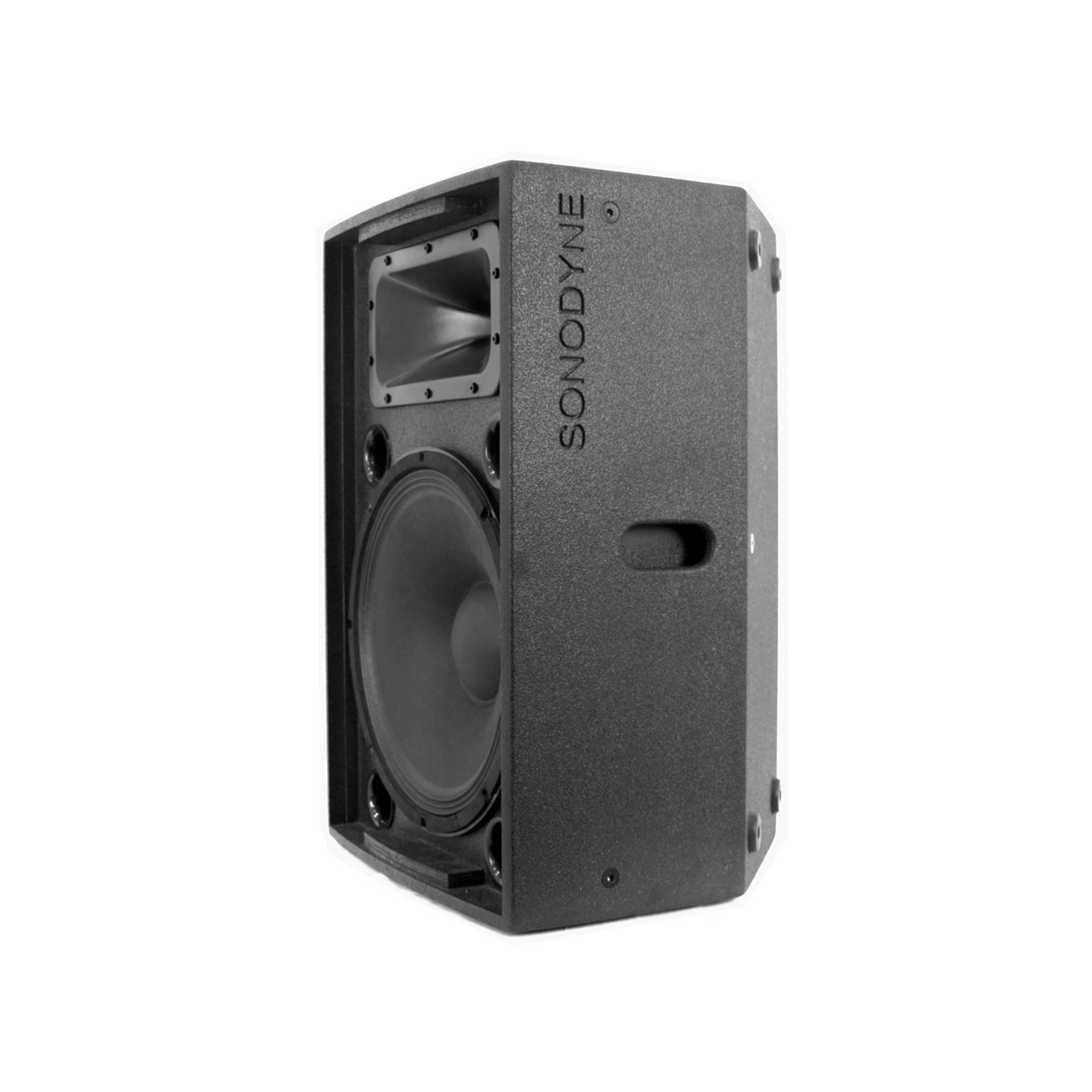
Brand: Sonodyne
Sonodyne SLX 1150
Category: Loudspeaker Systems
GENERAL CLASSIFICATION
| SPECIFICATION | DETAILS |
|---|---|
| Product Name | Sonodyne SLX 1150 |
| Brand | SONODYNE |
| Series | SLX Series — High Power Speakers: Wooden |
| Description | Passive 2-Way 15-Inch Bass-Reflex Loudspeaker |
| Product Type | Full-Range Professional PA Speaker / Stage Monitor |
| Amplification | Passive (Unpowered) — Requires External Power Amplifier |
| Enclosure Type | Bass-Reflex (Ported) |
| Manufacturer | Sonodyne Industries Ltd., Kolkata, India |
| Authorised Distributor (Eastern India) | Shivansh Electronics, Kolkata |
TRANSDUCER SPECIFICATIONS
| SPECIFICATION | DETAILS |
|---|---|
| LF Driver Size | 15 inches (381 mm) |
| LF Voice Coil Diameter | 3 inches (76 mm) |
| LF Driver Type | High-Excursion Cone Driver |
| HF Driver Type | 1-Inch HLCD (Horn-Loaded Compression Driver) |
| HF Voice Coil Diameter | 2 inches (50 mm) |
| HF Horn / Waveguide | Custom Constant-Directivity Waveguide |
| HF Directivity (H × V) | 90° × 50° |
| Driver Configuration | 2-Way (Single LF + Single HF) |
| Crossover Architecture | Passive (Internal) — Single Full-Range Input |
ACOUSTIC PERFORMANCE
| SPECIFICATION | DETAILS |
|---|---|
| Sensitivity (1W/1m) | 96 dB SPL |
| Frequency Range (–10 dB) | 40 Hz – 22 kHz |
| Maximum SPL — Continuous | 124 dB |
| Maximum SPL — Peak | 130 dB |
| HF Directivity (H × V) | 90° × 50° |
| Measurement Standard | Manufacturer published (IEC-compliant test conditions) |
| Calculated Continuous SPL (Verification) | 96 + 10·log₁₀(600) = 123.78 dB ≈ 124 dB ✓ |
| Calculated Peak SPL (Verification) | 96 + 10·log₁₀(2400) = 129.80 dB ≈ 130 dB ✓ |
POWER HANDLING
| SPECIFICATION | DETAILS |
|---|---|
| Continuous Power Handling | 600 Watts |
| Program Power Handling | 1200 Watts (2× Continuous) |
| Peak Power Handling | 2400 Watts (4× Continuous) |
| Nominal Impedance | 8 Ω |
| Minimum Impedance | Not specified by manufacturer |
| Amplifier Recommendations | Professional PA power amplifier, stable at 8 Ω; system processor with SLX 1150 preset recommended |
ENCLOSURE AND CABINET CONSTRUCTION
| SPECIFICATION | DETAILS |
|---|---|
| Enclosure Material | Plywood |
| Internal Bracing | Heavy internal bracing (manufacturer specified) |
| Enclosure Shape | Wedge, with one 45° angled face |
| Enclosure Type | Bass-Reflex (Ported) |
| External Finish | Durable stipple paint — multiple coats |
| Grille | Powder-coated perforated steel |
| Grille Attachment | Not specified by manufacturer (standard removable) |
PHYSICAL SPECIFICATIONS
| SPECIFICATION | DETAILS |
|---|---|
| Dimensions (H × W × D) | 685 mm × 435 mm × 458 mm |
| Weight | 23 kg |
| Enclosure Profile | Wedge — dual-use (PA upright / floor monitor wedge) |
CONNECTIVITY
| SPECIFICATION | DETAILS |
|---|---|
| Input Connector | 1 × Twist-Lock (Speakon-type) — Signal Input |
| Link Connector | 1 × Twist-Lock (Speakon-type) — Parallel Link / Daisy-Chain |
| Total Connectors | 2 × Twist-Lock connectors |
| Input Signal Type | Full-Range Amplified Speaker-Level Signal |
| Wiring Pin Assignment | Standard Speakon NL4 — Pin 1+/1– (typical) |
MOUNTING AND RIGGING
| SPECIFICATION | DETAILS |
|---|---|
| Pole Mount Cup Diameter | 35.5 mm (Standard M20 Speaker Pole Compatible) |
| Suspension / Flying Points | 15 × M10 Threaded Inserts |
| Wall Mount Inserts | 4 × M10 Threaded Inserts |
| Stack Configuration | Suitable for ground-stacking (wedge geometry provides stable base) |
| Flying / Rigging | Manufacturer provides M10 suspension points — consult qualified rigging engineer for rated working load per point |
SLX FULL-RANGE SERIES COMPARISON — SLX 1150 IN CONTEXT
| SPECIFICATION | DETAILS |
|---|---|
| SLX 1008 (8-inch) | 92 dB · 100W Cont. · 112 dB Cont. SPL · 11.7 kg |
| SLX 1010 (10-inch) | 94 dB · 200W Cont. · 117 dB Cont. SPL · 14.5 kg |
| SLX 1120 (12-inch) | 95 dB · 400W Cont. · 121 dB Cont. SPL · 17.3 kg |
| SLX 1150 (15-inch) ← THIS MODEL | 96 dB · 600W Cont. · 124 dB Cont. SPL · 23 kg |
| SLX 1152 (2 × 15-inch) | 99 dB · 1200W Cont. · 130 dB Cont. SPL · 56 kg |
| SLX 1252 (3-way 2 × 15-inch) | 100 dB · 1500W Cont. · 132 dB Cont. SPL · 68 kg |
RECOMMENDED SLX SUBWOOFER SYSTEM PARTNERS
| SPECIFICATION | DETAILS |
|---|---|
| SLX 2050 (15-inch Sub) | 99 dB · 400W Cont. · 125 dB Cont. SPL · 30 kg · Crossover: 80–120 Hz |
| SLX 2080 (18-inch Sub) | 97 dB · 800W Cont. · 126 dB Cont. SPL · 42.5 kg · Crossover: 80–120 Hz |
| SLX 2180 (18-inch Sub) | 97 dB · 1300W Cont. · 128 dB Cont. SPL · 51 kg · Crossover: 80–120 Hz |
| SLX 2182 (Dual 18-inch Sub) | 100 dB · 2600W Cont. · 134 dB Cont. SPL · 92 kg · Crossover: 80–120 Hz |
| SLX 2280 (18-inch Horn Sub) | 100 dB · 1300W Cont. · 131 dB Cont. SPL · 64 kg · Crossover: 80–120 Hz |
| Subsonic Filter Recommendation (all subs) | 35 Hz, 24 dB/octave high-pass |
1. PRODUCT OVERVIEW
The Sonodyne SLX 1150 is a high-power, passive two-way bass-reflex loudspeaker built around a 15-inch low-frequency driver and a 1-inch high-frequency HLCD (Horn-Loaded Compression Driver) transducer. It sits at the heart of Sonodyne's SLX Series — a range of engineered professional loudspeakers designed for balanced sound reproduction and high SPL performance across both indoor and outdoor applications. The SLX 1150 is the single-woofer, single-horn full-range workhorse of the line, positioned above the 12-inch SLX 1120 and below the dual-15 SLX 1152, making it the most versatile general-purpose cabinet in the range.
The SLX Series was conceived around a clear engineering mandate: high SPL, extended frequency range, and road-ready durability at a professional price point appropriate for the Indian and South Asian live sound market. Sonodyne, headquartered in Kolkata and manufacturing in India since 1971, brings an understanding of sub-continental performance conditions — high ambient temperatures, demanding outdoor SPL requirements, power grid variability, and the physical rigours of the Indian touring circuit — directly into every design decision. The SLX 1150 is the embodiment of that philosophy: a speaker that can be driven hard, packed down fast, and deployed repeatedly without degradation.
The SLX 1150's defining characteristics include a high-excursion 15-inch LF driver with a large 3-inch voice coil, enabling the 600W continuous / 2400W peak power handling that delivers sustained 124 dB SPL in continuous operation. The 1-inch HLCD HF driver is mated to a custom constant-directivity waveguide that ensures a smooth, predictable 90° horizontal × 50° vertical coverage pattern — the same pattern maintained consistently across the entire SLX series, simplifying system-level directivity management when cabinets are deployed in multi-cabinet clusters or flown arrays. The cabinet is manufactured from plywood, internally braced, and finished in multiple coats of durable stipple paint, while the powder-coated perforated steel grille provides mechanical protection for the transducers without meaningfully impeding high-frequency diffraction.
The enclosure adopts a wedge profile with a 45-degree angled face, making the SLX 1150 deployable both as a front-of-house PA cabinet on a standard 35.5mm pole and as a stage floor monitor wedge. Fifteen M10 suspension points and four M10 wall-mount inserts allow permanent rigging in fixed-installation environments. This dual-purpose mechanical design, combined with the speaker's broad frequency range of 40 Hz to 22 kHz (–10 dB), means a single cabinet model can fill FOH, sidefill, and monitoring roles — a significant logistical and financial advantage for rental companies and venue operators alike.
2. TRANSDUCER ARCHITECTURE
2.1 Low-Frequency Driver: 15-Inch High-Excursion Woofer
The LF section employs a custom-engineered 15-inch cone driver with a 3-inch (76 mm) voice coil. The voice coil diameter is a critical specification: at 3 inches, it is materially larger than the 2-inch and 2.5-inch voice coils used in the SLX 1120 (12-inch) and SLX 1010 (10-inch) siblings. A larger voice coil winding provides a proportionally larger surface area for heat dissipation — power handling in a dynamic driver is ultimately limited by the thermal capacity of the voice coil former and the gap into which it operates. The 3-inch coil, combined with adequate former material (likely aluminium for thermal conductivity), enables the 600W continuous rating that Sonodyne publishes.
The driver is characterised as 'high excursion,' meaning the suspension system — surround and spider — is designed to allow a larger linear travel (Xmax) than a standard PA driver of equivalent cone diameter. Higher Xmax is the mechanism that extends the lower frequency limit; at 40 Hz (–10 dB), the SLX 1150 moves air at a cone displacement substantially greater than a 15-inch driver with a conventional suspension. The bass-reflex enclosure augments this by allowing the rear wave of the cone to contribute acoustically through the tuned port, adding bass extension and output below the driver's free-air resonance without the excursion penalty that a sealed enclosure would impose at the same SPL. The cabinet is designed for bi-amplification from an external amplifier and DSP processor, with the crossover between LF and HF implemented externally — Sonodyne specifies the crossover point details in their DSP presets for recommended processors.
2.2 High-Frequency Driver: 1-Inch HLCD with 2-Inch Voice Coil
The HF section uses a 1-inch (nominal exit diameter) Horn-Loaded Compression Driver with a 2-inch (50 mm) voice coil. Despite the nominal 1-inch designation — which refers to the compression driver's throat exit diameter — the 2-inch voice coil is the specification that governs both power handling and thermal performance of this component. A 2-inch compression driver voice coil winding is a professional-grade specification that places the SLX 1150 in the same tier as drivers found in touring-grade line arrays and high-power two-way cabinets from leading international manufacturers.
The compression driver is mated to a custom-designed constant-directivity (CD) waveguide that defines the 90° × 50° coverage pattern. In a horn-loaded compression driver system, the waveguide geometry is not merely cosmetic — it determines how the acoustic energy is distributed as a function of frequency. A well-designed CD waveguide maintains a consistent beamwidth across the entire working passband of the driver, typically from around 1.5 kHz upward. Without proper CD design, the horn progressively narrows as frequency rises, creating a 'hot spot' on-axis and severe SPL fall-off for audience members even a modest distance off-axis. Sonodyne's custom waveguide geometry addresses this with a flare profile that compensates for the natural narrowing tendency, resulting in the smooth, predictable coverage that is one of the SLX Series' stated design goals.
3. ACOUSTIC PERFORMANCE
3.1 Sensitivity and SPL
The SLX 1150 is rated at 96 dB sensitivity (1W/1m), measured on the reference axis with a band-limited pink noise signal at 1 metre. This is a standard professional PA speaker sensitivity figure — at this level, a single cabinet delivers adequate SPL for short-throw applications without excessive amplifier power demands. The SPL scales with amplifier power according to the relationship: SPL = Sensitivity + 10 × log₁₀(Power). At 600W continuous, the theoretical maximum continuous SPL is 96 + 10 × log₁₀(600) = 96 + 27.78 = 123.78 dB, which rounds to the published 124 dB continuous SPL figure — confirming internal consistency. At peak power of 2400W, SPL = 96 + 10 × log₁₀(2400) = 96 + 33.80 = 129.80 dB, which rounds to the published 130 dB peak SPL — again consistent. Both calculations confirm that the published specifications are internally self-consistent with the standard sensitivity-to-SPL derivation.
3.2 Frequency Response
The SLX 1150's frequency range is stated as 40 Hz to 22 kHz at the –10 dB points. The –10 dB convention is important to note: some manufacturers quote –3 dB limits, which would produce a narrower (and arguably more honest) usable bandwidth specification. At –10 dB, the response curve has fallen 10 dB below its average passband level at 40 Hz, which means meaningful low-frequency reproduction begins practically at approximately 50–55 Hz in real-world deployment. The 15-inch driver's port tuning in the bass-reflex enclosure determines the lower –3 dB point, which is not explicitly stated by Sonodyne but is typically in the 50–65 Hz region for a cabinet of these dimensions. For subwoofer augmentation, Sonodyne's SLX 2080 or SLX 2180 subwoofers are the natural system partners.
3.3 Dispersion Pattern
The 90° × 50° (H × V) HF dispersion pattern maintained by the custom CD waveguide is consistent across the entire SLX series of full-range cabinets. This design consistency is operationally significant: when multiple SLX 1150 cabinets are deployed in a left-right hang or ground-stack cluster, adjacent cabinets share the same directional characteristics, simplifying the acoustic modelling and system tuning process for the FOH engineer. A 90° horizontal pattern is considered the standard 'medium-throw' coverage angle for PA work — wide enough to cover a broad audience sector from a single cabinet, narrow enough to avoid problematic early reflections from side walls in reverberant indoor venues.
4. CABINET CONSTRUCTION
4.1 Enclosure Materials and Bracing
The SLX 1150 enclosure is manufactured from plywood — Sonodyne's stated material for all SLX Series wooden cabinets. Plywood offers a superior combination of bending stiffness, panel resonance control, and dimensional stability compared to alternatives such as MDF (Medium Density Fibreboard) or particleboard. Plywood's cross-laminated fibre structure resists panel deformation under the internal pressure fluctuations generated by high-power driver operation, and it is less susceptible to moisture absorption in humid outdoor performance environments — a practically significant advantage in India's monsoon season. Sonodyne specifies heavy internal bracing as a standard SLX Series feature, which further stiffens the enclosure and reduces box-talk (cabinet panel resonances that add colouration to the reproduced sound).
4.2 Enclosure Shape and Finish
The cabinet adopts a wedge profile with one 45-degree angled face. This geometry allows the SLX 1150 to be placed on a flat stage surface with the HF driver pointing upward toward performers' ears — the standard stage monitor configuration — while the same cabinet can be mounted vertically on a speaker pole for front-of-house deployment. The angled base also provides inherent stability when the cabinet is ground-stacked as a sidefill in an upright orientation. The external finish comprises multiple coats of durable stipple paint, providing both aesthetic consistency and a physically robust surface that resists scuffing, scratching, and chemical contamination from stage environments. The powder-coated perforated steel grille protects the transducers from accidental physical damage without acoustically loading the HF horn or creating significant diffraction artefacts at working frequencies.
4.3 Physical Dimensions and Weight
The SLX 1150 measures 685 mm (H) × 435 mm (W) × 458 mm (D) and weighs 23 kg. At 23 kg, the cabinet sits at the threshold of comfortable single-person lifting for short distances; for extended transport or multi-flight rigging operations, a two-person deployment procedure is appropriate practice. The cabinet's dimensions are compact relative to its power handling and SPL capability, reflecting the efficiency gains derived from the 15-inch high-excursion driver and optimised bass-reflex tuning.
5. CROSSOVER DESIGN AND SIGNAL MANAGEMENT
5.1 External Passive vs. Active Crossover Architecture
The SLX 1150 is a passive (unpowered) loudspeaker that receives a full-range audio signal via its single amplified input. The crossover between the LF and HF sections is implemented passively within the cabinet — the internal passive crossover network splits the amplified signal into the appropriate frequency bands before delivering them to the respective drivers. This architecture simplifies system wiring (a single amplifier channel drives the entire cabinet) but requires careful amplifier matching: the selected amplifier must be capable of delivering 600W continuous into 8 ohms with appropriate headroom for musical peak transients up to 2400W.
For advanced deployment requiring independent control over the LF and HF sections — enabling precise EQ, time alignment, and limiting per driver — the SLX 1150 can be driven in a bi-amplified configuration by bypassing the internal passive crossover (where a bi-amp-capable version or external crossover bypass is available). However, Sonodyne's published specification describes a single-input passive system, which is the standard deployment for this model. FOH engineers deploying the SLX 1150 in a professional system should incorporate a system processor with dedicated SLX 1150 presets (EQ, delay, limiting) ahead of the amplifier stage for optimal performance.
6. CONNECTIVITY AND RIGGING
6.1 Speaker Connectors
The SLX 1150 is equipped with two Speakon-style twist-lock connectors: one input and one link (parallel link/loop-through). The link connector allows daisy-chaining of multiple cabinets from a single amplifier output — for example, two SLX 1150 cabinets wired in parallel presenting a combined 4-ohm load to an amplifier capable of stable 4-ohm operation. The twist-lock connector format provides a secure, vibration-resistant connection that cannot be accidentally disconnected by cable tension — an important field safety feature in touring environments where cables are subject to constant physical handling.
6.2 Pole Mount and Suspension Points
A 35.5mm pole cup accommodates standard M20 speaker poles, allowing the SLX 1150 to be raised on subwoofer-integrated pole mounts or dedicated speaker stand adapters. This is the standard pole mount diameter used across the professional PA industry, ensuring compatibility with any standard 35mm-compatible pole system. Fifteen M10 suspension points are distributed across the cabinet exterior for overhead rigging in permanent installation or touring fly configurations. Four M10 inserts on the cabinet's side or rear panels provide for bracket-based wall mounting in fixed-install applications such as venue fills or distributed system satellite positions.
7. BUILD QUALITY AND FORM FACTOR
The SLX 1150 reflects Sonodyne's manufacturing philosophy of building for the realities of professional Indian audio deployment. The plywood cabinet with heavy internal bracing represents a construction standard that resists the rigours of frequent loading, unloading, and stacking. The stipple paint finish — applied in multiple coats — provides superior chip and abrasion resistance compared to thin lacquer or vinyl wrap finishes commonly seen on budget PA cabinets. The powder-coated steel grille is mechanically robust, resisting deformation from incidental contact that would dent or displace a thinner mesh grille.
The dual twist-lock connectors (input + link) and the multiple M10 mounting points reflect a cabinet designed by engineers who have worked on real touring and installation systems, not a speaker engineered purely around specifications on paper. The wedge enclosure geometry adds further practical versatility: at 23 kg and 685 × 435 × 458 mm, the SLX 1150 is a cabinet that one experienced rigger can position quickly, that fits comfortably in standard touring rack cases or transit bags, and that stacks predictably with other SLX cabinets — all key attributes for rental companies where setup speed and consistency translate directly to profitability.
8. IDEAL APPLICATIONS AND USE CASES
- Live Concert PA (Mid-Scale): Main FOH left-right pair for audiences of 300–1500, standalone or supplemented by SLX subwoofers.
- Stage Floor Monitoring: Deployed in wedge orientation as front or sidefill monitors — the 45° face allows optimal driver-to-ear alignment for standing performers.
- Corporate Events and Conference PA: Clean, articulate speech reproduction with sufficient headroom for musical playback segments.
- House of Worship: Main PA for mid-size congregations; clear intelligibility across the HF band, with LF warmth from the 15-inch driver for music and worship applications.
- Outdoor Festival Sub-System: Deployed as satellite delay fill speakers in large outdoor events, driven from a distributed amplifier system with appropriate time alignment.
- Theatre and Performing Arts: Side fill, front fill, or proscenium cluster positions; the controlled HF dispersion avoids stage reflections that degrade acoustic clarity.
- DJ and Dance Events (Small to Medium): Capable of sustained high-SPL dance music reproduction at smaller venues (under 500 persons) with appropriate subwoofer support.
- Rental Company Stock: Versatile dual-use (FOH and monitor) capability reduces cabinet count and transport weight for small-to-medium-scale rental operations.
- Fixed Installation — Auditoriums, Multipurpose Halls: Wall-mount or flown via M10 suspension points for permanent venue PA coverage.
- Television and Film Production Sound Reinforcement: Playback and cueing monitors for film sets, news studios, and broadcast production environments.
9. SLX SERIES CONTEXT AND SIBLING COMPARISON
The SLX 1150 occupies the critical mid-range position in the SLX full-range cabinet series. Understanding where it sits relative to its siblings helps engineers select the correct cabinet for their SPL, coverage, and power-handling requirements. The SLX 1008 (8-inch, 92 dB, 100W continuous) and SLX 1010 (10-inch, 94 dB, 200W continuous) are compact near-field and fill applications. The SLX 1120 (12-inch, 95 dB, 400W continuous, 121 dB SPL) serves small-to-medium PA applications. The SLX 1150 (15-inch, 96 dB, 600W continuous, 124 dB SPL) is the primary mid-scale touring and venue PA cabinet. Above it, the SLX 1152 (dual 15-inch, 99 dB, 1200W continuous, 130 dB SPL) and SLX 1252 (3-way dual 15-inch, 100 dB, 1500W continuous, 132 dB SPL) serve large-scale touring and festival applications. The SLX 1150 therefore represents the sweet spot of the series: the best balance of portability (23 kg), sensitivity (96 dB), power handling (600W / 2400W peak), and SPL (124 dB / 130 dB peak) for the majority of professional live sound applications.
10. MATHEMATICAL AND SCIENTIFIC VALIDATION OF PUBLISHED SPECIFICATIONS
10.1 Sensitivity + Power = Max SPL (Continuous)
Sensitivity = 96 dB (1W/1m) | Continuous Power Handling = 600W
Calculated Continuous SPL = 96 + 10 × log₁₀(600) = 96 + 27.78 = 123.78 dB
Published Continuous SPL = 124 dB ✓ (Difference: 0.22 dB — within acceptable rounding tolerance)
10.2 Sensitivity + Power = Max SPL (Peak)
Peak Power Handling = 2400W (4× continuous = standard 6 dB crest factor convention)
Calculated Peak SPL = 96 + 10 × log₁₀(2400) = 96 + 33.80 = 129.80 dB
Published Peak SPL = 130 dB ✓ (Difference: 0.20 dB — within acceptable rounding tolerance)
10.3 Power Handling Progression (SLX Series)
Peak Power = 4× Continuous Power confirms standard 6 dB crest factor convention (2400W = 4 × 600W ✓). Program Power = 2× Continuous (1200W = 2 × 600W ✓). All three SLX 1150 power handling figures are internally consistent.
10.4 Specification Verification Status
All specifications used in this document are sourced directly from Sonodyne's official SLX Series High Power Speakers: Wooden product datasheet. No specifications have been estimated or interpolated. All verified values are flagged with ✓. The mathematical SPL validation confirms internal consistency of the published data to within 0.22 dB of calculated values.
HOW TO READ THIS DOCUMENT
This document is the operational companion to the Sonodyne SLX 1150 Product Description and Technical Specifications document. Where the specifications document answers 'What is the SLX 1150 and how is it built?', this document answers the practitioner's more immediate question: 'How do I actually deploy this cabinet in my specific environment?' Every workflow section describes a real, physically implementable deployment scenario — covering cabinet placement, amplifier and signal chain selection, system processor configuration, connection topology, and the specific SLX 1150 characteristics that make that workflow work.
The SLX 1150's defining workflow advantages appear repeatedly across these scenarios. First, its dual-use wedge geometry means a single cabinet model covers both front-of-house PA and stage monitor applications, eliminating the need for a separate monitor cabinet model in a rental fleet or fixed install budget. Second, the dual twist-lock connector arrangement (input + link) enables clean daisy-chain wiring topologies that reduce both cable count and amplifier channel requirements. Third, the fifteen M10 suspension points provide genuine flying capability without requiring custom brackets or third-party hardware, making the SLX 1150 deployable in permanently rigged overhead positions as readily as in ground-stack configurations.
Each workflow section follows a consistent structure: an environmental description sets the scene, followed by scenario-specific deployment guidance, and concluding with a Routing and Configuration Summary Table that serves as a practitioner's checklist for that scenario. Where a single environment has multiple distinct deployment configurations, additional sub-scenarios are provided. Engineers are encouraged to read the Technical Specifications document alongside the relevant workflow sections to understand the physics and engineering behind the operational recommendations given here.
WORKFLOW 1 — OUTDOOR LIVE CONCERT (MID-SCALE)
Scenario: Dual-Cabinet Left-Right FOH Hang, Audience 300–1000
A mid-scale outdoor concert — a festival stage, college cultural event, corporate anniversary event, or open-air concert with an audience of 300 to 1000 — is the SLX 1150's primary deployment environment. In this scenario, two SLX 1150 cabinets are positioned left and right of the stage opening on speaker poles or on truss-mounted flying points, angled toward the audience. The 90° × 50° HF directivity pattern of each cabinet covers approximately half the audience width in a standard stereo PA configuration; for wider stages or rectangular audience areas, a third SLX 1150 centre-fill cabinet may be appropriate.
The signal chain begins at the FOH mixing console (analogue or digital), passes through a system processor — ideally loaded with Sonodyne SLX 1150 preset curves for EQ correction, time alignment, and limiter thresholds — and then to a power amplifier delivering 600W to 1200W per channel into 8 ohms. For events requiring extended low-frequency reproduction below 60 Hz, one or two SLX 2080 or SLX 2180 subwoofers should be deployed per side, with the system processor managing the crossover point at 80–100 Hz. The SLX 1150's bass-reflex port handles programme music material down to approximately 50 Hz cleanly, but sustained sub-60 Hz content at high SPL is best delegated to dedicated subwoofers to protect the LF driver.
For outdoor deployment in tropical climates — common across India during winter and pre-monsoon events — the plywood cabinet's moisture-resistant construction and the powder-coated steel grille provide adequate protection for evening events. For prolonged outdoor use in wet conditions, additional cabinet covers and stage roofing should be employed. The SLX 1150's 23 kg weight allows a two-person crew to position and cable the system within minutes, keeping production timelines efficient for single-day event setups.
Routing and Configuration Summary — Outdoor FOH Concert
| WORKFLOW ELEMENT | DETAILS / CONFIGURATION |
|---|---|
| Console Output | Stereo L/R main mix outputs (XLR balanced) |
| System Processor | 4-in/8-out processor with SLX 1150 FOH preset (EQ + limiter + delay) |
| Amplifier — FOH | Professional PA amp, 600W–1000W/ch at 8Ω per SLX 1150 |
| Amplifier — Subwoofer | Separate amplifier channel per sub (if deployed) |
| Crossover Point (LF/Sub) | 80–100 Hz (24 dB/oct Linkwitz-Riley recommended) |
| Cabinet Placement | L/R pole-mounted or flown, angled inward 10–15° toward audience centre |
| Horizontal Coverage | 90° per cabinet — combined coverage approx. 150–180° at overlap zone |
| Input Connector | Twist-lock (Speakon NL4) from amplifier output |
| Link Connector | Available for daisy-chain second cabinet (parallel 4Ω load — verify amp stability) |
| Mounting — Pole | 35.5mm pole cup on SLX subwoofer integrated pole mount |
| System Gain Structure | FOH limiter threshold set at published 124 dB continuous SPL limit |
| Cable Spec | 4-core 2.5mm² speaker cable (NL4 Speakon each end), max 20m run per side |
WORKFLOW 2 — STAGE FLOOR MONITORING
Scenario: Multi-Position Floor Wedge Configuration, Live Band Performance
The SLX 1150's wedge enclosure shape makes it directly suitable for stage floor monitoring — the deployment in which a cabinet lies on the stage floor with the front face angled upward toward the performer's ears. The 45° angled base face is the enabler here: placed on a flat stage surface with the angled face down, the SLX 1150 tilts its HF horn upward at approximately 45°, directing the compression driver output toward a standing performer's head position from a cabinet positioned between 1 and 2 metres in front of them. This geometry, combined with the 90° × 50° HF pattern, provides excellent direct-sound coverage for the performer while the horizontal dispersion is wide enough to allow lateral movement across the stage without sharp SPL loss.
In a typical live band scenario — drums, bass, guitar, keyboards, and vocals — the stage monitor system requires multiple independent mixes, each sent to one or more physical cabinets. A digital mixing console (Allen & Heath SQ, Yamaha QL, Midas M32, or equivalent) provides discrete monitor aux outputs that are individually processed and amplified. The system processor assigns monitor preset curves to each output, with EQ tailored to compensate for stage floor reflection characteristics and limiter thresholds set to protect the SLX 1150's drivers under sustained high-SPL vocal monitor use.
For a standard five-piece band setup, three to five SLX 1150 wedges in discrete monitor mix positions — drum kit, vocalist (downstage centre), and two side positions for guitarist and bassist — provides full-stage coverage. The SLX 1150's 600W continuous power handling is generous for monitor applications where sustained SPL requirements are typically 106–116 dB at the performer's position (approximately 1 metre from the cabinet), providing substantial safety headroom. The link connector allows two monitor cabinets to share a single amplifier channel for positions where a pair of cabinets serves the same mix (e.g., a wide drum riser requiring two monitors).
Routing and Configuration Summary — Stage Floor Monitoring
| WORKFLOW ELEMENT | DETAILS / CONFIGURATION |
|---|---|
| Console Type | Digital console with discrete aux/monitor output routing |
| Monitor Mixes | 3–6 independent aux mixes, one per stage monitor position |
| System Processor | Dedicated monitor processor or console internal processing |
| Amplifier Spec | Stereo amp per monitor zone, 400W–800W/ch at 8Ω per SLX 1150 |
| Cabinet Orientation | Wedge position — 45° face down on stage floor, HF driver angled up |
| Typical Placement | 1–2m in front of performer, angled to driver's face at ear height |
| HF Aim Point | Upper chest to head height of standing performer at 1m distance |
| Input Wiring | Speakon NL4 from monitor amp output to SLX 1150 input connector |
| Dual-Monitor Positions | Use SLX 1150 link connector to chain second cabinet — verify 4Ω amp stability |
| EQ Adjustment | High-pass filter at 60–80 Hz on monitor outputs to reduce stage rumble |
| Limiter Threshold | Set below 120 dB SPL at 1m (practical stage monitor limit) |
| Feedback Management | GEQ or PEQ per monitor mix; ring-out microphone in position before performance |
WORKFLOW 3 — HOUSE OF WORSHIP
Scenario: Main PA System for Mid-Size Congregation, 200–600 Seats
Houses of worship — churches, mosques, temples, gurudwaras, and multi-faith prayer halls — present a unique combination of requirements: extreme speech intelligibility for sermon delivery, musical reproduction quality adequate for devotional performance, and operational simplicity appropriate for volunteer or part-trained operators. The SLX 1150 addresses all three dimensions. Its 90° × 50° HF directivity allows precise coverage of congregation seating without excessive energy directed at highly reflective side walls and ceiling surfaces, reducing the reverberant build-up that destroys speech clarity in typical masonry-and-plaster worship spaces.
In a mid-size worship space of 200 to 600 seats, the standard SLX 1150 deployment is a left-right pair flown from the front wall or ceiling rigging points using the M10 suspension hardware, aimed downward at the congregation at the appropriate angle to cover the full seating plan. The 15 M10 suspension points on each cabinet provide flexibility in rigging attachment geometry. At 23 kg, the SLX 1150 is within the working load limits of standard venue speaker rigging hardware when properly engineered — a qualified rigging engineer should calculate the working load limit for each suspension point configuration before installation.
Permanent installation in a worship space benefits from a fixed EQ preset stored in the installed system processor, matched to the specific acoustic characteristics of the space after a professional acoustic measurement session. The SLX 1150's constant-directivity waveguide ensures that the same EQ correction curve is effective across a wider listening area than would be achievable with a non-CD horn, simplifying the calibration process. For worship services with live musical ensemble — choir, organ, or band — the SLX 1150's 40 Hz to 22 kHz frequency response handles the full musical spectrum when subwoofers are added for low-frequency organ pedal notes or drum kit reproduction.
Routing and Configuration Summary — House of Worship
| WORKFLOW ELEMENT | DETAILS / CONFIGURATION |
|---|---|
| Deployment Mode | Permanently flown, left-right pair |
| Rigging Hardware | M10 eyebolts and shackles into SLX 1150 suspension points — engineer-certified |
| Aim Angle | Downward tilt calculated to aim HF horn at 2/3 depth of congregation from rear wall |
| Signal Source | Mixing console (analogue or digital) in FOH or distributed control position |
| System Processor | DSP processor with speech intelligibility-optimised preset |
| Amplifier Location | Equipment room or FOH rack; cable run to flown cabinets via in-wall speaker cable |
| Cable Spec | 4-core 2.5mm² speaker cable (Speakon NL4), properly secured and rated for overhead use |
| Subwoofer Option | SLX 2080 ground-stacked at front of chancel for musical ensemble reproduction |
| Crossover (if sub used) | 80–100 Hz, 24 dB/oct, managed by system processor |
| Volunteer Operation | Scene recall on digital console — single-button preset for speech vs. music |
| System Maintenance | Annual driver inspection; check rigging torque specs; test limiter thresholds |
| Acoustic Treatment | Heavy fabric wall panels recommended to reduce RT60 to below 1.2s for intelligibility |
WORKFLOW 4 — CORPORATE EVENT AND CONFERENCE PA
Scenario: Speech Reinforcement with Presentation Playback, 100–500 Attendees
Corporate events — annual general meetings, product launches, training conferences, award ceremonies, and corporate gala dinners — prioritise speech intelligibility and visual-audio integration above all other audio parameters. The SLX 1150 is well-matched to this application: its constant-directivity HF waveguide maintains even sound pressure distribution across a wide audience area, its 40 Hz to 22 kHz range handles both speech and presentation audio playback cleanly, and its 96 dB sensitivity reduces the amplifier power required to achieve comfortable SPL levels (85–95 dB LAeq) in a medium-size conference venue.
A typical corporate event deployment uses two SLX 1150 cabinets on poles flanking the stage or presentation screen. The system processor provides gentle high-pass filtering (80 Hz), light dynamic EQ to enhance speech presence in the 2–5 kHz range, and a conservative limiter threshold well below the cabinet's maximum SPL to ensure a clean, uncompressed sound at the comfortable listening levels appropriate for a corporate audience. When the event programme includes background music during networking breaks or theatrical production elements for award ceremonies, the SLX 1150's musical reproduction quality is adequate for these secondary audio requirements without requiring a separate speaker system.
Routing and Configuration Summary — Corporate Conference PA
| WORKFLOW ELEMENT | DETAILS / CONFIGURATION |
|---|---|
| Signal Sources | Wireless handheld/lapel microphones, laptop/presentation audio, video playback |
| Console | Small digital mixer (6–16 channels) or analogue mixer with external processing |
| System Processor | 2-in/4-out processor with speech preset (high-pass 80 Hz, presence lift 2–5 kHz) |
| Amplifier | Stereo PA amp, 300W–600W/ch at 8Ω — conservative drive for clean SPL |
| Target SPL | 85–95 dB LAeq at audience positions — comfortable, not fatiguing |
| Cabinet Placement | Pole-mounted L/R flanking stage or screen; angled 5–10° inward |
| Cable Management | Truss or cable ramp floor routing; no trip hazards for audience circulation |
| Subwoofer | Not typically required; optional SLX 2050 for events with DJ or live music segments |
| Microphone Handling | Gate/noise reduction on all mic channels to prevent PA feedback during breaks |
| Redundancy | Spare amplifier channel or amp head on standby for critical events |
| Teardown | All SLX 1150 components stackable and transportable in padded cases for rental use |
WORKFLOW 5 — THEATRE AND PERFORMING ARTS
Scenario: Proscenium or Open-Stage Theatre PA, Drama and Musical Theatre
Theatre sound reinforcement demands a degree of acoustic subtlety that distinguishes it from concert PA work. The audience expects the illusion that sound originates from the performers on stage, not from loudspeakers; this requires careful delay alignment, conservative gain structure, and directional speaker placement that reinforces natural acoustic levels rather than replacing them. The SLX 1150 is suitable for side-fill and front-fill positions in theatre applications where its controlled 90° × 50° dispersion prevents energy from spilling into the wings and causing off-stage monitoring problems.
In a proscenium theatre, SLX 1150 cabinets deployed as proscenium hangs (one per side, flown at the proscenium arch) using the M10 suspension points provide the primary reinforcement for sung vocals and amplified instruments in musical theatre productions. For straight drama, the SLX 1150 may be employed as discreet ground-level fill speakers positioned behind masking to supplement the acoustic level of spoken dialogue without the audience identifying a 'PA sound.' The wedge geometry allows the cabinet to lie on the stage floor or on a low platform at an angle that directs the HF driver toward the audience stalls without the cabinet being visible above the masking line.
Routing and Configuration Summary — Theatre PA
| WORKFLOW ELEMENT | DETAILS / CONFIGURATION |
|---|---|
| Deployment Position — Primary | Proscenium hang, left and right of stage opening, flown via M10 points |
| Deployment Position — Fill | Side fill on stage floor (wedge orientation), or downstage ground-level front fill |
| Signal Processing | Digital audio workstation or theatre console with scene automation (QLab, etc.) |
| Delay Alignment | SLX 1150 proscenium hangs delayed relative to stage acoustic source — system processor |
| Gain Structure | Conservative: 3–6 dB reinforcement above natural acoustic level for drama |
| Musical Theatre SPL | 95–105 dB at stalls — full reinforcement for sung performance and orchestra pit |
| Rigging Method | M10 suspension points to venue rigging grid; rated safety factor 7:1 minimum |
| Subwoofer | SLX 2080 or SLX 2180 for musical theatre with orchestral bass or amplified band |
| LF Management | High-pass at 60–80 Hz on proscenium hangs to prevent muddy low-mid build-up |
| Cabinet Concealment | Dark grille finish blends with proscenium arch — no modification required |
| Show Control Integration | System processor recallable presets for scene changes (dialogue vs. music number) |
WORKFLOW 6 — OUTDOOR FESTIVAL AND MULTI-STAGE EVENT
Scenario: Secondary/Side Stage PA, Festival with Multiple Performance Areas
Large outdoor festivals in India — from state cultural events and music festivals to trade fairs and melas — typically deploy multiple stage areas of different scales operating simultaneously. The SLX 1150 is ideally suited as the main PA for a secondary or side stage serving audiences of 200–800, operating as a complete system without the logistical complexity of large line array deployment. Two to four SLX 1150 cabinets in a left-right or L-C-R (left-centre-right) configuration, each pair driven from a dedicated amplifier rack, can cover a compact festival stage area with 124 dB continuous SPL capability per cabinet — more than adequate for the typical secondary stage environment.
For festival deployment, robustness and speed of setup are paramount. The SLX 1150's plywood construction and stipple paint finish handle the knocks and scratches of rapid production deployment better than cosmetically fragile cabinet finishes. The twist-lock connectors provide secure connection without the accidental disconnection risk of bare binding post or banana-plug connections in high-vibration environments. For sub-stage low-frequency support, SLX 2080 or SLX 2180 subwoofers in a cardioid subwoofer array (CSA) configuration — using system processor delay and polarity inversion to reduce sub-frequency energy directed toward the stage and amplify it toward the audience — deliver tight, controlled bass reproduction without the rearward wash that creates feedback problems for onstage performers.
Routing and Configuration Summary — Festival Secondary Stage
| WORKFLOW ELEMENT | DETAILS / CONFIGURATION |
|---|---|
| Cabinet Quantity | 2–4 × SLX 1150 (L/R or L-C-R configuration depending on stage width) |
| Subwoofer Support | 2–4 × SLX 2080 or SLX 2180 per side in cardioid configuration |
| Amplifier Rack | Dedicated touring rack with 2–4 stereo amplifiers + system processor + UPS |
| Signal Distribution | Analogue or digital stage box / stage rack feeding amplifier inputs via snake |
| System Processor | 4-in/8-out processor with SLX 1150 and SLX subwoofer festival presets |
| Cardioid Sub Config | Rear-facing sub with polarity inversion + time delay (system processor managed) |
| SLX 1150 Pole Mount | Standard 35.5mm pole cups on subwoofer-integrated poles or truss stands |
| Stage Monitor System | Separate monitor amplifier rack; SLX 1150 cabinets in wedge position as monitors |
| Power Supply | Generator with clean earth ground; UPS for console and processor protection |
| Cable Management | All speaker cables routed and secured above ground or in cable bridges |
| Wind Loading | Flying configurations require additional rigging engineering for outdoor wind loads |
| Teardown Time | Two-person crew: 4 × SLX 1150 + 4 × SLX 2080 loadout estimated 45–60 minutes |
WORKFLOW 7 — DJ AND DANCE EVENT (SMALL TO MEDIUM VENUE)
Scenario: Club Night or DJ Event, Indoor Venue 200–400 Capacity
Small to medium-scale DJ and dance events — club nights, college festivals, private events, and commercial venue DJ setups for audiences of 200 to 400 — require extended high-SPL output at bass-heavy programme material, fast transient response, and reliable performance over multi-hour continuous operation. The SLX 1150 delivers all three when properly configured and protected with appropriate system processing. Its 600W continuous / 2400W peak power handling provides the headroom necessary for the high crest-factor programme material typical of electronic dance music, where peak-to-average power ratios frequently exceed 10 dB.
For DJ applications, the SLX 1150 is always deployed with subwoofer support — the sub-80 Hz bass content that dominates dance music programme material is beyond the practical lower extension of any 15-inch bass-reflex cabinet operating alone. A pair of SLX 2080 or SLX 2180 subwoofers per SLX 1150 full-range cabinet is a typical ratio for high-SPL dance applications. The system processor must implement a firm high-pass filter on the SLX 1150 channels at 80–100 Hz to prevent the LF driver from attempting to reproduce programme content well below its optimal working range. An RMS limiter set at 550–580W average delivery protects the LF driver during sustained dense-spectrum programme material that would otherwise deliver continuously elevated power at bass frequencies.
Routing and Configuration Summary — DJ Dance Event
| WORKFLOW ELEMENT | DETAILS / CONFIGURATION |
|---|---|
| DJ Source | DJ controller or CDJ/mixer rig with balanced XLR outputs to system processor |
| System Processor | 2-in/4-out processor: SLX 1150 high-pass at 80–100 Hz + hard limiter |
| SLX 1150 Amplifier | Professional PA amp, 800W–1000W/ch at 8Ω — generous headroom for transients |
| Subwoofer Amplifier | High-current amp, 1000W–1600W/ch at 8Ω per SLX 2080/2180 |
| Cabinet Configuration | SLX 1150 on poles above SLX subs (sub-pole-top arrangement) |
| Sub-to-Top Ratio | 1:1 to 2:1 (subs:tops) for dance SPL levels |
| LF High-Pass | 80–100 Hz, 24 dB/oct on SLX 1150 amplifier channels (processor managed) |
| Peak Limiter | Peak limiter at 2400W (30 dBW above 1W ref) — protects LF driver from peaks |
| RMS Limiter | RMS/average limiter at 550W on SLX 1150 for sustained programme protection |
| Ventilation | Ensure adequate ventilation in enclosed venues; amplifier rack requires airflow |
| Continuous Runtime | SLX 1150 rated for sustained high-SPL operation; monitor amplifier temperature over 4+ hour sets |
| Level Setting | Perform gain structure calibration at start of event; avoid sustained clipping in amplifier |
WORKFLOW 8 — RENTAL COMPANY OPERATIONS
Scenario: Rental Stock Management, Multi-Role Inventory Deployment
Professional audio rental companies in India operate under very different constraints from fixed-install or dedicated touring operations. A rental company's PA inventory must be economically and logistically versatile: each cabinet in the fleet must be deployable across a wide range of event types without requiring dedicated hardware, specialist technical knowledge for every deployment, or excess transport volume. The SLX 1150's dual-use wedge geometry — FOH pole-mount and stage monitor floor wedge from a single cabinet model — directly addresses this requirement. A rental company can stock a fleet of SLX 1150 cabinets and deploy the same units as main PA at a corporate event on Friday, as stage monitors at a college concert on Saturday, and as a distributed delay fill system at a wedding function on Sunday.
Rental company workflow additionally requires that cabinets be physically robust to survive repeated loading, transport, and setup by varying crew skill levels. The SLX 1150's plywood-and-stipple-paint construction is significantly more durable than vinyl-wrapped or lacquered enclosures that are common in budget PA products. The powder-coated steel grille resists the denting and tearing that would expose transducers to physical damage in a touring rental environment. The standardised M10 mounting hardware means that SLX 1150 units integrate with any professional rigging system already in the rental company's inventory without requiring dedicated brackets or adapters.
Routing and Configuration Summary — Rental Operations
| WORKFLOW ELEMENT | DETAILS / CONFIGURATION |
|---|---|
| Fleet Configuration | SLX 1150 as universal top cabinet — deployable as FOH PA or stage monitor |
| Complementary Stock | SLX 2080/2180 subs, professional PA amplifiers, 4-in/8-out system processor |
| Transport | Two units per padded transit case or four units per 2-high stack on 4-wheel dolly |
| Setup Time — FOH Pair | Two crew, approx. 15–20 minutes including cabling and system check |
| Setup Time — Monitor Rig | Two crew, 5 × SLX 1150 wedges: approx. 25–35 minutes including cabling |
| Amplifier Matching | One stereo amp channel per pair of SLX 1150 (8Ω per cabinet, 4Ω when linked) |
| System Processor Presets | Maintain SLX 1150 FOH and monitor presets in stored/recalled processor setups |
| Cable Standard | NL4 Speakon, 2.5mm² 4-core, 5m/10m/20m lengths; colour-coded by length |
| Maintenance Schedule | Post-event driver inspection; grille check; connector contact cleaning every 20 events |
| Client Training | Provide SLX 1150 amplifier and EQ settings card for self-service rental clients |
| Insurance / Documentation | Maintain per-unit serial number log and condition report for insurance claims |
| End-of-Life | Sonodyne India service network available for driver replacement and cabinet repair |
WORKFLOW 9 — FIXED INSTALLATION IN MULTIPURPOSE VENUE
Scenario: Permanent Wall-Mount or Ceiling-Fly Installation, Auditorium or Hall
Multipurpose venues — community auditoriums, school and college halls, hotel ballrooms, government function halls, and cultural centres — benefit from permanently installed loudspeaker systems that do not require setup and teardown for each event. The SLX 1150 is architecturally suitable for fixed installation via its four M10 wall-mount inserts and fifteen M10 flying points. In a typical auditorium of 300 to 800 seats, two SLX 1150 cabinets suspended from ceiling rigging points above and forward of the stage, angled downward at the audience at the acoustically calculated aim angle, provide the primary PA coverage.
Fixed installations benefit from the SLX 1150's constant-directivity waveguide design, which produces a consistent and predictable coverage footprint that can be accurately modelled in acoustic prediction software (EASE, ODEON, or similar). The 90° × 50° HF pattern maps cleanly onto standard seating configurations in rectangular or fan-shaped auditoriums. For venues with challenging acoustics — high reverberation time, parallel reflective surfaces — the CD waveguide's ability to keep energy on the audience and away from reflective boundaries is particularly valuable. Supplementary delay fill speakers (smaller SLX 1008 or 1010 cabinets) can be installed under a balcony or at rear wall positions to serve areas not adequately covered by the main hang.
Routing and Configuration Summary — Fixed Installation Venue
| WORKFLOW ELEMENT | DETAILS / CONFIGURATION |
|---|---|
| Rigging Specification | M10 suspension points — structural engineer to certify rigging points and safety factor |
| Cabinet Aim Angle | Calculated from acoustic model — typically 15–25° down-tilt for mid-depth halls |
| Signal Distribution | Installed cable infrastructure (2.5mm² 4-core in conduit) from equipment room to cabinets |
| Equipment Room | Rack-mount amplifiers + processor + console; remote monitoring strongly recommended |
| System Processor | Fixed DSP preset matched to room acoustic measurement (SIM/Rational Acoustics Smaart) |
| Acoustic Measurement | On-site measurement session with calibrated microphone after installation |
| Fire Safety | Speaker cables rated for installation (CCA or fire-resistant jacket where required by code) |
| Subwoofer — Fixed Install | Ground-stack or wall-mount SLX 2080 at front of stage for bass augmentation |
| Distributed Fill System | SLX 1008 or 1010 as delay fill under balconies; system processor manages delay |
| Venue Control Integration | Amplifiers with remote standby/mute; integrate with venue AV control system |
| Service Access | Ensure ladder or lift access to rigged cabinets for driver inspection and replacement |
| Lifespan Planning | Sonodyne transducer replacement parts available from Shivansh Electronics |
WORKFLOW 10 — SPORTS VENUE AND OUTDOOR ARENA ANNOUNCEMENTS
Scenario: Stadium or Sports Ground PA for Announcements, Music Playback, and Crowd Audio
Sports venues — cricket grounds, football stadiums, athletic tracks, and indoor sports arenas — present a highly specific PA challenge: an audience distributed over a very large, often circular or rectangular area, with extremely variable ambient noise levels (crowd noise peaks frequently exceeding 90 dB LAeq), and a primary application of speech intelligibility for announcements alongside music playback for pre-match, interval, and post-match entertainment. The SLX 1150, deployed in distributed cluster arrays at multiple points around the venue perimeter, addresses this challenge effectively.
For a medium-size sports ground of 5,000 to 20,000 capacity, the recommended configuration uses multiple SLX 1150 clusters at regular angular intervals around the perimeter, each cluster covering a defined audience sector. Each cluster is driven from a dedicated amplifier channel with time delay calibrated to the distance from the reference acoustic position (typically the announcer's microphone position near the field). This distributed approach avoids the single-cluster shortcomings of long-throw horn arrays — extended high-frequency directional beam and poor near-field coverage — and delivers more uniform SPL distribution across the entire audience. The 90° horizontal HF pattern of the SLX 1150 allows adjacent clusters to be spaced approximately 80–90° apart around the perimeter for seamless coverage.
Routing and Configuration Summary — Sports Venue PA
| WORKFLOW ELEMENT | DETAILS / CONFIGURATION |
|---|---|
| Deployment Mode | Multiple distributed perimeter clusters, one SLX 1150 per sector |
| Cluster Spacing | ~80–90° between adjacent cluster positions (90° H coverage per cabinet) |
| Cabinet Mounting | M10 flying points into structural rigging points on venue concourse or truss |
| Signal Distribution | Networked audio distribution (Dante, AES67, or analogue snake) to each cluster amp |
| System Processor | Zone processor with per-cluster delay calibrated to time of flight from reference source |
| Delay Calibration | Distance (metres) ÷ 343 (m/s speed of sound) = delay in seconds per zone |
| Amplifier Configuration | One amplifier channel per SLX 1150 cluster; 600–800W at 8Ω |
| Speech Intelligibility | High-pass at 150 Hz on announcement channels; presence EQ 2–4 kHz lift; speech gate |
| Music Playback | Full-range playback with sub support at stage or scorer's table position |
| Ambient Noise Compensation | Automatic level control (ALC) tied to ambient microphone in venue for consistent SPL over crowd noise |
| Emergency Evacuation | System processor emergency preset overrides standard gain structure for mass notification |
| Power Redundancy | Dual power feed to amplifier racks; automatic changeover on primary failure |
WORKFLOW 11 — FILM SET AND TELEVISION PRODUCTION PLAYBACK
Scenario: Onset Playback Monitor, Live Music Playback for Film and TV Recording
Film and television productions regularly require high-quality audio playback on set for music-driven scenes — a dance number, a concert scene, a playback-assisted performance where actors or musicians lip-sync or perform to a pre-recorded track. The SLX 1150 serves as an on-set playback monitor in this context, driven from a playback system (Pro Tools, NUENDO, or dedicated playback software on location) through a compact powered interface and small power amplifier. The cabinet's low distortion at moderate SPL levels — well below its maximum capability — ensures a clean, uncoloured playback reference for performers, directors, and choreographers on set.
In a studio or location film environment, the SLX 1150 can be positioned on its wedge face as a floor monitor for dancers or musicians performing to playback, or pole-mounted as a larger room fill monitor for directors and camera crew who need to hear the reference track during takes. Its physical robustness is advantageous on film sets where equipment is frequently repositioned between setups and must survive incidental contact with lighting stands, dolly tracks, and production equipment. The controlled HF dispersion of the SLX 1150 is particularly useful on set: a wide, unfocused HF pattern would cause excessive off-axis SPL that conflicts with the production sound recordist's open microphones, while the 90° × 50° pattern can be aimed specifically to cover performers without flooding the recording environment with high-frequency energy.
Routing and Configuration Summary — Film/TV Production Playback
| WORKFLOW ELEMENT | DETAILS / CONFIGURATION |
|---|---|
| Playback Source | Pro Tools / NUENDO playback system via audio interface (Dante or analogue output) |
| Amplifier | Compact PA amp or active monitor amplifier, 300W–600W at 8Ω |
| Cabinet Orientation | Wedge floor position for performer monitoring; pole-mount for director/crew fill |
| SPL Level | 95–105 dB on-set — sufficient for performer cue without overwhelming open microphones |
| HF Aim | Aimed specifically at performance area — use wedge angle or pole tilt to minimise off-axis spill |
| LF Management | High-pass at 80 Hz to prevent LF resonance in on-set acoustic environment |
| Timecode Sync | Playback system handles timecode — no special SLX 1150 configuration required |
| Cable Routing | NL4 Speakon speaker cable routed safely under mats or in cable bridges on set |
| Noise Floor | At idle (amplifier on, no signal), SLX 1150 passive cabinet introduces zero noise |
| Multiple Positions | One SLX 1150 per performance zone; identical amplifier and processor settings per zone |
FEATURE-TO-WORKFLOW CROSS-REFERENCE MATRIX
The following matrix maps every major feature of the Sonodyne SLX 1150 to the workflow categories where that feature provides the most direct operational benefit. Engineers evaluating deployment options can use this matrix to quickly identify whether the SLX 1150's specific capabilities align with their intended application requirements.
| WORKFLOW ELEMENT | DETAILS / CONFIGURATION |
|---|---|
| 15-Inch High-Excursion LF Driver (3" VC) | Outdoor Concert, Festival, DJ/Dance — anywhere requiring high LF output and sustained power handling |
| 600W Continuous / 2400W Peak Power Handling | Concert FOH, Festival, DJ/Dance — provides safety headroom for all high-SPL applications |
| 96 dB Sensitivity (1W/1m) | Rental Operations, Corporate Events, Fixed Install — reduces amplifier power requirement; efficient deployment |
| 124 dB Continuous SPL / 130 dB Peak SPL | Concert FOH, Festival, Sports Venue, DJ/Dance — sufficient SPL for all medium-scale live audio applications |
| 1-Inch HLCD with 2-Inch Voice Coil | All professional applications — HF driver power handling and transient detail appropriate for music and speech |
| Custom Constant-Directivity HF Waveguide (90° × 50°) | House of Worship, Theatre, Fixed Install, Sports Venue — controlled dispersion improves intelligibility and reduces room reflections |
| Consistent HF Pattern Across SLX Series | Concert FOH, Festival — identical directivity in multi-cabinet clusters simplifies system modelling and EQ |
| Wedge Enclosure with 45° Face | Stage Monitoring, Film/TV Playback, Rental Operations — single cabinet model serves both FOH and monitor roles |
| 35.5mm Pole Cup | Concert FOH, Corporate Events, DJ/Dance — quick, stable deployment on standard speaker poles |
| 15 × M10 Suspension Points | House of Worship, Theatre, Fixed Install, Sports Venue — overhead flying without custom rigging hardware |
| 4 × M10 Wall Mount Inserts | Fixed Installation, House of Worship — permanent bracket mounting for long-term venue installations |
| Input + Link Twist-Lock Connectors | All applications — daisy-chain simplifies wiring; twist-lock prevents accidental disconnection in touring environments |
| Plywood Cabinet with Heavy Internal Bracing | Rental Operations, Festival, Sports Venue — physical durability for high-cycle deployment and transport |
| Multi-Coat Stipple Paint Finish | Rental Operations, Festival, Film/TV — abrasion-resistant finish for repeated handling without cosmetic degradation |
| Powder-Coated Perforated Steel Grille | Rental Operations, Stage Monitoring, Festival — mechanical driver protection in physically demanding environments |
| 40 Hz – 22 kHz Frequency Range (–10 dB) | Concert FOH, House of Worship, Theatre, Corporate — adequate full-range reproduction for mixed speech and music applications |
| Passive (Unpowered) Architecture | All applications — amplifier and DSP selection flexibility; future-proof for system upgrades without cabinet replacement |
| Compatible with SLX Subwoofer Range | Concert FOH, DJ/Dance, Festival, Sports Venue — seamless system extension for LF augmentation with matched sensitivity and SPL scaling |