


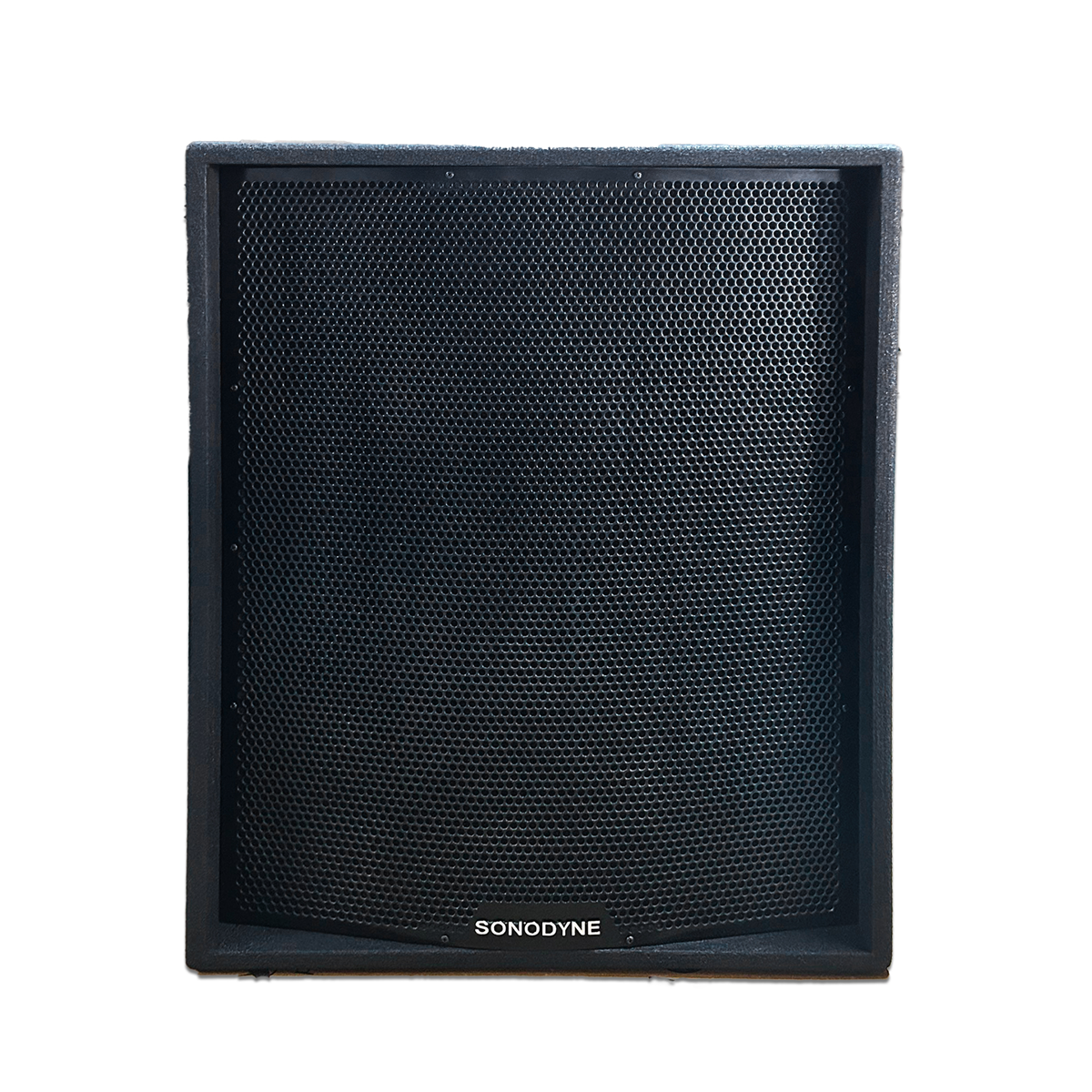
Brand: Sonodyne
Sonodyne SLX 2180
Category: Loudspeaker Systems
GENERAL OVERVIEW
| SPECIFICATION | DETAILS |
|---|---|
| Manufacturer | Sonodyne Technologies Pvt. Ltd. |
| Product Name | SLX 2180 |
| Product Series | SLX Series |
| Description | Passive 18-inch Subwoofer |
| Country of Manufacture | India (Make in India) |
| Product Type | Passive, single-driver, bass-reflex subwoofer |
| Intended Use | Live sound reinforcement, permanent installation, touring |
| Manufacturer Address | 98 NB Block E, New Alipore, Kolkata 700053, India |
TRANSDUCER SPECIFICATIONS
| SPECIFICATION | DETAILS |
|---|---|
| LF Driver Size | 18 inches (457 mm) |
| Voice Coil Diameter | 5 inches (127 mm) |
| Driver Count | 1 (single driver) |
| Transducer Type | High-excursion, moving-coil dynamic transducer |
| Magnet Type | Not specified by manufacturer (contact Sonodyne for T-S parameters) |
| Thiele-Small Parameters | Not published by manufacturer; contact Sonodyne Technologies for engineering data |
ACOUSTIC PERFORMANCE
| SPECIFICATION | DETAILS |
|---|---|
| Sensitivity (1W / 1m) | 97 dB SPL |
| Frequency Range (−10 dB) | 30 Hz to 150 Hz |
| Frequency Response (−3 dB) | 40 Hz to 170 Hz |
| Maximum SPL — Continuous | 128 dB SPL |
| Maximum SPL — Peak | 134 dB SPL |
| SPL Math Validation (Cont.) | 97 + 10·log₁₀(1300) = 128.1 dB ✓ (matches specification) |
| SPL Math Validation (Peak) | 97 + 10·log₁₀(5200) = 134.2 dB ✓ (matches specification) |
| Directivity | Not applicable (omnidirectional below crossover frequency for subwoofers) |
POWER HANDLING
| SPECIFICATION | DETAILS |
|---|---|
| Continuous (AES) | 1,300 W |
| Program Power | 2,600 W (2× continuous) |
| Peak Power | 5,200 W (4× continuous) |
| Nominal Impedance | 8 Ω |
| Recommended Amplifier | Sonodyne SLA2013 @ 1,300 W / 8 Ω |
| Alt. Amplifier Rating | 1,950 W RMS @ 8 Ω minimum (1.5× AES continuous) for non-SLA amplifiers without clip limiting |
CROSSOVER & FILTERING
| SPECIFICATION | DETAILS |
|---|---|
| Crossover Type | Passive — no internal crossover; external crossover required |
| Recommended Crossover Frequency | 80 Hz to 120 Hz (low-pass) |
| Recommended Crossover Slope | 18 to 24 dB per octave |
| Recommended Subsonic Filter | 35 Hz, 24 dB per octave |
| Recommended Processor | Sonodyne SLX SC1 (subsonic filter + low-pass filter + gain + phase) |
| Crossover Topology Note | 4th-order (24 dB/oct Linkwitz-Riley or Butterworth) recommended for maximum driver protection below cabinet tuning frequency |
CONNECTIVITY
| SPECIFICATION | DETAILS |
|---|---|
| Input Connector | 1 × Twist-lock (Speakon-compatible), signal input |
| Link Connector | 1 × Twist-lock (Speakon-compatible), parallel link output for daisy-chaining |
| Wiring Topology | Input and Link wired in parallel; daisy-chaining reduces load impedance |
| Two Cabinets in Parallel | 4 Ω load (within safe operating range for most professional amplifiers) |
| Three Cabinets in Parallel | ~2.7 Ω load (verify amplifier minimum impedance before deployment) |
CABINET CONSTRUCTION
| SPECIFICATION | DETAILS |
|---|---|
| Enclosure Design | Bass-reflex (ported) |
| Enclosure Shape | Rectangular |
| Enclosure Material | 18 mm plywood |
| Internal Bracing | Heavy internal bracing (manufacturer specification) |
| Exterior Finish | Multi-coat durable stipple paint |
| Grille Material | 18-gauge powder-coated perforated steel |
| Grille Attachment | Not specified (verify in person — typically metal clips or recessed fasteners on professional units) |
PHYSICAL SPECIFICATIONS
| SPECIFICATION | DETAILS |
|---|---|
| Dimensions (H × W × D) | 700 mm × 565 mm × 690 mm |
| Weight | 51 kg |
| Handling Requirement | Two-person lift recommended (51 kg exceeds single-person safe manual handling limit) |
| Stackability | Rectangular form factor permits stacking; verify stability with top cabinet weight |
| Mounting / Rigging | Not specified by manufacturer for subwoofer models (ground-stack or custom sub-array frames) |
| Colour / Appearance | Stipple paint finish (colour not specified — contact Sonodyne) |
SLX SUBWOOFER FAMILY COMPARISON
| SPECIFICATION | DETAILS |
|---|---|
| LF Driver | SLX 2050: 15" / 3" VC | SLX 2080: 18" / 4" VC | SLX 2180: 18" / 5" VC | SLX 2182: 2×18" / 5" VC | SLX 2280: 18" / 5" VC |
| Impedance | SLX 2050: 8 Ω | SLX 2080: 8 Ω | SLX 2180: 8 Ω | SLX 2182: 4 Ω | SLX 2280: 8 Ω |
| Continuous | SLX 2050: 400 W | SLX 2080: 800 W | SLX 2180: 1,300 W | SLX 2182: 2,600 W | SLX 2280: 1,300 W |
| Peak | SLX 2050: 1,600 W | SLX 2080: 3,200 W | SLX 2180: 5,200 W | SLX 2182: 10,400 W | SLX 2280: 5,200 W |
| Sensitivity | SLX 2050: 99 dB | SLX 2080: 97 dB | SLX 2180: 97 dB | SLX 2182: 100 dB | SLX 2280: 100 dB |
| Max SPL Cont. | SLX 2050: 125 dB | SLX 2080: 126 dB | SLX 2180: 128 dB | SLX 2182: 134 dB | SLX 2280: 131 dB |
| Max SPL Peak | SLX 2050: 131 dB | SLX 2080: 132 dB | SLX 2180: 134 dB | SLX 2182: 140 dB | SLX 2280: 137 dB |
| Freq. (−10dB) | SLX 2050: 45Hz–XO | SLX 2080: 30Hz–XO | SLX 2180: 30Hz–XO | SLX 2182: 30Hz–XO | SLX 2280: 30Hz–XO |
| Dimensions | SLX 2050: 590×460×520mm | SLX 2080: 700×565×690mm | SLX 2180: 700×565×690mm | SLX 2182: 574×1205×681mm | SLX 2280: 850×570×854mm |
| Weight | SLX 2050: 30 kg | SLX 2080: 42.5 kg | SLX 2180: 51 kg | SLX 2182: 92 kg | SLX 2280: 64 kg |
COMPLIANCE & CERTIFICATIONS
| SPECIFICATION | DETAILS |
|---|---|
| Manufacturer Standard | Specifications subject to change per Sonodyne continuous improvement policy |
| AES Power Standard | Power handling rated per AES2-1984 (r2003) standard (continuous / program / peak) |
| SPL Measurement | Free-field, on-axis, 1 W / 1 m (sensitivity); half-space loading conditions for max SPL |
| Country of Manufacture | India — Mukherjee Innovation Centre, Kolkata |
| Certifications | Not published in available documentation — contact Sonodyne Technologies for compliance certificates |
1. PRODUCT OVERVIEW
The Sonodyne SLX 2180 is a high-power passive 18-inch subwoofer designed and manufactured by Sonodyne Technologies Pvt. Ltd. — one of India's foremost professional audio engineering companies, operating out of their Mukherjee Innovation Centre in Kolkata. It belongs to the SLX Series, Sonodyne's flagship range of engineered professional loudspeakers intended for high-SPL live sound reinforcement and permanent installation. Within the SLX subwoofer family the SLX 2180 occupies the position of the single-driver 18-inch flagship, stepping above the SLX 2050 (15-inch, 400 W) and the SLX 2080 (18-inch, 800 W, 4-inch voice coil) while sharing the same cabinet format as its larger sibling, the SLX 2182 dual-18 system.
The defining characteristic of the SLX 2180 is its extraordinarily large 5-inch (127 mm) voice coil — a specification that is exceptional even among professional subwoofers in this power class. Where the SLX 2080 makes do with a 4-inch voice coil and a continuous power rating of 800 W, the SLX 2180's 5-inch voice coil enables a continuous AES power handling of 1,300 W, a program rating of 2,600 W, and a peak rating of 5,200 W. This translates directly into peak acoustic output of 134 dB SPL — a genuinely concert-class specification that places the SLX 2180 on equal footing with imported subwoofers costing significantly more. Sonodyne's stated design goals for the SLX range are 'balanced sound and high SPL in both indoor and outdoor applications', and the SLX 2180 delivers on both dimensions with a sensitivity of 97 dB (1 W / 1 m) and usable low-frequency extension to 30 Hz (−10 dB).
From a cabinet and construction perspective the SLX 2180 uses an 18 mm plywood enclosure — chosen for its superior stiffness-to-weight ratio over MDF — with a durable multi-coat stipple paint finish and a heavy internally braced rectangular form. The transducer is protected by a powder-coated 18-gauge perforated steel grille. Connectivity is provided by a pair of Neutrik-style Twist-lock connectors (one input, one link-output), enabling multiple cabinets to be daisy-chained from a single amplifier channel. Sonodyne recommends pairing the SLX 2180 with their own SLA2013 amplifier, which delivers 1,300 W into 8 Ω, and strongly advises the inclusion of their SLX SC1 subsonic filter / low-pass processor for system protection and optimal bass performance.
As a 'Make in India' product the SLX 2180 carries the advantage of local manufacturing, competitive pricing relative to equivalent imported systems, and direct manufacturer service support across India. For the Indian professional audio market — where outdoor events, festivals, house-of-worship installations, and touring sound companies place extreme demands on subwoofer systems — the SLX 2180 represents a compelling high-value proposition backed by Sonodyne's four decades of loudspeaker engineering heritage.
2. TRANSDUCER ARCHITECTURE
2.1 Low-Frequency Driver — 18-Inch, 5-Inch Voice Coil
The SLX 2180 employs a single high-excursion 18-inch (457 mm) low-frequency transducer with a 5-inch (127 mm) voice coil — the largest voice coil in the entire SLX subwoofer range and a specification that distinguishes this driver from the vast majority of 18-inch subwoofers available in the Indian market. Understanding the engineering significance of voice coil diameter requires examining the physics of power handling in a loudspeaker transducer.
In a moving-coil loudspeaker, the voice coil is the element that converts electrical energy into mechanical (acoustic) energy. The power handling limit of a loudspeaker is fundamentally a thermal limit: the coil is resistive, and as current flows through it, it dissipates heat (P = I²R). The rate at which this heat can be conducted away from the coil and into the surrounding air and magnet structure determines the continuous power handling. A larger voice coil has a proportionally greater surface area in contact with the magnetic gap and the surrounding former material, which means it can radiate heat more efficiently. This is why professional touring subwoofers with 4-inch and 5-inch voice coils can absorb hundreds or thousands of watts of continuous programme material while drivers with 2-inch or 3-inch voice coils cannot.
The 5-inch voice coil of the SLX 2180's driver enables the 1,300 W continuous AES rating — more than 60% higher than the 800 W rating of the SLX 2080's 4-inch coil driver. The voice coil is wound on a high-temperature former (typically aluminium or Kapton in this class of driver) and operates within a precisely engineered magnetic gap. The driver is further specified as a high-excursion design, which refers to the driver's ability to travel significant distances from its rest position while remaining under magnetic control — a parameter directly related to the driver's ability to reproduce deep bass frequencies at high displacement levels. Sonodyne does not publish Thiele-Small parameters for the SLX 2180 driver in publicly available documentation; engineers requiring T-S data for custom system design should contact Sonodyne Technologies directly.
2.2 Why 18 Inches? The Physics of Bass Reproduction
The acoustic output of a loudspeaker at low frequencies is proportional to the product of cone area and peak linear excursion (Sd × Xmax). Increasing cone diameter from 15 inches to 18 inches increases the radiating area by approximately 44% (area scales as the square of radius). This means that an 18-inch driver needs proportionally less excursion than a 15-inch driver to produce the same acoustic volume velocity at a given frequency — a mechanical advantage that reduces distortion and improves long-term reliability. The SLX 2180's large cone area, combined with the high-excursion specification of the driver, enables it to reproduce frequencies down to 30 Hz (−10 dB) with the acoustic output required for large venues.
3. ACOUSTIC PERFORMANCE
3.1 Sensitivity and Maximum SPL
The SLX 2180's sensitivity is specified at 97 dB (1 W / 1 m), measured on-axis in free-field conditions. Sensitivity is the most operationally important single specification for a passive loudspeaker, as it governs how much acoustic output is obtained per watt of amplifier power. At 97 dB/W/m the SLX 2180 is a high-sensitivity transducer — the combination of large radiating area and relatively efficient motor design (large magnet, high flux density in the gap) contributes to this figure.
Mathematical SPL Validation — The maximum SPL specifications can be cross-validated against the sensitivity and power handling using the standard acoustic formula: SPL_max = Sensitivity + 10 × log₁₀(Power). For continuous operation: 97 + 10 × log₁₀(1300) = 97 + 10 × 3.114 = 97 + 31.14 = 128.14 dB → Sonodyne specifies 128 dB continuous SPL. The formula result of 128.1 dB agrees with the specified value to within 0.15 dB, confirming the specification is internally consistent and derived from a standard AES measurement convention. For peak SPL: 97 + 10 × log₁₀(5200) = 97 + 10 × 3.716 = 97 + 37.16 = 134.16 dB → Sonodyne specifies 134 dB peak SPL. Again, the formula and the specification agree to within 0.17 dB. Both specifications pass mathematical validation. No discrepancies detected.
3.2 Frequency Response
The frequency range of the SLX 2180 is specified as 30 Hz to 150 Hz at the −10 dB points, with a −3 dB frequency response of 40 Hz to 170 Hz. The −10 dB and −3 dB measurements are both standard conventions; the −10 dB figure describes the outermost practical limits of bass extension while the −3 dB range describes the flat, usable working bandwidth. For a subwoofer, the upper −3 dB limit of 170 Hz is well above the recommended crossover window of 80–120 Hz, which means the driver rolls off gently above the crossover point and causes no interference with the full-range cabinet's low-frequency output. The lower −3 dB limit of 40 Hz covers the entire useful sub-bass range for music reproduction, including kick drum fundamentals (around 50–70 Hz), bass guitar fundamentals (41–80 Hz), and the lowest organ pedal tones (~30 Hz). Extension to 30 Hz at −10 dB means that even subsonic programme material, though attenuated, is reproduced without complete roll-off.
3.3 Crossover Configuration
The SLX 2180 is a passive single-driver subwoofer with no internal crossover network. Crossover filtering must be applied externally — in the system DSP processor, the amplifier's onboard DSP, or a dedicated crossover such as Sonodyne's SLX SC1. Sonodyne recommends a low-pass crossover frequency in the range 80 to 120 Hz, with a slope of 18 to 24 dB per octave. A steep slope (24 dB/oct, which is a 4th-order Linkwitz-Riley or 4th-order Butterworth) is preferable for the subwoofer application because it rapidly attenuates frequencies above the crossover point, preventing the subwoofer from producing midrange content that would create comb filtering and localisation artefacts when combined with the full-range top cabinets. The SLX SC1 subsonic filter is specifically designed for the SLX 2180 and SLX 2182, providing a subsonic high-pass filter (to protect the driver from infrasonic signals below 35 Hz), a variable-frequency low-pass filter for crossover adjustment, a gain control, and a phase inversion switch — all critical tools for integrating a passive subwoofer into a professional sound system.
4. CABINET CONSTRUCTION & FORM FACTOR
4.1 Plywood Enclosure
The SLX 2180 cabinet is constructed from 18 mm plywood with heavy internal bracing. The choice of 18 mm plywood (as opposed to MDF, which is used in many budget loudspeaker systems) reflects a deliberate professional engineering decision. Plywood is a cross-laminated wood product whose grain orientation alternates between layers, giving it high stiffness in multiple directions and excellent resistance to resonance. Unlike MDF, which can delaminate when exposed to moisture or subjected to mechanical shock, plywood retains its structural integrity under the rigours of touring and rental use. The 18 mm wall thickness and internal bracing structure minimise cabinet resonances — spurious vibrations in the panel walls that would otherwise add colouration to the reproduced bass. A stiff, well-braced cabinet radiates primarily from its driver cone rather than its walls, which translates to higher acoustic efficiency and lower distortion.
The enclosure geometry is rectangular, which offers the simplest and most volume-efficient form factor for a single-driver subwoofer. Rectangular cabinets are the standard in professional sub-bass reinforcement because they maximise internal volume (and therefore bass extension) relative to external footprint, are easy to stack, and are compatible with standard pole-mount hardware. The SLX 2180's dimensions of 700 mm (H) × 565 mm (W) × 690 mm (D) are typical for a high-power 18-inch subwoofer and allow the cabinet to be used as a base for top-cabinet stacking. Notably, it shares the same cabinet dimensions as the SLX 2080, confirming that the upgrade from 2080 to 2180 is entirely a driver and magnet system upgrade rather than a cabinet redesign.
4.2 Finish and Grille
The exterior finish is a multi-coat durable stipple paint applied directly to the plywood surface. This finish provides resistance to scuffs, minor impacts, and moisture ingress — the inevitable hazards of a professional touring or rental loudspeaker. The stipple texture also contributes to grip when the cabinet is being handled manually. The transducer is protected by an 18-gauge (1.2 mm) perforated steel grille with a powder-coat finish. At 18 gauge, the grille is substantial enough to withstand casual impact without deforming — thin grilles (22 or 24 gauge) are prone to denting under field conditions. The perforation pattern in a professional loudspeaker grille is engineered to have minimal acoustic blockage at the operating frequencies; for a subwoofer operating below 150 Hz, even large perforation patterns have negligible effect on the acoustic output.
4.3 Physical Dimensions and Weight
The SLX 2180 weighs 51 kg — a weight that requires two-person handling for safe transportation and positioning. This is consistent with other professional 18-inch single-driver subwoofers in this power class; the high mass is a consequence of the large magnet system (required for the high-efficiency driver motor), the 18 mm plywood panels, and the heavy internal bracing. Rental companies and touring production teams should factor the 51 kg weight into their labour and logistics planning. The cabinet has no integral handles specified in the manufacturer's documentation, so appropriate hardware (recessed handles if field-fitted) should be confirmed with the unit in hand.
5. CONNECTIVITY & SIGNAL ROUTING
5.1 Twist-Lock Connectors
The SLX 2180 is equipped with two Twist-lock (Speakon-style) connectors: one labelled INPUT and one labelled LINK. This is the standard parallel-wired daisy-chain topology used across the professional loudspeaker industry. The input connector receives the amplified signal from the power amplifier. The link connector is wired in parallel to the input, providing a feed-through connection that allows a second (or third) SLX 2180 to be connected in a series chain from the same amplifier channel. When cabinets are linked in this way they are electrically in parallel, halving the load impedance seen by the amplifier for each additional cabinet added. With a nominal impedance of 8 Ω per cabinet, two linked cabinets present a 4 Ω load, which is within the safe operating range of virtually all professional power amplifiers. Three cabinets in parallel would present approximately 2.7 Ω — this should be checked against the amplifier's minimum load specification before deployment.
5.2 Recommended Amplification
Sonodyne's official amplifier recommendation for the SLX 2180 is their own SLA2013 amplifier, delivering 1,300 W per channel into 8 Ω. The SLA2013 features built-in clip limiting, which is an important protection mechanism for the loudspeaker: amplifier clipping (where the output waveform is driven beyond the linear range and the peaks are 'flattened') generates high levels of odd-order harmonic distortion — particularly at the 3rd and 5th harmonics — that are concentrated in the midrange frequencies where voice coils are most vulnerable to thermal damage. The SLA2013's clip limiter prevents sustained clipping, thereby protecting the SLX 2180 from damage.
For engineers using amplifiers other than the SLA2013, Sonodyne recommends selecting an amplifier whose continuous RMS power output is 1.5× the continuous AES rating of the loudspeaker — i.e., 1.5 × 1,300 W = 1,950 W per channel at 8 Ω. This headroom recommendation is standard professional practice: an amplifier with sufficient headroom operates well below its clip threshold under normal programme material, and the occasional signal peaks are absorbed by the amplifier's dynamic headroom rather than causing sustained clipping. Engineers should further ensure that the amplifier's clip indicator illuminates only occasionally during signal peaks, never sustained.
6. SUBSONIC FILTER & SYSTEM PROTECTION
Sonodyne explicitly recommends a subsonic (high-pass) filter set at 35 Hz with a slope of 24 dB per octave for the SLX 2180. This recommendation is grounded in fundamental vented-enclosure acoustics. The SLX 2180 is a bass-reflex (ported) design — the cabinet features a tuned port whose resonance frequency is calibrated to extend the bass response below the driver's natural low-frequency roll-off. However, below the cabinet's tuning frequency, the port's acoustic output drops rapidly and the driver cone is no longer effectively 'loaded' by the box. In this sub-tuning-frequency region, the driver has very little mechanical resistance to cone displacement, meaning that large infrasonic signals (below ~30–35 Hz) can drive the cone far beyond its rated Xmax without producing significant acoustic output. The results are voice coil overheating, mechanical damage (surround tearing, former buckling), and in severe cases complete driver failure.
The 35 Hz / 24 dB per octave subsonic filter aggressively removes infrasonic content before it reaches the driver. At one octave below the filter frequency (17.5 Hz) the signal is attenuated by 24 dB — rendering it essentially harmless to the driver. Sonodyne specifically recommends the SLX SC1 processor for the SLX 2180 and SLX 2182, which provides a complete signal processing chain: subsonic filter, variable low-pass crossover, gain control, and phase switch. In any professional deployment of the SLX 2180, the use of a subsonic filter should be considered mandatory, not optional.
7. SLX SERIES CONTEXT & COMPETITIVE POSITIONING
Within Sonodyne's SLX subwoofer family, the SLX 2180 occupies a clearly differentiated position. The entry-level SLX 2050 uses a 15-inch driver with a 3-inch voice coil, rated at 400 W continuous — suitable for smaller venues or as fill systems. The SLX 2080 steps up to an 18-inch driver with a 4-inch voice coil at 800 W continuous, capable of 125 dB peak — a capable mid-level subwoofer for medium venues. The SLX 2180, with its 5-inch voice coil and 1,300 W continuous / 134 dB peak specification, is the professional touring-class single-18 solution. Above it sits the SLX 2182 (dual 18-inch, 4 Ω, 2,600 W continuous, 140 dB peak) for stadium-scale events, and the SLX 2280 (18-inch horn-loaded, 1,300 W, 137 dB peak) for maximum SPL efficiency in specific deployment scenarios.
From a competitive standpoint the SLX 2180 competes with professional 18-inch passive subwoofers in the mid-to-high professional range. Its 5-inch voice coil and 134 dB peak SPL are specifications that are typically found in this tier of professional loudspeaker engineering. The 'Make in India' manufacturing origin of the SLX 2180 carries the practical advantages of lower freight costs, faster availability of spares, and manufacturer-direct technical support within India — all of which are operationally significant for Indian sound rental and installation companies.
8. IDEAL APPLICATIONS & USE CASES
The following professional environments represent the primary and secondary use cases for the Sonodyne SLX 2180, given its high continuous power handling, 134 dB peak SPL, 18-inch driver, and passive (amplifier-driven) architecture:
- Outdoor Music Festivals and Concert Events: Large-format temporary deployments where multiple SLX 2180 units are configured in sub arrays (cardioid or broadside) driven by professional power amplifiers to achieve the high SPL required for audience areas of several thousand square metres.
- Indoor Concert Venues, Clubs, and Live Music Rooms: Permanent or semi-permanent subwoofer installations where the SLX 2180 provides deep, high-SPL bass reinforcement integrated with full-range SLX top cabinets.
- Houses of Worship (Large Format): Main sanctuary subwoofer reinforcement in large auditoria where both musical bass impact and spoken-word fundamentals require controlled low-frequency enhancement.
- Corporate Events and Product Launches: Large-format event sound where high SPL and clean bass are required for music and video presentations.
- DJ and Nightclub Sound Systems: High-SPL dance music environments where sub-bass impact (60–100 Hz kick) and very deep sub-bass (30–50 Hz) are both required.
- Touring and Rental Sound Companies: Professional road-ready subwoofer for event production, suitable for touring in road cases.
- Theatre and Performing Arts: Main system subwoofer for large stage productions, musical theatre, and immersive sound design.
- Sports Venues and Stadia: Public address reinforcement with musical programme material requiring sub-bass extension.
- Film and Live Broadcast Monitoring (Supplementary): Not a primary recommendation for monitoring applications, but capable of providing powerful sub-bass augmentation in large playback environments.
HOW TO READ THIS DOCUMENT
This document is the operational companion to the Sonodyne SLX 2180 Product Description & Technical Specifications. Where that document answers 'What is the SLX 2180 and how is it measured?', this document answers 'How do I deploy the SLX 2180 in my specific professional environment?' Every workflow section describes a real-world deployment scenario — including the physical setup, signal routing, amplifier configuration, crossover and filter settings, and any special operational considerations that a practising audio engineer would need to know. The goal is to move beyond the specification sheet and give engineers, production managers, installation designers, and rental company operators a concrete, immediately actionable reference for integrating the SLX 2180 into their systems.
Each workflow section follows a consistent structure: a scenario description that establishes the physical and operational context, a detailed technical walkthrough that explains signal routing and configuration choices, and a Routing / Configuration Summary Table that functions as a practitioner's checklist. Engineers who are already familiar with a particular deployment environment can skip directly to the summary table; those who are less experienced in a given application domain should read the full scenario description for context and reasoning.
The three defining workflow advantages of the Sonodyne SLX 2180 that appear repeatedly across all deployment scenarios are: (1) its 5-inch voice coil and 1,300 W continuous / 5,200 W peak power handling, which means it can be driven to full output for extended durations without thermal shutdown — unlike lower-rated subwoofers that require conservative power management; (2) its 97 dB sensitivity, which allows it to deliver high SPL (128 dB continuous, 134 dB peak) from a single cabinet without requiring exotic high-power amplifiers; and (3) its robust 18 mm plywood construction and durable paint finish, which makes it a genuinely road-worthy cabinet for touring and rental applications as well as a long-service fixed installation unit.
WORKFLOW 1 — OUTDOOR MUSIC FESTIVAL & CONCERT EVENT
Scenario: Large-Format Ground-Stack Sub Array for 3,000+ Audience
The outdoor music festival is the most demanding application for a professional subwoofer system, combining high sustained SPL requirements, wide audience coverage, variable acoustic environments, and the need for extended continuous operation over multiple headliner sets. In a typical Indian outdoor festival — a Durga Puja stage event, a college cultural festival, or a corporate gala with a 2,000–5,000 person audience area — the system designer must deliver consistent sub-bass impact across an area of several thousand square metres, with reliable performance through heat, humidity, and the mechanical stresses of transportation and rapid deployment.
For outdoor festivals, SLX 2180 cabinets are deployed in ground-stack sub arrays, typically in groups of two to four per side (L/R configuration) or in a central mono sub cluster. A four-cabinet per side configuration (eight total) driven by four stereo amplifier channels provides 16 × 134 dB peak SPL, and with proper phase alignment and array positioning, a system capable of covering large festival grounds. Each SLX 2180 pair on a single amplifier channel is loaded at 4 Ω (two cabinets in parallel); the Sonodyne SLA2013 amplifier is rated for this load. For larger sub arrays using four cabinets per channel at 2 Ω, verify the amplifier's minimum impedance rating before deployment — many professional amplifiers are 2 Ω stable but this must be confirmed.
Crossover and subsonic filter settings are managed at the digital system processor (an outboard DSP unit such as the Sonodyne SLX SC1, or a touring-standard processor). The low-pass crossover is set at 80–100 Hz with a 24 dB/oct slope. The subsonic filter is set at 35 Hz / 24 dB/oct to protect the drivers from infrasonic energy generated by wind noise and microphone rumble in an outdoor environment — a particular hazard in open-air settings. For cardioid subwoofer configurations (where rear-firing cabinets are used to reduce low-frequency energy behind the stage), the SLX SC1's phase inversion switch is essential for correctly aligning the delayed, inverted rear cabinet in the cardioid processing chain.
Workflow 1 — Routing / Configuration Summary
| WORKFLOW ELEMENT | DETAILS / CONFIGURATION |
|---|---|
| Cabinet Count (per system) | 4 to 8 SLX 2180 units (2–4 per side, or centre mono cluster) |
| Cabinet Configuration | Ground-stack; pairs stacked vertically with top cabinets pole-mounted on sub stacks |
| Amplifier per Cabinet Pair | Sonodyne SLA2013 or equivalent, 2× 1,300 W @ 4 Ω minimum |
| Signal Source | FOH digital mixing console → system processor → amplifier rack |
| System Processor | Sonodyne SLX SC1 or touring-standard 2-way processor |
| Low-Pass Crossover | 80–100 Hz, 24 dB/oct (Linkwitz-Riley 4th order preferred) |
| Subsonic Filter | 35 Hz, 24 dB/oct (mandatory outdoors — wind and handling noise) |
| Subwoofer Channel | Dedicated mono summed sub bus from FOH console |
| Cardioid Option | Rear-facing cabinet delayed ~8 ms + polarity inverted via SLX SC1 phase switch |
| Gain Structure | Line-level input to amplifier at nominal +4 dBu; SLA2013 clip LED = occasional peaks only |
| Weather Protection | Transducer forward-facing (away from prevailing wind); do not use in rain without cover |
| Transportation | Road case or padded covers; 51 kg per cabinet requires two-person handling |
WORKFLOW 2 — INDOOR CONCERT VENUE / LIVE MUSIC ROOM
Scenario: Permanent Sub-Bass Reinforcement in a 500–1,500 Capacity Venue
Indoor concert venues — including auditoriums, banquet halls converted for live music, dedicated music rooms, and dedicated concert halls — present a different set of challenges from outdoor festivals. The acoustic environment is bounded (reflective walls, ceiling, and floor), which means bass frequencies build up through room modes and standing waves. Subwoofer placement and quantity must be chosen with these acoustic effects in mind. Additionally, indoor venues typically require tighter SPL control to avoid over-pressurising the room, particularly in low-ceiling venues where excessive sub-bass levels cause listener fatigue and muddy the mid-bass range.
In a medium-capacity indoor venue (500–1,000 persons), one or two SLX 2180 cabinets per side is typically sufficient, depending on room dimensions and the low-frequency gain provided by boundary reinforcement (the SBIR — subwoofer boundary interaction reflection — effect means that floor-placed subwoofers near a wall can gain 3–6 dB of additional acoustic output at bass frequencies). The SLX 2180's 128 dB continuous SPL per cabinet is more than sufficient for indoor environments where 105–115 dB programme SPL at the mix position is the target. Smaller deployment means more headroom available in the amplifier and processor chain, which translates to lower distortion and extended driver longevity.
Permanent installations benefit from a fixed DSP system configured and locked for the specific room. The crossover frequency, EQ curves, delay times (for time-aligning the subwoofer's acoustic output with the top cabinet array), and limiter thresholds are set during commissioning and remain constant. The SLX SC1 processor or an equivalent facility DSP handles this function. Room measurement and acoustic analysis with a measurement microphone (such as with Smaart or EASERA software) is strongly recommended during commissioning to verify flat frequency response at the primary listening positions and identify and correct any room mode issues through parametric EQ.
Workflow 2 — Routing / Configuration Summary
| WORKFLOW ELEMENT | DETAILS / CONFIGURATION |
|---|---|
| Cabinet Count | 2 to 4 SLX 2180 (1–2 per side) |
| Placement | Floor-standing at front of stage wings or under stage lip; boundary placement adds 3–6 dB free LF reinforcement |
| Amplification | Sonodyne SLA2013 per cabinet pair; fixed installation rack-mount |
| System Processor | Venue-installed DSP (Sonodyne SLX SC1 or equivalent) |
| Crossover Frequency | 80–100 Hz, 24 dB/oct low-pass (permanent, set at commissioning) |
| Subsonic Filter | 35 Hz, 24 dB/oct (protects from induced sub-harmonic distortion at high SPL) |
| Time Alignment | Delay added to SLX 2180 to time-align with top cabinets (measure with SoundVision or Smaart) |
| EQ | Parametric EQ on sub channel to correct room mode peaks (typically 60–100 Hz range) |
| Limiting | Hard limiter set at 1,300 W equivalent signal level in DSP; amplifier clip limiter as secondary protection |
| Top Cabinet Integration | SLX 1150 or SLX 1152 recommended as companion full-range cabinets |
| Phase Check | Sub and top cabinets phase-aligned at crossover frequency; use SLX SC1 phase inversion if needed |
WORKFLOW 3 — HOUSE OF WORSHIP (LARGE-FORMAT SANCTUARY)
Scenario: Main Sanctuary Sub-Bass Reinforcement for Contemporary Worship
Contemporary houses of worship — particularly large urban churches, temples with PA-supported music programmes, and mega-church-format venues in India — have become one of the most technically demanding audio environments. The combination of contemporary praise music (with programmatic bass guitar, kick drum, and synthesised bass), congregational speech intelligibility requirements, and live streaming output demands a subwoofer system that can deliver musical bass impact without compromising the clarity and intelligibility of vocal content. The SLX 2180 is well-suited to this environment: its 30 Hz (−10 dB) extension covers contemporary music bass fundamentals, while the carefully controlled crossover at 80–100 Hz ensures a clean handoff to the full-range tops that carry the critical midrange and vocal content.
In a large sanctuary with 600–1,500 seating capacity, one SLX 2180 per side, floor-mounted at the front of the platform, is typically appropriate. The subwoofer's position should be set in from the stage edge to take advantage of floor and wall boundary reinforcement, and should ideally be aligned with the horizontal centre of the audience area for even coverage. Mono subwoofer operation (both cabinets receiving the same summed signal) is strongly recommended over stereo sub operation in large reverberant spaces, as low frequencies are effectively non-directional below ~100 Hz and stereo sub processing can create phase cancellations at certain seating positions. The system operator — who in a house of worship context is frequently a non-specialist volunteer — benefits from the simplicity of a committed, locked DSP configuration where only the master bus level needs adjustment for each service.
For houses of worship that operate multiple services per weekend and have limited technical staff, the robustness of the SLX 2180's 18 mm plywood construction and its passive architecture (no internal amplifier electronics to fail) is a practical advantage. The SLA2013 amplifier should be rack-mounted in a ventilated equipment room, minimising noise and heat in the sanctuary. Long cable runs from the amplifier rack to the subwoofer are standard in this deployment; verify cable gauge is adequate for the run length to avoid resistive losses that reduce effective power delivery to the cabinet.
Workflow 3 — Routing / Configuration Summary
| WORKFLOW ELEMENT | DETAILS / CONFIGURATION |
|---|---|
| Cabinet Count | 2 SLX 2180 (1 per side, L/R placement at front of platform) |
| Sub Operation | Mono summed (both cabinets receive identical signal) — recommended for reverberant sanctuaries |
| Amplifier Location | Rack-mounted in equipment room; speaker cable run to SLX 2180 position |
| Speaker Cable Gauge | 2.5 mm² (13 AWG) minimum for runs up to 30 m at 8 Ω; 4 mm² (11 AWG) for longer runs |
| System Processor | Locked DSP preset; only master level adjusted by operator |
| Crossover | 100 Hz, 24 dB/oct (slightly higher crossover to improve speech clarity in mid-bass range) |
| Subsonic Filter | 35 Hz, 24 dB/oct |
| Low-Frequency EQ | Cut at dominant room modes (measure and treat); typical cut at 80 Hz ±6 dB |
| Limiter | Programme limiter set 3 dB below maximum continuous rating; protects from operator errors |
| Live Stream Output | Subwoofer contribution taken pre-DSP or via dedicated sub feed in broadcast console |
| Operator Interface | Simple — single bus level fader for sub channel; DSP settings locked for non-technical volunteers |
WORKFLOW 4 — TOURING SOUND COMPANY / EVENT PRODUCTION
Scenario: Multi-Day Touring Event with Rapid Deployment Requirements
Sound rental and touring production companies are among the primary users of the Sonodyne SLX 2180. For a rental company, the subwoofer must meet a set of operational requirements that go well beyond audio specifications: it must survive the mechanical abuse of loading and unloading, transportation in trucks and tempo vehicles over Indian roads, repeated assembly and disassembly, and exposure to the weather extremes of different regions and seasons. The SLX 2180's 18 mm plywood construction, heavy bracing, and durable stipple paint finish address these requirements directly — this is not a studio-grade cabinet masquerading as a touring product but a purpose-built professional system designed for field use.
For a touring production company, the inventory strategy for the SLX 2180 is typically four to eight cabinets per complete rig, allowing flexible deployment from small stages (two cabinets) to large festival stages (eight cabinets) from the same inventory. The passive architecture is operationally valuable in a rental context: when an SLX 2180 fails (whether from driver failure or cabinet damage), the repair is limited to the transducer or cabinet — there is no internal amplifier or DSP to diagnose, replace, or calibrate. Passive cabinets can also be substituted with different amplifiers as needed, giving the production team flexibility when specific amplifiers are unavailable.
For multi-day touring events, the amplifier rack should be pre-configured and patched before each event, with the SLX SC1 (or equivalent system processor) preset loaded and locked. The link-output topology of the SLX 2180 allows the rigging team to quickly daisy-chain pairs of cabinets with a single cable run from the amplifier, reducing the number of cables required and simplifying the patch. A pre-show polarity and phase check (comparing the subwoofer's acoustic output against the top cabinets using a measurement microphone) takes approximately five minutes and should be part of the standard pre-show checklist for every deployment.
Workflow 4 — Routing / Configuration Summary
| WORKFLOW ELEMENT | DETAILS / CONFIGURATION |
|---|---|
| Inventory Recommendation | 4–8 SLX 2180 per touring rig; scalable from 2-cabinet small shows to 8-cabinet festivals |
| Deployment Time | Experienced crew: 2-cabinet ground stack setup in approximately 15–20 minutes |
| Transportation | Padded road cases or custom flight cases (51 kg per cabinet; two-person handling mandatory) |
| Amplifier Setup | Pre-configured SLA2013 rack; patch cables pre-labelled and pre-cut for standard configurations |
| System Processor | SLX SC1 or touring-standard 2-way DSP with touring presets saved and recalled |
| Cable Management | Use link connectors to daisy-chain cabinet pairs; reduces amplifier-to-cabinet cable runs by 50% |
| Pre-Show Check | Polarity test (pink noise + measurement mic); phase alignment at crossover frequency |
| Subsonic Filter | Always engaged — rental events frequently include DJ sets with infrasonic content |
| Limiter Setting | Conservative touring limit: set programme limiter at −3 dB below specified continuous rating |
| Post-Show Inspection | Check grille for impact damage; inspect Twist-lock connector contacts; check cabinet seams |
| Spare Parts Recommendation | Carry one spare 18" driver and Twist-lock replacement panels per 4-cabinet inventory |
WORKFLOW 5 — DJ / NIGHTCLUB / DANCE MUSIC ENVIRONMENT
Scenario: Fixed Installation for High-SPL Dance Music
Nightclubs and dance music venues represent the application where a subwoofer is pushed hardest over the longest sustained periods. DJ sets can run for four to eight hours with essentially continuous high-SPL programme material — kick drum at 60–90 Hz, sub bass at 30–60 Hz, and synthesised low-end frequencies that can extend well below 30 Hz in modern electronic music. For this environment, the SLX 2180's combination of a 5-inch voice coil, 1,300 W continuous rating, and high-temperature voice coil former is critical: a lesser subwoofer driven at this intensity for extended periods will overheat and fail; the SLX 2180 is thermally capable of sustained high-power operation.
In a typical nightclub installation, two to four SLX 2180 cabinets are positioned under or alongside the DJ booth, at the front of the dancefloor, or in a dedicated sub-bass stack. Corner loading (placing the cabinet in or near a room corner) provides free acoustic gain of up to 9 dB in the sub-bass range due to boundary reinforcement, which can significantly increase effective output without increasing amplifier power. The trade-off is reduced directional control and potential for room mode excitation. For dance music environments where maximum bass impact is the priority and tonal accuracy is secondary, corner loading is a pragmatic choice. For venues where bass quality and definition are priorities, free-field placement with modest parametric EQ correction is preferred.
The subsonic filter is particularly important in a DJ environment because vinyl and digital DJ playback sources frequently contain infrasonic energy from tonearm resonances, room feedback, and digital artefacts. Without the 35 Hz subsonic filter, these infrasonic signals can drive the SLX 2180's cone into extremely large excursions, generating audible distortion and potentially damaging the driver over time. The filter should be implemented in the system DSP and confirmed with a spectrum analyser or measurement tool that can display sub-20 Hz content.
Workflow 5 — Routing / Configuration Summary
| WORKFLOW ELEMENT | DETAILS / CONFIGURATION |
|---|---|
| Cabinet Count | 2–4 SLX 2180 for medium club (200–600 capacity); 4–6 for large venue |
| Placement Options | Under-stage / under-DJ-booth for maximum impact; corner-loaded for maximum SPL (verify room modes) |
| Amplification | SLA2013 per cabinet pair; amplifiers installed in fixed ventilated rack |
| System Processor | Venue DSP with dedicated sub preset; SLX SC1 strongly recommended |
| Crossover | 80–90 Hz, 24 dB/oct; lower crossover (80 Hz) for cleaner bass definition |
| Subsonic Filter | 35 Hz, 24 dB/oct — mandatory; DJ sources contain significant infrasonic content |
| EQ — Sub Enhancement | Optional gentle boost (2–3 dB) at 50–70 Hz for kick drum impact (use sparingly; monitor driver temperature) |
| Limiter | Thermal-model limiter in DSP; set release time >200 ms to prevent pumping on bass-heavy programme |
| Drive Level | Nominal operating level should keep SLA2013 clip LED inactive; peaks illuminate briefly only |
| Continuous Operation | SLX 2180 rated for sustained 1,300 W; amplifier fan ventilation must be unobstructed |
| Maintenance Schedule | Monthly driver inspection (visible flex surround check); quarterly Twist-lock contact cleaning |
WORKFLOW 6 — CORPORATE EVENT & CONFERENCE AUDIO
Scenario: Large Corporate Event with Live Entertainment and Presentation
Corporate events — product launches, annual award ceremonies, large-format conferences, and brand activations — increasingly combine high-quality live musical entertainment with speech reinforcement and multimedia playback, all in a single system. These events typically take place in large hotel ballrooms, convention centres, or purpose-built event spaces. The audio requirement is more nuanced than a pure music event: the system must be transparent enough to faithfully reproduce voice and speech (where low-frequency extension below ~80 Hz actually reduces clarity rather than improving it) while simultaneously delivering satisfying bass impact for musical segments and video playback.
For corporate events, one SLX 2180 per side is generally appropriate for venues up to approximately 1,000 capacity, with the subwoofer level in the mix set conservatively — providing bass extension and warmth rather than high-SPL bass impact. The crossover frequency may be raised slightly (to 100–120 Hz) compared to a music-only event, giving the subwoofer a broader low-frequency contribution that adds weight and body to both music and voice content. Importantly, the subwoofer should be time-aligned with the top cabinets to ensure coherent bass integration at the crossover frequency — an out-of-time subwoofer creates a 'disconnected' bass sound that is particularly noticeable with spoken word content.
Workflow 6 — Routing / Configuration Summary
| WORKFLOW ELEMENT | DETAILS / CONFIGURATION |
|---|---|
| Cabinet Count | 2 SLX 2180 (1 per side) for events up to ~1,000 capacity |
| Level Philosophy | Conservative sub level — bass extension and warmth, not maximum SPL |
| Crossover Frequency | 100–120 Hz, 24 dB/oct (higher than music events; improves speech integration) |
| Subsonic Filter | 35 Hz, 24 dB/oct |
| Sub Bus Source | Summed mono sub send from FOH console; low-frequency instruments only |
| Time Alignment | Critical: delay sub to align with top cabinet acoustic output at crossover |
| Low-Cut on Mics | All microphones set with high-pass filter at 80–100 Hz to prevent sub overload from handling noise |
| Multimedia Playback | Playback system (laptop / media server) connected via DI at FOH; sub content in playback mix |
| Amplifier Power | SLA2013 operating well below maximum; conservative gain setting appropriate |
| Noise Floor | Verify venue ambient noise floor does not mask quiet speech passages when sub is active |
WORKFLOW 7 — THEATRE & PERFORMING ARTS
Scenario: Musical Theatre Production — Sub-Bass Augmentation for Live Orchestra and Playback
Large-format theatre — including musical theatre, opera productions, and contemporary dance performances with electronic music — has specific subwoofer requirements that differ from pure music events. Theatrical audio must serve the drama of the production, which means sub-bass should be present but rarely dominant; it should enhance the physical impact of orchestral fortes, the thunderous punch of a climactic musical moment, or the cinematic low-end of a contemporary dance piece without overloading the acoustic balance. The SLX 2180's full 30 Hz extension and controllable output make it an appropriate choice when deployed with careful level management.
In a theatrical setting, the SLX 2180 (one or two units) is typically positioned below the stage apron or under the forestage, firing into the audience area. This under-stage position provides naturally even bass distribution across the stalls and dress circle while minimising visual intrusion. Time alignment with the flown PA or front-fill cabinets is essential — delay times should be measured and set during technical rehearsals before audiences are present. The theatre's acoustic environment (typically a hard-surface reverberant space in the 1–1.5 second RT60 range) requires careful LF management to avoid bass buildup, particularly in the 60–120 Hz region.
Workflow 7 — Routing / Configuration Summary
| WORKFLOW ELEMENT | DETAILS / CONFIGURATION |
|---|---|
| Cabinet Count | 1–2 SLX 2180 for theatres up to ~1,000 seats |
| Physical Position | Under-stage apron or under forestage, firing into stalls; concealed from audience sightlines |
| Crossover | 80–100 Hz, 24 dB/oct; integrate with main flown PA system |
| Time Alignment | Set during tech rehearsal via measurement; critical for coherent sub integration with main PA |
| Sub Bus Sources | Orchestral low brass and percussion; playback tracks with deliberate sub content; effects (thunder, explosions) |
| Level Automation | Sub level may be automated scene-by-scene via console scene recall (quiet dialogue scenes = sub off) |
| Subsonic Filter | 35 Hz, 24 dB/oct (orchestral double bass can excite very low resonances in certain conditions) |
| LF EQ | Broad cut at dominant room modes to prevent bass build-up in reverberant theatrical space |
| Amplifier Location | Pit amp rack or dedicated amp room; no audible fan noise during quiet dramatic scenes |
WORKFLOW 8 — SPORTS VENUE & STADIUM PA
Scenario: Public Address and Music Reinforcement in a Large Sports Arena
Sports venues — including cricket stadia, football grounds, indoor sports halls, and wrestling arenas — use public address systems primarily for announcements and crowd engagement, with musical content (match intros, half-time entertainment, celebration audio) as a secondary use. In these environments, a powerful subwoofer system serves both functional purposes: it adds weight and authority to announcements, making them easier to comprehend over crowd noise, and it delivers the high-SPL music content that creates crowd excitement. The SLX 2180's 128 dB continuous SPL per cabinet allows it to cut through the acoustic noise floor of a large crowd without audible distortion.
For a medium-sized sports venue (5,000–15,000 capacity), four to eight SLX 2180 cabinets deployed in clusters around the venue perimeter provide the most even coverage. Because sports venues are typically open or semi-open structures with poor acoustic isolation, the sub-bass content must be managed to avoid excessive leakage to surrounding areas — the subsonic filter and a relatively high crossover frequency (100 Hz) help minimise the low-end energy that travels the furthest from the venue.
Workflow 8 — Routing / Configuration Summary
| WORKFLOW ELEMENT | DETAILS / CONFIGURATION |
|---|---|
| Cabinet Count | 4–8 SLX 2180 for medium sports venue (cluster deployment) |
| Cluster Positions | Distributed at perimeter positions (4 clusters) for maximum coverage uniformity |
| Crossover | 100 Hz, 24 dB/oct (higher crossover reduces LF spill to venue exterior) |
| Subsonic Filter | 35 Hz, 24 dB/oct |
| Sub Bus Priority | Announcements (speech) and music mixed on dedicated bus; sub level adjusted per content type |
| Amplifier Type | Network-enabled amplifiers recommended for distributed venue control; SLA2013 at each cluster |
| Time Alignment | Critical in distributed deployment; each cluster delayed to align with primary cluster acoustic output |
| Coverage Uniformity | Verify ±3 dB SPL variation at target positions across audience area with measurement system |
| Crowd Noise Management | Sub level may require real-time adjustment as crowd noise floor varies through match |
WORKFLOW 9 — MULTI-ZONE FIXED INSTALLATION (HOTEL / CONVENTION CENTRE)
Scenario: Multi-Function Venue with Configurable Sub-Bass Zones
Large hotels, convention centres, and multi-purpose event facilities frequently require a sub-bass reinforcement system that can be reconfigured between different room setups — from a full-room concert configuration to a partitioned room with separate audio zones. In this environment, the SLX 2180 is typically specified as part of a larger permanent installation, with its amplification and processing managed by a centralised DSP system. The passive architecture of the SLX 2180 is an advantage here: the cabinets remain fixed in position while the signal routing and amplification can be reconfigured via the DSP system to suit different room configurations.
A typical multi-function installation might place two SLX 2180 cabinets under the front stage of the main ballroom, with each cabinet driven by a dedicated amplifier channel that can be individually controlled or muted by the venue's audio control system. When the room is divided into zones, the sub-bass can be applied to selected zones only, preventing bass buildup in areas where it is not required. Long-term reliability is a critical requirement in a permanent installation context: the SLX 2180's passive design, robust plywood cabinet, and proven Sonodyne driver make it an appropriate choice for permanent deployment where service access may be infrequent.
Workflow 9 — Routing / Configuration Summary
| WORKFLOW ELEMENT | DETAILS / CONFIGURATION |
|---|---|
| Cabinet Count | 2–4 SLX 2180 per main room (scalable per room size) |
| Mounting / Position | Fixed floor-standing under stage apron; cabled to permanent amplifier rack |
| System Control | Central DSP system with room configuration presets; individual channel muting per zone |
| Amplifier Rack | Sonodyne SLA2013 in ventilated, locked rack room; networked for remote monitoring if available |
| Crossover | 100 Hz, 24 dB/oct (permanent setting locked in venue DSP) |
| Subsonic Filter | 35 Hz, 24 dB/oct (permanent) |
| Cable Infrastructure | Permanent installation-grade speaker cable (1.5–2.5 mm² depending on run length) in conduit |
| Service Access | Annual driver inspection; bi-annual Twist-lock contact cleaning and connection re-torque |
| System Backup | Document DSP presets; maintain one spare SLA2013 amplifier channel in inventory |
| Room Partition Mode | Individual amplifier channel muting via DSP for zoned operation |
WORKFLOW 10 — OUTDOOR TEMPORARY INSTALLATION (FILM SCREENING / CULTURAL FESTIVAL)
Scenario: Open-Air Cultural Event with Sub-Bass Augmentation for Film or Live Programme
Outdoor film screenings, cultural festivals (including classical music recitals with electronic reinforcement, traditional folk performances with contemporary production values, and government or municipal events), and large religious gatherings with organised audio are increasingly common in India. These events combine the logistical challenges of a temporary outdoor deployment with specific audio requirements that may differ from a music concert — for example, a film screening requires tight sub-bass control to deliver cinematic low-frequency impact (from action sequences, vehicle sounds, and music scores) while keeping dialogue intelligibility high.
For an outdoor film screening, the SLX 2180 provides the cinema-grade sub-bass foundation that elevates the viewing experience in an open-air setting. The subsonic filter is critical in this application, as film audio frequently contains dedicated LFE (Low Frequency Effects) content that can extend below 20 Hz in theatrical prints — content that is inaudible but that can damage a subwoofer if played without filtering. The crossover should be set at 80 Hz to align with a standard 5.1 or stereo playback system's bass management. The SLX 2180's 30 Hz (−10 dB) extension ensures the full cinema bass experience is preserved down to the lowest audible frequencies.
Workflow 10 — Routing / Configuration Summary
| WORKFLOW ELEMENT | DETAILS / CONFIGURATION |
|---|---|
| Cabinet Count | 2–4 SLX 2180 (size of audience area and programme type dependent) |
| Programme Source | Film audio playback system (laptop / media server with cinema audio decoder) |
| Crossover | 80 Hz, 24 dB/oct (standard film bass management crossover) |
| Subsonic Filter | 35 Hz, 24 dB/oct — mandatory; film LFE content can extend below 20 Hz |
| Sub Level | Film standard: LFE channel aligned at −10 dB relative to main channels at equal level |
| Delay / Alignment | Delay sub to time-align with screen speakers (distance from screen to subwoofer ÷ speed of sound) |
| Environmental Protection | Cover cabinets during non-operating periods; forward-facing grille away from prevailing wind |
| Audience SPL Target | 85–95 dB Leq at audience reference point; sub contribution adds body without dominating |
| Noise Regulations | Apply appropriate output limiting to comply with local noise ordinances if applicable |
WORKFLOW 11 — CARDIOID SUBWOOFER ARRAY CONFIGURATION
Scenario: Directional Sub Array for Stage-Side or Arena Deployment
A cardioid subwoofer array is a deployment technique where subwoofer cabinets are arranged and processed to produce a directional radiation pattern — high SPL towards the audience, significantly reduced SPL towards the stage. This is valuable in situations where stage monitors and musicians' personal monitoring systems are affected by excessive sub-bass energy from the front-of-house subwoofer system, which causes low-frequency noise interference and reduces clarity for performers. The SLX 2180, with its consistent 8 Ω impedance and phase-invertible (via the SLX SC1) output, is well-suited to cardioid array configurations.
The most common cardioid arrangement is the 'one forward, one reverse with delay' method: one SLX 2180 faces the audience (forward), while a second SLX 2180 is positioned behind it facing the stage (reverse). The reverse cabinet's signal is polarity-inverted (using the SLX SC1's phase switch) and delayed by a time equal to the cabinet-to-cabinet distance divided by the speed of sound. This creates acoustic cancellation behind the array (towards the stage) and reinforcement in front (towards the audience). The result is typically 10–15 dB less SPL behind the array compared to an equivalent non-cardioid deployment, dramatically reducing the low-frequency energy that reaches the stage area.
Workflow 11 — Routing / Configuration Summary
| WORKFLOW ELEMENT | DETAILS / CONFIGURATION |
|---|---|
| Cabinet Count | Pairs (2 per array element — 1 forward, 1 reverse) |
| Forward Cabinet | Facing audience; standard polarity; no delay |
| Reverse Cabinet | Facing stage (behind forward cabinet); polarity inverted; delay applied |
| Required Processor | SLX SC1 (phase inversion + delay) or equivalent system processor with delay and polarity |
| Delay Calculation | Delay (ms) = Cabinet separation (m) ÷ 0.343 (speed of sound at 20°C, m/ms) |
| Typical Cabinet Separation | 0.69 m (= SLX 2180 depth); delay ≈ 2 ms |
| Rear Attenuation | Typically 10–15 dB below frontal SPL when correctly configured and measured |
| Verification Method | Measure with calibrated microphone at front and rear positions; adjust delay until rear minimum achieved |
| Crossover | 80–100 Hz, 24 dB/oct (same as standard deployment) |
| Subsonic Filter | 35 Hz, 24 dB/oct (unchanged) |
| Stage Benefits | Reduced sub-bass bleed onto stage reduces IEM interference and improves monitor clarity for performers |
FEATURE-TO-WORKFLOW CROSS-REFERENCE MATRIX
The following table maps every major feature of the Sonodyne SLX 2180 to the workflow categories where that feature is most operationally relevant. This serves as a quick cross-reference for system designers evaluating the SLX 2180 for a specific deployment context.
| WORKFLOW ELEMENT | DETAILS / CONFIGURATION |
|---|---|
| 18-inch driver, 30 Hz (−10 dB) extension | Outdoor Festival (WF1), Indoor Concert (WF2), DJ/Nightclub (WF5), Film Screening (WF10) |
| 5-inch voice coil, 1,300 W continuous power handling | Outdoor Festival (WF1), Touring/Rental (WF4), DJ/Nightclub (WF5), Sports Venue (WF8) |
| 128 dB continuous / 134 dB peak SPL | Outdoor Festival (WF1), Sports Venue (WF8), DJ/Nightclub (WF5) |
| 97 dB sensitivity (high efficiency) | All workflows — reduces amplifier power requirement across all applications |
| 8 Ω nominal impedance (single cabinet) | Touring/Rental (WF4) — compatible with broadest range of professional amplifiers |
| Twist-lock INPUT + LINK connectors (daisy-chain) | Outdoor Festival (WF1), Touring/Rental (WF4), Cardioid Array (WF11) |
| 18 mm plywood construction + heavy internal bracing | Touring/Rental (WF4), Outdoor Festival (WF1), Sports Venue (WF8) |
| Durable stipple paint finish + powder-coated steel grille | Touring/Rental (WF4), Outdoor Festival (WF1), Film Screening (WF10) |
| Passive architecture (no internal amplifier) | Multi-Zone Fixed Install (WF9), Touring/Rental (WF4), HOW (WF3) |
| Recommended 35 Hz / 24 dB/oct subsonic filter | DJ/Nightclub (WF5), Film Screening (WF10), Outdoor Festival (WF1), Cardioid Array (WF11) |
| Recommended crossover 80–120 Hz, 18–24 dB/oct | All workflows — crossover range covers all professional deployment scenarios |
| SLX SC1 processor compatibility (phase + delay + gain) | Cardioid Array (WF11), Outdoor Festival (WF1), Indoor Concert (WF2) |
| Rectangular form factor / stackable | Outdoor Festival (WF1), Indoor Concert (WF2), Touring/Rental (WF4) |
| 700 × 565 × 690 mm dimensions | Multi-Zone Install (WF9) — verify sub-stage cavity dimensions before specifying |
| Make in India — local parts and service | Touring/Rental (WF4), HOW (WF3), Multi-Zone Install (WF9) — reduced spare parts lead time |