
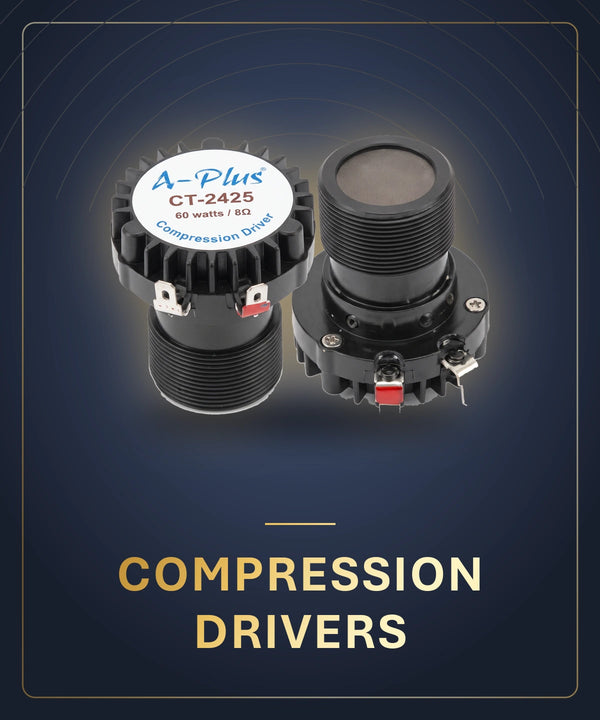
How to Choose Compression Drivers
November 5, 2026 · Shivansh Electronics, Kolkata
A compression driver is a high-frequency transducer designed to be loaded by a horn. It produces high sound levels with good efficiency and controlled directivity, which makes it the standard choice in professional PA, cinema and installation loudspeakers. This guide explains how to choose compression drivers and match them with horns and crossovers.
How a compression driver works
A light diaphragm drives air through a phase plug into a narrow throat, and a horn then guides and spreads the sound. This compression of air into a small opening gives the driver high efficiency compared with a direct-radiating tweeter. The horn controls coverage, so the driver and horn must be chosen as a pair.
Throat size
Throat diameter is a key specification, measured in inches or millimetres: common sizes are 1 inch, 1.4 inch, 2 inch and larger. Smaller throats handle higher frequencies well and are used for compact systems. Larger throats handle lower crossover points and higher power, but their top-end response may roll off earlier. Choose a driver throat that matches the horn throat, or use a suitable adaptor.
Diaphragm materials
- Titanium: light, strong and bright, common in professional systems
- Aluminium: a different balance of stiffness and damping
- Polymer or composite: often smoother in character and resistant to fatigue
- Replaceable diaphragms: useful in a touring environment, where repair is cheaper than replacing the whole driver
The diaphragm affects the sound, durability and power handling. A voice coil that is larger or better cooled generally takes more power.
Impedance, sensitivity and power handling
Most compression drivers are 8 ohms, though other values exist. Check the sensitivity, usually given on a particular horn, because it is not meaningful without a stated test condition. Power ratings are given for a specific frequency range above the recommended crossover point. High-frequency drivers are easily damaged by amplifier clipping or by feeding low frequencies, so follow the minimum crossover frequency in the data sheet.
Crossover and processing
Use a high-pass filter at the recommended frequency and slope to protect the diaphragm. Active systems with DSP can correct the response of the driver and horn, including time alignment and equalisation. In passive systems, a good crossover network sets the transition between the woofer and the horn driver. Our loudspeaker drivers range covers matching woofers.
Matching with horns
- Match the throat diameter and bolt pattern
- Choose horn coverage angles to suit the venue
- Check the horn's cut-off frequency and the lowest crossover point you intend to use
- Consider horn size, weight and material, such as moulded plastic or aluminium
- Check the driver's frequency response on the chosen horn, because the pair determines the final response
Choosing for your application
Live PA
Choose a robust driver with high power handling, serviceable diaphragms and a design that suits the cabinet. See PA loudspeakers.
Installed sound
Look for reliability, consistent performance and wide, even coverage. Weather resistance may matter for outdoor use.
Repairs and upgrades
Match the throat size, mounting pattern, impedance and frequency range. Compare the sensitivity of old and new drivers so levels stay balanced with the woofer.
Installation and protection
Mount the driver on the horn with all the bolts tightened evenly, and ensure the throat and flange are properly aligned so that no air leaks. Protect the driver from dust, moisture and impact, and keep the diaphragm area covered when the driver is removed from the horn. When testing, start at a low level with a high-pass filter in place, then increase gradually. Fit a fuse, lamp or limiter if the system design calls for one, and replace diaphragms with the correct replacement part for the model.
Common mistakes to avoid
- Using a driver with a different throat size from the horn
- Setting the crossover too low, which can destroy the diaphragm
- Driving the amplifier into clipping
- Ignoring the sensitivity difference between the woofer and the horn driver
- Mixing impedances on the same amplifier channel without checking the load
- Leaving the driver without protection from dust and moisture
Buying compression drivers at Shivansh Electronics
Shivansh Electronics, Kolkata, West Bengal, India supplies genuine products, exactly as the manufacturers build and specify them. Every product page has its specifications, including throat size, impedance and power handling, so you can compare drivers before you decide. Our team can advise you on WhatsApp or by phone about drivers and horn matching.


