

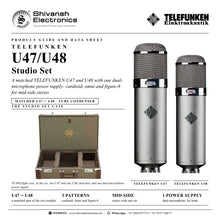


TELEFUNKEN U47/U48 Studio Set
MRP - Rs. 40,20,200
TELEFUNKEN U47/U48 Studio Set: a matched U47 (cardioid, omni) and U48 (cardioid, figure-8) on one dual power supply, ready for Mid-Side, FC40S case. Available in India from Shivansh Electronics, Kolkata, West Bengal, India.
VISUAL GUIDE — See Every Photo, Spec & Setup Step (PDF)
The price shown is the MAXIMUM RETAIL PRICE (MRP), inclusive of all taxes. For the best price, exclusive offers and discounted rates, delivery timelines, or any other information, please DM us or call +91 89818 07755 / +91 91477 00677. We will gladly share an exclusive coupon code that you can apply at checkout. All payments are processed securely through Razorpay, our trusted payment gateway partner.
General
| Type | Matched set of two vacuum tube condenser microphones, large diaphragm |
| Series | TELEFUNKEN Diamond Series |
| Microphones | 1x U47 and 1x U48 |
| Matching | Capsules hand‑selected and tested; matched BV8 transformers and VF14K tubes |
| Polar patterns | U47: cardioid, omnidirectional U48: cardioid, figure‑8 |
| Pattern selection | Switch on each microphone |
| Capsule | TELEFUNKEN M7, centre‑terminated large diaphragm, dual diaphragm |
| Tube | TELEFUNKEN VF14K |
| Transformer | TELEFUNKEN BV8, nickel alloy core, 6.5:1 ratio |
| Build | Hand built and point‑to‑point wired in South Windsor, Connecticut, USA |
Acoustic and electrical (each microphone)
| Frequency range | 20 Hz - 20 kHz, ±3 dB |
| Sensitivity | 24.5 mV/Pa, ±1 dB |
| THD (amplifier, 1 kHz at 1 Pa) | < 0.3% |
| Maximum SPL (1% THD) | 127 dB SPL |
| Signal‑to‑noise ratio | 85 dBA |
| Self‑noise (amplifier) | 9 dBA |
| Output impedance | 200 ohms |
Power supply
| Power source | External dual‑microphone power supply (no phantom power required) |
| Power supply | One dual‑microphone tube power supply for both microphones |
| Audio outputs | XLR on the power supply, to the mic preamps with standard 3‑pin microphone cables |
| Warm‑up time | 10 minutes |
Physical (each microphone)
| Dimensions | 240 mm long x 60 mm diameter |
| Weight | 620 g |
| Finish | Nickel‑plated headgrille, TELEFUNKEN Diamond badge |
In the set
| Microphones | 1x TELEFUNKEN U47, 1x TELEFUNKEN U48, matched |
| Power supply | 1x dual‑microphone power supply |
| Case | FC40S locking flight case |
| Part number | SYTM‑041 |
Compliance
| EMC Directive | 2014/30/EU (EN 55013 applied) |
| Low Voltage Directive | 2014/35/EU (EN 60065 applied) |
| RoHS | RoHS2 Directive 2011/65/EU |
Product overview
The TELEFUNKEN U47/U48 Studio Set pairs a U47 and a U48, the two versions of TELEFUNKEN's recreation of the classic German large-diaphragm tube microphone, as a matched set on one dual-microphone power supply: cardioid, omnidirectional and figure-8 in a single system, including a ready-made Mid-Side stereo pair.
The U47 offers cardioid and omnidirectional; the U48 offers cardioid and figure-8. TELEFUNKEN notes that the two microphones combined provide a wide variety of recording techniques, including Mid-Side stereo, and that its Studio Set was the first version of this combination offered with matched microphones. The capsules are hand-selected and tested for consistent performance in TELEFUNKEN's Connecticut laboratory, together with matched custom BV8 output transformers, VF14K tubes and premium resistors and capacitors. The result is one system that can be a lead vocal microphone and a duet microphone on Monday, and a Mid-Side pair on piano or backing vocals on Tuesday.
| Matched microphones | U47 + U48 |
| Polar patterns across the set | 3 |
| Sensitivity (each) | 24.5 mV/Pa |
| Max SPL (1% THD) | 127 dB SPL |
Key features
- One U47 and one U48, matched: capsules, BV8 transformers and VF14K tubes hand-selected and tested
- Cardioid, omnidirectional and figure-8 across the two microphones
- A ready-made Mid-Side pair: U47 as the mid microphone, U48 in figure-8 as the side microphone
- One dual-microphone power supply for both microphones
- US-made M7 capsules: historically accurate, centre terminated, dual diaphragm
- Point-to-point wired in the USA, true to the original design
- FC40S locking flight case, designed for the U47 and U48 Stereo and Studio Set systems
Sound character
Both microphones have the classic punchy, mid-forward sound with pleasing bite and a legendary extended low-frequency response; in cardioid the U47 and U48 are sonically identical. The U47's omnidirectional pattern gives a fantastic sense of space and bass without proximity effect, while its cardioid gives the classic proximity effect. The U48's figure-8 picks up equally from front and rear while rejecting the sides, which helps control ambient and indirect sound when recording ensembles or in less-than-ideal rooms.
Mid-Side with the Studio Set
In Mid-Side, the U47 faces the source in cardioid or omnidirectional as the mid microphone, and the U48 sits directly above or below it, turned sideways in figure-8, as the side microphone. Decoded in the mixer, the pair gives a strong centre image with a width that can be set after recording, so you choose how much room to bring in. Because the capsules, tubes and transformers are matched, the two microphones share the same tonal character, which keeps the decoded stereo image smooth and natural. TELEFUNKEN's own press release describes an M-S array of this set left set up on a rolling stand for everything from piano to backing vocals.
Capsule, tube and transformer
Each microphone uses the M7 centre-terminated, dual-diaphragm capsule, which combines the mechanical design of the earliest German condensers with a modern, more stable tensioning material, made by hand in limited quantity in South Windsor, Connecticut. The VF14K is TELEFUNKEN's drop-in solution to the dwindling supply of the original tube: a new old stock military-grade glass tube and a passive circuit in a plug-and-play casing, with sonic characteristics extremely close to the original and a 5-year manufacturer's warranty. The BV8 is a hefty, nickel alloy core, twin-coil output transformer wound in America to vintage specification, with a 6.5:1 ratio, very low distortion and a wide, flat frequency response.
Two microphones, many techniques
Beyond Mid-Side, the Studio Set works as two complementary mono microphones. Use the U47 in cardioid for lead vocals, electric guitar or a kick drum front, or in omnidirectional for a natural room sound; use the U48 in figure-8 for two singers facing each other, for duets and for ensembles in difficult rooms, or in cardioid as a second, sonically identical cardioid microphone. The pattern is selected on each microphone, and the U48 is easily recognised by its red polar pattern logo.
Power supply, case and build
The set includes one dual-microphone power supply that powers both microphones. TELEFUNKEN tube power supplies are hand-built in Connecticut with premium components, calibrated to the specific microphone system they come with and burned in with it as a complete unit, using vintage-correct locking connectors. The FC40S locking flight case is listed by TELEFUNKEN for the U47 or U48 Stereo and Studio Set systems: a shell made of a blend of seven hardwoods, wrapped in a durable travelling fabric, with dual combination locks, nickel trim, an embroidered TELEFUNKEN diamond logo inside the lid and an engraved logo plate (with matching serial number when applicable). It holds two microphones in wooden boxes, one stereo power supply and two tube microphone cables. Each microphone is hand built and point-to-point wired at the TELEFUNKEN facility in South Windsor, Connecticut, with near-identical metalwork and circuit components to the original design.
What's in the set
- 1x TELEFUNKEN U47 microphone (cardioid and omnidirectional), matched
- 1x TELEFUNKEN U48 microphone (cardioid and figure-8), matched
- 1x dual-microphone tube power supply
- FC40S locking flight case (listed by TELEFUNKEN for the Stereo and Studio Set systems)
TELEFUNKEN's official sources name the two matched microphones, the dual-microphone power supply and the FC40S case for the Studio Set but do not itemise its cables, shock mounts and wooden boxes; please confirm the exact contents with Shivansh Electronics before ordering. The VF14K tube carries a 5-year manufacturer's warranty; register each microphone at t-funk.com/warranty.
TELEFUNKEN U47/U48 Studio Set: frequently asked questions
What is the difference between the U47 and the U48?
The U47 offers cardioid and omnidirectional; the U48 offers cardioid and figure-8. In cardioid the two are sonically identical.
Why choose the Studio Set over a Stereo Set?
The Studio Set gives you all three patterns, cardioid, omnidirectional and figure-8, and a ready-made Mid-Side pair, from just two matched microphones.
Does the Studio Set need phantom power?
No. Both microphones are powered by the included dual-microphone power supply. Connect its XLR outputs to your mic preamps with standard 3-pin microphone cables.
Does it need to warm up?
Yes. Make all connections first, switch on the power supply and let the system warm up for 10 minutes before use.
Are the U47 and U48 available on their own or as stereo sets?
Yes, the TELEFUNKEN U47, the TELEFUNKEN U48 and their Stereo Sets are listed as separate products at Shivansh Electronics.
Where can I buy the TELEFUNKEN U47/U48 Studio Set in India?
The TELEFUNKEN U47/U48 Studio Set is available from Shivansh Electronics, Kolkata, West Bengal, India, with delivery across India.
Workflow 1: Mid-Side stereo
Stereo capture with the U47 as mid and the U48 as side microphone, with width adjustable after recording.
Connections
| Connect | To |
|---|---|
| U47 and U48 microphones | Dual‑microphone power supply via two tube microphone cables |
| Power supply XLR outputs | Two mic preamp / audio interface inputs (standard 3‑pin XLR cables) |
| Power supply power cable | Mains power, 115 V or 230 V as set |
Setup
- Mount the U47 facing the source and the U48 directly above or below it, turned sideways.
- Set the U47 to cardioid (or omnidirectional) and the U48 to figure-8.
- Connect both microphones to the dual-microphone power supply, switch on and allow 10 minutes of warm-up.
- Set gain on both channels and decode the mid and side signals in your mixer.
Tip: Raise or lower the side channel to widen or narrow the stereo image.
Workflow 2: Piano in Mid-Side
Grand and upright piano with a strong centre image and a choice of how much room to bring in.
Connections
| Connect | To |
|---|---|
| U47 and U48 microphones | Dual‑microphone power supply via two tube microphone cables |
| Power supply XLR outputs | Two mic preamp / audio interface inputs (standard 3‑pin XLR cables) |
| Power supply power cable | Mains power, 115 V or 230 V as set |
Setup
- Place the Mid-Side pair outside the curve of the piano, the U47 facing the strings and the U48 turned sideways above or below it.
- Use cardioid on the U47 for a closer sound or omnidirectional for more room, with the U48 on figure-8.
- Connect both microphones to the dual-microphone power supply, switch on and allow 10 minutes of warm-up.
- Set gain on the loudest passages, decode in the mixer and adjust the width to taste.
Workflow 3: Backing vocals and vocal groups
Backing singers and vocal groups gathered around one stereo array.
Connections
| Connect | To |
|---|---|
| U47 and U48 microphones | Dual‑microphone power supply via two tube microphone cables |
| Power supply XLR outputs | Two mic preamp / audio interface inputs (standard 3‑pin XLR cables) |
| Power supply power cable | Mains power, 115 V or 230 V as set |
Setup
- Set up the Mid-Side array at head height with the singers arranged in front of the U47.
- Set the U47 to cardioid or omnidirectional and the U48 to figure-8.
- Connect both microphones to the dual-microphone power supply, switch on and allow 10 minutes of warm-up.
- Balance the singers by their distance to the array, set gain and record.
Tip: A Mid-Side array on a rolling stand can stay set up and move from source to source.
Workflow 4: Lead vocals with the U47
Lead vocals that need an authoritative midrange and a full low end.
Connections
| Connect | To |
|---|---|
| U47 microphone | Dual‑microphone power supply via its tube microphone cable |
| Power supply XLR output | Mic preamp / audio interface input (standard 3‑pin XLR cable) |
| Power supply power cable | Mains power, 115 V or 230 V as set |
Setup
- Fit the U47 in a shock mount on a sturdy stand.
- Connect the microphone to the power supply and the XLR output to your preamp before switching on.
- Select cardioid on the U47, power up and let the system warm up for 10 minutes.
- Set gain while the singer performs at full level, then record.
Tip: Add a pop filter for close vocal work.
Workflow 5: Duets with the U48 in figure-8
Two singers or players facing each other on one microphone.
Connections
| Connect | To |
|---|---|
| U48 microphone | Dual‑microphone power supply via its tube microphone cable |
| Power supply XLR output | Mic preamp / audio interface input (standard 3‑pin XLR cable) |
| Power supply power cable | Mains power, 115 V or 230 V as set |
Setup
- Place the U48 between the two performers, one on each side of the capsule.
- Set the U48 to figure-8 with its red polar pattern switch.
- Make all connections, switch on and allow 10 minutes of warm-up.
- Balance the performers by moving them closer or further away, then set gain and record.
Tip: The sides of the figure-8 pattern reject sound, which keeps other instruments out of the duet microphone.
Workflow 6: Drums: kick front and room
A drum kit with the U47 on the kick drum and the U48 capturing the kit and room.
Connections
| Connect | To |
|---|---|
| U47 and U48 microphones | Dual‑microphone power supply via two tube microphone cables |
| Power supply XLR outputs | Two mic preamp / audio interface inputs (standard 3‑pin XLR cables) |
| Power supply power cable | Mains power, 115 V or 230 V as set |
Setup
- Place the U47 in front of the kick drum and the U48 a few metres in front of the kit.
- Set the U47 to cardioid for a focused kick and the U48 to figure-8 or cardioid for the room.
- Connect both microphones to the dual-microphone power supply, switch on and allow 10 minutes of warm-up.
- Set gain on the loudest hits (127 dB SPL maximum) and blend the two in the mix.
Tip: Keep the power supply at least 3 m from the microphones while recording.


