



NEUMANN TLM 102
MRP - Rs. 79,900
NEUMANN TLM 102 compact large-diaphragm cardioid studio microphone: transformerless, 12 dB-A self-noise, 144 dB max. SPL, nickel or black, with SG 2. Available in India from Shivansh Electronics, Kolkata, West Bengal, India.
VISUAL GUIDE — See Every Photo, Spec & Setup Step (PDF)
The price shown is the MAXIMUM RETAIL PRICE (MRP), inclusive of all taxes. For the best price, exclusive offers and discounted rates, delivery timelines, or any other information, please DM us or call +91 89818 07755 / +91 91477 00677. We will gladly share an exclusive coupon code that you can apply at checkout. All payments are processed securely through Razorpay, our trusted payment gateway partner.
Acoustics
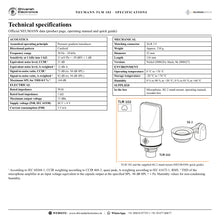
| Acoustical operating principle | Pressure gradient transducer |
| Directional pattern | Cardioid |
| Frequency range | 20 Hz - 20 kHz |
| Sensitivity at 1 kHz into 1 kΩ | 11 mV/Pa (-39 dBV ± 1 dB) |
| Equivalent noise level, CCIR | 21 dB |
| Equivalent noise level, A‑weighted | 12 dB‑A |
| Signal‑to‑noise ratio, CCIR (re. 94 dB SPL) | 73 dB |
| Signal‑to‑noise ratio, A‑weighted (re. 94 dB SPL) | 82 dB |
| Maximum SPL for THD 0.5 % | 144 dB |
Electrical
| Rated impedance | 50 Ω |
| Rated load impedance | 1 kΩ |
| Maximum output voltage | 13 dBu |
| Supply voltage (P48, IEC 61938) | 48 V ± 4 V |
| Current consumption (P48, IEC 61938) | 3.5 mA |
| Output | Balanced, transformerless; XLR 3: pin 1 0 V / ground, pin 2 + phase, pin 3 - phase |
Mechanical and environment
| Matching connector | XLR 3 F |
| Weight | Approx. 210 g |
| Diameter | 52 mm |
| Length | 116 mm |
| Operating temperature | 0 °C to +70 °C |
| Storage temperature | -20 °C to +70 °C |
| Humidity (non‑condensing) | 0 % to 90 % at +20 °C; 0 % to 85 % at +60 °C |
Notes
| Noise and S/N | According to IEC 60268‑1; CCIR weighting according to CCIR 468‑3, quasi peak; A‑weighting according to IEC 61672‑1, RMS |
| Maximum SPL | THD of the microphone amplifier at an input voltage equivalent to the capsule output at the specified SPL |
| Reference | 94 dB SPL = 1 Pa |
Product overview
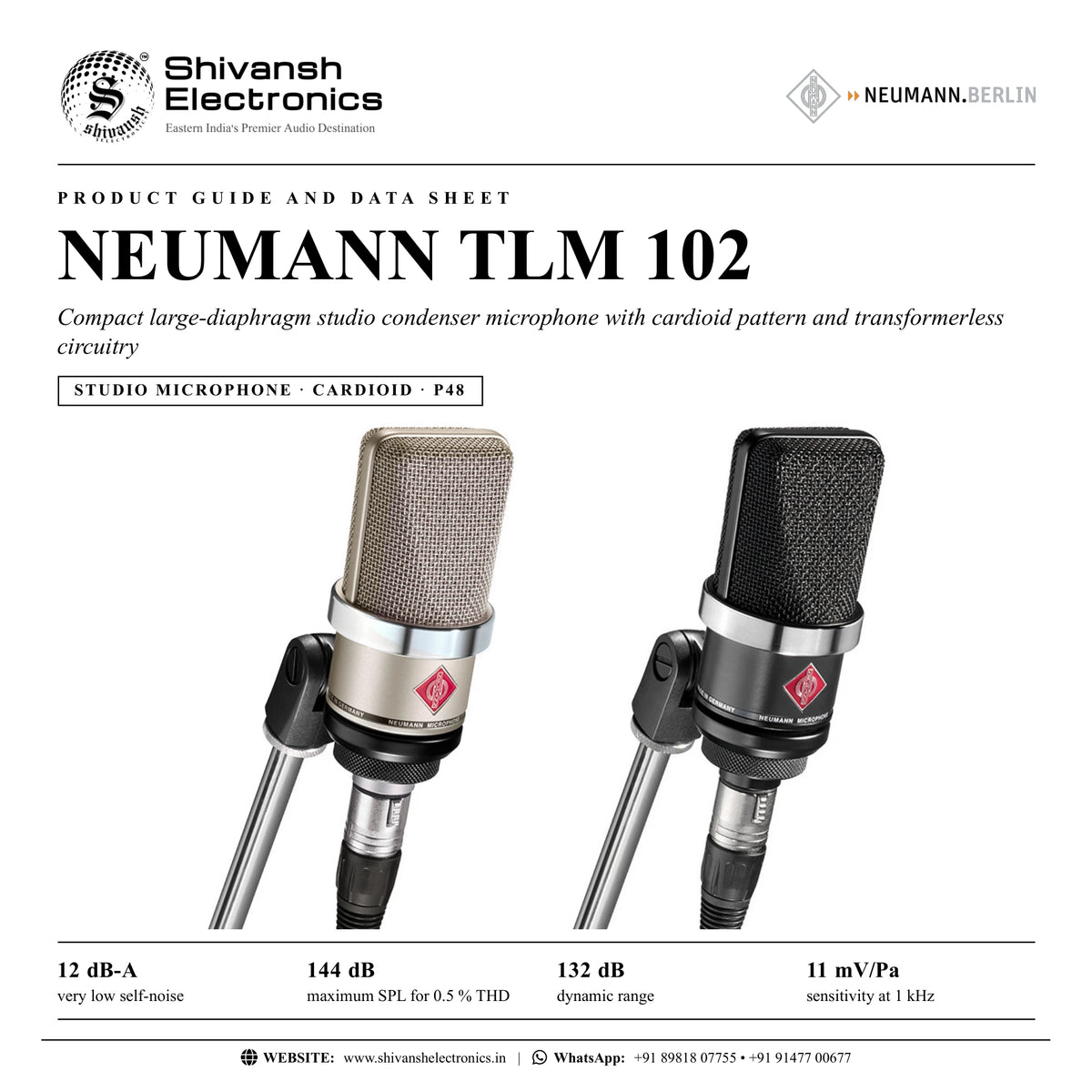
The NEUMANN TLM 102 is a compact large-diaphragm condenser microphone with a cardioid pattern and transformerless circuitry that brings Neumann quality to even the smallest studio.
It combines technical excellence with a beautifully balanced sound for silky vocals, crisp guitars and powerful drums. With its cardioid pattern and an integrated pop screen, the TLM 102 is a joy to use, even for novices.
| Very low self‑noise | 12 dB‑A |
| Maximum SPL for 0.5 % THD | 144 dB |
| Dynamic range | 132 dB |
| Sensitivity at 1 kHz | 11 mV/Pa |
Key features
- Compact microphone with genuine Neumann large-diaphragm capsule
- Uniform cardioid pattern, addressed from the side with the Neumann logo
- Transformerless circuitry for high SPLs without distortion: up to 144 dB
- Very low self-noise of only 12 dB-A
- Gentle treble lift around 10 kHz for silky highs
- Integrated pop screen
- Dynamic range of 132 dB, sensitivity 11 mV/Pa
- Balanced XLR 3 output, 48 V phantom powering (P48, 3.5 mA)
Smart looks, smart engineering
The newly developed large-diaphragm condenser capsule of the TLM 102 delivers a clear and focused sound with superb definition. Its remarkably linear response across the entire midrange captures the authentic character of any voice or instrument, enhanced by a slight lift around 10 kHz for silky highs, and the well-controlled proximity effect of a large-diaphragm cardioid capsule gives it a gorgeous bottom end.
Technical performance
Its self-noise of only 12 dB-A is much lower than the ambient noise in even a very quiet room, while it handles sound pressure levels of up to 144 dB free from distortion. As a member of the TLM range it has a transformerless output stage: powerful bass even at highest signal levels and a very direct sound without transmission losses.
Big sound for small studios
Due to its enormous dynamic range of 132 dB and a remarkably uniform cardioid pickup pattern, the TLM 102 is very easy to use in home and project studios and in demanding live applications. Its uncoloured sound and fast transient response suit male and female vocals, acoustic and electric guitar, bass guitar and double bass, drums, percussion, brass and saxophone.
Designed and made in Germany
The TLM 102 is a true Neumann, designed and manufactured in Germany with great attention to every detail: a gleaming chrome ring between a classic tapered headgrille and the famous Neumann diamond, in nickel or black.
In the box
- TLM 102 microphone (nickel) or TLM 102 bk microphone (black)
- SG 2 stand mount
- Operating manual
- Wooden box
Available versions
- TLM 102: nickel, Cat. No. 008626
- TLM 102 bk: black, Cat. No. 008627
NEUMANN TLM 102: frequently asked questions
Does the TLM 102 need phantom power?
Yes. It requires 48 V phantom power (P48, IEC 61938): any P48 supply that provides at least 3.5 mA per channel can be used.
Which side of the TLM 102 is the front?
The microphone is addressed from the side on which the Neumann logo is located.
How quiet is the TLM 102?
Its equivalent noise level is only 12 dB-A (21 dB CCIR), with a signal-to-noise ratio of 82 dB A-weighted re. 94 dB SPL.
What is the difference between the TLM 102 and the TLM 102 bk?
Only the finish: the TLM 102 (Cat. No. 008626) is nickel and the TLM 102 bk (Cat. No. 008627) is black. Both come with the SG 2 stand mount.
Where can I buy the NEUMANN TLM 102 in India?
The NEUMANN TLM 102 is available from Shivansh Electronics, Kolkata, West Bengal, India, with delivery across India.
Workflow 1: Lead vocals in a home studio
Singers and producers recording vocals at home or in a project studio.
Connections
| Connect | To |
|---|---|
| TLM 102 in its SG 2 stand mount | Microphone stand |
| XLR 3 microphone cable | Microphone preamp or audio interface input |
| Pop screen | Between singer and microphone |
Setup
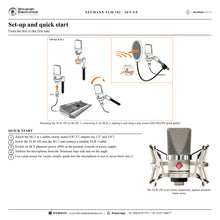
- Mount the TLM 102 in the SG 2 on a stable stand.
- Connect a balanced XLR 3 cable and switch on 48 V phantom power.
- Face the Neumann logo to the singer and place a pop screen in between.
- Set the gain with the loudest passage and record.
Tip: The integrated pop screen helps, but a pop screen in front is still recommended for close vocals.
Workflow 2: Acoustic guitar
Guitarists and engineers recording acoustic guitar.
Connections
| Connect | To |
|---|---|
| TLM 102 | Stand in front of the guitar |
| XLR 3 cable | P48 input |
Setup
- Place the microphone in front of the guitar, logo side facing the instrument.
- Switch on phantom power.
- Move it to balance body and string sound.
- Set the gain and record.
Tip: Fast transient response keeps picking detail crisp.
Workflow 3: Guitar and bass amplifiers
Musicians recording electric guitar or bass guitar amplifiers.
Connections
| Connect | To |
|---|---|
| TLM 102 | Stand in front of the amplifier |
| XLR 3 cable | P48 input |
Setup
- Aim the logo side at the speaker.
- Start with a low gain setting.
- Raise the gain until there is enough headroom at the loudest notes.
- Record.
Tip: 144 dB maximum SPL handles loud amplifiers without distortion.
Workflow 4: Drums and percussion
Engineers miking drums, overheads or percussion.
Connections
| Connect | To |
|---|---|
| TLM 102 | Stand above or beside the kit |
| XLR 3 cable | P48 input of the console or interface |
Setup
- Position the microphone over the kit or in front of the percussion.
- Switch on phantom power.
- Set the gain for the loudest hits.
- Check the balance and record.
Tip: The transformerless output keeps the bass powerful even at highest levels.
Workflow 5: Brass and saxophone
Horn players and engineers recording brass and saxophone.
Connections
| Connect | To |
|---|---|
| TLM 102 | Stand in front of the instrument |
| XLR 3 cable | P48 input |
Setup
- Place the microphone in front of the bell, logo side facing it.
- Switch on phantom power.
- Adjust distance to tame the loudest notes.
- Set the gain and record.
Tip: The uniform cardioid pattern keeps the source in focus.
Workflow 6: Live and speech
Users of demanding live applications, podcasts and voice recordings.
Connections
| Connect | To |
|---|---|
| TLM 102 | Stand or elastic suspension |
| XLR 3 cable | Console or P48 power supply |
Setup
- Mount the microphone; use an elastic suspension against structure-borne noise.
- Connect to a P48 input that supplies at least 3.5 mA.
- Address the microphone from the logo side.
- Test by speaking, never by blowing into it.
Tip: Cable lengths up to approximately 300 m do not affect the frequency response.


