
NEUMANN U 87 Ai
MRP - Rs. 3,94,900
NEUMANN U 87 Ai studio condenser microphone: omni, cardioid and figure-8, pad and low cut, 12 dB-A self-noise, nickel or matte black. Available in India from Shivansh Electronics, Kolkata, West Bengal, India.
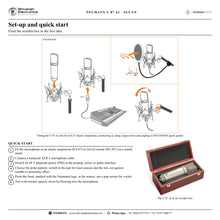
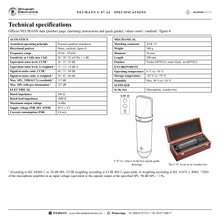
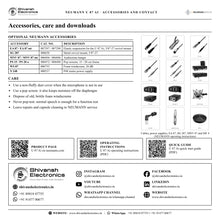
VISUAL GUIDE — See Every Photo, Spec & Setup Step (PDF)
The price shown is the MAXIMUM RETAIL PRICE (MRP), inclusive of all taxes. For the best price, exclusive offers and discounted rates, delivery timelines, or any other information, please DM us or call +91 89818 07755 / +91 91477 00677. We will gladly share an exclusive coupon code that you can apply at checkout. All payments are processed securely through Razorpay, our trusted payment gateway partner.
Acoustics
| Acoustical operating principle | Pressure gradient transducer |
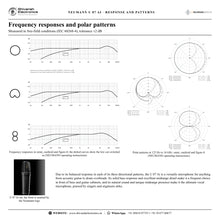
| Directional pattern | Omnidirectional, cardioid, figure‑8 |
| Frequency range | 20 Hz - 20 kHz |
| Sensitivity at 1 kHz into 1 kΩ (omni / cardioid / figure‑8) | 20 / 28 / 22 mV/Pa ± 1 dB |
| Equivalent noise level, CCIR (omni / cardioid / figure‑8) | 26 / 23 / 25 dB |
| Equivalent noise level, A‑weighted (omni / cardioid / figure‑8) | 15 / 12 / 14 dB‑A |
| Signal‑to‑noise ratio, CCIR, re. 94 dB SPL (omni / cardioid / figure‑8) | 68 / 71 / 69 dB |
| Signal‑to‑noise ratio, A‑weighted, re. 94 dB SPL (omni / cardioid / figure‑8) | 79 / 82 / 80 dB |
| Maximum SPL for THD 0.5 % (cardioid) | 117 dB |
| Maximum SPL for THD 0.5 % with pre‑attenuation | 127 dB |
Electrical
| Rated impedance | 200 Ω |
| Rated load impedance | 1000 Ω |
| Maximum output voltage | -6 dBu |
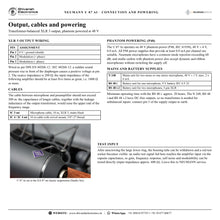
| Supply voltage (P48, IEC 61938) | 48 V ± 4 V |
| Current consumption (P48, IEC 61938) | 0.8 mA |
| Output | Transformer‑balanced; pin 1 ground, pin 2 +, pin 3 - |
| Switches | Polar pattern; pre‑attenuation -10 dB; low cut |
Mechanical and environment
| Matching connector | XLR 3 F |
| Weight | 500 g |
| Diameter | 56 mm |
| Length | 200 mm |
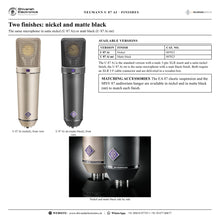
| Finishes | Nickel; matte black (mt) |
| Operating temperature range | 0 °C to +70 °C |
| Storage temperature range | -20 °C to +70 °C |
| Humidity range | Max. 90 % at +20 °C |
Notes
| Noise and S/N | According to IEC 60268‑1; CCIR weighting according to CCIR 468‑3, quasi peak; A‑weighting according to IEC 61672‑1, RMS |
| Maximum SPL | THD of the microphone amplifier at an input voltage equivalent to the capsule output at the specified SPL |
Product overview
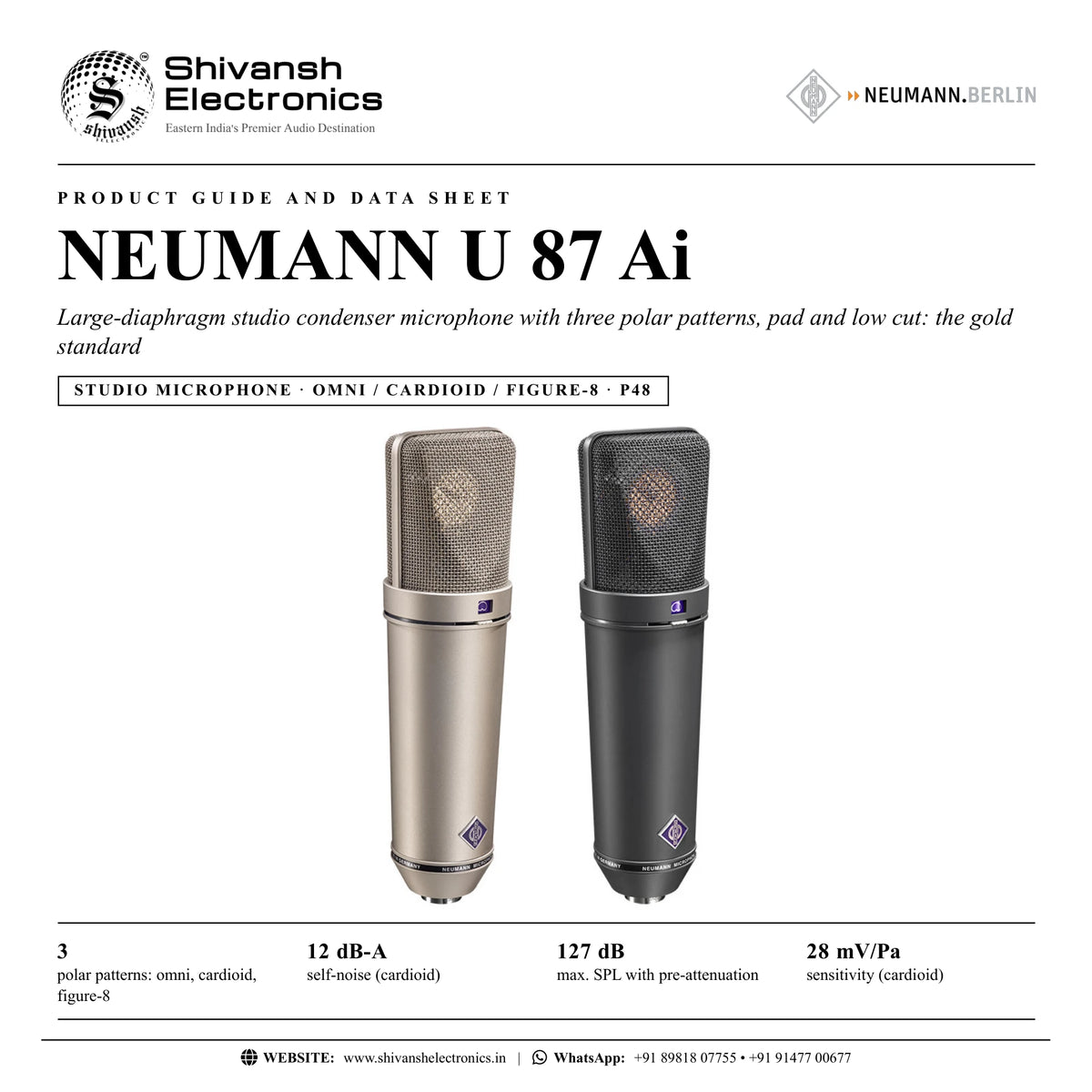
The NEUMANN U 87 Ai is probably the best-known and most frequently used studio microphone the world over: a large-diaphragm condenser microphone with three polar patterns, pad and low cut, and a smooth, refined sound as iconic as its elegant design.
Introduced in 1967, the U 87 has shaped the sound of countless hit records, and to this day no professional recording studio is complete without one. It is the standard microphone for speech and vocals, and its unique combination of linearity and character makes it both versatile and instantly recognisable: although its on-axis frequency response is remarkably flat, it just sounds right. The U 87 Ai is available in nickel and in matte black (U 87 Ai mt), each delivered in a wooden box.
| Polar patterns: omni, cardioid, figure‑8 | 3 |
| Self‑noise (cardioid) | 12 dB‑A |
| Max. SPL with pre‑attenuation | 127 dB |
| Sensitivity (cardioid) | 28 mV/Pa |
Key features
- The world's most famous studio microphone, introduced in 1967
- Classic sound, instantly recognisable yet versatile, with a balanced frequency response
- Three polar patterns: omni, cardioid, figure-8
- Switchable low cut and pad: -10 dB pre-attenuation for up to 127 dB SPL
- Very low self-noise: 12 dB-A in cardioid
- Dual-diaphragm capsule design of the U 67, FET circuit with transformer-balanced output
- XLR 3 output, 48 V phantom powering (P48, 0.8 mA)
- Two finishes: nickel and matte black (mt), delivered in a wooden box
Classic Neumann engineering
The U 87 Ai uses the same dual-diaphragm condenser capsule design as its predecessor, the legendary U 67 of the early 1960s. Its head amplifier is based on the same design principles as its tube-driven predecessor, but realises them with a unique FET circuit with a minimal signal path and a transformer-balanced output, ensuring maximum signal integrity and high common mode rejection. The result is a studio microphone of unmatched clarity.
Three patterns, pad and low cut
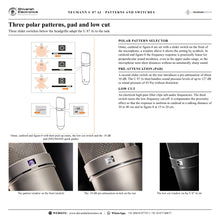
Omni, cardioid or figure-8 are selected with a slider switch on the front, shown by symbols in a window above it. A second switch on the rear introduces a pre-attenuation of about 10 dB, so the microphone handles up to 127 dB SPL without distortion. The low-cut switch compensates the proximity effect: the response is uniform in cardioid at 30 to 40 cm and in figure-8 at 15 to 20 cm talking distance.
Applications
Its natural sound and unique midrange presence make the U 87 Ai the ultimate vocal microphone and the prime choice for speech: voice-over, dubbing and audio books. Thanks to its balanced response in each pattern it is a versatile microphone for anything from acoustic guitar to drum overheads; its solid bass and excellent midrange detail suit bass and guitar cabinets; in classical recordings it is a frequent spot microphone for soloists such as cello, and a stereo pair is the preferred choice of many engineers for piano in any genre.
In the box
- U 87 Ai microphone (nickel) or U 87 Ai mt microphone (matte black)
- Wooden box
Available versions
- U 87 Ai mt: matte black, Cat. No. 007023
- U 87 Ai: nickel, Cat. No. 007022
NEUMANN U 87 Ai: frequently asked questions
Which polar patterns does the U 87 Ai offer?
Omni, cardioid and figure-8, selected with a slider switch on the front of the microphone; a window above it shows the setting.
Does the U 87 Ai need phantom power?
Yes: 48 V phantom power (P48, IEC 61938), 48 V ± 4 V, 0.8 mA. Any P48 supply that provides at least 0.8 mA per channel is suitable.
What do the pad and low-cut switches do?
The pad reduces the sensitivity by about 10 dB so the microphone handles up to 127 dB SPL. The low cut attenuates low-frequency noise and compensates the proximity effect at close distances.
What is the difference between the U 87 Ai and the U 87 Ai mt?
Only the finish: the U 87 Ai (Cat. No. 007022) has a satin nickel finish and the U 87 Ai mt (Cat. No. 007023) a matt black finish. Both are delivered in a wooden box.
Where can I buy the NEUMANN U 87 Ai in India?
The NEUMANN U 87 Ai is available from Shivansh Electronics, Kolkata, West Bengal, India, with delivery across India.
Workflow 1: Lead vocals
Singers, producers and studios recording vocals.
Connections
| Connect | To |
|---|---|
| U 87 Ai in an EA 87 elastic suspension | Microphone stand |
| XLR 3 microphone cable | Microphone preamp or audio interface input (P48) |
| Pop screen (PS 15 / PS 20 a) | Between singer and microphone |
Setup
- Fit the U 87 Ai in the elastic suspension and connect a balanced XLR cable.
- Switch on 48 V phantom power.
- Select cardioid and face the front (Neumann logo) to the singer, with a pop screen in between.
- Set the gain on the loudest passage and record.
Tip: Use the low cut if the singer works very close to the microphone.
Workflow 2: Voice-over, dubbing and audio books
Speakers and narrators in voice booths and broadcast studios.
Connections
| Connect | To |
|---|---|
| U 87 Ai | Mixer or interface microphone input (P48) |
| Elastic suspension | Desk or floor stand |
Setup
- Select cardioid.
- Position the speaker 30 to 40 cm in front of the logo side and switch in the low cut for an even response.
- Check the level with normal speech.
- Record.
Tip: Test with normal speech, never by blowing into the microphone.
Workflow 3: Acoustic guitar and solo instruments
Recording acoustic instruments in the studio.
Connections
| Connect | To |
|---|---|
| U 87 Ai | Preamp input (P48) |
Setup
- Select cardioid for a focused sound or omni to include more room.
- Place the microphone in front of the instrument.
- Move it until body and detail are balanced.
- Record and compare takes.
Tip: The response stays balanced in each of the three patterns.
Workflow 4: Bass and guitar cabinets
Engineers miking amplifiers close up.
Connections
| Connect | To |
|---|---|
| U 87 Ai | Preamp or mixer input (P48) |
Setup
- Switch in the -10 dB pad.
- Place the microphone in front of the speaker.
- Set the gain so the input does not clip.
- Record.
Tip: With the pad the U 87 Ai handles up to 127 dB SPL.
Workflow 5: Drum overheads and room sound
Drum recording in studios.
Connections
| Connect | To |
|---|---|
| U 87 Ai (one or two) | Preamp inputs (P48) |
| Swivel mount or suspension | Tall boom stands |
Setup
- Place the microphone(s) above the kit.
- Use cardioid for a direct sound or omni for more room.
- Switch in the pad if the cymbals are loud.
- Check the balance of the kit and record.
Tip: Use the low cut against stand rumble.
Workflow 6: Piano and classical soloists
Classical, jazz and pop engineers.
Connections
| Connect | To |
|---|---|
| Two U 87 Ai as a stereo pair | Two preamp inputs (P48) |
| Stereo bar or two stands | In front of or above the piano |
Setup
- Set up two U 87 Ai as a stereo pair at the piano, or one as a spot microphone for a soloist such as cello.
- Choose the pattern for the stereo technique.
- Match the gain of both channels.
- Record.
Tip: A stereo pair of U 87 Ai is the preferred choice of many engineers for piano.