
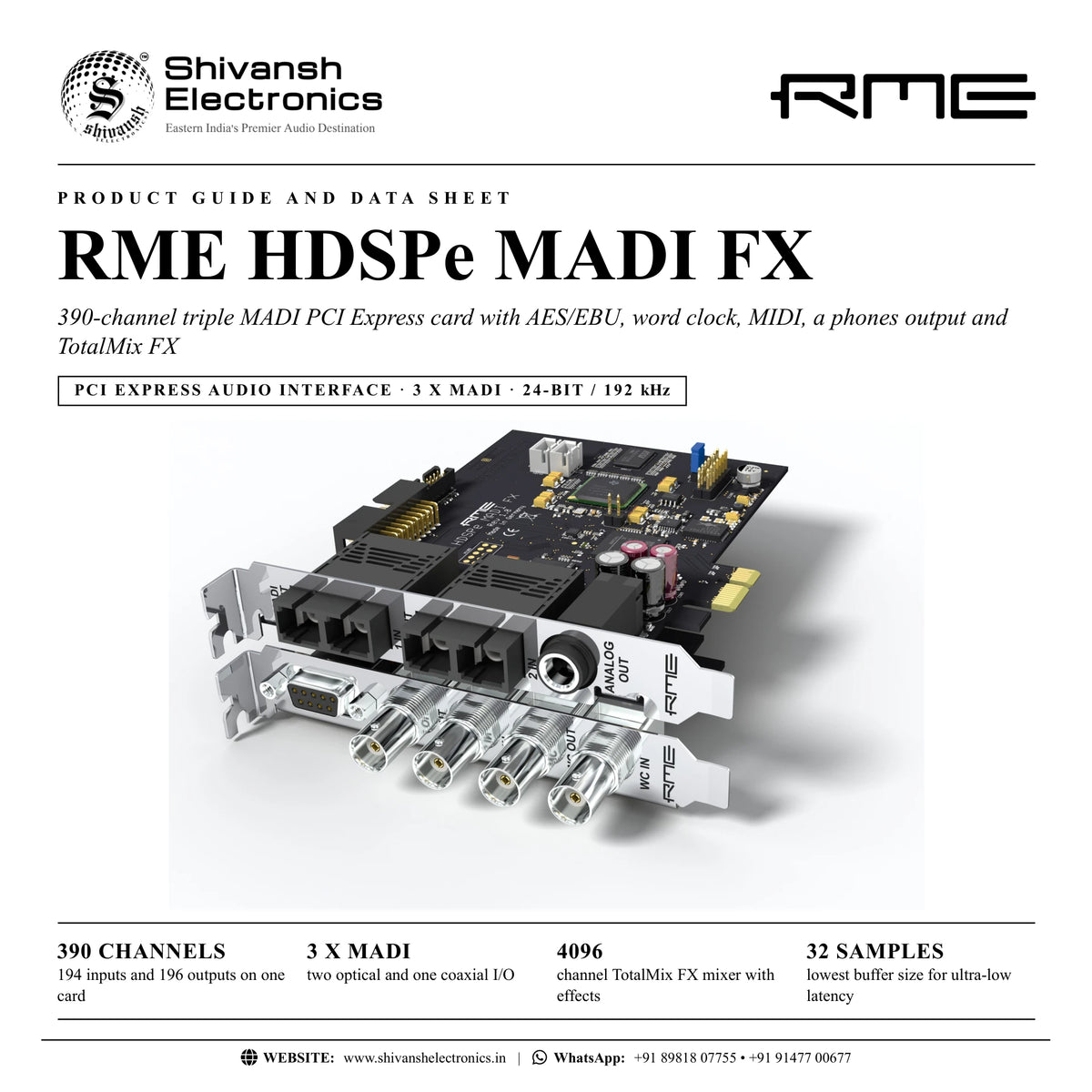


RME HDSPe MADI FX
MRP - Rs. 1,82,157
RME HDSPe MADI FX 390-channel PCIe card: 2 x optical and 1 x coaxial MADI, AES/EBU, word clock, MIDI, phones output, TotalMix FX and SRO. Available in India from Shivansh Electronics, Kolkata, West Bengal, India.
VISUAL GUIDE — See Every Photo, Spec & Setup Step (PDF)
The price shown is the MAXIMUM RETAIL PRICE (MRP), inclusive of all taxes. For the best price, exclusive offers and discounted rates, delivery timelines, or any other information, please DM us or call +91 89818 07755 / +91 91477 00677. We will gladly share an exclusive coupon code that you can apply at checkout. All payments are processed securely through Razorpay, our trusted payment gateway partner.
General
| Type | 390‑channel triple MADI PCI Express card, 24‑bit / 192 kHz |
| Channels | 192 / 192 MADI at 48 kHz, 96 / 96 at 96 kHz, 48 / 48 at 192 kHz, plus AES and analogue |
| Bus | PCI Express 1.1, 1‑lane endpoint, 2.5 Gbps, up to 500 MB/s |
| Buffer sizes | 32 to 8192 samples |
| Mixer | TotalMix FX, 4096 channels, 46‑bit; 3‑band EQ, Low Cut, Reverb, Echo, Compressor, Expander, Auto Level, Room EQ |
| Clock sources | Internal, MADI, word clock, AES |
| Sample rates | 28 - 200 kHz (DDS) |
MADI
| Optical | 2 x FDDI duplex SC, 62.5/125 and 50/125; up to 2000 m |
| Coaxial | 1 x BNC, 75 Ohm, AES10‑1991; up to 100 m |
| Formats | 56 and 64 channel mode, plus 96k Frame; 64 / 32 / 16 channels per port at 48 / 96 / 192 kHz |
AES/EBU, word clock and MIDI
| AES/EBU | 1 x XLR I/O (breakout), transformer‑balanced, galvanically isolated; Professional 4.5 Vpp, Consumer 2.6 Vpp; 27 - 200 kHz |
| Word clock | BNC in (10 kOhm, switchable 75 Ohm) and out (4.0 Vpp into 75 Ohm) |
| MIDI | 1 x MIDI I/O (breakout), 3 x MIDI over MADI |
Stereo monitor output (phones)
| Connector | 6.3 mm TRS, 75 Ohm |
| SNR | 115 dB RMS unweighted, 118 dBA at 44.1 kHz |
| THD / THD+N | < -104 dB / < -102 dB |
| Frequency response | 5 Hz - 22 kHz at 44.1 kHz (-0.5 dB); 5 Hz - 66.5 kHz at 192 kHz (-1 dB) |
| Output level | +13 dBu at 0 dBFS |
System requirements
| Slot | One free PCI Express slot (1 lane, version 1.1) plus one slot opening |
| Drivers | RME drivers for Windows and macOS |
Product overview
The RME HDSPe MADI FX is a 390-channel triple MADI PCI Express card: two optical and one coaxial MADI I/O, AES/EBU, word clock, MIDI and a reference-quality phones output, with TotalMix FX and Seamless Redundancy Operation.
The main board carries two optical MADI I/Os (SC, multi-mode) and the analogue output; the included BNC-X expansion board adds coaxial MADI, word clock on BNC and a 15-pin D-sub for the breakout cable with MIDI and AES/EBU on XLR. A modular Hammerfall Pro Audio Core processes three times the channels of RME's earlier MADI card while reducing system load, with latencies down to 32 samples. Unused channels are deactivated automatically, so stereo playback needs no more performance than a stereo card. Only one PCIe slot plus one slot opening is needed.
| Audio channels (194 in / 196 out) | 390 |
| Two optical, one coaxial | 3 x MADI |
| Channel TotalMix FX mixer | 4096 |
| Lowest buffer size | 32 samples |
Key features
- 192 inputs and 192 outputs in MADI format at 44.1 / 48 kHz; 96 / 96 at 96 kHz, 48 / 48 at 192 kHz
- AES/EBU I/O on XLR, transformer-balanced, also for synchronisation
- Analogue stereo output for high- and low-impedance headphones with its own submix
- TotalMix FX: 4096 channels, 46-bit, EQ, dynamics, reverb, echo and Room EQ
- Seamless Redundancy Operation (SRO) with the three MADI receivers
- Word clock I/O, SteadyClock FS, single / double / quad speed detection
- MIDI: 1 x MIDI I/O plus 3 x MIDI over MADI
- DIGICheck with EBU R128 metering
- Optional OPTO-X board for a third optical MADI I/O
TotalMix FX for hundreds of channels
A special version of TotalMix FX hides unused channels and stores complete hide setups for one-click switching. The 192 kHz effects engine renders EQ, compressors, reverb and echo on the card for latency-free monitoring. In the matrix every channel is routed individually with its own level, turning the card into a MADI router.
Seamless Redundancy Operation
In SRO mode the card records up to 64 channels from one MADI input. If that input fails, the audio of one of the other two inputs is used without interrupting the audio data, with no reclocking, and the interruption is minimised to a few samples.
MIDI over MADI and remote control
Each MADI I/O has its own virtual MIDI port, so MIDI travels invisibly with the audio. This allows remote control and monitoring of all RME MADI devices over long distances, for example between front of house and stage, with free RME MIDI Remote software for Windows and Mac.
In the box
- RME HDSPe MADI FX PCI Express card
- HDSPe MADI FX BNC-X expansion board
- AES/MIDI breakout cable
- Expansion board ribbon cable (20-conductor)
- Internal sync cable (3-conductor)
- Quick Info guide
Free RME software: TotalMix FX, DIGICheck and MIDI Remote. RME drivers for Windows and macOS. Requires one free PCI Express slot (1 lane) and one free slot opening.
RME HDSPe MADI FX: frequently asked questions
How many MADI ports does the MADI FX have?
Three: two optical MADI I/Os on the main board and one coaxial MADI I/O on the BNC-X expansion board. With the optional OPTO-X board all three are optical.
What happens if a MADI feed fails?
In Seamless Redundancy Operation the card switches to one of the other two MADI inputs without interrupting the audio data.
Can I monitor on headphones?
Yes. The analogue stereo output suits high- and low-impedance headphones; any input, track or submix can be monitored, with one-click Cue for each of the 98 stereo submixes.
Where can I buy the RME HDSPe MADI FX in India?
The RME HDSPe MADI FX is available from Shivansh Electronics, Kolkata, West Bengal, India, with delivery across India.
Workflow 1: Large studio MADI system
Connect several MADI converters and preamps to one recording computer.
Connections
| Connect | To |
|---|---|
| MADI converter 1 | MADI 1 optical I/O |
| MADI converter 2 | MADI 2 optical I/O |
| MADI device on BNC | MADI 3 coaxial I/O |
| Headphones | Analogue output |
Setup
- Set all devices to the same sample rate and MADI format.
- Choose the clock source in the Settings dialog.
- Route up to 192 channels each way to the recording software.
- Hide unused channels in TotalMix FX for a clear view.
Workflow 2: Fail-safe live recording
Keep a 64-channel recording running if the main MADI feed fails.
Connections
| Connect | To |
|---|---|
| Main MADI feed | MADI 1 IN |
| Backup MADI feeds | MADI 2 IN and MADI 3 IN |
Setup
- Enable Redundancy Mode in the Settings dialog.
- Record up to 64 channels.
- If the current input fails, another input takes over without interrupting the audio.
- Check the current MADI input in the dialog.
Tip: No reclocking is needed; the interruption is minimised to a few samples.
Workflow 3: FOH to stage with MIDI over MADI
Control RME MADI devices on stage from the front of house computer.
Connections
| Connect | To |
|---|---|
| Stage RME MADI devices | MADI optical I/O |
| RME MIDI Remote | Virtual MIDI over MADI port |
Setup
- Connect the stage devices over optical MADI.
- Give each device its own ID.
- Open MIDI Remote and select the MADI MIDI port.
- Monitor and configure the devices remotely.
Workflow 4: MADI router and format converter
Route individual channels between MADI ports and formats.
Connections
| Connect | To |
|---|---|
| Optical MADI source | MADI 1 IN |
| Coaxial MADI destination | MADI 3 OUT |
Setup
- Open the TotalMix FX matrix.
- Route each channel individually with its own level.
- Save the routing as a snapshot.
- Use in-the-box conversion between optical and coaxial MADI.
Workflow 5: AES/EBU monitoring and talkback
Add a second monitoring output or talkback through the AES/EBU port.
Connections
| Connect | To |
|---|---|
| AD/DA converter | AES/EBU I/O (breakout cable) |
| Main headphones | Analogue output |
Setup
- Connect the converter to the AES/EBU breakout.
- Create a submix for the AES output in TotalMix FX.
- Use the analogue output for the engineer's headphones.
- Set Professional or Consumer AES format as needed.
Workflow 6: Latency-free monitoring with effects
Give performers headphone mixes with effects rendered on the card.
Connections
| Connect | To |
|---|---|
| MADI inputs | MADI 1‑3 |
| Headphone amplifiers | MADI or AES outputs |
Setup
- Build one submix per performer in TotalMix FX.
- Add EQ, dynamics, reverb or echo on the card.
- Recall complete setups with snapshots.
- Calibrate monitors with Room EQ.


