SCHOEPS CMIT 5
PRICE ON ENQUIRY
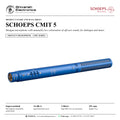
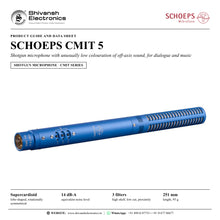
SCHOEPS CMIT 5 shotgun microphone with unusually low off-axis colouration, three switchable filters and a robust all-metal housing. Available in India from Shivansh Electronics, Kolkata, West Bengal, India.
VISUAL GUIDE — See Every Photo, Spec & Setup Step (PDF)
PRICE ON ENQUIRY. For the price, exclusive offers, delivery timelines, or any other information, please Contact / WhatsApp +91 89818 07755 / +91 91477 00677. We will gladly share a personalised quotation for Shivansh Electronics, Kolkata, West Bengal, India. All payments are processed securely through Razorpay, our trusted payment gateway partner.
Acoustics
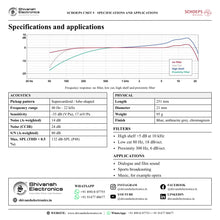
| Pickup pattern | Supercardioid / lobe-shaped |
| Frequency range | 40 Hz - 22 kHz |
| Sensitivity | -35 dB (V/Pa), 17 mV/Pa |
| Equivalent noise level (A-weighted) | 14 dB |
| Equivalent noise level (CCIR) | 24 dB |
| Signal-to-noise ratio (A-weighted) | 80 dB |
| Maximum sound pressure level (THD < 0.5 %) | 132 dB-SPL (P48) |
Filters
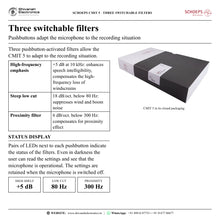
| High shelf filter | Switchable, +5 dB at 10 kHz |
| Low cut filter | Switchable, 80 Hz, 18 dB/oct. |
| Proximity filter | Switchable, 300 Hz, 6 dB/oct. |
Electrical
| Maximum output voltage | 1.3 V (2.5 dBV) with 1 kΩ load |
| Minimum recommended load impedance | 1 kΩ |
| Output impedance | 50 Ω |
| Maximum cable length | More than 400 m |
| SCHOEPS RFI shield | Yes |
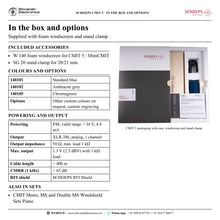
| Powering standard / valid range | P48 / more than 34 V |
| Current consumption | 4.4 mA (P48) |
| Common mode rejection ratio (at 1 kHz) | More than 65 dB |
| Output | XLR-3M, analog, 1 channel |
Physical
| Length | 251 mm |
| Diameter | 21 mm |
| Weight | 95 g |
| Surface finish | Blue; custom colours anthracite grey, chromagreen |
Options
| Custom colour | Anthracite grey, chromagreen, other colours on request |
| Custom engraving | Available |
Product overview
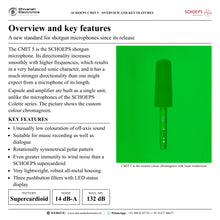
The SCHOEPS CMIT 5 is the SCHOEPS shotgun microphone that has set a new standard for shotgun microphones since its release, with unusually low colouration of off-axis sound.
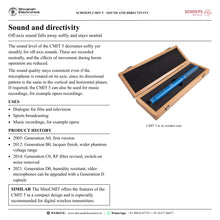
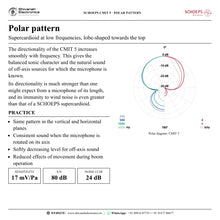
Its directionality increases smoothly with higher frequencies, which gives a very balanced sonic character. The level of off-axis sound decreases softly yet steadily, so sound from the side is recorded neutrally and the effects of movement during boom operation are reduced. The CMIT 5 also has a much stronger directionality than one might expect from a microphone of its length, and it can be used for music recordings as well, for example opera.
Because its directional pattern is the same in the vertical and horizontal planes, the sound stays consistent even when the microphone is rotated on its axis. Three pushbutton-activated filters adapt it to the recording situation, and pairs of LEDs show their status even in darkness. Capsule and amplifier are built as a single unit, and the very lightweight, robust all-metal housing gives even greater immunity to wind noise than a SCHOEPS supercardioid.
| Lobe-shaped, rotationally symmetrical | Supercardioid |
| Equivalent noise level | 14 dB-A |
| Maximum SPL (P48) | 132 dB-SPL |
| Weight, 251 mm long | 95 g |
Key features
- Unusually low colouration of off-axis sound
- Suitable for music recording as well as dialogue
- Rotationally symmetrical polar pattern
- Even greater immunity to wind noise than a SCHOEPS supercardioid
- Very lightweight, robust all-metal housing
- Three switchable filters: high-frequency emphasis, steep low cut and proximity filter
- LED status display that stays readable in darkness; settings retained when switched off
- SCHOEPS RFI shield; humidity resistant since Generation D0
Filters
The high-frequency emphasis (+5 dB at 10 kHz) enhances speech intelligibility and compensates for the high-frequency loss of windscreens. The steep low cut (18 dB/oct. below 80 Hz) suppresses wind and boom noise, and the gentle roll-off (6 dB/oct. below 300 Hz) compensates for proximity effect.
Made for
- Film and television dialogue on the boom
- Sports broadcasting
- Music recording, for example opera
- Location recording where off-axis sound must stay natural
In the box
- CMIT 5 shotgun microphone
- W 140 foam windscreen
- SG 20 stand clamp
SCHOEPS CMIT 5: frequently asked questions
What makes the CMIT 5 different as a shotgun microphone?
Its directionality rises smoothly with frequency and off-axis sound falls away softly and evenly, so sound from the side is recorded with very little colouration and boom movement is less audible.
Can it be used for music?
Yes. SCHOEPS describes the CMIT 5 as suitable for music recording as well as dialogue, for example opera recordings.
Which filters does it have?
Three pushbutton filters: +5 dB at 10 kHz, a low cut of 18 dB/oct. below 80 Hz and a proximity filter of 6 dB/oct. below 300 Hz. LEDs show the status and the settings are kept when the microphone is switched off.
How is it powered?
With P48 phantom power (valid range above 34 V); the current consumption is 4.4 mA. The output is an analog XLR-3M.
Which colours are available?
Standard blue, anthracite grey and chromagreen are offered as variants; other custom colours and custom engraving are available on request.
Where can I buy the SCHOEPS CMIT 5 in India?
The SCHOEPS CMIT 5 is available from Shivansh Electronics, Kolkata, West Bengal, India, with delivery across India.
Workflow 1: Film dialogue on the boom
Production sound mixers recording dialogue on location.
Connections
| Connect | To |
|---|---|
| CMIT 5 with windscreen | Boom pole with elastic suspension |
| CMIT 5 XLR-3M | Recorder input with P48 |
Setup
- Mount the CMIT 5 in an elastic suspension on the boom and fit the windscreen.
- Switch on P48 at the recorder.
- Press the low-cut button when the boom moves or wind is present.
- Add the high-frequency emphasis to compensate a windshield.
Tip: The LEDs show the filter settings even in darkness.
Workflow 2: Sports broadcasting
Broadcast sound teams covering courts and pitches.
Connections
| Connect | To |
|---|---|
| CMIT 5 | Stand or mount at the edge of play |
| CMIT 5 | Console input with P48 |
Setup
- Place the microphone close to the playing area and aim it at the action.
- Use the low cut against low-frequency noise.
- Feed the analog output to the broadcast console.
Tip: Long cable runs of more than 400 m are possible.
Workflow 3: Opera and music recording
Music engineers who need reach with natural off-axis sound.
Connections
| Connect | To |
|---|---|
| CMIT 5 | Stand clamp SG 20 on a stand |
| CMIT 5 | Preamp input with P48 |
Setup
- Aim the microphone at the singers from the stage edge or above.
- Leave the filters off for the most natural sound.
- Blend it with the main microphones in the mix.
Tip: Sound from the side is lower in level but stays neutral.
Workflow 4: Close-range recording
Recordists who must place the microphone close to the source.
Connections
| Connect | To |
|---|---|
| CMIT 5 with W 140 | Stand or boom |
| CMIT 5 | Preamp input with P48 |
Setup
- Fit the W 140 foam windscreen.
- Switch on the proximity filter to compensate for proximity effect.
- Add the high-frequency emphasis for more speech intelligibility.
Tip: The proximity filter rolls off 6 dB/oct. below 300 Hz.
Workflow 5: Outdoor recording in wind
Location and nature recordists.
Connections
| Connect | To |
|---|---|
| CMIT 5 | Windshield with suspension |
| CMIT 5 | Field recorder with P48 |
Setup
- Mount the CMIT 5 in a windshield with suspension.
- Switch on the steep low cut against wind noise.
- Use the high-frequency emphasis to compensate the windshield.
Tip: The CMIT 5 already has greater immunity to wind noise than a SCHOEPS supercardioid.
Workflow 6: MS stereo with the CMIT 5
Film and broadcast recordists needing mono-compatible stereo.
Connections
| Connect | To |
|---|---|
| CMIT 5 (mid) + figure-eight (side) | MS windshield set |
| Two outputs | Two recorder channels, MS decoded later |
Setup
- Use the CMIT 5 as the mid microphone facing the source.
- Add a figure-eight side microphone in the same windshield.
- Record both channels and decode MS in post-production.
Tip: SCHOEPS offers complete CMIT MS and Double MS windshield sets.