

SCHOEPS V4
PRICE ON ENQUIRY
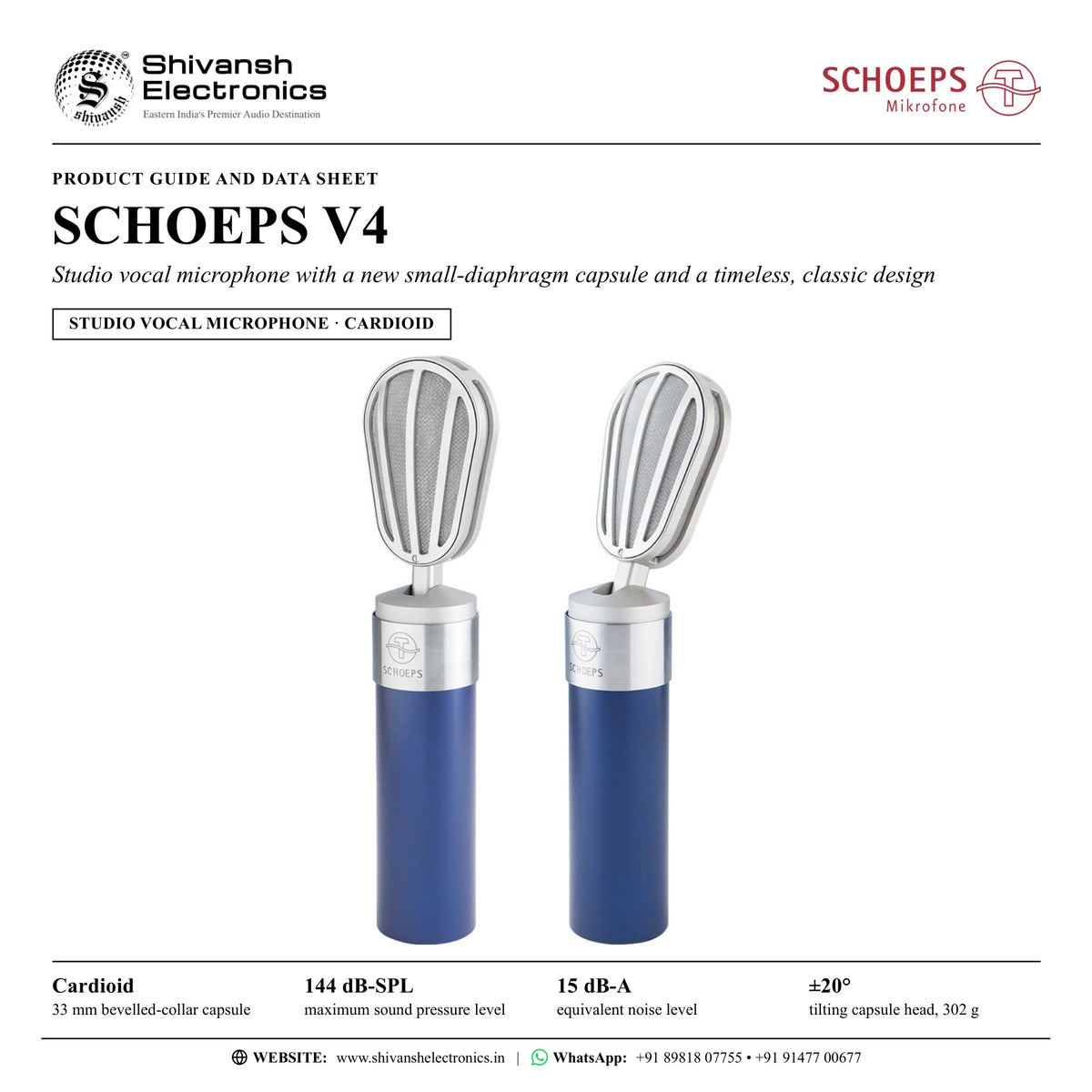
SCHOEPS V4 U studio vocal microphone: new small-diaphragm capsule with bevelled collar, tilting head, 144 dB-SPL and classic design. Available in India from Shivansh Electronics, Kolkata, West Bengal, India.
VISUAL GUIDE — See Every Photo, Spec & Setup Step (PDF)
PRICE ON ENQUIRY. For the price, exclusive offers, delivery timelines, or any other information, please Contact / WhatsApp +91 89818 07755 / +91 91477 00677. We will gladly share a personalised quotation for Shivansh Electronics, Kolkata, West Bengal, India. All payments are processed securely through Razorpay, our trusted payment gateway partner.
Acoustics
| Pickup pattern | Cardioid |
| Frequency range | 50 Hz - 22 kHz |
| Sensitivity | -36 dB (V/Pa), 16 mV/Pa |
| Equivalent noise level (A-weighted) | 15 dB |
| Equivalent noise level (CCIR) | 25 dB |
| Signal-to-noise ratio (A-weighted) | 79 dB |
| Maximum sound pressure level (THD < 0.5 %) | 144 dB-SPL |
| Low cut filter | 40 Hz, 18 dB/oct. |
Electrical
| Maximum output voltage | 4.8 V (13 dBV) with 1 kΩ load |
| Minimum recommended load impedance | 1 kΩ |
| Output impedance | 50 Ω |
| Maximum cable length | More than 300 m |
| SCHOEPS RFI shield | Yes |
| Powering standard / valid range | P48 / more than 43 V |
| Current consumption | 3.3 mA |
| Common mode rejection ratio (at 1 kHz) | More than 80 dB |
| Output | XLR-3M, analog, 1 channel |
Physical
| Length | 194 mm |
| Diameter | 34 mm |
| Width of the capsule head | 45 mm |
| Head swivel | ±20° |
| Weight | 302 g |
| Surface finish | Blue, grey or special finish |
Product overview
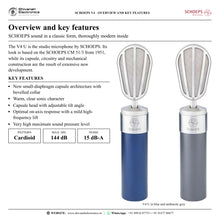
The SCHOEPS V4 U is the SCHOEPS studio vocal microphone, uniting the outstanding technical characteristics typical of SCHOEPS with a timeless, classic design.
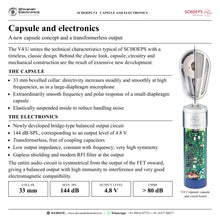
Its look is based on the SCHOEPS CM 51/3 from 1951, but the V4 U is a thoroughly modern studio microphone: capsule, circuitry and mechanical construction are the result of extensive new development. A new small-diaphragm capsule architecture with a 33 mm bevelled collar makes the directivity increase steadily and smoothly at high frequencies, as in a large-diaphragm microphone, while keeping the extraordinarily smooth frequency and polar response of a small-diaphragm capsule.
The result is a warm, clear sonic character. The on-axis response is optimal with a mild high-frequency lift, and the diffuse-field response runs parallel to it with a gentle roll-off at high frequencies, so room sound stays pleasant. The capsule head tilts by ±20°, the capsule is elastically suspended inside against handling noise, and newly designed electronics reach a very high maximum sound pressure level of 144 dB-SPL.
| Pickup pattern | Cardioid |
| Maximum SPL | 144 dB-SPL |
| Equivalent noise level | 15 dB-A |
| Tilting capsule head | ±20° |
Key features
- New small-diaphragm capsule architecture with bevelled collar for controlling the polar response
- Warm, clear sonic character with smoothly rolled-off diffuse-field response
- Capsule head with adjustable tilt angle (±20°)
- Optimal on-axis frequency response with a mild high-frequency lift
- Very smooth polar response with carefully controlled narrowing at high frequencies
- Diffuse-field response parallel to the 0° response, with a gentle roll-off at high frequencies
- Newly designed electronics with a very high maximum SPL of 144 dB-SPL
- Transformerless, balanced bridge-type output; high immunity to interference
The electronics
A newly developed bridge-type balanced output circuit gives a maximum sound pressure level of 144 dB-SPL, corresponding to an output level of 4.8 V. The output stage is transformerless and free of coupling capacitors, so the output impedance is low and constant with frequency while the symmetry is very high. The entire audio circuit is symmetrical from the output of the FET onward, with gapless shielding and a modern RFI filter at the output for very good electromagnetic compatibility.
Made for
- Studio vocals, including close-miked rock vocals
- Acoustic instruments such as guitar and viola
- Speech recording
In the box
- V4 U studio microphone
- Premium case
- Mounting is separate: the USM-V4 elastic suspension or SGV stand clamp, or the V4 USM Set and V4 SGV Set
SCHOEPS V4: frequently asked questions
Is the V4 a large- or small-diaphragm microphone?
It uses a small-diaphragm capsule with a 33 mm bevelled collar. The collar makes the directivity increase smoothly at high frequencies, as in a large-diaphragm microphone, while the smooth frequency and polar response of a small diaphragm are kept.
How does it sound?
Warm and clear. The 0° response is linear to 20 kHz with a moderate 2 dB lift between 4 and 15 kHz, and the diffuse-field response runs parallel with a gentle high-frequency roll-off, so the room sound is pleasant and never draws attention to itself.
Can the capsule be angled?
Yes. The capsule head swivels by ±20°, so the microphone can be aimed precisely without moving the stand.
How do I mount it?
SCHOEPS recommends the USM-V4 elastic suspension for maximum solid-borne sound isolation, or the SGV stand clamp. Both are also available as sets with the microphone and wooden case.
Which colours are available?
Blue and anthracite grey, both with a premium case; other custom colours are available on request.
Where can I buy the SCHOEPS V4 in India?
The SCHOEPS V4 is available from Shivansh Electronics, Kolkata, West Bengal, India, with delivery across India.
Workflow 1: Lead vocals in the studio
Studio engineers and producers recording singers.
Connections
| Connect | To |
|---|---|
| V4 U in USM-V4 | Microphone stand or boom arm |
| V4 U XLR-3M | Preamp input with P48 |
Setup
- Mount the V4 U in the USM-V4 elastic suspension.
- Tilt the capsule head towards the singer's mouth.
- Switch on P48 and set the gain; the 144 dB-SPL headroom handles loud singers.
Tip: The USM-V4 is recommended for maximum solid-borne sound isolation.
Workflow 2: Close-miked rock vocals
Engineers recording powerful voices close up.
Connections
| Connect | To |
|---|---|
| V4 U | Stand with SGV or USM-V4 |
| V4 U | Preamp input with P48 |
Setup
- Place the singer close to the microphone on axis.
- Set the gain with plenty of headroom.
- Keep the room behind the singer controlled; the diffuse-field roll-off keeps it in the background.
Tip: The transformerless output stays clean even at very high levels.
Workflow 3: Acoustic guitar
Studio engineers recording guitar.
Connections
| Connect | To |
|---|---|
| V4 U | Stand with SGV clamp |
| V4 U | Preamp input with P48 |
Setup
- Position the microphone at a moderate distance from the instrument.
- Use the tilting head to aim at the sweet spot.
- Adjust the distance for the balance of direct and room sound.
Tip: The smooth polar response keeps off-axis sound natural.
Workflow 4: Viola and string instruments
Engineers recording strings in the studio.
Connections
| Connect | To |
|---|---|
| V4 U | Stand with USM-V4 |
| V4 U | Preamp input with P48 |
Setup
- Place the microphone above and in front of the instrument.
- Angle the capsule head towards the instrument.
- Record with little or no EQ.
Tip: The mild high-frequency lift adds clarity without harshness.
Workflow 5: Speech recording
Studios recording speech and narration.
Connections
| Connect | To |
|---|---|
| V4 U in USM-V4 | Boom arm or stand |
| V4 U | Preamp or interface with P48 |
Setup
- Mount the V4 U in the USM-V4 for isolation from table and stand noise.
- Tilt the head towards the speaker.
- Set the gain for speech.
Tip: The internal elastic capsule suspension reduces handling and structure-borne noise.
Workflow 6: Long cable runs and noisy RF environments
Studios and installations with long lines.
Connections
| Connect | To |
|---|---|
| V4 U | Wall box or stage box |
| Stage box | Console input with P48 |
Setup
- Run the cable to the console; more than 300 m is possible.
- Supply P48 (valid range above 43 V).
- Check the level and record.
Tip: Gapless shielding and a modern RFI filter give high immunity to interference.