

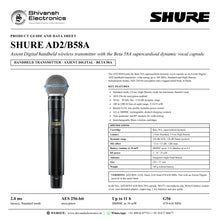
SHURE AD2/B58A
PRICE ON ENQUIRY
Shure AD2/B58A: Axient Digital handheld transmitter with Beta 58A capsule, Standard and High Density modes, AES 256-bit encryption, G56 band. Available in India from Shivansh Electronics, Kolkata, West Bengal, India.
VISUAL GUIDE — See Every Photo, Spec & Setup Step (PDF)
PRICE ON ENQUIRY. For the price, exclusive offers, delivery timelines, or any other information, please Contact / WhatsApp +91 89818 07755 / +91 91477 00677. We will gladly share a personalised quotation for Shivansh Electronics, Kolkata, West Bengal, India. All payments are processed securely through Razorpay, our trusted payment gateway.
Transmitter
| Microphone cartridge | Beta 58A (supercardioid dynamic), RPW118 |
| Mic offset range | -12 to +21 dB, in 1 dB steps |
| Battery type | Shure SB900C rechargeable Li-ion or LR6 AA batteries 1.5 V |
| Battery runtime @ 10 mW | Shure SB900C: up to 11 hours; alkaline: up to 8 hours |
| Battery runtime @ 35 mW (UHF) | SB900C: 5 h 30 min; alkaline: 3 h 30 min |
| Dimensions (L × dia.) | 256 × 51 mm (10.1 × 2.0 in) |
| Weight | 340 g (12.0 oz), without battery |
| Housing | Cast aluminium, black finish |
| Operating temperature | -18 °C (0 °F) to 50 °C (122 °F); battery characteristics may limit this range |
| Storage temperature | -29 °C (-20 °F) to 74 °C (165 °F); battery characteristics may limit this range |
Audio input
| Configuration | Unbalanced |
| Maximum input level (1 kHz at 1 % THD) | 145 dB SPL typical, stated with the SM58 cartridge; dependent on microphone type |
| Audio frequency response | 20 Hz - 20 kHz (±1 dB), dependent on microphone type |
RF output
| Antenna type | Integrated single-band helical |
| Occupied bandwidth | <200 kHz |
| Channel-to-channel spacing | Standard mode: 350 kHz; High Density mode: 125 kHz (varies by region) |
| Modulation type | Shure Axient Digital proprietary |
| RF output power | 2 mW, 10 mW, 35 mW (G56: 2/10/35 mW; varies by region) |
| Specific absorption rate (SAR) | <0.19 W/kg |
System (with an Axient Digital receiver)
| RF carrier frequency range | 470-960 MHz, varies by region; this item: G56, 470-636 MHz |
| Working range | 100 m (330 ft); actual range depends on RF signal absorption, reflection and interference |
| RF tuning step size | 25 kHz, varies by region |
| Latency | Standard mode: 2.0 ms; High Density mode: 2.9 ms |
| Audio dynamic range (A-weighted, typical, system gain +10) | XLR analog output: 120 dB (117 dB unweighted); Dante digital output: 130 dB (126 dB unweighted) |
| Total harmonic distortion (-6 dBFS input, 1 kHz, system gain +10) | <0.01 % |
| System audio polarity | Positive pressure on the microphone diaphragm gives positive voltage on pin 2 (with respect to pin 3) of the XLR output and the tip of the 6.35 mm (1/4") output |
Versions
| AD2/B58=-G56 | Black finish, G56: 470-636 MHz |
Product overview
The Shure AD2/B58A is an Axient Digital handheld wireless microphone transmitter with the Beta 58A supercardioid dynamic vocal capsule, built in rugged metal with a black finish.
A rugged metal handheld transmitter with powerful features and a BETA 58A cartridge, in black. The AD2/B58A is a component of Axient Digital Wireless Systems: it pairs with an Axient Digital receiver such as the AD4D two-channel or AD4Q four-channel receiver in the same frequency band. With breakthrough RF performance and wide tuning up to 184 MHz, it puts professional-quality wireless digital audio within reach. In India it is offered in the G56 band, 470 to 636 MHz; when buying separate wireless components, match their frequency bands to ensure proper system operation.
Two transmission modes let you balance coverage and channel count. Standard mode gives optimal coverage with 2.0 ms latency, while High Density mode gives a dramatic increase in maximum system channel count, with 125 kHz channel spacing instead of 350 kHz and 2.9 ms latency. Every link can be secured with AES 256-bit encryption, the audio path offers a flat 20 Hz to 20 kHz range and more than 120 dB dynamic range, and line-of-sight operating range is 100 m (300 ft). RF power switches between 2, 10 and 35 mW.
Power comes from two AA batteries or a Shure SB900-series lithium-ion rechargeable battery: up to 8 hours on alkaline AA cells and up to 11 hours on the SB900C at 10 mW, with precision metering, zero memory effect and external contacts for docked charging. A backlit LCD with easy-to-navigate menus, a low-profile lockable power switch, menu and power lockout, Safe Start, RF mute, a built-in tone generator and RF markers for walk-testing make it practical for busy productions.
The microphone cartridge is interchangeable: the AD2/B58A ships with the Beta 58A capsule (RPW118), and other Shure wireless cartridges listed in the AD2 user guide, such as the SM58, Beta 58A, Beta 87A, KSM8, KSM9 and KSM11, fit the same AD2 body. The supplied battery contact cover prevents reflections from the battery contacts during broadcasts or live performances.
| Latency, Standard mode | 2.0 ms |
| Encryption-enabled transmission | AES 256-bit |
| SB900C rechargeable at 10 mW | Up to 11 h |
| G56 band | 470-636 MHz |
Key features
- Beta 58A supercardioid dynamic vocal capsule on an Axient Digital AD2 handheld transmitter
- Works with Axient Digital Wireless Systems; wide tuning up to 184 MHz
- Two transmission modes: Standard for optimal coverage, High Density for maximum system channel count and robust coverage
- AES 256-bit encryption-enabled, secure transmission
- 20 Hz to 20 kHz flat frequency response, >120 dB dynamic range, automatic input staging
- 100 m (300 ft) line-of-sight operating range; switchable 2/10/35 mW RF power
- Rugged cast aluminium construction in black finish
- Backlit LCD with easy-to-navigate menu and controls
- Low-profile, lockable power switch; menu and power lockout
- AA or SB900C lithium-ion rechargeable batteries; external contacts for docked charging
- Built-in tone generator and RF markers for walk-testing
- Interchangeable Shure wireless microphone cartridges
Made for
- Vocals on live stages
- Professional musical entertainment and similar productions
- Multi-channel productions in crowded RF using High Density mode
- Broadcasts and live performances (battery contact cover against reflections)
- Events that need encrypted, secure wireless audio
In the box
- AD2/B58A handheld transmitter with Beta 58A capsule
- WA371 microphone clip
- WA618 battery contact cover for AD2
- Euro-threaded adapter (31A1856)
- Zipper bag (95B2313)
- 2 × AA alkaline batteries
- User guide
Connections
- Wireless link to an Axient Digital receiver, G56 band 470-636 MHz, integrated single-band helical antenna
- Infrared (IR) port for IR sync and firmware updates from the receiver
- External charging contacts for Shure docking chargers
Shure AD2/B58A: frequently asked questions
Is the AD2/B58A a complete wireless system?
No. The AD2/B58A is the handheld transmitter only. It needs an Axient Digital receiver, such as the AD4D or AD4Q, in the same frequency band; this item is the G56 version, 470 to 636 MHz.
Standard or High Density mode: which should I use?
Standard mode gives optimal coverage and the lowest latency (2.0 ms). High Density mode dramatically increases the maximum system channel count, with 125 kHz channel spacing, at 2.9 ms latency. For more range, Shure advises Standard (normal) mode instead of High Density.
How long do the batteries last?
At 2 or 10 mW, up to 11 hours on a Shure SB900C rechargeable battery and up to 8 hours on two AA alkaline batteries; at 35 mW about 5 hours 30 minutes and 3 hours 30 minutes. NiMH and lithium primary AA cells also work: set the battery type in the menu for an accurate runtime display.
Can I change the microphone cartridge?
Yes. The AD2 takes interchangeable Shure wireless cartridges; the user guide lists models such as the SM58, Beta 58A, Beta 87A, Beta 87C, KSM8, KSM9, KSM9HS and KSM11. The AD2/B58A ships with the Beta 58A capsule.
Is the transmitter encrypted?
Yes. Transmission is AES 256-bit encryption-enabled. Enable encryption on the receiver, then IR sync the transmitter; a new key is generated on every sync.
Where can I buy the Shure AD2/B58A in India?
The Shure AD2/B58A is available from Shivansh Electronics, Kolkata, West Bengal, India, with delivery across India.
Workflow 1: Lead vocal on a live stage
Singers and live sound engineers who want a wireless Beta 58A on stage.
Connections
| Connect | To |
|---|---|
| AD2/B58A (G56) | Axient Digital AD4D or AD4Q receiver (470-636 MHz) |
| Receiver XLR output (mic or line) | Mixing console input |
Setup
- Select a receiver channel and run a group scan for a clear frequency.
- Power on the transmitter and press SYNC on the receiver; align the IR windows until Sync Success! appears.
- Set the receiver XLR output to mic or line to match the console input and adjust system gain.
- Lock the power switch and menu (Utilities > Locks) before the show.
Tip: Hold the up button while powering on to lock or unlock the controls quickly.
Workflow 2: Digital console over Dante
Venues and tours with a Dante audio network.
Connections
| Connect | To |
|---|---|
| AD2/B58A | Axient Digital AD4D or AD4Q receiver (470-636 MHz) |
| Receiver Dante 1 / Dante 2 ports | Dante network and digital console |
| Receiver ctrl port | Computer with Wireless Workbench |
Setup
- Sync the transmitter to its receiver channel.
- Patch the receiver Dante outputs to the console.
- Monitor RF, battery and audio in Wireless Workbench.
- Use the receiver headphone output for Dante Cue monitoring.
Tip: The Dante digital output gives 130 dB dynamic range (A-weighted), against 120 dB at the XLR analog output.
Workflow 3: High channel-count production in High Density mode
Productions that must fit many wireless channels into limited spectrum.
Connections
| Connect | To |
|---|---|
| AD2/B58A transmitters | AD4Q four-channel receivers |
| Receivers | Wireless Workbench for frequency coordination |
Setup
- Set the receiver channels to High Density transmission mode.
- Scan and coordinate frequencies; High Density channels can be spaced 125 kHz apart instead of 350 kHz.
- IR sync each transmitter so it takes the mode, frequency and encryption settings.
- Walk-test the space with the tone generator and RF markers before the show.
Tip: Standard mode gives optimal coverage and the lowest latency (2.0 ms); High Density gives a dramatic increase in maximum system channel count (2.9 ms).
Workflow 4: Rechargeable battery fleet with docked charging
Rental companies, theatres and venues running many transmitters every day.
Connections
| Connect | To |
|---|---|
| AD2/B58A with SB900C battery | SBC200 or SBC220 docking charger |
| SBC220 (networked) | Wireless Workbench battery monitoring |
Setup
- Fit Shure SB900C lithium-ion rechargeable batteries (sold separately) and remove the AA adapter.
- Check runtime in hours and minutes, charge, health, cycle count and temperature under Utilities > Battery.
- Between shows, dock the transmitters in a Shure docking charger such as the SBC200 or the networked SBC220 using the external charging contacts.
- Batteries charge to 50 % in one hour and reach full charge within three hours.
Tip: For long-term storage, keep batteries at room temperature and charged to about 40 %.
Workflow 5: Several singers or presenters on one receiver system
Productions where different microphones must sound equally loud.
Connections
| Connect | To |
|---|---|
| AD2/B58A transmitters | Axient Digital receiver channels |
| Receiver outputs | Console inputs |
Setup
- Sound-check the first transmitter, then switch it off.
- Sound-check the next transmitter and repeat for the others.
- Where levels differ, adjust Audio > Offset on the transmitter, -12 to +21 dB.
- Fit the WA618 battery contact cover for broadcasts so the contacts do not reflect light.
Tip: With a single transmitter, leave Offset at 0 dB.
Workflow 6: Walk-testing the RF coverage before a show
RF technicians checking coverage of a stage, hall or set.
Connections
| Connect | To |
|---|---|
| AD2/B58A (tone generator, markers) | Axient Digital receiver |
| Receiver network port | Wireless Workbench |
Setup
- Enable the tone generator (Audio > Tone Gen), starting at -60 dB, 400 Hz or 1000 Hz.
- Enable Marker in the Utilities menu.
- Walk the performance area and press enter to drop a marker in Wireless Workbench wherever the signal needs attention.
- Turn the tone off from the menu or by cycling the power.
Tip: Always start the test tone at -60 dB to avoid overloading loudspeakers or headphones.


