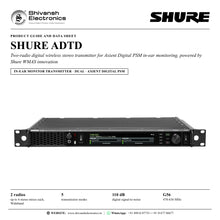

SHURE ADTD
PRICE ON ENQUIRY
Shure ADTD Axient Digital PSM dual transmitter: two radios, WMAS Multichannel Wideband, Spatial Diversity, ShowLink, Dante/AES67/AES3 inputs; G56 band. Available in India from Shivansh Electronics, Kolkata, West Bengal, India.
VISUAL GUIDE — See Every Photo, Spec & Setup Step (PDF)
PRICE ON ENQUIRY. For the price, exclusive offers, delivery timelines, or any other information, please Contact / WhatsApp +91 89818 07755 / +91 91477 00677. We will gladly share a personalised quotation for Shivansh Electronics, Kolkata, West Bengal, India. All payments are processed securely through Razorpay, our trusted payment gateway.
System
| RF carrier frequency range | 470 to 1260 MHz, varies by region |
| Working range | 100 m (330 ft); actual range depends on RF signal absorption, reflection and interference |
| RF tuning step size | 25 kHz (typical) |
| Latency (analog input) | Analog FM 1.29 ms; digital ≤2.8 ms |
| Audio frequency response | 20 Hz - 15 kHz (±1 dB) |
| Signal-to-noise ratio, digital | 110 dB (typical) |
| Total harmonic distortion | Analog FM <0.5 % (typical, ±34 kHz deviation, 1 kHz); digital <0.01 % (typical) |
| MPX pilot tone (Analog FM) | 19 kHz |
| System audio polarity | Not inverted |
| Spectral efficiency per 6 MHz | Multichannel Wideband 28 channels; Narrowband and SC Narrowband 17 channels; Analog FM 9 channels |
Transmitter
| Dimensions (H × W × D) | 44 × 482 × 385 mm (1.7 × 19.0 × 15.2 in) |
| Weight | ADTD 4.7 kg; ADTDDC 4.9 kg (10.8 lb) |
| Housing | Steel; extruded aluminium |
| AC input | 100 to 240 V AC, 50-60 Hz, 1.2 A max (6.2 A max outlet loaded) |
| AC output | 100-240 V AC, 5 A max, 50/60 Hz, unswitched |
| DC input (ADTDDC only) | 12-48 V DC, 10.1 A max |
| Fuse | T5A |
| RF connector type | BNC |
| RF output impedance | 50 Ω |
| Network interface | 10/100 Mbps, 1 Gbps, Dante digital audio |
| Operating temperature | -18 °C (0 °F) to 50 °C (122 °F) |
| Storage temperature | -29 °C (-20 °F) to 74 °C (165 °F) |
Audio input
| Polarity | Positive |
| Nominal input level | Switchable +4 dBu, -10 dBV |
| Maximum input level | +4 dBu setting: 28 dBV; -10 dBV setting: 16 dBV |
| Connectors | Analog XLR (1 ground, 2 hot, 3 cold); 6.35 mm (1/4") TRS (tip hot, ring cold, sleeve ground); AES3 XLR |
| Impedance | 32.59 kΩ |
| Gain adjustment range | Analog 12 dB (auxiliary mode); digital -16 to +20 dB |
| Phantom power protection | Analog 50 V DC; AES3 100 V DC |
| AES3 sample rates | 48, 96 and 192 kHz |
| Dante | Min. latency 250 µs; 48 / 96 kHz; 24-bit |
Headphone output
| Connector | Locking 3.5 mm (1/8") TRS |
| Minimum load impedance | 2 Ω |
| Output impedance | <1 Ω |
| Audio output power | 100 mW at 32 Ω |
| L/R stereo separation | >75 dB at 300 Ω; >90 dB at 600 Ω; >100 dB at 1 kΩ |
| Dynamic range | 110 dB, A-weighted |
Versions
| ADTDIN=-G56 | AC power, G56: 470-636 MHz |
| ADTDDC=-G56 | DC power, G56: 470-636 MHz |
Product overview
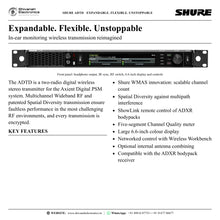
The Shure ADTD Axient Digital PSM Wireless Dual Transmitter is a two-radio, digital wireless stereo transmitter that reimagines in-ear monitoring wireless transmission: expandable, flexible, unstoppable.
Powered by Shure WMAS innovation, the ADTD delivers flexible spectral efficiency and access to scalable channel count. Performance features including Multichannel Wideband RF and patented Spatial Diversity transmission, which defends against multipath interference, ensure faultless performance in the most challenging RF environments. Every transmission is secured by an encrypted RF signal, and the ADTD is compatible with the Axient Digital PSM ADXR bodypack receiver.
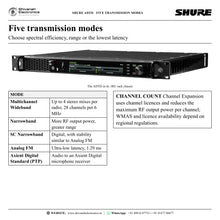
Five transmission modes are available. Multichannel Wideband delivers up to four stereo audio channels, not just one, with each ADTD radio. Narrowband gives more RF output power for greater range; SC Narrowband combines the spectrum efficiency of fully digital RF with signal stability similar to Analog FM; Analog FM achieves ultra-low latency with updated hybrid technology; and Axient Digital Standard (PTP) sends a high-quality wireless audio signal to any Axient Digital microphone receiver.
ShowLink remote control gives real-time control of all ADXR bodypack parameters from the monitor mix position and elsewhere, while networked control with Shure Wireless Workbench extends RF monitoring and management. Analog and digital inputs (AES3, AES67, Dante), optional internal antenna combining that reduces or eliminates external combiners, a large 6.6-inch colour display and a five-segment Channel Quality meter bring a new level of management and flexibility to the entire in-ear monitor workflow.
A wide tuning range covers more cities, festivals and events on tour. The ADTD has a locking AC power connection that cascades to additional components, and a DC module version supports redundant power. In India it is offered in the G56 band (470 to 636 MHz) as ADTDIN=-G56 with AC power and ADTDDC=-G56 with DC power.
| Up to 4 stereo mixes per radio in Multichannel Wideband | 2 radios |
| Transmission modes | 5 |
| Digital signal-to-noise ratio, typical | 110 dB |
| G56 band | 470-636 MHz |
Key features
- Two-radio digital wireless stereo transmitter for Axient Digital PSM in-ear monitoring
- Shure WMAS innovation: spectral efficiency and access to scalable channel count
- Patented Spatial Diversity transmission defends against multipath interference
- Five transmission modes: Multichannel Wideband, Narrowband, SC Narrowband, Analog FM, Axient Digital Standard (PTP)
- Real-time remote control of all ADXR parameters with ShowLink
- Encrypted RF signal for every transmission
- Five-segment Channel Quality meter displays RF signal-to-noise
- Large 6.6-inch front panel colour display
- Networked control with Shure Wireless Workbench
- Optional internal antenna combining reduces or eliminates external combiners
- 4 switchable combo inputs for analog or AES3; 4 Ethernet ports for control and Dante / AES67
- Locking AC power cascade; DC module version for redundant power
Made for
- Onstage in-ear monitoring for professional touring and live sound
- Monitor engineers controlling bodypacks remotely from the mix position
- Crowded RF environments at festivals and large events
- Digital audio networks with Dante, AES67 and AES3 sources
- Point-to-point audio links to Axient Digital receivers
In the box
- ADTDIN=-G56 (AC power): 1 × ADTD, 1 × rackmount kit, 1 × locking power cable, 1 × locking power jumper cable, 2 × BNC cables, 2 × BNC cable assemblies, 2 × BNC bulkhead adapters, 2 × half-wave antennas, 1 × Ethernet cable, 1 × Ethernet jumper cable
- ADTDDC=-G56 (DC power): 1 × ADTD, 1 × rackmount kit, 2 × BNC cables, 2 × BNC cable assemblies, 2 × BNC bulkhead adapters, 2 × half-wave antennas, 1 × Ethernet cable, 1 × Ethernet jumper cable
Connections
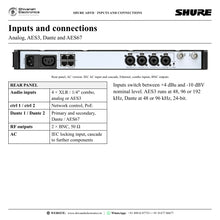
- Audio inputs: 4 × XLR / 6.35 mm (1/4") TRS combo, switchable analog or AES3
- 4 × Ethernet: ctrl 1, ctrl 2 (network control, PoE), Dante primary, Dante secondary
- 2 × BNC coaxial RF antenna outputs, 50 Ω
- Locking 3.5 mm (1/8") headphone output with adjustable volume
- AC version: IEC locking AC input and AC power cascade; DC version: DC input 12-48 V
- IR sync window for the ADXR bodypack
Shure ADTD: frequently asked questions
How many in-ear mixes can the ADTD transmit?
The ADTD has two radios. In Narrowband, SC Narrowband or Analog FM each radio carries one stereo mix; in Multichannel Wideband, Shure WMAS innovation lets each ADTD radio deliver up to four stereo audio channels. Increased channel count via Channel Expansion uses channel licences, reduces the maximum RF output power per channel and may affect range; WMAS and channel licence availability depend on regional regulations.
Which transmission mode should I use?
Multichannel Wideband gives the best spectral efficiency, Narrowband more RF output power and range, SC Narrowband stability close to Analog FM with fully digital RF, Analog FM the lowest latency (1.29 ms), and Axient Digital Standard (PTP) a link to an Axient Digital microphone receiver.
Which bodypack works with the ADTD?
The Axient Digital PSM ADXR wireless bodypack receiver.
What is the difference between ADTDIN=-G56 and ADTDDC=-G56?
Both work in the G56 band (470 to 636 MHz). ADTDIN=-G56 is the AC power version with a locking AC input and AC cascade; ADTDDC=-G56 adds a DC input (12-48 V DC) to support redundant power.
Can I feed it from a digital console?
Yes. Each input accepts analog or AES3 digital audio, and the Dante ports accept Dante and AES67 network audio at 48 or 96 kHz.
Where can I buy the Shure ADTD in India?
The Shure ADTD is available from Shivansh Electronics, Kolkata, West Bengal, India, with delivery across India.
Workflow 1: Touring band in-ear monitors
Monitor engineers running stereo in-ear mixes for a touring band.
Connections
| Connect | To |
|---|---|
| Monitor console outputs (analog or AES3) | ADTD combo inputs |
| ADTD BNC outputs | Half-wave antennas or antenna combiner |
| ADTD | ADXR bodypacks via IR sync |
Setup
- Choose an operational preset: Narrowband with spatial diversity for the best RF performance, or Multichannel Wideband for more mixes.
- Scan and assign frequencies in Wireless Workbench.
- Set each input to +4 dBu or -10 dBV and to analog or AES3 with the rear switch.
- IR sync each ADXR at the front-panel sync window.
Tip: Spatial diversity uses two transmit antennas per channel to protect against multipath interference.
Workflow 2: Dante-fed monitor world
Productions with a digital console on a Dante or AES67 network.
Connections
| Connect | To |
|---|---|
| Console Dante outputs | ADTD Dante primary / secondary |
| ADTD ctrl ports | Computer with Wireless Workbench |
Setup
- Connect the Dante primary and secondary ports to the audio network.
- Route the console mixes to the ADTD channels.
- Monitor RF and audio in Wireless Workbench.
- Check any channel on the front-panel headphone output.
Tip: Dante input runs at 48 or 96 kHz, 24-bit, with 250 µs minimum latency.
Workflow 3: Remote bodypack control with ShowLink
Monitor engineers who adjust artists' packs from the mix position.
Connections
| Connect | To |
|---|---|
| AD610 access point | ShowLink network |
| ADXR bodypacks | ShowLink network ID |
Setup
- Set the 4-character network ID on the AD610.
- Enter the same ID on each ADXR.
- Adjust ADXR parameters in real time from the mix position.
- Use ShowLink Test to map the coverage area.
Tip: ShowLink carries control data only: any loss of ShowLink never affects the audio.
Workflow 4: Festival stage in crowded RF
Festival and event crews with limited spectrum.
Connections
| Connect | To |
|---|---|
| ADTD in Multichannel Wideband | Spatial diversity antennas |
| ADXR bodypacks | Shared carrier frequency |
Setup
- Select Multichannel Wideband with spatial diversity.
- Carry up to four stereo mixes per radio on one frequency.
- Coordinate fewer frequencies to reduce intermodulation.
- Check the Channel Quality meter during soundcheck.
Tip: RF output power is divided across the stereo subchannels in Multichannel Wideband.
Workflow 5: Ultra-low latency monitoring
Performers who need the lowest possible monitor latency.
Connections
| Connect | To |
|---|---|
| Console output | ADTD input |
| ADTD in Analog FM | ADXR bodypack |
Setup
- Select the Analog FM operational preset.
- Assign one frequency per stereo mix.
- Set input level and gain.
- Sync the ADXR and check the mix.
Tip: Analog FM latency is 1.29 ms, against 2.8 ms for the digital modes.
Workflow 6: Point-to-point link to an Axient Digital receiver
Crews sending a fixed wireless audio feed between two racked units.
Connections
| Connect | To |
|---|---|
| ADTD in Axient Digital Standard (PTP) | AD4D, AD4Q or ADX5D receiver |
Setup
- Set the receiver to Standard transmission mode.
- Set the ADTD to the same frequency as the receiver.
- Coordinate the frequency through the receiver.
- Send the mono audio signal.
Tip: Syncing, linking and encryption are not available in PTP mode.