


SHURE BETA 181
PRICE ON ENQUIRY
Shure Beta 181 ultra-compact side-address condenser mic with cardioid capsule, interchangeable capsules, XLR preamp, clip, windscreen and case. Available in India from Shivansh Electronics, Kolkata, West Bengal, India.
VISUAL GUIDE — See Every Photo, Spec & Setup Step (PDF)
PRICE ON ENQUIRY. For the price, exclusive offers, delivery timelines, or any other information, please Contact / WhatsApp +91 89818 07755 / +91 91477 00677. We will gladly share a personalised quotation for Shivansh Electronics, Kolkata, West Bengal, India. All payments are processed securely through Razorpay, our trusted payment gateway.
Acoustics (cardioid capsule, Beta 181/C)
| Type | Electret condenser |
| Polar pattern | Cardioid (interchangeable capsule) |
| Frequency response | 20 to 20,000 Hz |
| Sensitivity (open circuit voltage, 1 kHz, typical) | -46.5 dBV/Pa (4.7 mV); 1 Pa = 94 dB SPL |
| Maximum SPL (1 kHz, 1 % THD) | 151.5 dB SPL (2500 Ω load); 149.0 dB SPL (1000 Ω load) |
| Signal-to-noise ratio | 73.5 dB |
| Dynamic range | 131.0 dB (2500 Ω load); 128.5 dB (1000 Ω load) |
| Clipping level (1 kHz, 1 % THD) | 10.5 dBV (2500 Ω load); 7.5 dBV (1000 Ω load) |
| Self noise (equivalent SPL, A-weighted, typical) | 20.5 dB SPL-A |
Electrical
| Output impedance | 110 Ω |
| Common mode rejection | ≥55 dB |
| Polarity | Positive pressure on the diaphragm produces positive voltage on pin 2 with respect to pin 3 |
| Power requirements | 11-52 V DC phantom power, 2.4 mA maximum (specifications measured at 48 V DC) |
| Recommended load | Minimum preamplifier input load impedance 1000 Ω |
Physical
| Weight | 145 g (5.1 oz) |
| Dimensions (shure.com) | 34.5 × 124 × 20.3 mm |
Optional capsules (sold separately)
| RPM181/S supercardioid | -49.5 dBV/Pa (3.4 mV); max SPL 154.5 dB (2500 Ω); self noise 22.5 dB SPL-A |
| RPM181/O omnidirectional | -52.0 dBV/Pa (2.5 mV); max SPL 157.0 dB (2500 Ω); self noise 23.5 dB SPL-A |
| RPM181/BI bidirectional | -51.0 dBV/Pa (2.8 mV); max SPL 156.0 dB (2500 Ω); self noise 23.0 dB SPL-A |
Versions
| Beta 181/C | Beta 181 with cardioid polar pattern capsule (interchangeable) |
| Beta 181/C-X | Condenser, cardioid, metallic blue, 3-pin XLR |
Product overview
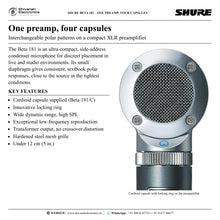
The Shure Beta 181 is an ultra-compact, side-address condenser microphone with interchangeable capsules, designed for discreet placement in live and studio environments; this store item is the Beta 181/C with the cardioid capsule.
A compact preamplifier with integrated XLR connection attaches to any of four interchangeable polar pattern capsules: cardioid, supercardioid, omnidirectional and bidirectional. The small diaphragm gives superior audio with consistent, textbook polar responses in a form factor small enough to get close to the source in the tightest conditions, and an innovative locking ring secures the capsule to the preamplifier.
The Beta 181 is a multipurpose instrument microphone for guitars, bass and drums, including overheads and snares. The cardioid capsule supplied with the Beta 181/C is best suited to drum overheads, piano and acoustic instruments, and can be paired with a Beta 181 fitted with the bidirectional capsule for M/S stereo miking. Further capsules (RPM181/S supercardioid, RPM181/O omnidirectional, RPM181/BI bidirectional) are available separately.
The frequency response is tailored for wide dynamic range applications in high SPL environments: with the cardioid capsule the Beta 181 handles 151.5 dB SPL (2500 Ω load) with 131 dB dynamic range and 20.5 dB self noise. Performance characteristics include exceptional low-frequency reproduction, high output level, no crossover distortion and a transformer output. At under 12 cm (5 in.), the compact side-address design reduces stage clutter, and a hardened steel mesh grille resists denting, wear and abuse.
In India the Beta 181 is offered as Beta 181/C and Beta 181/C-X: condenser, cardioid capsule (interchangeable), metallic blue, 3-pin XLR connector. Each comes with a microphone clip, windscreen and zippered carrying case.
| Cardioid supplied; S, O, BI optional | 4 capsules |
| Max SPL, cardioid, 2500 Ω load | 151.5 dB |
| Self noise, cardioid, A-weighted | 20.5 dB |
| Weight | 145 g |
Key features
- Interchangeable polar pattern capsules attach to a compact preamplifier with integrated XLR connection
- Supplied with the cardioid capsule (Beta 181/C)
- Side-address design for discreet positioning in tight performance and recording settings
- Innovative locking ring secures the capsule to the preamplifier
- Wide dynamic range for use in high SPL environments
- Small diaphragm with consistent, textbook polar responses
- Exceptional low-frequency reproduction and high output level
- No crossover distortion; transformer output
- Hardened steel mesh grille resists denting, wear and abuse
- Compact design under 12 cm (5 in.) reduces stage clutter
Made for
- Drum overheads
- Snare drum and close miking (with supercardioid capsule)
- Piano
- Acoustic instruments, guitars and bass
- M/S stereo technique, paired with a Beta 181 with bidirectional capsule
- Live performance and studio recording in tight spaces
In the box
- Beta 181 microphone with cardioid capsule
- A57F microphone clip
- A181WS foam windscreen
- A181C zippered carrying case
Connections
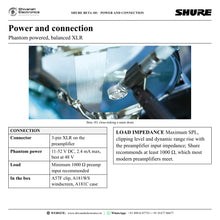
- Three-pin XLR on the preamplifier
- Requires 11-52 V DC phantom power, 2.4 mA maximum; best at 48 V DC
- Use a balanced XLR-to-XLR microphone cable; minimum preamplifier input load of 1000 Ω recommended
Shure Beta 181: frequently asked questions
Which capsule comes with the Beta 181/C?
The Beta 181/C comes with the cardioid capsule. Supercardioid (RPM181/S), omnidirectional (RPM181/O) and bidirectional (RPM181/BI) capsules are available separately and attach to the same preamplifier.
What is each capsule best for?
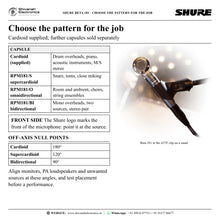
Cardioid: drum overheads, piano, acoustic instruments and M/S stereo. Supercardioid: snare, toms, acoustic instruments and close miking. Omnidirectional: room and ambient pickup, choirs, orchestras and string ensembles. Bidirectional: mono overheads, two sources on one channel, or stereo with a pair of bidirectional microphones.
How do I change the capsule?
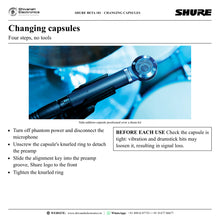
Turn off phantom power and disconnect the microphone, unscrew the capsule's knurled ring, slide the alignment key into the groove on the preamplifier so the Shure logo faces the front, and tighten the ring. Before each use, check the capsule is tight, as vibration or drumstick hits may loosen it.
Which side faces the source?
The front of the microphone is marked by the Shure logo; position this side toward the sound source.
Does it need phantom power?
Yes. It performs best with a 48 V DC supply and operates down to 11 V DC with slightly decreased headroom and sensitivity.
Where can I buy the Shure Beta 181 in India?
The Shure Beta 181 is available from Shivansh Electronics, Kolkata, West Bengal, India, with delivery across India.
Workflow 1: Drum overheads
Drummers and engineers miking a kit live or in the studio.
Connections
| Connect | To |
|---|---|
| Beta 181/C on an overhead stand (A57F clip) | Balanced XLR cable |
| XLR cable | Console or interface input with 48 V phantom power |
Setup
- Clip the Beta 181 to a stand and point the Shure logo side at the kit.
- Switch on 48 V phantom power.
- Set the gain with headroom for cymbal crashes.
- Check the capsule ring is tight before playing.
Tip: The cardioid capsule is best suited to drum overheads, piano and acoustic instruments.
Workflow 2: Snare and toms in tight spaces
Live engineers short on room around the kit.
Connections
| Connect | To |
|---|---|
| Beta 181 with RPM181/S supercardioid capsule | Console input with phantom power |
Setup
- Fit the optional supercardioid capsule (phantom power off).
- Position the compact side-address body close to the snare or between toms.
- Aim the logo side at the drum head.
- Set gain; the capsule handles 154.5 dB SPL.
Tip: Vibration and accidental drumstick hits may loosen the capsule: check it before each use.
Workflow 3: Piano
Engineers miking grand or upright pianos.
Connections
| Connect | To |
|---|---|
| Beta 181/C | Preamp input with phantom power |
Setup
- Place the microphone discreetly near the strings.
- Point the logo side at the source.
- Set gain on a preamp with at least 1000 Ω input load.
- Adjust position to taste.
Tip: Higher preamp input impedance gives better max SPL and dynamic range.
Workflow 4: M/S stereo recording
Studios recording acoustic instruments in stereo.
Connections
| Connect | To |
|---|---|
| Beta 181/C (mid) | Input 1 |
| Beta 181 with RPM181/BI (side) | Input 2 |
Setup
- Mount the cardioid microphone facing the source.
- Mount the bidirectional microphone close to it, side-on.
- Record both channels at matched gain.
- Decode M/S in the mix.
Tip: Sounds picked up from the back of a bidirectional capsule are out of polarity with the front.
Workflow 5: Acoustic instruments on stage
Live engineers miking acoustic guitar and other instruments.
Connections
| Connect | To |
|---|---|
| Beta 181/C on a stand | Stage box with phantom power |
Setup
- Place the microphone close to the instrument.
- Aim the logo side at the sound source.
- Align monitors at the cardioid null, 180° behind the mic.
- Test placement before the performance.
Tip: The compact, under 12 cm body reduces stage clutter.
Workflow 6: Room and ensemble pickup
Engineers capturing choirs, string ensembles or room ambience.
Connections
| Connect | To |
|---|---|
| Beta 181 with RPM181/O omnidirectional capsule | Console or recorder input with phantom power |
Setup
- Fit the optional omnidirectional capsule.
- Place the microphone for the desired room balance.
- Set the gain.
- Record or reinforce the ensemble.
Tip: Swap capsules on the same preamp to change pattern for each job.


