



SHURE BETA 87C
PRICE ON ENQUIRY
Shure Beta 87C cardioid condenser vocal microphone with warm, natural sound, excellent rear rejection for in-ear monitoring and 3-stage pop filter. Available in India from Shivansh Electronics, Kolkata, West Bengal, India.
VISUAL GUIDE — See Every Photo, Spec & Setup Step (PDF)
PRICE ON ENQUIRY. For the price, exclusive offers, delivery timelines, or any other information, please Contact / WhatsApp +91 89818 07755 / +91 91477 00677. We will gladly share a personalised quotation for Shivansh Electronics, Kolkata, West Bengal, India. All payments are processed securely through Razorpay, our trusted payment gateway.
Acoustics
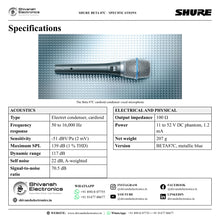
| Type | Electret condenser |
| Frequency response | 50 to 16,000 Hz |
| Polar pattern | Cardioid |
| Sensitivity (1 kHz, open circuit voltage) | -51 dBV/Pa (2 mV); 1 Pa = 94 dB SPL |
| Maximum SPL (1 kHz, 1 % THD, 1 kΩ load) | 139 dB |
| Signal-to-noise ratio (ref. 94 dB SPL at 1 kHz) | 70.5 dB |
| Dynamic range (1 kHz, 1 kΩ load) | 117 dB |
| Clipping level (1 kHz, 0.25 % THD, 1 kΩ load) | -6 dBV (0.5 V) |
| Self noise (typical, equivalent SPL, A-weighted) | 22 dB |
| Hum pickup (typical, 60 Hz, equivalent SPL/mOe) | -5 dB |
Electrical
| Output impedance | 100 Ω |
| Polarity | Positive pressure on the diaphragm produces positive voltage on pin 2 with respect to pin 3 |
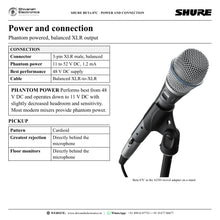
| Power requirements | 11 to 52 V DC phantom power (1.2 mA); best at 48 V DC |
| Connector | Three-pin professional audio (XLR), male, balanced |
Physical
| Housing | Aluminium construction with painted blue metallic finish; hardened steel grille with nickel satin chrome plating |
| Net weight | 207 g (0.475 lb) |
| Dimensions (shure.com) | 43 mm wide, 160 mm high |
Versions
| BETA87C | Condenser, cardioid, metallic blue, 3-pin XLR |
Product overview
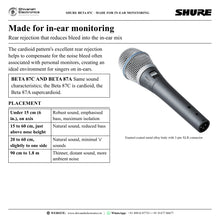
The Shure Beta 87C is a premium cardioid hand-held condenser vocal microphone with a smooth, tailored response for a warm, natural sound and excellent rear rejection, ideal with in-ear monitoring.
Precision-engineered to deliver an extremely smooth, extended high-end response in a cardioid electret condenser design, the Beta 87C suits a professional lead or backing vocalist on stage, for live recording or in the studio. Its warm, natural sound and excellent rear rejection create an ideal environment for personal monitoring, helping to compensate for the noise bleed often associated with the use of personal monitors.
The uniform cardioid pattern gives maximum gain before feedback, excellent rejection of off-axis sound and minimal off-axis tone colouration. A smooth, wide frequency response with a slight presence rise and a controlled low-frequency roll-off that compensates for proximity effect is tailored for vocals, and the microphone handles high sound pressure levels with a 117 dB dynamic range.
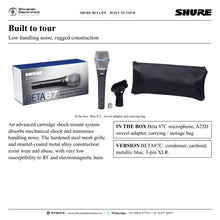
An advanced cartridge shock-mount system absorbs mechanical shock and minimises handling noise, a three-stage pop filter minimises breath pops and noise, and a break-resistant stand adapter, dent-resistant hardened steel mesh grille and enamel-coated metal alloy construction withstand the rigours of daily touring. It has very low susceptibility to RF and electromagnetic hum and runs on phantom power.
The Beta 87C and Beta 87A share the same sound characteristics; the difference is the polar pattern: cardioid for the Beta 87C, supercardioid for the Beta 87A. The India version is BETA87C: condenser, cardioid, metallic blue, 3-pin XLR connector.
| Electret condenser | Cardioid |
| Dynamic range | 117 dB |
| Maximum SPL (1 kHz, 1 % THD) | 139 dB |
| Net weight | 207 g |
Key features
- Smooth, wide frequency response with slight presence rise
- Uniform cardioid pattern for maximum isolation and gain before feedback
- Excellent rear rejection, ideal with in-ear personal monitoring
- Minimal off-axis tone colouration
- Low-frequency roll-off compensates for proximity effect
- Three-stage pop filter minimises breath pops and noise
- Advanced cartridge shock-mount system minimises handling noise
- Break-resistant stand adapter
- Very low susceptibility to RF and electromagnetic hum
- Dent-resistant steel mesh grille, enamel-coated metal alloy construction
Made for
- Lead and backing vocals on stage
- Singers using in-ear monitors
- Live recording
- Studio vocal recording
- Professional sound reinforcement and touring
In the box
- Beta 87C microphone
- A25D swivel adapter (microphone clip)
- Carrying / storage bag
Connections
- Three-pin professional audio (XLR) male connector, balanced
- Requires 11 to 52 V DC phantom power (1.2 mA); best at 48 V DC
- Use a balanced XLR-to-XLR microphone cable
Shure Beta 87C: frequently asked questions
Why is the Beta 87C good with in-ear monitors?
Its cardioid pattern has excellent rear rejection, which helps to compensate for the noise bleed often associated with personal monitors, and its warm, natural sound creates an ideal environment for in-ear monitoring.
What is the difference between the Beta 87C and the Beta 87A?
Both have the same sound characteristics. The Beta 87C uses a cardioid pattern, the Beta 87A a supercardioid pattern.
Does it need phantom power?
Yes. It performs best with a 48 V DC supply and operates from supplies as low as 11 V DC with slightly decreased headroom and sensitivity. Use a balanced XLR-to-XLR cable.
Where should floor monitors go?
For a cardioid microphone, place monitors and loudspeakers directly behind it, and always test placement before a performance.
Where can I buy the Shure Beta 87C in India?
The Shure Beta 87C is available from Shivansh Electronics, Kolkata, West Bengal, India, with delivery across India.
Workflow 1: Lead vocals with in-ear monitors
Singers who perform on in-ear monitors instead of wedges.
Connections
| Connect | To |
|---|---|
| Beta 87C (XLR) | Console input with 48 V phantom power |
| Console monitor mix | Personal in-ear monitor system |
Setup
- Clip the Beta 87C into the A25D swivel adapter on a stand, or hand hold it.
- Switch on 48 V phantom power on the input.
- Build the in-ear mix with the vocal on top.
- Set gain and EQ at soundcheck.
Tip: The cardioid pattern's rear rejection helps compensate for noise bleed with personal monitors.
Workflow 2: Stage with floor wedges
Monitor engineers using wedges with cardioid microphones.
Connections
| Connect | To |
|---|---|
| Beta 87C | Vocal channel |
| Monitor sends | Wedge directly behind the microphone |
Setup
- Place the wedge directly behind the microphone.
- Bring the vocal into the monitor mix.
- Ring out the system and check gain before feedback.
- Test placement before the performance.
Tip: A cardioid microphone rejects most sound directly behind it.
Workflow 3: Backing vocals
Bands with several singers.
Connections
| Connect | To |
|---|---|
| One Beta 87C per singer | Separate console inputs with phantom power |
Setup
- Give each singer their own microphone.
- Keep microphones at least three times as far apart as each is from its singer.
- Aim each microphone at its singer.
- Balance the voices in the mix.
Tip: Using fewer microphones gives better gain before feedback.
Workflow 4: Live recording
Engineers recording concerts.
Connections
| Connect | To |
|---|---|
| Beta 87C | Split or stage box |
| Split | FOH console and recording preamps |
Setup
- Power the microphone with 48 V phantom from one side of the split.
- Set recording gain with headroom.
- Record the vocal as its own track.
- Use the wide dynamic range for quiet and loud passages.
Tip: 117 dB dynamic range and 139 dB maximum SPL.
Workflow 5: Studio vocal recording
Singers and studios recording vocals.
Connections
| Connect | To |
|---|---|
| Beta 87C on a stand | Microphone preamp or interface with phantom power |
Setup
- Mount the microphone with the swivel adapter.
- Place the singer 15 to 60 cm away, just above nose height, for a natural sound.
- Move slightly off to one side for minimal 's' sounds.
- Record and adjust distance to taste.
Tip: The three-stage pop filter minimises breath pops.
Workflow 6: Touring vocal microphone
Touring artists on in-ears every night.
Connections
| Connect | To |
|---|---|
| Beta 87C in its bag | Venue stage box XLR input with phantom power |
Setup
- Carry the microphone and swivel adapter in the bag.
- Connect to the stage box and enable phantom power.
- Add a windscreen when using it outdoors.
- Check the in-ear mix at soundcheck.
Tip: Shock mount, hardened grille and break-resistant stand adapter withstand daily touring.


