SHURE GLXD14+/B98
PRICE ON ENQUIRY
Shure GLXD14+/B98 dual-band digital wireless instrument system with Beta 98H/C clip-on mic, GLXD1+ bodypack and GLXD4+ receiver. Available in India from Shivansh Electronics, Kolkata, West Bengal, India.
VISUAL GUIDE — See Every Photo, Spec & Setup Step (PDF)
PRICE ON ENQUIRY. For the price, exclusive offers, delivery timelines, or any other information, please Contact / WhatsApp +91 89818 07755 / +91 91477 00677. We will gladly share a personalised quotation for Shivansh Electronics, Kolkata, West Bengal, India. All payments are processed securely through Razorpay, our trusted payment gateway.
System (GLX-D+)
| Tuning bandwidth (Z4) | 2400-2483.5 MHz and 5725-5875 MHz |
| Band modes | 2.4 GHz only, 5.8 GHz only, or best band 2.4 + 5.8 GHz (default) |
| Transmit mode | Shure proprietary digital |
| RF output power | 10 mW E.I.R.P. maximum |
| Audio frequency response | 20 Hz - 20 kHz |
| Dynamic range | 122 dB, A-weighted |
| RF sensitivity | -88 dBm, typical |
| Total harmonic distortion | 0.2 %, typical |
| Battery life | Up to 11.5 hours |
| Channel count | Up to 4 typical, 8 optimal (2.4 GHz only: up to 4 typical, 5 optimal) |
| Latency | Group 1 and Group 3: 4.53 ms; Group 2: 8 ms |
| Ambient temperature | Operating 0 °C to 45 °C; charging 0 °C to 40 °C |
GLXD4+ tabletop receiver
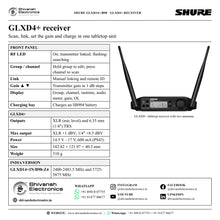
| Power requirements | 14.5 V - 17 V, 600 mA (PS43 power supply) |
| Antennas | Two, dual-band ½ wave sleeve dipole, non-removable |
| Dimensions | 182.82 × 121.97 × 40.3 mm (antennas folded); 185.6 mm high with antennas opened |
| Weight | 310 g |
| Housing | PC/ABS |
| Spurious rejection | > 35 dB, typical |
| Gain adjustment range | -20 to 40 dB, 1 dB increments |
| Phantom power protection | Yes |
| Outputs | XLR, impedance balanced, 100 Ω; 6.35 mm (1/4") TRS, impedance balanced, 100 Ω (50 Ω unbalanced) |
| Maximum audio output level | XLR: +1 dBV; 6.35 mm (1/4"): +8.5 dBV |
| Pin assignments | XLR: 1 = ground, 2 = hot, 3 = cold; 6.35 mm: tip = audio, ring = no audio, sleeve = ground |
| Antenna input | 50 Ω; maximum input level -20 dBm |
| Other connections | 15 V DC power port, USB-C (firmware), battery charging bay |
GLXD1+ bodypack transmitter
| Power | Shure SB904 rechargeable lithium-ion battery |
| Antenna type | Dual-band internal monopole |
| Dimensions (H × W × D) | 115 × 66.94 × 28.51 mm |
| Weight | 153.1 g, without battery |
| Housing | Aluminium alloy, ABS plastic |
| Input | 4-pin male mini connector (TA4M), unbalanced |
| Input impedance | 900 kΩ |
| Maximum input level | +8.4 dBV (7.5 Vp-p) |
| Pin assignments | 1 = ground (cable shield); 2 = +5 V bias; 3 = audio; 4 = tied through active load to ground |
| Other | USB-C charging port, link button, status LED, reversible belt clip |
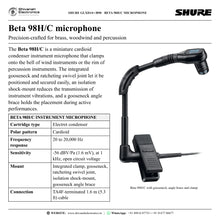
Beta 98H/C instrument microphone
| Cartridge type | Electret condenser |
| Polar pattern | Cardioid |
| Frequency response | 20 to 20,000 Hz |
| Sensitivity | -56 dBV/Pa (1.6 mV), at 1 kHz, open circuit voltage |
| Mount | Integrated clamp, gooseneck, ratcheting swivel joint, isolation shock-mount, gooseneck angle brace |
| Connection | TA4F-terminated 1.6 m (5.3 ft) cable |
SB904 battery
| Battery type | Rechargeable lithium-ion |
| Nominal capacity | 2420 mAh (8.71 Wh) |
| Nominal voltage | 3.6 V |
| Dimensions (H × W × D) | 72.8 × 20.96 × 20.80 mm |
| Weight | 53.7 g |
| Temperature | Charging 0 °C to 40 °C; operating -18 °C to 45 °C |
Versions
| GLXD14+IN/B98-Z4 | Z4: 2400-2483.5 MHz and 5725-5875 MHz |
Product overview
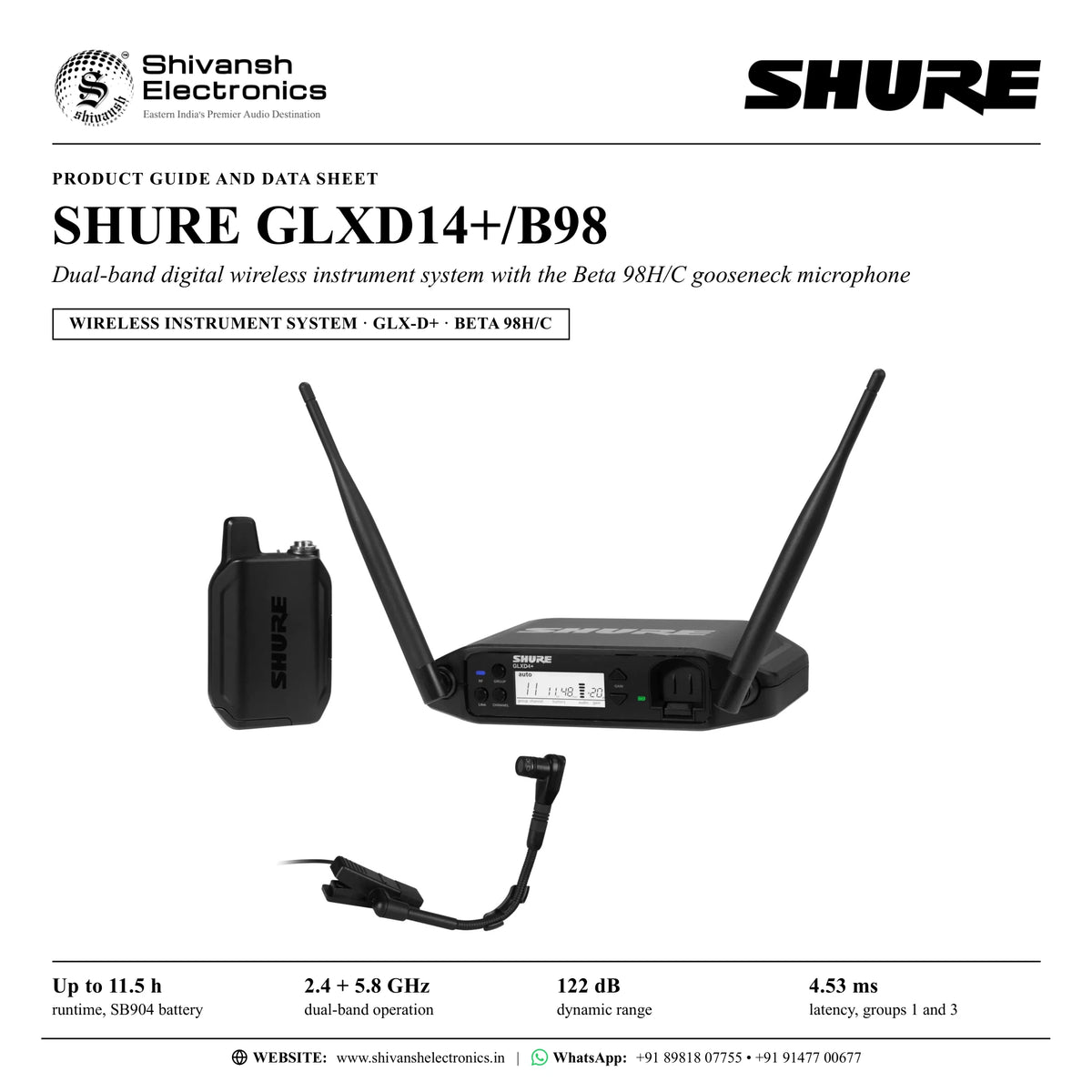
The Shure GLXD14+/B98 is a GLX-D+ dual-band digital wireless instrument system with the Beta 98H/C flexible gooseneck microphone, the GLXD1+ bodypack and the GLXD4+ tabletop receiver, for brass, woodwind and percussion.
The Beta 98H/C is a miniature cardioid condenser instrument microphone that clamps onto the bell of wind instruments or the rim of percussion instruments. The integrated gooseneck and ratcheting swivel joint let it be positioned and secured easily, an isolation shock-mount reduces the transmission of instrument vibrations, and a gooseneck angle brace holds the placement during active performances.
The system works in both the 2.4 GHz and the 5.8 GHz bands. Shure Dual Band Technology more than doubles the available bandwidth, and automatic frequency management moves the system away from interference without interrupting the audio, so the system is ready to go every time without frequency planning.
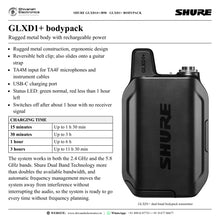
The GLXD1+ bodypack has a rugged metal construction, an ergonomic shape and a reversible belt clip. It runs on a Shure SB904 lithium-ion rechargeable battery for up to 11.5 hours; the battery charges in the charging bay of the receiver or over USB-C on the transmitter, and the receiver screen shows the remaining runtime in hours and minutes.
The GLXD4+ tabletop receiver has two antennas, a display for group, channel, battery runtime, audio level and gain, transmitter gain control in 1 dB steps, an XLR microphone output and a 6.35 mm (1/4") output. In India the set is supplied as GLXD14+IN/B98-Z4 (2400-2483.5 MHz and 5725-5875 MHz) with the PS43 power supply and a black carrying case.
| Runtime, SB904 battery | Up to 11.5 h |
| Dual-band operation | 2.4 + 5.8 GHz |
| Dynamic range, A-weighted | 122 dB |
| Latency, groups 1 and 3 | 4.53 ms |
Key features
- Dual Band Technology: operates in 2.4 GHz and 5.8 GHz
- Automatic frequency management moves away from interference without audio interruption
- Beta 98H/C cardioid condenser, precision-crafted for brass, woodwind and percussion
- Clamps onto the bell or rim; gooseneck with ratcheting swivel joint
- Isolation shock-mount reduces instrument vibration noise
- SB904 lithium-ion rechargeable battery, up to 11.5 hours
- Charges in the receiver charging bay or over USB-C
- Remaining runtime shown in hours and minutes on the receiver
- Transmitter gain set from the receiver in 1 dB steps
- XLR and 6.35 mm (1/4") outputs
- Black carrying case included
Made for
- Saxophone, clarinet and other woodwinds
- Trumpet, trombone and other brass
- Percussion instruments
- Horn players who move freely on stage
In the box
- GLXD4+ tabletop receiver
- GLXD1+ bodypack transmitter
- Beta 98H/C gooseneck instrument microphone
- PS43 power supply
- SB904 lithium-ion rechargeable battery
- Black carrying case
Connections
- Beta 98H/C TA4F connector to the GLXD1+ TA4M input
- GLXD4+: XLR microphone output (microphone level) to a mixer
- GLXD4+: 6.35 mm (1/4") TRS output to mixers, recorders and amplifiers
- GLXD4+: 15 V DC power port for the PS43 power supply
- GLXD4+: USB-C port for firmware updates from a computer
- GLXD1+: USB-C charging port
Shure GLXD14+/B98: frequently asked questions
Which instruments is this system for?
Brass, woodwind and percussion. The Beta 98H/C clamps onto the bell of wind instruments or the rim of percussion instruments.
Which frequencies does it use in India?
The India version (Z4) tunes 2400-2483.5 MHz and 5725-5875 MHz. By default the receiver uses the best band mode with both bands; it can also be set to 2.4 GHz only or 5.8 GHz only.
How is the battery charged?
Put the SB904 in the charging bay of the receiver while the receiver is plugged in, or connect a USB charger to the USB-C port of the GLXD1+. About 15 minutes of charging gives up to 1 h 30 min of use, 1 hour gives up to 6 hours and 3 hours gives up to 11 h 30 min. The transmitter does not pass audio while the charging cable is connected.
How many systems can run together?
Up to 4 systems typical and 8 optimal in dual-band mode. Set every receiver to the same group, link each receiver and transmitter pair one at a time, and keep transmitters more than 2 m apart.
Where should the receiver go?
At least 3 m away from Wi-Fi access points, computers and other active 2.4 GHz and 5.8 GHz sources, with a clear line of sight to the transmitter, for example on stage or at the top of the equipment rack.
Where can I buy the Shure GLXD14+/B98 in India?
The Shure GLXD14+/B98 is available from Shivansh Electronics, Kolkata, West Bengal, India, with delivery across India.
Workflow 1: Saxophone or clarinet solo
Woodwind players who move around the stage.
Connections
| Connect | To |
|---|---|
| Beta 98H/C on the bell | GLXD1+ TA4M input |
| GLXD4+ XLR output | Mixer channel |
Setup
- Clamp the Beta 98H/C to the bell and aim the gooseneck.
- Plug it into the GLXD1+ and clip the bodypack to a belt.
- Switch on the receiver and press channel to scan; then switch on the GLXD1+.
- Set the gain on the receiver while the player plays loudest.
Tip: OL on the receiver display means overload: reduce the gain.
Workflow 2: Trumpet or trombone
Brass players in bands and big bands.
Connections
| Connect | To |
|---|---|
| Beta 98H/C | Brass bell |
| GLXD1+ | GLXD4+ to console |
Setup
- Clamp to the bell rim and fit the angle brace.
- Keep monitors behind the cardioid microphone.
- Do an audio check at full volume.
Tip: The angle brace keeps the placement during active playing.
Workflow 3: Horn section with several systems
Bands with two or more wireless horns.
Connections
| Connect | To |
|---|---|
| Each Beta 98H/C and GLXD1+ | Its own GLXD4+ |
| Receivers | Mixer inputs |
Setup
- Switch off all receivers and transmitters.
- Set every receiver to the same group.
- Switch on and link one pair at a time.
- Keep transmitters more than 2 m apart.
Tip: Up to 4 systems typical, 8 optimal in dual-band mode.
Workflow 4: Percussion
Percussionists who move between instruments.
Connections
| Connect | To |
|---|---|
| Beta 98H/C | Rim of the drum |
| GLXD1+ | GLXD4+ |
Setup
- Clamp the microphone to the rim.
- Bend the gooseneck toward the playing surface.
- Start with a low gain for loud hits and raise it if needed.
Tip: Watch the audio meter on the receiver while adjusting the gain.
Workflow 5: Church or school band
Worship teams and school ensembles.
Connections
| Connect | To |
|---|---|
| Beta 98H/C and GLXD1+ | GLXD4+ |
| GLXD4+ XLR output | Mixer |
Setup
- Charge the SB904 fully before the service or concert.
- Lock the receiver controls by holding group and channel.
- Check the runtime on the receiver screen.
- Store everything after use.
Tip: Locked controls prevent accidental changes or power-off.
Workflow 6: Busy RF environment
Engineers in venues with lots of Wi-Fi.
Connections
| Connect | To |
|---|---|
| GLXD4+ | Clear line of sight to the stage |
Setup
- Keep the receiver at least 3 m from Wi-Fi access points and computers.
- Turn on Wi-Fi before scanning for a channel.
- Avoid heavy Wi-Fi traffic during the show.
- Mark trouble spots during sound check.
Tip: If dropouts occur, change group or channel.