

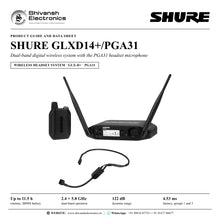


SHURE GLXD14+/PGA31
PRICE ON ENQUIRY
Shure GLXD14+/PGA31 dual-band digital wireless headset system with PGA31 headset mic, GLXD1+ bodypack and GLXD4+ receiver. Available in India from Shivansh Electronics, Kolkata, West Bengal, India.
VISUAL GUIDE — See Every Photo, Spec & Setup Step (PDF)
PRICE ON ENQUIRY. For the price, exclusive offers, delivery timelines, or any other information, please Contact / WhatsApp +91 89818 07755 / +91 91477 00677. We will gladly share a personalised quotation for Shivansh Electronics, Kolkata, West Bengal, India. All payments are processed securely through Razorpay, our trusted payment gateway.
System (GLX-D+)
| Tuning bandwidth (Z4) | 2400-2483.5 MHz and 5725-5875 MHz |
| Band modes | 2.4 GHz only, 5.8 GHz only, or best band 2.4 + 5.8 GHz (default) |
| Transmit mode | Shure proprietary digital |
| RF output power | 10 mW E.I.R.P. maximum |
| Audio frequency response | 20 Hz - 20 kHz |
| Dynamic range | 122 dB, A-weighted |
| RF sensitivity | -88 dBm, typical |
| Total harmonic distortion | 0.2 %, typical |
| Battery life | Up to 11.5 hours |
| Channel count | Up to 4 typical, 8 optimal (2.4 GHz only: up to 4 typical, 5 optimal) |
| Latency | Group 1 and Group 3: 4.53 ms; Group 2: 8 ms |
| Ambient temperature | Operating 0 °C to 45 °C; charging 0 °C to 40 °C |
GLXD4+ tabletop receiver
| Power requirements | 14.5 V - 17 V, 600 mA (PS43 power supply) |
| Antennas | Two, dual-band ½ wave sleeve dipole, non-removable |
| Dimensions | 182.82 × 121.97 × 40.3 mm (antennas folded); 185.6 mm high with antennas opened |
| Weight | 310 g |
| Housing | PC/ABS |
| Spurious rejection | > 35 dB, typical |
| Gain adjustment range | -20 to 40 dB, 1 dB increments |
| Phantom power protection | Yes |
| Outputs | XLR, impedance balanced, 100 Ω; 6.35 mm (1/4") TRS, impedance balanced, 100 Ω (50 Ω unbalanced) |
| Maximum audio output level | XLR: +1 dBV; 6.35 mm (1/4"): +8.5 dBV |
| Pin assignments | XLR: 1 = ground, 2 = hot, 3 = cold; 6.35 mm: tip = audio, ring = no audio, sleeve = ground |
| Antenna input | 50 Ω; maximum input level -20 dBm |
| Other connections | 15 V DC power port, USB-C (firmware), battery charging bay |
GLXD1+ bodypack transmitter
| Power | Shure SB904 rechargeable lithium-ion battery |
| Antenna type | Dual-band internal monopole |
| Dimensions (H × W × D) | 115 × 66.94 × 28.51 mm |
| Weight | 153.1 g, without battery |
| Housing | Aluminium alloy, ABS plastic |
| Input | 4-pin male mini connector (TA4M), unbalanced |
| Input impedance | 900 kΩ |
| Maximum input level | +8.4 dBV (7.5 Vp-p) |
| Pin assignments | 1 = ground (cable shield); 2 = +5 V bias; 3 = audio; 4 = tied through active load to ground |
| Other | USB-C charging port, link button, status LED, reversible belt clip |
PGA31 headset microphone
| Type | Electret condenser |
| Polar pattern | Unidirectional (cardioid) |
| Frequency response | 60 to 20,000 Hz |
| Output impedance | 600 Ω at 1 kHz, typical |
| Audio output level | -50 dBV/Pa |
| Signal-to-noise ratio | 66 dB at 1 kHz |
| Maximum SPL | 145.0 dB (1000 Ω load, 3 % THD) |
| Dynamic range | 117.0 dB (1 kHz, 1000 Ω load) |
| Equivalent output noise | 28 dB, typical, A-weighted |
| Power requirements | +5 V DC (nominal), 10 V maximum (DC bias) |
| Polarity | Positive pressure on the diaphragm gives positive voltage on pin 3 with respect to pin 1 |
| Cable | 1.3 m (50 in) |
| Connector | TA4F |
| Weight | 45 g, net |
SB904 battery
| Battery type | Rechargeable lithium-ion |
| Nominal capacity | 2420 mAh (8.71 Wh) |
| Nominal voltage | 3.6 V |
| Dimensions (H × W × D) | 72.8 × 20.96 × 20.80 mm |
| Weight | 53.7 g |
| Temperature | Charging 0 °C to 40 °C; operating -18 °C to 45 °C |
Versions
| GLXD14+IN/PGA31-Z4 | Z4: 2400-2483.5 MHz and 5725-5875 MHz |
Product overview
The Shure GLXD14+/PGA31 is a GLX-D+ dual-band digital wireless headset system with the PGA31 headset microphone, the GLXD1+ bodypack and the GLXD4+ tabletop receiver, for spoken word without complication.
The PGA31 is a performance headset microphone for general, speaking and performance use, with a permanently-biased electret condenser element. Its wearable wireframe headset gives a comfortable, secure fit for hands-free use, the unidirectional (cardioid) pickup pattern gives excellent off-axis rejection for higher gain before feedback when a stage monitor is used, and the flexible gooseneck allows discreet adjustment of the microphone position for further source isolation. It plugs straight into the bodypack with its TA4F (TQG) connector.
The system works in both the 2.4 GHz and the 5.8 GHz bands. Shure Dual Band Technology more than doubles the available bandwidth, and automatic frequency management moves the system away from interference without interrupting the audio, so the system is ready to go every time without frequency planning.
The GLXD1+ bodypack has a rugged metal construction, an ergonomic shape and a reversible belt clip. It runs on a Shure SB904 lithium-ion rechargeable battery for up to 11.5 hours; the battery charges in the charging bay of the receiver or over USB-C on the transmitter, and the receiver screen shows the remaining runtime in hours and minutes.
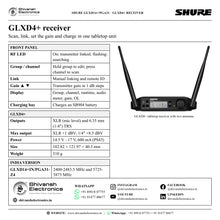
The GLXD4+ tabletop receiver has two antennas, a display for group, channel, battery runtime, audio level and gain, transmitter gain control in 1 dB steps, an XLR microphone output and a 6.35 mm (1/4") output. In India the set is supplied as GLXD14+IN/PGA31-Z4 (2400-2483.5 MHz and 5725-5875 MHz) with the PS43 power supply and a black carrying case.
| Runtime, SB904 battery | Up to 11.5 h |
| Dual-band operation | 2.4 + 5.8 GHz |
| Dynamic range, A-weighted | 122 dB |
| Latency, groups 1 and 3 | 4.53 ms |
Key features
- Dual Band Technology: operates in 2.4 GHz and 5.8 GHz
- Automatic frequency management moves away from interference without audio interruption
- PGA31 cardioid electret condenser headset for speech and performance
- Wireframe headset with secure fit and flexible gooseneck boom
- GLXD1+ bodypack with rugged metal construction and reversible belt clip
- SB904 lithium-ion rechargeable battery, up to 11.5 hours
- Charges in the receiver charging bay or over USB-C
- Remaining runtime shown in hours and minutes on the receiver
- Transmitter gain set from the receiver in 1 dB steps
- XLR and 6.35 mm (1/4") outputs
- Black carrying case included
Made for
- Spoken word: presentations, lectures and training
- General speaking and performance use
- Active performers and multi-instrumentalists
- Stages with a monitor speaker (cardioid pickup)
In the box
- GLXD4+ tabletop receiver
- GLXD1+ bodypack transmitter
- PGA31 headset microphone
- PS43 power supply
- SB904 lithium-ion rechargeable battery
- Black carrying case
Connections
- PGA31 TA4F (TQG) connector to the GLXD1+ TA4M input
- GLXD4+: XLR microphone output (microphone level) to a mixer
- GLXD4+: 6.35 mm (1/4") TRS output to mixers, recorders and amplifiers
- GLXD4+: 15 V DC power port for the PS43 power supply
- GLXD4+: USB-C port for firmware updates from a computer
- GLXD1+: USB-C charging port
Shure GLXD14+/PGA31: frequently asked questions
How is the PGA31 worn?
Fit the windscreen on the boom, place the headband around the back of the head with the boom on the left side, and position the microphone at the corner of the mouth. Avoid placing it directly in front of the mouth to reduce pops and plosives.
Which frequencies does it use in India?
The India version (Z4) tunes 2400-2483.5 MHz and 5725-5875 MHz. By default the receiver uses the best band mode with both bands; it can also be set to 2.4 GHz only or 5.8 GHz only.
How is the battery charged?
Put the SB904 in the charging bay of the receiver while the receiver is plugged in, or connect a USB charger to the USB-C port of the GLXD1+. About 15 minutes of charging gives up to 1 h 30 min of use, 1 hour gives up to 6 hours and 3 hours gives up to 11 h 30 min. The transmitter does not pass audio while the charging cable is connected.
How many systems can run together?
Up to 4 systems typical and 8 optimal in dual-band mode. Set every receiver to the same group, link each receiver and transmitter pair one at a time, and keep transmitters more than 2 m apart.
Where should the receiver go?
At least 3 m away from Wi-Fi access points, computers and other active 2.4 GHz and 5.8 GHz sources, with a clear line of sight to the transmitter, for example on stage or at the top of the equipment rack.
Where can I buy the Shure GLXD14+/PGA31 in India?
The Shure GLXD14+/PGA31 is available from Shivansh Electronics, Kolkata, West Bengal, India, with delivery across India.
Workflow 1: Lecture hall or classroom
Lecturers and trainers who walk while they talk.
Connections
| Connect | To |
|---|---|
| PGA31 | GLXD1+ TA4M input |
| GLXD4+ XLR output | Mixer or amplifier input |
Setup
- Place the receiver with a clear line of sight to the teaching area.
- Keep it at least 3 m from Wi-Fi access points and computers.
- Fit the headset with the microphone at the corner of the mouth.
- Switch on the receiver, press channel to scan, then switch on the GLXD1+.
- Set the gain on the receiver while the speaker talks at full voice.
Tip: Lock the receiver controls by holding group and channel.
Workflow 2: Conference or seminar presenter
Company speakers who need both hands free.
Connections
| Connect | To |
|---|---|
| PGA31 and GLXD1+ | GLXD4+ |
| GLXD4+ XLR output | Mixer microphone input |
Setup
- Clip the bodypack to a belt and route the cable under the jacket.
- Check that the RF LED on the receiver stays lit.
- Watch the audio meter and reduce the gain if OL appears.
- Check the runtime shown on the receiver before the session.
Tip: Fully charge a new SB904 before first use.
Workflow 3: Singer who plays an instrument
Multi-instrumentalists and active performers.
Connections
| Connect | To |
|---|---|
| PGA31 | GLXD1+ |
| GLXD4+ XLR output | Mixing console |
Setup
- Fit the headset and bend the gooseneck to the corner of the mouth.
- Place the monitor speaker to the side of or behind the cardioid pickup.
- Set the gain at the loudest passages of the soundcheck.
- Lock the transmitter controls before the show.
Tip: The cardioid pattern gives higher gain before feedback with a stage monitor.
Workflow 4: Panel with several presenters
Events with more than one headset speaker.
Connections
| Connect | To |
|---|---|
| Each PGA31 and GLXD1+ | Its own GLXD4+ |
| Receivers | Mixer inputs |
Setup
- Switch off all receivers and transmitters.
- Set every receiver to the same group.
- Switch on and link one pair at a time.
- Keep transmitters more than 2 m apart.
- Press link to use remote ID and check which pack belongs to which receiver.
Tip: Up to 4 systems typical, 8 optimal in dual-band mode.
Workflow 5: Recorded training session
Trainers recording a talk on video.
Connections
| Connect | To |
|---|---|
| PGA31 on the presenter | GLXD1+ |
| GLXD4+ 1/4" output | Recorder input |
Setup
- Connect the 6.35 mm (1/4") output to the recorder.
- Raise the gain until the meter moves well, then back off if OL appears.
- Keep the microphone out of the direct breath stream.
- Check the runtime on the receiver screen during breaks.
Tip: OL on the display means overload: reduce the transmitter gain.
Workflow 6: Full-day event with quick top-ups
Organisers running back-to-back sessions.
Connections
| Connect | To |
|---|---|
| SB904 | GLXD4+ charging bay |
| GLXD1+ USB-C | USB charger |
Setup
- Watch the runtime shown on the receiver.
- A red transmitter LED means less than 1 hour left.
- During a break, charge the battery for 15 minutes for up to 1 h 30 min of use.
- Switch the bodypack off between sessions.
Tip: The transmitter does not pass audio while the charging cable is connected.


