

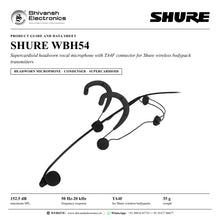

SHURE WBH54
PRICE ON ENQUIRY
Shure WBH54 supercardioid headworn vocal microphone with TA4F connector for Shure wireless bodypacks; black or tan. Available in India from Shivansh Electronics, Kolkata, West Bengal, India.
VISUAL GUIDE — See Every Photo, Spec & Setup Step (PDF)
PRICE ON ENQUIRY. For the price, exclusive offers, delivery timelines, or any other information, please Contact / WhatsApp +91 89818 07755 / +91 91477 00677. We will gladly share a personalised quotation for Shivansh Electronics, Kolkata, West Bengal, India. All payments are processed securely through Razorpay, our trusted payment gateway.
Acoustics
| Type | Electret condenser |
| Frequency response | 50 to 20,000 Hz |
| Polar pattern | Supercardioid |
| Sensitivity (1 kHz, open circuit voltage) | -56.0 dBV/Pa (1.58 mV); 1 Pa = 94 dB SPL |
| Maximum SPL (1 kHz, 1 % THD) | 152.5 dB |
| Signal-to-noise ratio | 55.0 dB |
| Dynamic range (1 kHz) | 109.4 dB |
| Self noise (equivalent SPL, A-weighted, typical) | 43.1 dB |
Electrical
| Power requirements | +5 V DC |
| Polarity | Positive pressure on the diaphragm produces positive voltage on pin 3 with respect to pin 1 |
| Connector | TA4F (TQG) 4-pin mini connector |
Physical
| Weight | 35 g (1.25 oz) |
| Cable length | 1.5 m |
Versions
| WBH54B | Black |
| WBH54T | Tan |
Product overview
The Shure WBH54 is the wireless version of the Beta 54 supercardioid headworn vocal microphone, with a TA4F connector for Shure wireless bodypack transmitters, delivering a warm, natural sound with maximum gain before feedback and ambient noise rejection.
The WBH54 is a subminiature electret condenser headworn microphone that gives uncompromised sound quality and reliability with minimal visibility. Its supercardioid polar pattern provides maximum gain before feedback and rejection of ambient noise, and its extended frequency response is tailored for vocal performance, making it ideal for lead and backing vocals on stage and for live recording.
Despite its small size, the condenser element handles extremely high sound pressure levels: 152.5 dB maximum SPL for the WBH54. Snap-fit foam windscreens stay in place during intensive movement, and the standard gold mesh protective cap keeps the polar pattern and sound quality intact. The durable, low-profile wire-frame headband is fully adjustable for stability and comfort, and the boom can be moved to the left or right side of the head.
The WBH54 is designed for use with Shure wireless microphone systems: its TA4F connector attaches to wireless bodypack transmitters, which supply its +5 V DC. The in-line preamp is not included. Compared with the omnidirectional Beta 53, which suits spoken word in quieter environments, the supercardioid Beta 54 / WBH54 has a tailored response for vocals in loud environments such as the stage.
In India the WBH54 is offered in black (WBH54B) and tan (WBH54T), each with its headband, windscreens, protective caps, lapel clip, boom holders, logo pad and plastic carrying case.
| Electret condenser | Supercardioid |
| Maximum SPL (1 kHz, 1 % THD) | 152.5 dB |
| Frequency response | 50 Hz-20 kHz |
| Weight | 35 g |
Key features
- Supercardioid polar pattern for maximum gain before feedback and ambient rejection
- Extended frequency response tailored for vocal performances
- Able to handle extremely high sound pressure levels
- Snap-fit foam windscreens stay in place during intensive movement
- TA4F connector for Shure wireless bodypack transmitters
- Subminiature condenser element with minimal visibility
- Durable, low-profile wire-frame headband, fully adjustable for stability and comfort
- Reversible boom for left or right side wearing
- Cable length 1.5 m
- Choice of black or tan finish
Made for
- Lead and backing vocals on stage
- Singers who play an instrument or dance while performing
- Live recording
- Loud stage environments
- Theatre and touring with Shure wireless systems
In the box
- WBH54 microphone with headband
- 2 × snap-fit foam windscreens
- 2 × standard protective caps
- 1 × swivelling lapel clip
- 2 × boom holders
- 1 × logo pad
- 1 × plastic carrying case
Connections
- TA4F (TQG) 4-pin mini connector to a Shure wireless bodypack transmitter
- Power: +5 V DC from the bodypack transmitter
- Cable length: 1.5 m
Shure WBH54: frequently asked questions
What is the difference between the WBH54 and the Beta 54?
They share the same supercardioid headworn microphone. The WBH54 is the wireless model with a TA4F connector for Shure wireless bodypacks (in-line preamp not included); the Beta 54 has a detachable in-line preamp for wired use with phantom power.
Should I choose the Beta 54 or the Beta 53 style?
The supercardioid Beta 54 / WBH54 has a tailored response for vocals in loud environments such as the stage. The omnidirectional Beta 53 has a flat response, better suited to spoken word in quieter environments.
Which protective cap should I use?
Always use the WBH54 with the standard gold mesh protective cap. Using it with no cap, or with a filtered cap, degrades sound quality and alters the polar pattern.
How do I position it?
Adjust the headband width and the boom height and length, then place the microphone near the corner of the mouth. Roll the boom for subtle adjustments and to avoid contact with skin; do not bend the boom.
Where can I buy the Shure WBH54 in India?
The Shure WBH54 is available from Shivansh Electronics, Kolkata, West Bengal, India, with delivery across India.
Workflow 1: Wireless lead vocal for a moving performer
Singers who dance or move around the stage.
Connections
| Connect | To |
|---|---|
| WBH54 (TA4F) | Shure wireless bodypack transmitter |
| Bodypack transmitter | Shure wireless receiver to console input |
Setup
- Adjust headband width, boom height and boom length.
- Place the capsule near the corner of the mouth.
- Plug the TA4F connector into the bodypack and set the bodypack gain.
- Route the receiver output to the console and check level.
Tip: Snap-fit foam windscreens stay in place during intensive movement.
Workflow 2: Singing instrumentalist
Drummers, keyboard players and guitarists who sing.
Connections
| Connect | To |
|---|---|
| WBH54 | Bodypack transmitter on the belt |
| Wireless receiver | Vocal channel on the console |
Setup
- Fit the headband and reverse the boom to the side that suits the instrument.
- Clip the cable with the swivelling lapel clip.
- Set the vocal level at soundcheck.
- Check gain before feedback with monitors on.
Tip: The supercardioid pattern gives maximum gain before feedback and ambient rejection.
Workflow 3: Backing vocals with headworn mics
Bands whose backing singers also play or move.
Connections
| Connect | To |
|---|---|
| One WBH54 per singer | One bodypack transmitter each |
| Wireless receivers | Separate console inputs |
Setup
- Fit each singer with their own headset.
- Roll the boom for a comfortable, consistent position.
- Set each bodypack gain.
- Balance the voices in the mix.
Tip: Always use the standard gold mesh protective cap to keep the polar pattern intact.
Workflow 4: Theatre and musical shows
Theatre sound teams who need discreet vocal miking.
Connections
| Connect | To |
|---|---|
| WBH54 in tan or black | Bodypack transmitter worn under costume |
| Wireless receivers | Show console |
Setup
- Choose the finish to suit the performer and costume.
- Fit the headband and place the mic at the corner of the mouth.
- Secure the cable with the lapel clip.
- Line-check every channel before the show.
Tip: The subminiature condenser element gives minimal visibility.
Workflow 5: Live recording of a headset performance
Engineers recording shows with headworn vocals.
Connections
| Connect | To |
|---|---|
| Wireless receiver output | Split to FOH console and recorder |
Setup
- Set the bodypack gain for headroom on loud passages.
- Split the receiver output to the recorder.
- Record the vocal as its own track.
- Monitor for windscreen or cable noise.
Tip: The WBH54 handles up to 152.5 dB SPL.
Workflow 6: Care between shows
Touring crews maintaining headsets.
Connections
| Connect | To |
|---|---|
| WBH54 | Plastic carrying case |
Setup
- Grip the windscreen's internal frame when removing it, not the foam.
- Clean foam windscreens with soap and water.
- Replace damaged or clogged caps and windscreens.
- Store the microphone and accessories in the carrying case.
Tip: Never bend the boom; roll it for adjustments.


