
TELEFUNKEN U48
MRP - Rs. 20,10,200
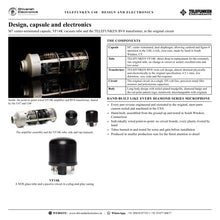
TELEFUNKEN U48 tube condenser mic with M7 capsule, VF14K tube and BV8 transformer: cardioid and figure-8, complete system. Available in India from Shivansh Electronics, Kolkata, West Bengal, India.
VISUAL GUIDE — See Every Photo, Spec & Setup Step (PDF)
The price shown is the MAXIMUM RETAIL PRICE (MRP), inclusive of all taxes. For the best price, exclusive offers and discounted rates, delivery timelines, or any other information, please DM us or call +91 89818 07755 / +91 91477 00677. We will gladly share an exclusive coupon code that you can apply at checkout. All payments are processed securely through Razorpay, our trusted payment gateway partner.
General
| Type | Vacuum tube condenser microphone, large diaphragm |
| Series | TELEFUNKEN Diamond Series |
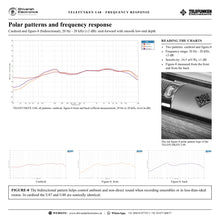
| Polar patterns | Cardioid, figure‑8 (bidirectional) |
| Pattern selection | Red polar pattern switch on the microphone |
| Capsule | TELEFUNKEN M7, centre‑terminated large diaphragm, dual diaphragm |
| Tube | TELEFUNKEN VF14K |
| Transformer | TELEFUNKEN BV8, nickel alloy core, 6.5:1 ratio |
| Build | Hand built and point‑to‑point wired in South Windsor, Connecticut, USA |
Acoustic and electrical
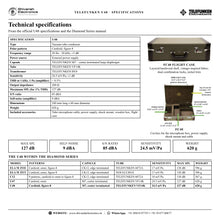
| Frequency range | 20 Hz - 20 kHz, ±3 dB |
| Sensitivity | 24.5 mV/Pa, ±1 dB |
| THD (amplifier, 1 kHz at 1 Pa) | < 0.3% |
| Maximum SPL (1% THD) | 127 dB SPL |
| Signal‑to‑noise ratio | 85 dBA |
| Self‑noise (amplifier) | 9 dBA |
| Output impedance | 200 ohms |
Power supply and cable
| Power source | External power supply (no phantom power required) |
| Power supply | M 940H, fully regulated |
| Mains voltage | 115 V or 230 V (set on the power supply) |
| Microphone cable | M 840TH, vintage‑correct 6‑pin locking connectors, 10 m |
| Audio output | XLR on the power supply, to the mic preamp with a standard 3‑pin microphone cable |
| Warm‑up time | 10 minutes |
Physical
| Dimensions | 240 mm long x 60 mm diameter |
| Weight | 620 g (microphone) |
| Finish | Nickel‑plated headgrille, TELEFUNKEN Diamond badge, red polar pattern logo |
In the box
| Microphone | TELEFUNKEN U48 |
| Power supply | M 940H, with power cable |
| Cable | M 840TH tube microphone cable, 10 m |
| Mount | M 740 elastic shock mount |
| Protection | WB40 wooden microphone box, FC40 locking flight case |
Compliance
| EMC Directive | 2014/30/EU (EN 55013 applied) |
| Low Voltage Directive | 2014/35/EU (EN 60065 applied) |
| RoHS | RoHS2 Directive 2011/65/EU |
Product overview
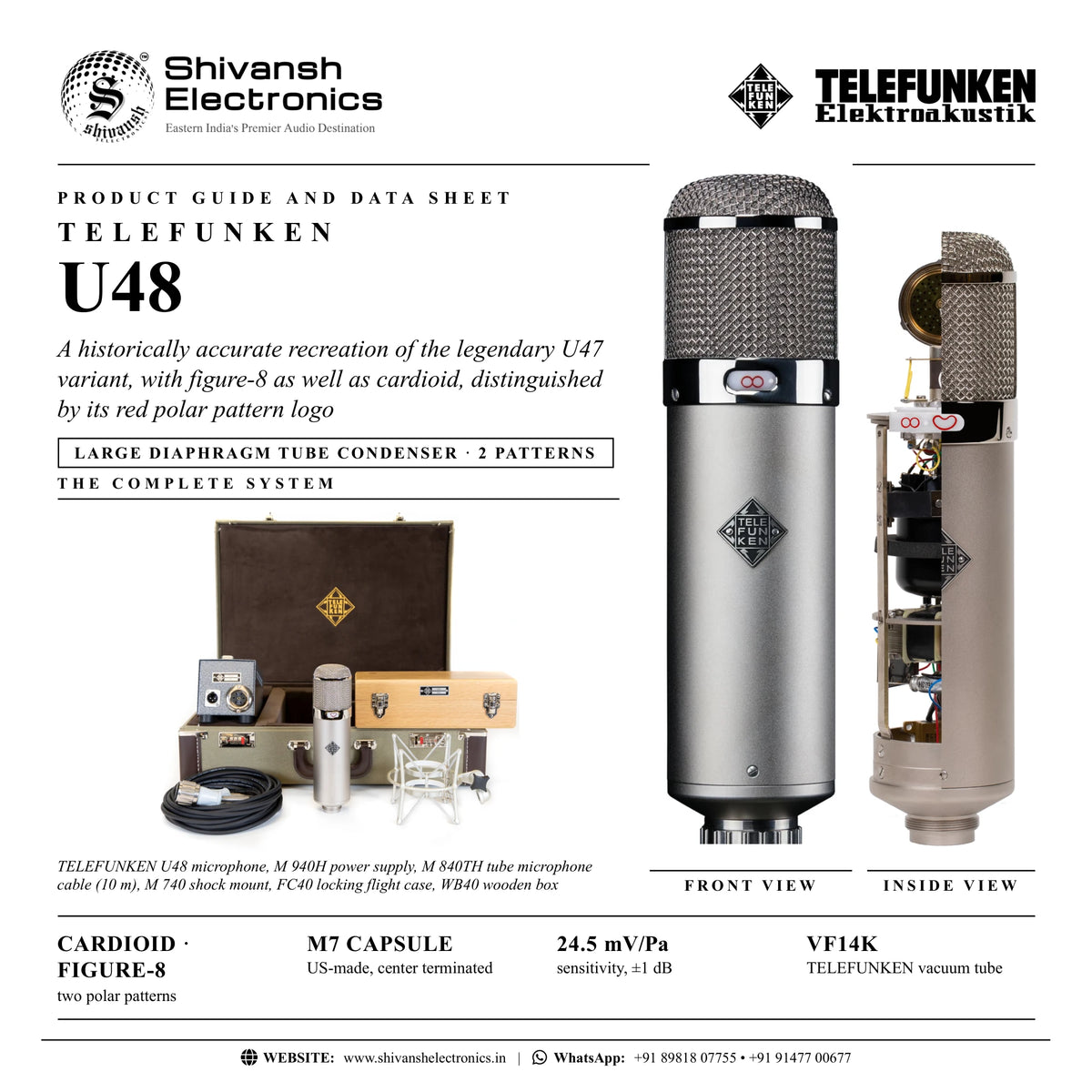
The TELEFUNKEN U48 is a historically accurate recreation of the figure-8 variant of the classic German large-diaphragm tube microphone, offering cardioid and bidirectional (figure-8) patterns and easily recognised by its red polar pattern logo.
One of the most iconic and versatile tube microphones ever created, the U48 is celebrated for its authoritative midrange, smooth low-end depth and the added flexibility of figure-8. It delivers on everything from soaring vocals and electric guitar to lush orchestral and chamber performances. TELEFUNKEN's recreation keeps every hallmark of the original, including the BV8 output transformer and M7-style capsule, for unmistakable warmth, detail and dimension. It is a complete system with power supply, 10 m cable, shock mount, wooden box and locking flight case.
| Sensitivity | 24.5 mV/Pa |
| Max SPL (1% THD) | 127 dB SPL |
| Self‑noise (amplifier) | 9 dBA |
| Vacuum tube | VF14K |
Key features
- Classic punchy, mid-forward sound with pleasing bite
- Legendary extended low-frequency response
- Two polar patterns: cardioid and figure-8
- US-made M7 capsule: historically accurate, centre terminated, dual diaphragm
- TELEFUNKEN VF14K vacuum tube, a plug-and-play solution for the original tube type
- TELEFUNKEN BV8 output transformer, wound in America to vintage specification
- Point-to-point wired in the USA, true to the original design
- Complete system: fully regulated M 940H power supply, American-made vintage-compatible cable, M 740 shock mount, WB40 wooden box and FC40 flight case
Sound character
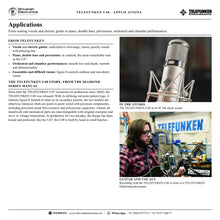
The U48 shares the punchy, mid-forward sound and extended low end of the U47; in cardioid the two are sonically identical. It is equally at home on vocals, piano, double bass and percussion, and adds figure-8 for duets, ensembles and stereo work.
Why figure-8
Figure-8 picks up equally from the front and rear while rejecting sound from the sides. That makes the U48 very helpful for controlling ambient and indirect sound when recording ensembles or in less-than-ideal rooms, for two performers facing each other, and as the side microphone in Mid-Side stereo. Cardioid gives focused single-source pickup. The pattern is selected on the microphone with the red polar pattern switch.
Capsule, tube and transformer
The M7 centre-terminated, dual-diaphragm capsule combines the mechanical design of the earliest German condensers with a modern, more stable tensioning material, for a very punchy response with depth and clarity; it is made by hand in limited quantity in South Windsor, Connecticut. The VF14K is TELEFUNKEN's drop-in solution to the dwindling supply of the original tube: a new old stock military-grade glass tube and a passive circuit in a plug-and-play casing that fits the original socket, with sonic characteristics extremely close to the original, nearly identical gain and distortion figures and a 5-year manufacturer's warranty. The BV8 is a hefty, nickel alloy core, twin-coil output transformer wound in America to vintage specification, with a 6.5:1 ratio, very low distortion and a wide, flat frequency response.
Power supply, cable and mounts
The M 940H power supply is designed and built in America with vintage-correct styling and modern components. It is fully regulated, calibrated to its own microphone and set for 115 V or 230 V mains, and it uses vintage-correct locking connectors and pinout, so it also mates with vintage microphones of this design. The M 840TH cable, made by TELEFUNKEN technicians in the USA, has oxygen-free copper conductors, 100% shielding with a dense helical copper screen plus metallised foil, and is 10 m long. The M 740 is a vintage-styled clasping elastic shock mount with durable metal cages.
Built by hand in Connecticut
In production since 2004, the TELEFUNKEN recreation is wired point to point with precision metal film resistors and polystyrene capacitors, using near-identical metalwork, contacts, cable connectors and circuit components. Almost all metalwork and mechanical parts are interchangeable with original examples. The circuit runs on a single 105-volt line, as on the original design. Most metalwork and mechanical parts are custom tooled and machined in the USA, and every power supply is calibrated to its own microphone and burned in with it as a complete system. The locking flight case has a shell of layered hardwoods wrapped in a durable, vintage-inspired fabric, suede-lined cavities for every component, dual combination locks and nickel trim. The wooden microphone box is made in the USA of solid white oak with a satin lacquer, and carries a metal name plate with the model and serial number.
In the box
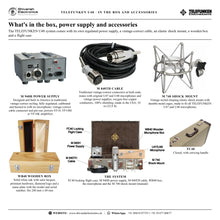
- TELEFUNKEN U48 microphone
- M 940H tube microphone power supply
- Power cable for the power supply
- M 840TH tube microphone cable, 10 m
- M 740 shock mount
- FC40 locking flight case
- WB40 wooden microphone box
The VF14K tube carries a 5-year manufacturer's warranty; register the microphone at t-funk.com/warranty for TELEFUNKEN's limited warranty plan. A standard 3-pin microphone cable from the power supply to the preamp is not included.
TELEFUNKEN U48: frequently asked questions
What is the difference between the U48 and the U47?
The U48 offers cardioid and figure-8; the U47 offers cardioid and omnidirectional. In cardioid the two are sonically identical. The U48 is identified by its red polar pattern logo.
Does the U48 need phantom power?
No. It is powered by its own M 940H power supply, which is included. Connect the power supply's XLR output to your mic preamp with a standard 3-pin microphone cable.
Does it need to warm up?
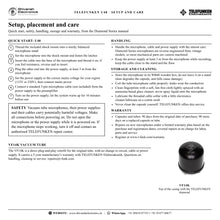
Yes. Make all connections first, switch on the power supply and let the system warm up for 10 minutes before use.
Can the power supply run on 230 V mains?
Yes. The power supply is set to 115 V or 230 V; make sure it matches your mains voltage before plugging in.
Is a stereo set available?
Yes, the TELEFUNKEN U48 Stereo Set is listed as a separate product at Shivansh Electronics.
Where can I buy the TELEFUNKEN U48 in India?
The TELEFUNKEN U48 is available from Shivansh Electronics, Kolkata, West Bengal, India, with delivery across India.
Workflow 1: Lead vocals
Vocals that need an authoritative midrange and smooth low-end depth.
Connections
| Connect | To |
|---|---|
| U48 microphone | M 940H power supply via TELEFUNKEN M 840TH cable |
| M 940H XLR output | Mic preamp / audio interface input (standard 3‑pin XLR cable) |
| M 940H power cable | Mains power, 115 V or 230 V as set |
Setup
- Fit the M 740 shock mount to a sturdy stand and set the U48 into it.
- Connect the M 840TH cable to the microphone and power supply, then the XLR output to your preamp, before switching on.
- Select cardioid on the microphone, power up and let the system warm up for 10 minutes.
- Set gain while the singer performs at full level, then record.
Tip: Add a pop filter for close vocal work.
Workflow 2: Duets and face-to-face performers
Two singers or players recorded on one microphone.
Connections
| Connect | To |
|---|---|
| U48 microphone | M 940H power supply via TELEFUNKEN M 840TH cable |
| M 940H XLR output | Mic preamp / audio interface input (standard 3‑pin XLR cable) |
Setup
- Place the U48 between the two performers, one at the front and one at the rear.
- Select figure-8 so both sides are picked up equally and the sides are rejected.
- Make all connections, switch on and allow 10 minutes to warm up.
- Balance the performers by moving them closer or further, then set gain.
Workflow 3: Ensembles in difficult rooms
Ensembles and less-than-ideal rooms where indirect sound needs controlling.
Connections
| Connect | To |
|---|---|
| U48 microphone | M 940H power supply via TELEFUNKEN M 840TH cable |
| M 940H XLR output | Mic preamp / audio interface input (standard 3‑pin XLR cable) |
Setup
- Mount the U48 facing the ensemble.
- Select figure-8 and turn the null sides towards unwanted sound sources or reflective walls.
- Connect, switch on and let the system warm up for 10 minutes.
- Set gain during the loudest passages and adjust the angle by ear.
Workflow 4: Electric guitar amp
Guitar cabinets that benefit from punch and bite.
Connections
| Connect | To |
|---|---|
| U48 microphone | M 940H power supply via TELEFUNKEN M 840TH cable |
| M 940H XLR output | Mic preamp / audio interface input (standard 3‑pin XLR cable) |
Setup
- Place the U48 in its shock mount in front of the speaker cabinet.
- Use cardioid for a direct sound, or figure-8 to add the room behind the microphone.
- Make all connections, switch on and allow 10 minutes of warm-up.
- Set gain with the amp at playing volume; the U48 handles up to 127 dB SPL.
Tip: Keep the power supply at least 3 m from the microphone while recording.
Workflow 5: Orchestral and chamber recording
Orchestras, chamber groups and choirs captured with one U48.
Connections
| Connect | To |
|---|---|
| U48 microphone | M 940H power supply via TELEFUNKEN M 840TH cable |
| M 940H XLR output | Mic preamp / audio interface input (standard 3‑pin XLR cable) |
Setup
- Place the U48 in its M 740 shock mount on a tall stand in front of the ensemble.
- Select cardioid to focus on the players, or figure-8 to pick up the front and rear while rejecting the sides.
- Make all connections, switch on and allow 10 minutes of warm-up.
- Set gain during the loudest passages and adjust the height and distance by ear.
Workflow 6: Piano, double bass and percussion
Acoustic instruments that need depth and a rich midrange.
Connections
| Connect | To |
|---|---|
| U48 microphone | M 940H power supply via TELEFUNKEN M 840TH cable |
| M 940H XLR output | Mic preamp / audio interface input (standard 3‑pin XLR cable) |
Setup
- Mount the U48 in the M 740 shock mount facing the instrument.
- Use cardioid for a focused sound.
- Make all connections first, then switch on and allow 10 minutes of warm-up.
- Set gain on the loudest passages and record.