





VERTIGO SOUND VSC-3
PRICE ON ENQUIRY
VERTIGO SOUND VSC-3 quad discrete VCA compressor: four 1979 VCAs, true stereo / mono / dual SC, Peak or RMS, TipToe ratio. Available in India from Shivansh Electronics, Kolkata, West Bengal, India.
VISUAL GUIDE — See Every Photo, Spec & Setup Step (PDF)
PRICE ON ENQUIRY. For the price, exclusive offers, delivery timelines, or any other information, please DM us or call +91 89818 07755 / +91 91477 00677. We will gladly share a personalised quotation for Shivansh Electronics, Kolkata, West Bengal, India. All payments are processed securely through Razorpay, our trusted payment gateway partner.
Audio
| Modes | Stereo SC / Dual Mono / Mono SC, switchable |
| Detection | Peak or RMS |
| Input | Transformer balanced, max. +22 dBu |
| Output | Electronically floating balanced, max. +27 dBu at 600 Ω |
| Minimum output load | 600 Ω |
| Dynamic range | 117 dB |
| Frequency response | 10 Hz - 70 kHz (-3 dB) |
| Signal‑to‑noise ratio | 97 dB at +6 dBu (20 Hz - 20 kHz, unweighted, RMS) |
| Noise | -91 dBu (20 Hz - 22 kHz, unweighted, RMS) at unity gain |
| Crosstalk between channels | > 100 dB at any frequency |
Controls
| Threshold | -22 to +23 dBu (zoomed -6 to +10 dBu) |
| Ratio | Soft (1:1 to 8:1), 2:1, 4:1, 8:1, 10:1, Brick (40:1) |
| Attack | 0.1, 0.3, 1, 3, 5, 10, 15, 20, 30, 40 ms |
| Release | 0.05, 0.1, 0.2, 0.3, 0.5, 0.6, 0.9, 1.2 s, Auto fast, Auto slow |
| Make Up | 0 to +22 dB (zoomed 0 to +6 dB) |
| SC Filter | 60 Hz / 90 Hz / Off per channel |
| Metering | 20‑segment gain reduction per channel, 0.25‑20 dB |
| Bypass | Hardwire relay bypass (System) |
Power
| Mains voltage | 115 V or 230 V (changed by the manufacturer) |
| Mains fuse | 230 V: 200 mA slow; 115 V: 400 mA slow |
| Power consumption | Max. 12 W |
| Power supply | Linear, toroidal transformer |
Product overview
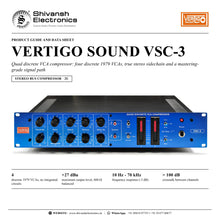
The VERTIGO SOUND VSC-3 is a quad discrete VCA compressor: four fully discrete 1979 VCAs in two channels, True Stereo, Mono summed and Dual Mono sidechain modes, Peak or RMS detection and a mastering-grade signal path with transformer input and floating balanced outputs.
The VSC-3 is the successor of the VSC-2 and does everything the VSC-2 is known for, plus new features and options. It is named Quad Discrete Compressor because it uses four VCAs built only from discrete components, a nod to the best VCA-based compressors of the 70s and 80s. The VERTIGO SOUND VCA is named 1979. This classic topology is combined with a modern mastering-grade signal path and innovative features such as a ratio that rises with level in Soft mode. Developed as a bus compressor, with every control available separately per channel, it is just as useful in mastering and while recording.
| Discrete 1979 VCAs | 4 |
| Max. output level, 600 Ω | +27 dBu |
| Frequency response (-3 dB) | 10 Hz - 70 kHz |
| Crosstalk between channels | > 100 dB |
Key features
- Four discrete 1979 VCAs: no integrated circuits, encased in ceramic for thermal stability
- True Stereo SC, Mono summed SC and Dual Mono modes; mid-side capable
- Peak or RMS detection, switchable
- Soft (TipToe) ratio rising from 1:1 to 8:1 with level, plus 2:1, 4:1, 8:1, 10:1 and Brick (40:1)
- Ratio switch compensates the level for equal-loudness comparison
- 10 attack and 10 release settings, including slow and fast auto release
- Two switchable sidechain high-pass filters per channel (60 Hz / 90 Hz)
- 20-segment gain reduction meter per channel, 0.25 to 20 dB
- Transformer-isolated inputs and floating balanced outputs; hard relay bypass
- Detented controls for easy recall; gold-plated rotary switches and CNC machined aluminium knobs
- Toroidal transformer linear power supply
The discrete 1979 VCA
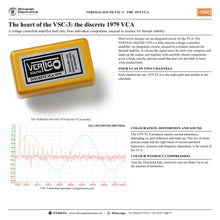
Most newer designs use an integrated circuit for the VCA. The VERTIGO SOUND 1979 is a fully discrete voltage controlled amplifier that colours the signal more the more you compress and make up the output. With a carefully designed circuit and choice of components it gives a fresh, punchy, precise sound that does not turn dull or nasty even when pushed hard. It produces mainly second harmonics, depending on gain reduction and make up; turn the Threshold fully clockwise and use Make Up to add colour without compression.
True stereo without image shift
Each channel has one 1979 VCA in the audio path and another in the sidechain. In Stereo SC mode both sidechains stay fully active and are not summed: the higher peak on either channel compresses both, so the VSC-3 reacts even to out-of-phase peaks without image shift, far removed from simple stereo linking. Channel A controls become the masters, so there is no left-right trimming. Mono SC mode reacts to the mono sum for more glue, and Dual mode gives two entirely separate compressors with crosstalk below -100 dB.
TipToe ratio and time constants
Soft is not the usual soft knee: it is a threshold-related ratio that rises from 1:1 up to 8:1 with level, so the compressor tiptoes into compression inaudibly. The fixed ratios run from medium to hard knee, and Brick (40:1) limits. Attack runs from 0.1 to 40 ms and release from 0.05 to 1.2 s plus two auto modes, all on detented switches; threshold covers -22 to +23 dBu and make up adds up to +22 dB, each with a zoomed range for the most used settings.
Mastering-grade signal path
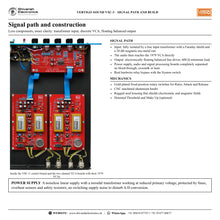
The input is fully isolated by a line transformer with a Faraday shield and a magnetic mu-metal can; the audio then reaches the VCA and leaves through an electronically floating balanced output driver rated at +27 dBu into 600 Ω. Power supply, audio and signal processing boards are completely separated, the System switch is a real hardwire bypass, and a noiseless linear supply with a toroidal transformer keeps the studio free of switching noise.
In the box
- VSC-3 quad discrete VCA compressor
VERTIGO SOUND VSC-3: frequently asked questions
Is the VSC-3 a stereo or a dual-mono compressor?
Both. It works in True Stereo SC mode, Mono summed SC mode or Dual Mono mode, where each channel has entirely separate controls and metering; dual mono also allows mid-side processing.
What does the Soft ratio do?
Soft (TipToe) is a ratio that increases with level, from 1:1 up to 8:1, for an inaudible start of compression. It is not a conventional soft knee.
Can the VSC-3 add colour without compressing?
Yes. Turn the Threshold fully clockwise and use Make Up to control the amount of harmonics from the discrete 1979 VCAs.
Does it need empty rack space for ventilation?
No, it generates very little heat, but its discrete VCAs are sensitive to temperature differences, so avoid mounting heat-generating devices directly above or below it.
Where can I buy the VERTIGO SOUND VSC-3 in India?
The VERTIGO SOUND VSC-3 is available from Shivansh Electronics, Kolkata, West Bengal, India, with delivery across India.
Workflow 1: Mix bus compression
Mixing engineers gluing a stereo mix.
Connections
| Connect | To |
|---|---|
| Mix bus insert send L / R | Input A / B |
| Output A / B | Mix bus insert return L / R |
Setup
- Select Stereo SC and Peak mode.
- Set Attack to 10 ms and Release to 0.6 s to start.
- Lower the Threshold to about 2-4 dB of gain reduction.
- Match the loudness with Make Up and compare with the System switch.
Tip: If the low end starts to pump, switch on the SC Filter at 60 or 90 Hz.
Workflow 2: Mastering
Mastering studios needing image-stable stereo compression.
Connections
| Connect | To |
|---|---|
| Mastering chain L / R | Input A / B |
| Output A / B | Next processor or converter |
Setup
- Select Stereo SC mode: channel A controls are the masters.
- Use a gentle ratio or Soft.
- Find the time constants with a heavy setting, then reduce gain reduction.
- Use the detented positions and the recall sheet to document the setting.
Tip: Stereo SC reacts to out-of-phase peaks without image shift.
Workflow 3: Mid-side processing
Engineers working on mid and side separately.
Connections
| Connect | To |
|---|---|
| Mid signal | Input A |
| Side signal | Input B |
Setup
- Select Dual mode: no shared controls.
- Set each channel independently.
- Watch each meter separately.
- Return the outputs to the M/S decoder.
Tip: Crosstalk below -100 dB makes the two channels behave like separate units.
Workflow 4: Mono vocal chain with both channels
Vocal recording or mixing with a custom curve.
Connections
| Connect | To |
|---|---|
| Vocal source | Input A |
| Output A | Input B |
| Output B | Recorder or mix return |
Setup
- Set channel A to Soft mode.
- Set channel B to 8:1.
- Shape the curve with the channel B Attack and Threshold.
- Use Make Up on both channels to match level.
Tip: Shorter attacks can be musical in Soft mode.
Workflow 5: Subgroup glue
Backing vocals, drums or bass groups.
Connections
| Connect | To |
|---|---|
| Subgroup L / R | Input A / B |
| Output A / B | Subgroup return |
Setup
- Select Mono SC mode for more glue.
- Choose RMS for very dynamic material.
- Set Release, including the auto modes.
- Check the gain reduction meters.
Tip: Mono SC narrows the stereo image but adds glue.
Workflow 6: Colour without compression
Adding harmonic character from the 1979 VCAs.
Connections
| Connect | To |
|---|---|
| Source | Input A / B |
| Output A / B | Return |
Setup
- Turn the Threshold fully clockwise.
- Raise Make Up to set the amount of harmonics.
- Compare with the System switch.
- Adjust level downstream as needed.
Tip: The 1979 VCA produces mainly second harmonics, depending on gain reduction and make up.


