ALLEN & HEATH Avantis
PRICE ON ENQUIRY
Allen & Heath Avantis 64 channel, 42 bus digital mixer: two 15.6" Full HD touchscreens, 24 motorised faders, 96 kHz XCVI core, dPack ready. Available in India from Shivansh Electronics, Kolkata, West Bengal, India.
VISUAL GUIDE — See Every Photo, Spec & Setup Step (PDF)
PRICE ON ENQUIRY. For the price, exclusive offers, delivery timelines, or any other information, please Contact / WhatsApp +91 89818 07755 / +91 91477 00677. We will gladly share a personalised quotation for Shivansh Electronics, Kolkata, West Bengal, India. All payments are processed securely through Razorpay, our trusted payment gateway.
General
| Type | Digital mixer for standalone operation, 64 x 42 |
| Processing core | XCVI FPGA, variable bit depth, 96-bit accumulator |
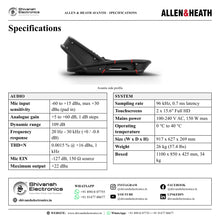
| Sampling rate | 96 kHz |
| Latency | 0.7 ms, analogue input to output |
| Chassis | Super-tough, lightweight full-metal chassis |
Mixing capacity
| Input channels | 64 mono, full processing (LPF / HPF, gate, PEQ, comp, delay); 96 with dPack |
| Mix busses | 42, configurable, full processing on mix outputs (PEQ, GEQ, comp, delay); 56 with dPack |
| System inputs and outputs | 400, soft patchable, all independently assigned |
| FX | 12 stereo RackExtra FX racks with dedicated stereo returns, library of factory presets |
| DCA groups | 16, with DCA Spill |
| Mute groups | 8 |
| Automatic Mic Mixer | Up to 64 channels in 1, 2 or 4 zones; gain sharing or NOM |
| Scenes | 500 per show; cue list, crossfade up to 20 s per scene |
| DEEP processing | Ready: emulations of classic preamps, compressors and GEQs, no added latency |
Control
| Touchscreens | 2 x 15.6" Full HD (1080p) capacitive, gesture control |
| Faders | 24 motorised, touch-sensitive, in two banks of 6 layers: 144 fader strips; optional dedicated master section |
| Rotary modes | Gain, Pan, Sends and up to 3 custom functions |
| SoftKeys | 24 assignable |
| Custom rotaries | 6 assignable (two sets of 3 rotary encoders) |
| Fader illumination | Integrated into the armrest, adjustable |
| Metering | 22-segment meters, multipoint peak detection; signal generator, RTA and spectrogram |
| User access | User permissions with password log-in; channel safes, global and per-scene recall filters |
| Remote control | Avantis Director, MixPad, OneMix, 4You, Custom Control; up to 48 IP remote controllers over TCP/IP |
| MIDI | MIDI control driver, MIDI control via TCP/IP |
Inputs
| Mic/line XLR inputs | 12, balanced XLR, +48 V phantom power |
| Mic/line preamp | Fully recallable |
| Input sensitivity | -60 to +15 dBu |
| Analogue gain | +5 to +60 dB, 1 dB steps |
| Pad | -20 dB active pad |
| Maximum input level | +30 dBu (pad in) |
| Input impedance | > 4 kΩ (pad out), > 10 kΩ (pad in) |
| Mic EIN | -127 dB with 150 Ω source |
| Phantom power indication | Per socket, internal or external phantom power sensing, triggered at +24 V |
| Digital input | 1 x stereo AES3 on XLR (2 channels), 2.5 Vpp balanced, terminated 110 Ω |
| Input SRC | 24-bit, 32 kHz - 192 kHz, with bypass option |
Outputs
| Analogue XLR outputs | 12, balanced, relay protected |
| Output impedance | < 75 Ω |
| Nominal output | +4 dBu = 0 dB meter reading |
| Maximum output level | +22 dBu |
| Residual output noise | -95 dBu (muted, 22-22 kHz); -90 dBu (muted, 0-80 kHz) |
| Digital outputs | 2 x stereo AES3 on XLR, 2.5 Vpp balanced, terminated 110 Ω |
| Output sampling rate | 96 kHz, globally switchable to 48 kHz or 44.1 kHz; SRC bypass option |
| Headphones | 1/4" TRS and 3.5 mm, dedicated analogue volume control |
System performance
| Measured | Balanced XLR in to XLR out, 22-40 kHz, minimum gain, pad out |
| Dynamic range | 109 dB |
| System signal to noise | -92 dB |
| Frequency response | 20 Hz - 30 kHz (+0 / -0.8 dB) |
| THD+N (analogue in to out) | 0.0015 % @ +16 dBu output, 1 kHz, 0 dB gain |
| Headroom | +18 dB |
| Internal operating level | 0 dBu |
| dBFS alignment | +18 dBu = 0 dBFS (+22 dBu at XLR output) |
| Meter calibration | 0 dB meter = -18 dBFS (+4 dBu at XLR out) |
| Meter peak indication | -3 dBFS (+19 dBu at XLR out) |
Expansion and networking
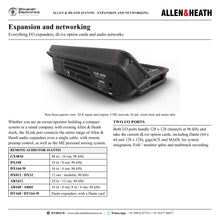
| SLink | Locking RJ45; gigaACE, DX, GX, dSnake and ME protocols; up to 128 x 128 channels; remote preamp control |
| I/O ports | 2, each capable of 128 x 128 at 96 kHz, for option cards inc. Dante, MADI, gigaACE and AES/EBU |
| Network | 2 x gigabit Ethernet (1,000 Mbit/s) |
| Word clock | BNC, input or output, switchable in software |
USB audio
| Playback | Mono / stereo .WAV, 16 / 24-bit, 44.1 / 48 / 96 kHz; MP3; FLAC |
| Recording | Stereo .WAV, 24-bit, 96 kHz |
| Data | USB transfer of scenes, libraries and shows |
Power
| Mains power | 100-240 V AC, 50-60 Hz, 150 W max; earthed 3-pin IEC inlet, two-pole push-button switch |
| Operating temperature | 0 °C to 40 °C (32 °F to 104 °F); recommended 5 °C to 40 °C |
Physical
| Dimensions (W x D x H) | 917 x 627 x 269 mm (36.1" x 24.7" x 10.6") |
| Weight | 26 kg (57.4 lbs) |
| Boxed dimensions (W x D x H) | 1100 x 850 x 425 mm (43.3" x 33.5" x 16.7") |
| Boxed weight | 34 kg (75 lbs) |
Options
| dPack | 96 input channels, 56 busses, 24 Dyn8, DEEP preamp, compressor and expander models, NEQ12 |
| RackUltra FX card | 8 RackUltra FX slots, 8 stereo sends and returns, PEQ and dynamics on input and output of each slot; requires dPack |
Product overview
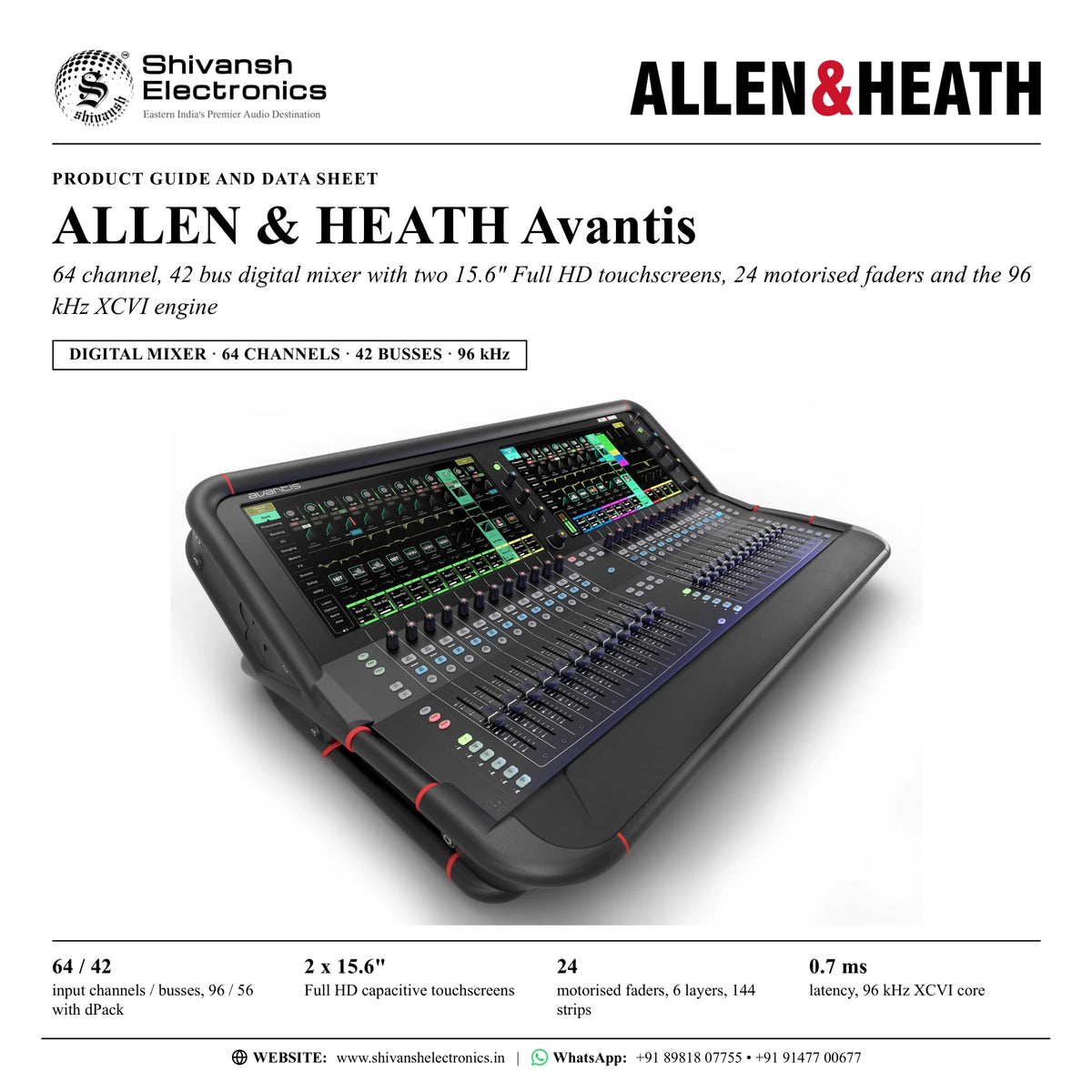
The Allen & Heath Avantis is a 64 channel, 42 configurable bus digital mixer with two 15.6" Full HD touchscreens, 24 motorised faders on 6 layers and the 96 kHz XCVI FPGA engine with 0.7 ms latency, expandable to 96 channels and 56 busses with dPack.
Avantis puts Allen & Heath's next-generation technology into a standalone console. Its 96 kHz XCVI FPGA engine, with variable bit depth and a 96-bit accumulator, runs 64 mono input channels with full processing, 12 stereo FX returns and 42 flexible mix busses, with 400 soft-patchable system inputs and outputs and a latency of no more than 0.7 ms from analogue input to output. Add-on processing comes from Allen & Heath's flagship dLive mixing system, and Avantis is fully compatible with all the dLive I/O cards, the full Everything I/O range and the IP controllers.
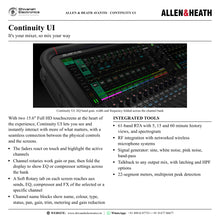
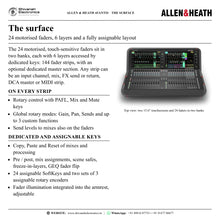
A super-tough, lightweight full-metal chassis carries two 15.6" Full HD capacitive touchscreens with gesture control and 24 motorised, touch-sensitive faders in two banks of 6 layers: 144 fader strips, with an optional dedicated master section. Any strip can be an input channel, mix, FX send or return, DCA master or MIDI strip, with its own rotary and PAFL, Mix and Mute keys. Continuity UI links these controls with the screens: the faders highlight the active channels on touch, the channel rotaries work gain or pan and, at the touch of a button, fold the display to show EQ or compressor settings across the whole bank, and a Soft Rotary tab on each screen reaches aux sends, EQ, compressor and FX of the selected channel.
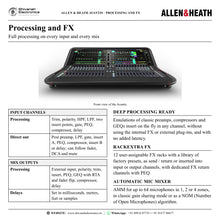
Every input channel has trim, polarity, high and low pass filters, two insert points, gate, parametric EQ, compressor and delay; every mix has an external input, insert, parametric EQ, a graphic EQ with RTA and fader flip, compressor and delay. Avantis is DEEP processing ready, with emulations of classic preamps, compressors and GEQs that insert on the fly in any channel without using the internal FX and without added latency. Twelve RackExtra FX racks with a library of factory presets run as send / return or as inserts, each with a dedicated stereo return, and 16 DCA groups with DCA Spill, 8 mute groups, an automatic mic mixer for up to 64 microphones in 1, 2 or 4 zones, a 61-band RTA with 5, 15 and 60 minute history views and 500 scenes per show complete the toolset.
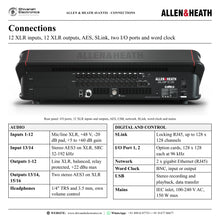
Local I/O covers 12 XLR mic/line inputs with fully recallable preamps, 12 XLR line outputs, one stereo AES input and two stereo AES outputs, plus BNC word clock, USB stereo recording and playback and two headphone outputs. The SLink port connects the entire range of Allen & Heath audio expanders and the ME personal mixing system over a single cable, with up to 128 x 128 channels and remote preamp control, and two I/O ports, each capable of 128 x 128 channels at 96 kHz, take dLive option cards such as Dante (64 x 64 and 128 x 128), gigaACE and MADI for system integration, FoH / monitor splits and multitrack recording.
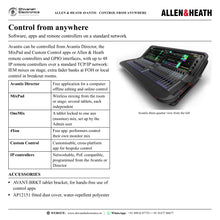
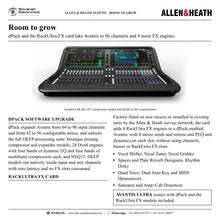
Avantis can be controlled from Avantis Director on a computer, the MixPad, OneMix, 4You and Custom Control apps and up to 48 IP remote controllers over a standard TCP/IP network, for IEM mixes on stage, extra fader banks at FOH or local control in breakout rooms. It suits owner/operators building a compact system as well as rental companies with existing Allen & Heath stock, and it grows with the work: the dPack software upgrade expands it to 96 input channels and 56 busses with the full DEEP processing suite, 24 Dyn8 engines and NEQ12, and the RackUltra FX card adds 8 RackUltra FX engines.
| Input channels / configurable busses (96 / 56 with dPack) | 64 / 42 |
| Full HD capacitive touchscreens | 2 x 15.6" |
| Motorised faders, 6 layers, 144 fader strips | 24 |
| Latency, 96 kHz XCVI FPGA core | 0.7 ms |
Key features
- 96 kHz XCVI FPGA core: variable bit depth, 96-bit accumulator, 0.7 ms latency
- 64 input channels and 42 configurable busses, 96 / 56 with the dPack upgrade
- Two 15.6" Full HD capacitive touchscreens with gesture control and Continuity UI
- 24 motorised, touch-sensitive faders on 6 layers: 144 fader strips, optional dedicated master section
- 24 assignable SoftKeys, 6 assignable custom rotaries and integrated fader illumination
- Full processing on every input and mix; DEEP processing ready
- 12 stereo RackExtra FX with dedicated returns
- 16 DCA groups with DCA Spill, 8 mute groups, 500 scenes per show
- Automatic Mic Mixer (AMM) for up to 64 channels in 1, 2 or 4 zones
- 12 XLR mic/line inputs, 12 XLR line outputs, 1 stereo AES input, 2 stereo AES outputs
- SLink port for remote expanders and the ME personal mixing system, up to 128 x 128 channels
- 2 I/O ports, each 128 x 128 at 96 kHz, for Dante, MADI, gigaACE and other option cards
Made for
- Front of house and monitor mixing for live productions
- In-ear monitor (IEM) mixes controlled from the stage
- FoH / monitor splits and system integration
- Multitrack recording and virtual soundcheck
- Owner/operator systems and rental companies with Allen & Heath stock
- Breakout rooms and multi-microphone setups with automatic mic mixing
In the box
- Avantis digital mixer
Connections
- Inputs 1-12: XLR mic/line inputs (balanced, +48 V phantom power, -20 dB pad)
- Input 13/14: stereo AES3 input on XLR
- Outputs 1-12: XLR line outputs (balanced, relay protected)
- Outputs 13/14 and 15/16: two stereo AES3 outputs on XLR
- SLink port (locking RJ45) for remote expanders and the ME personal mixing system
- I/O Port 1 and I/O Port 2 for option cards, 128 x 128 channels each at 96 kHz
- Network: two gigabit Ethernet ports (RJ45)
- Word Clock: BNC connector, input or output
- USB for stereo recording and playback and for scenes, libraries and shows
- 1/4" TRS and 3.5 mm headphone outputs with dedicated analogue volume control
- Mains: earthed 3-pin IEC inlet with two-pole push-button switch
Allen & Heath Avantis: frequently asked questions
Avantis or Avantis Ultra: what is the difference?
Both have the same surface and local I/O. Avantis Ultra adds 96 input channels and 56 busses, 24 Dyn8 engines, the DEEP preamp, compressor and expander models, NEQ12 and 8 RackUltra FX, with the dPack software and the RackUltra FX module included. An Avantis can be upgraded later with dPack, and with the RackUltra FX card, which requires dPack and is installed by the Allen & Heath service network.
Avantis or Avantis Solo: which should I choose?
Both run the same 64 channel, 42 bus engine with 12 RackExtra FX and two 128 x 128 I/O ports. Avantis has two 15.6" touchscreens, 24 faders, 24 SoftKeys, 12 XLR inputs and outputs, one stereo AES input and two stereo AES outputs; Avantis Solo has one 15.6" touchscreen, 12 faders, 18 SoftKeys, 6 XLR inputs and outputs and one stereo AES input and output.
How do I add more inputs and outputs?
Connect Allen & Heath remote expanders to the SLink port, with preamps controlled and recalled from the Avantis: for example the GX4816 with 48 inputs and 16 outputs, the DX168 with 16 inputs and 8 outputs, or the AR2412 with 24 inputs and 12 outputs. For audio networks, fit option cards such as Dante, MADI or gigaACE in the two I/O ports; with a Dante card, the DT168 and DT164-W Dante expanders can be added too.
Can performers control their own monitor mixes?
Yes. With the free 4You app, performers control their own monitor mix from a smartphone or tablet, and OneMix locks a tablet to a single aux mix without the risk of affecting the other monitors or the FOH main mix. The ME personal mixing system connects to the SLink port, or to the DX2 port of a GX4816 expander.
Can I record a show on the Avantis?
Yes. Avantis records stereo .WAV files at 24-bit, 96 kHz and plays back .WAV, MP3 and FLAC files over USB. For multitrack recording and virtual soundcheck, an option card in an I/O port carries the channels to the recording system, and Avantis works with multitrack recording software made to interface with Allen & Heath consoles.
Where can I buy the Allen & Heath Avantis in India?
The Allen & Heath Avantis is available from Shivansh Electronics, Kolkata, West Bengal, India, with delivery across India.
Workflow 1: Front of house with a stage expander
Live sound engineers, owner/operators and rental companies mixing bands and events.
Connections
| Connect | To |
|---|---|
| Avantis SLink port | GX4816 or DX168 expander on stage (single-cable digital snake) |
| Stage microphones and line sources | Expander XLR inputs, preamps controlled from the Avantis |
| Avantis XLR outputs 1-12 | Main and monitor speaker systems |
Setup
- Connect the expander to the SLink port with one CAT5e or CAT6 cable; the Avantis controls and recalls the remote preamps.
- Patch local and remote inputs to the 64 input channels in the soft patch bay.
- Lay out the 24 faders and 6 layers the way you mix: any strip can be a channel, mix, FX, DCA or MIDI strip.
- Set gain, filters, gate, EQ and compressor with Continuity UI and the Soft Rotary tab.
- Send the main mix and monitor mixes to the local XLR outputs or to the expander outputs.
Tip: In cascade mode two DX168 units share a single cable connection to the Avantis.
Workflow 2: Monitor mixing from the stage
Monitor engineers and bands running wedge and in-ear monitor mixes.
Connections
| Connect | To |
|---|---|
| Avantis Network port | Wireless router (access point) |
| Tablet with MixPad or OneMix | Avantis over Wi-Fi |
| Performers' smartphones or tablets with 4You | Their own monitor mixes |
Setup
- Connect a wireless router to one of the two Network ports.
- Walk the stage with MixPad on a tablet and set the monitor mixes where they are heard, while the console mixes front of house.
- As the Admin user, set up OneMix tablets, each locked to one musician's aux mix.
- Let performers adjust their own monitor mix with the free 4You app.
- Shape each mix with its parametric EQ, graphic EQ, compressor and delay.
Tip: Several tablets can be connected, each providing independent control.
Workflow 3: 48 stage inputs and personal mixers on one cable
Bands and production teams who want a large stage box and personal monitor mixing.
Connections
| Connect | To |
|---|---|
| Avantis SLink port | GX4816 GX port |
| GX4816 DX2 port | ME personal mixing system |
| GX4816 DX1 port | Further compatible Allen & Heath expander (optional) |
Setup
- Connect the GX4816 to the SLink port: 48 mic preamps and 16 XLR line outputs at 96 kHz, all recallable from the Avantis.
- The GX4816 firmware updates automatically when it is connected to the mixing system.
- Connect the ME personal mixing system to the GX4816 DX2 port, which is ME compatible with Avantis.
- Musicians set their own mixes on their ME personal mixers.
- Feed stage monitors from the 16 XLR line outputs of the GX4816.
Tip: Phantom power LEDs on every GX4816 input show the status at a glance on stage.
Workflow 4: Multitrack recording and virtual soundcheck
Engineers recording shows and rehearsing mixes without the band.
Connections
| Connect | To |
|---|---|
| Option card in an I/O port (Dante, MADI or gigaACE) | Multitrack recording system |
| Input channel direct outputs | Card sends, through the soft patch bay |
Setup
- Fit an option card in I/O Port 1 or 2: each port handles up to 128 x 128 channels at 96 kHz.
- Choose the direct-out tap-off point, for example post preamp, and patch the direct outputs to the card.
- Record every channel with multitrack recording software made to interface with Allen & Heath consoles.
- For a virtual soundcheck, patch the card returns to the input channels and play the tracks back through the mix.
- Capture a stereo mix to USB at the same time, as a 24-bit, 96 kHz .WAV file.
Tip: Direct outputs can follow the fader, DCA and mute, or stay independent of them.
Workflow 5: Breakout rooms with automatic mic mixing
Installers and AV teams running systems with several rooms and many microphones.
Connections
| Connect | To |
|---|---|
| Room microphones | Avantis XLR inputs or a remote expander |
| IP remote controllers (PoE) | Avantis Network port over a standard TCP/IP network |
| GPIO interface | Third-party control systems |
Setup
- Assign up to 64 microphones to the automatic mic mixer in 1, 2 or 4 zones, in gain sharing or NOM mode.
- Program IP controllers from the Avantis or Director for local control in each breakout room.
- Build a Custom Control layout for simple, bespoke control of the rooms.
- Set user permissions with password log-in to restrict operator access.
- Recall a specific scene for each user log-in.
Tip: Up to 48 IP remote controllers can run over a standard TCP/IP network.
Workflow 6: Show preparation with Avantis Director
Engineers preparing shows before they reach the venue.
Connections
| Connect | To |
|---|---|
| Computer with Avantis Director | Avantis Network port (online control) |
| USB drive | Avantis USB port (scenes, libraries and shows) |
Setup
- Build the show offline in the free Avantis Director application: patch, names, processing and scenes.
- Connect the computer to the Network port for online control at the venue.
- Store channel processing as library items; they are archived with the show file and can move on USB to other systems.
- Set up a cue list with crossfades of up to 20 seconds per scene.
- Protect channels with scene safes and per-scene recall filters.
Tip: A scene can trigger another scene recall, delayed by up to 4 minutes.