
RME Micstasy
MRP - Rs. 4,82,856
RME Micstasy 8-channel full range mic / line / instrument preamp, 85 dB gain, 192 kHz AD, AES/EBU, ADAT, MIDI remote. Available in India from Shivansh Electronics, Kolkata, West Bengal, India.
VISUAL GUIDE — See Every Photo, Spec & Setup Step (PDF)
The price shown is the MAXIMUM RETAIL PRICE (MRP), inclusive of all taxes. For the best price, exclusive offers and discounted rates, delivery timelines, or any other information, please DM us or call +91 89818 07755 / +91 91477 00677. We will gladly share an exclusive coupon code that you can apply at checkout. All payments are processed securely through Razorpay, our trusted payment gateway partner.
General
| Type | 8‑channel mic / line / instrument preamp and AD converter |
| Format | 19‑inch, 2 units |
| Remote control | MIDI (5‑pin DIN), MIDI over MADI with the I64 MADI Card |
| Presets | 8 user presets |
Microphone / line inputs 1-8 (rear)
| Input | XLR, electronically balanced, 2 kOhm |
| Gain range | -9 dB to +76.5 dB |
| Maximum input level | +30 dBu (gain -9 dB), -56.5 dBu (gain 76.5 dB) |
| Frequency response | 20 Hz - 100 kHz (-0.1 dB), 10 Hz - 150 kHz (-0.3 dB) |
| THD / THD+N (30 dB gain) | < -110 dB (0.0003 %) / < -100 dB (0.001 %) |
| Channel separation | > 120 dB |
| EIN at 150 Ohm | 122.0 dBu (30 dB gain), 126.1 dBu (40 dB), 127.2 dBu (50‑70 dB) |
Instrument / line inputs 1-8 (front)
| Input | 6.3 mm TRS, electronically balanced; 5.6 kOhm unbalanced, 11.2 kOhm balanced; Hi‑Z 470 kOhm |
| Gain range | 0 to +50 dB |
| Maximum input level | +21 dBu (gain 0 dB) |
| SNR (gain 0 dB) | 112.4 dB RMS unweighted, 116 dB(A) |
Line outputs 1-8
| Output | XLR, balanced, 150 Ohm |
| Level | Switchable +13, +19, +24 dBu; maximum +27 dBu |
AD conversion
| Resolution | 24 bit |
| SNR | 115.0 dB RMS unweighted, 118 dB(A) at +30 dBu |
| Frequency response | 5 Hz - 20.6 kHz (44.1 kHz), 5 Hz - 45.3 kHz (96 kHz), 5 Hz - 70 kHz (192 kHz) |
| THD+N | < -110 dB, < 0.0003 % |
Digital
| AES/EBU | 25‑pin D‑sub: 4 x out (8 channels up to 192 kHz), 1 x in |
| ADAT | 2 x TOSLINK out, S/MUX and S/MUX4 |
| Word clock | BNC in (75 Ohm switchable) / out |
| Clocks | Internal, AES, word clock, option (MADI); 28 - 200 kHz |
| MIDI | 5‑pin DIN in / out |
Physical
| Power | Internal 100‑240 V AC; typical 24 W, maximum < 40 W |
| Dimensions (W x H x D) | 483 x 88 x 242 mm with rack ears |
| Weight | 3 kg |
| Temperature | +5 to +50 °C |
Product overview
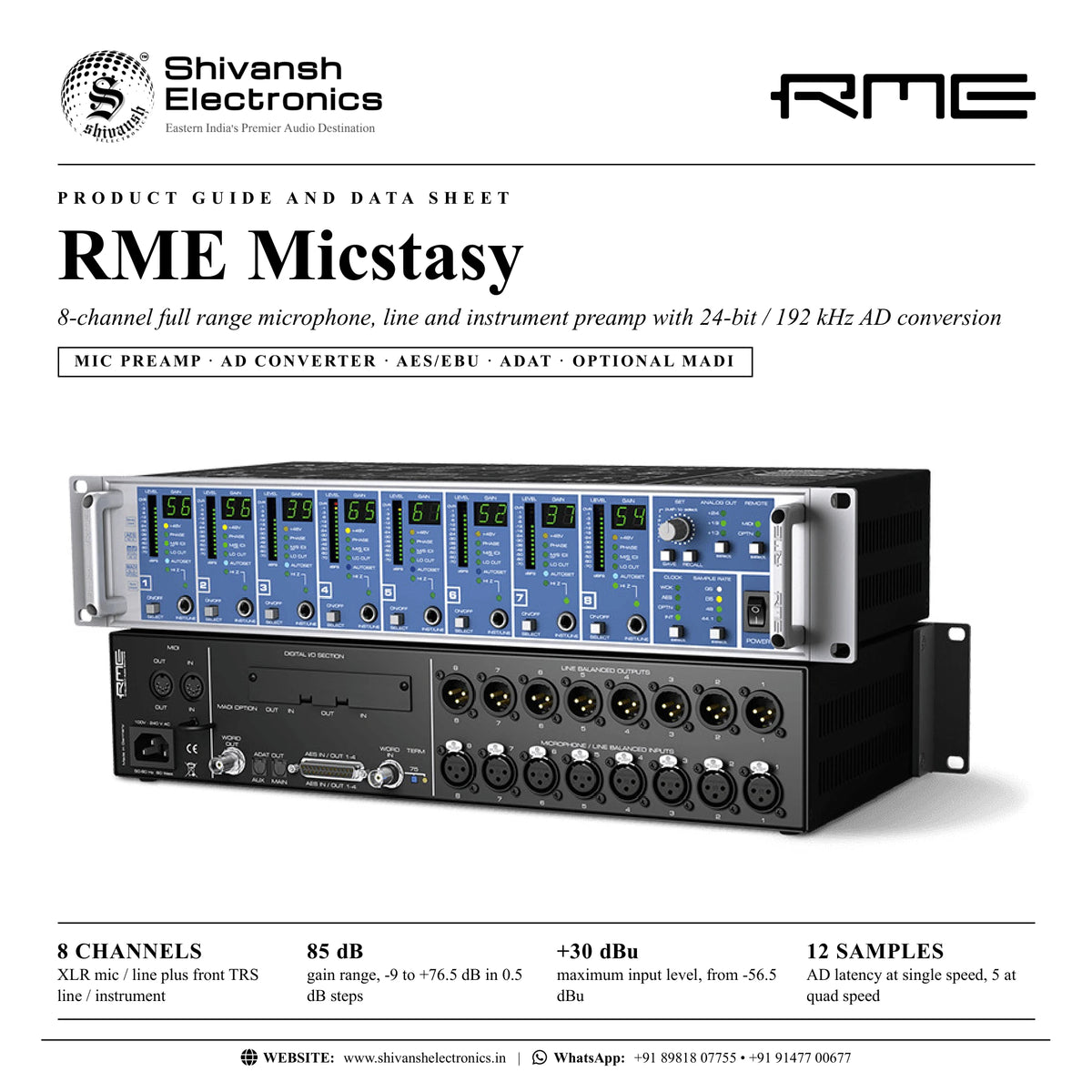
The RME Micstasy is an 8-channel full range microphone, line and instrument preamp with reference-quality 24-bit / 192 kHz AD conversion, fully remote controllable via MIDI and MIDI over MADI, in a 2-unit 19-inch chassis.
Micstasy amplifies and digitises every analogue source: high-level stage signals, studio line signals, instruments and dynamic, condenser or ribbon microphones. It works analogue (mic / line in to line out) and digital (mic / line in to digital out) at the same time, so the amplified signals at the eight balanced line outputs can be passed on without a separate splitter. Eight XLR inputs on the rear offer an 85 dB gain range from -56.5 dBu up to +30 dBu, eight front TRS inputs take line and instrument signals with Hi-Z, and four AES/EBU and two ADAT outputs deliver the digital signal. The optional I64 MADI Card adds MADI I/O with serial cascading of up to eight units.
| Mic / line / instrument channels | 8 |
| Gain range in 0.5 dB steps | 85 dB |
| Maximum input level | +30 dBu |
| AD latency at single speed | 12 samples |
Key features
- 8 balanced XLR mic / line inputs with 85 dB gain range, -56.5 dBu to +30 dBu
- High-end circuitry with 4 relays per channel and a super low-noise microphone front end
- Near click-free gain changes in steps of 0.5 dB
- 8 front TRS line / instrument inputs with Hi-Z option
- 8 balanced XLR line outputs, up to +27 dBu
- 4 x AES/EBU out on D-sub (8 channels at 192 kHz) and 2 x ADAT out (8 channels at 96 kHz)
- Lo Cut 18 dB/oct, phase, M/S encoding for the digital outputs
- AutoSet automatic gain reduction with multiple linking
- 13-LED level meter per channel, 8 user presets
- Fully remote controllable via MIDI and MIDI over MADI
- Optional I64 MADI Card: 64-channel MADI with serial cascading and digital return path
- SteadyClock, SyncCheck and Intelligent Clock Control
One preamp for every source
Each channel offers gain, +48 V phantom power, phase reversal, M/S processing for the digital outputs, Lo Cut, AutoSet and Hi-Z, all switched per channel with the SELECT key and the SET encoder. TotalGain spans line levels from stage equipment to the quietest ribbon microphone.
AutoSet: overload protection without a limiter
Because the gain is controlled digitally, Micstasy can set it automatically: when a signal reaches the threshold (-1, -3, -6 or -12 dBFS) the gain is reduced, with no extra circuitry in the signal path. Channels can be linked so stereo pairs keep their balance, and the gain can still be changed manually.
Very low latency
The AD converters' digital filter delays the signal by only 12 samples at single speed (0.25 ms), 9 samples at double speed and 5 samples at quad speed, so monitoring through the converter feels like analogue.
Remote control and MADI
All functions can be controlled via MIDI, and with the I64 MADI Card via MIDI over MADI, so the unit can sit right next to the microphones. Each Micstasy can get its own ID. With the I64 MADI Card up to eight units can be cascaded on one MADI line, with Delay Compensation and eight channels usable as a digital return path.
In the box
- RME Micstasy
- Power cord
- Manual
- RME driver CD
- Optical cable (TOSLINK), 2 m
RME Micstasy: frequently asked questions
Can I use the analogue and digital outputs at the same time?
Yes. The amplified signals are available at the eight analogue line outputs while the AD converter feeds the AES/EBU and ADAT outputs.
Does it support ribbon and condenser microphones?
Yes. Phantom power is switchable per channel for condenser microphones, and the high gain with a super low-noise front end suits dynamic and ribbon microphones.
Is MADI included?
MADI is available with the optional I64 MADI Card, which adds coaxial and optical MADI I/O, serial cascading and remote control via MADI.
Where can I buy the RME Micstasy in India?
The RME Micstasy is available from Shivansh Electronics, Kolkata, West Bengal, India, with delivery across India.
Workflow 1: Stage split without a splitter
Feed the monitor console analogue while recording the same signals digitally.
Connections
| Connect | To |
|---|---|
| Stage mics | Mic / line inputs 1‑8 (XLR) |
| Monitor console | Line outputs 1‑8 |
| Recording interface | ADAT or AES/EBU out |
Setup
- Set gains per channel with SELECT and the SET encoder.
- Choose the analogue output reference level.
- Connect the ADAT or AES outputs to the recorder.
- Both paths run at the same time.
Tip: Linked AutoSet protects the recording from overload.
Workflow 2: Studio preamp for an ADAT interface
Add eight reference-class preamps to an interface.
Connections
| Connect | To |
|---|---|
| Microphones | XLR inputs |
| Instruments | Front INST/LINE jacks with Hi‑Z |
| Audio interface | ADAT out |
Setup
- Connect the ADAT outputs to the interface.
- Set the Micstasy clock to the interface's ADAT or word clock.
- Activate Hi-Z for guitars and basses on the front jacks.
- Record at up to 96 kHz over ADAT.
Tip: AES/EBU outputs carry all eight channels at up to 192 kHz.
Workflow 3: Orchestral and choir recording
Capture wide dynamic range sources with clean, low-noise gain.
Connections
| Connect | To |
|---|---|
| Condenser and ribbon mics | XLR inputs with +48 V as needed |
| Recorder | AES/EBU out |
Setup
- Switch phantom power only where needed.
- Set gains in 0.5 dB steps while watching the 13-LED meters.
- Use Lo Cut to remove rumble.
- Store the setup in a preset.
Tip: Gain changes are near click-free thanks to the relay-based circuit.
Workflow 4: Remote-controlled preamp near the microphones
Place the preamp on stage and control it from the control room.
Connections
| Connect | To |
|---|---|
| Microphones | XLR inputs |
| Control computer | MIDI I/O or MIDI over MADI |
Setup
- Give each unit its own ID.
- Choose the remote source on the REMOTE key.
- Adjust gains from the control room.
- Recall presets for different programmes.
Tip: Short microphone cables keep noise and interference low.
Workflow 5: Cascaded MADI system
Combine up to eight Micstasy on one MADI line.
Connections
| Connect | To |
|---|---|
| Micstasy units with I64 MADI Card | MADI in / out in series |
| MADI interface | Last unit's MADI out |
Setup
- Install the I64 MADI Card in each unit.
- Connect the units in series and use Auto ID.
- Activate Delay Compensation.
- Receive up to 64 channels at the last unit.
Tip: Eight MADI channels can be used as a digital return path to the AES and ADAT outputs.
Workflow 6: M/S stereo recording
Record mid/side and decode it digitally.
Connections
| Connect | To |
|---|---|
| Mid microphone | Odd input |
| Side microphone | Even input |
| Recorder | AES/EBU or ADAT out |
Setup
- Set gains for the M and S microphones.
- Activate M/S on the channel pair.
- Record the decoded stereo signal.
- Adjust the side level to change the stereo width.
Tip: M/S processing affects only the digital outputs.