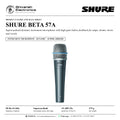



SHURE BETA 57A
PRICE ON ENQUIRY
Shure Beta 57A supercardioid dynamic instrument microphone for amps, drums, horns and vocals, with neodymium magnet and hardened steel grille. Available in India from Shivansh Electronics, Kolkata, West Bengal, India.
VISUAL GUIDE — See Every Photo, Spec & Setup Step (PDF)
PRICE ON ENQUIRY. For the price, exclusive offers, delivery timelines, or any other information, please Contact / WhatsApp +91 89818 07755 / +91 91477 00677. We will gladly share a personalised quotation for Shivansh Electronics, Kolkata, West Bengal, India. All payments are processed securely through Razorpay, our trusted payment gateway.
Acoustics
| Type | Dynamic (moving coil) |
| Frequency response | 50 to 16,000 Hz |
| Polar pattern | Supercardioid |
| Sensitivity (1 kHz, open circuit voltage) | -51 dBV/Pa (2.8 mV); 1 Pa = 94 dB SPL |
Electrical
| Output impedance | 290 Ω (User Guide); 150 Ω rated (Spec Sheet) |
| Connector | Three-pin professional audio (XLR), male, balanced |
Physical
| Housing | Silver blue enamel-painted die-cast metal with hardened, matte-finished steel mesh grille |
| Net weight | 275 g (0.6 lb) |
| Dimensions (shure.com) | 38 × 160 × 38 mm |
Versions
| Beta 57A-X | Dynamic, supercardioid, metallic blue, 3-pin XLR |
Product overview
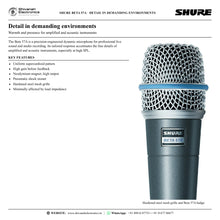
The Shure Beta 57A is a precision-engineered supercardioid dynamic instrument microphone that gives high gain before feedback in demanding environments, for professional live sound reinforcement and studio recording.
The Beta 57A suits many amplified and acoustic instruments, such as guitar amplifiers, acoustic guitar, saxophone, snare drum and brass, and can also be used by vocalists. Its tailored frequency response provides warmth and presence and accentuates the fine details of instruments, especially in high sound pressure level environments.
A tight supercardioid pattern is maintained throughout the frequency range, giving high gain before feedback, maximum isolation from other sound sources and minimum off-axis tone colouration. The hardened steel mesh grille facilitates use of proximity effect while resisting wear and abuse, and a neodymium magnet gives greater sensitivity, higher output and a high signal-to-noise ratio.
A proven pneumatic shock mount minimises the transmission of mechanical noise and vibration, the response is minimally affected by varying load impedance, and the dent-resistant grille and enamel-coated die-cast metal construction withstand the rigours of daily sound reinforcement, on stage and in the studio.
The India version is the Beta 57A-X: dynamic, supercardioid, metallic blue, with a 3-pin XLR connector.
| Dynamic (moving coil) | Supercardioid |
| Frequency response | 50 Hz-16 kHz |
| Sensitivity (2.8 mV) | -51 dBV/Pa |
| Net weight | 275 g |
Key features
- Tailored frequency response gives drums, guitars, vocals and horns studio quality sound
- Uniform supercardioid pattern for high gain before feedback and superior off-axis rejection
- Maximum isolation from other sources, minimum off-axis tone colouration
- Hardened steel mesh grille facilitates use of proximity effect and resists wear and abuse
- Neodymium magnet for greater sensitivity and high signal-to-noise output
- Advanced pneumatic shock mount minimises mechanical noise and vibration
- Minimally affected by varying load impedance
- Enamel-coated die-cast metal construction
- Legendary Shure quality and reliability
Made for
- Guitar and bass amplifiers
- Acoustic guitar
- Snare drum and tom-toms
- Saxophone, brass and woodwinds
- Vocals
- Live sound reinforcement and studio recording
In the box
- Beta 57A microphone
- A25D stand adapter
- 95A2050 5/8" to 3/8" thread adapter
- Storage bag
Connections
- Three-pin professional audio (XLR) male connector, balanced
- Dynamic microphone: no phantom power needed
Shure Beta 57A: frequently asked questions
How should I mic a guitar amplifier?
2.5 cm (1 in.) from the speaker on the centre of the cone gives sharp attack and emphasised bass; at the edge of the cone a higher frequency sound; 15 to 30 cm away a full, balanced sound; 60 to 90 cm back a softer attack with reduced bass.
Can it be used on snare and toms?
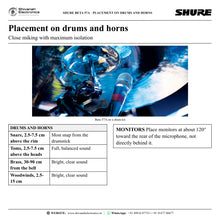
Yes. Place it 2.5 to 7.5 cm (1 to 3 in.) above the rim of the snare's top head, aimed at the head, for the most snap; on toms 2.5 to 7.5 cm above each head for a full, balanced sound.
Can I sing into a Beta 57A?
Yes. Its response is shaped for guitars, drums and vocals, and it can be used by vocal artists as well as on instruments.
Where should monitors go?
A supercardioid microphone rejects sound most at about 120° toward its rear. Place monitors and loudspeakers at these angles, not directly behind it, and test placement before a performance.
Where can I buy the Shure Beta 57A in India?
The Shure Beta 57A is available from Shivansh Electronics, Kolkata, West Bengal, India, with delivery across India.
Workflow 1: Guitar amplifier on stage
Guitarists and live engineers.
Connections
| Connect | To |
|---|---|
| Beta 57A in the A25D stand adapter | Balanced XLR cable |
| XLR cable | Console input |
Setup
- Place the microphone 2.5 cm from the speaker, on the centre of the cone.
- Move toward the edge for more high frequencies.
- Set gain and EQ; no phantom power is needed.
- Check bleed from the drums and monitors.
Tip: The supercardioid pattern gives maximum isolation from other sources.
Workflow 2: Snare drum
Drummers and engineers who want snap from the snare.
Connections
| Connect | To |
|---|---|
| Beta 57A on a short boom stand | Console input |
Setup
- Place it 2.5 to 7.5 cm above the rim of the top head.
- Aim it at the drum head.
- Point the rear rejection zone toward the hi-hat or monitors.
- Set the gain for the loudest hits.
Tip: The tailored response accentuates fine detail at high SPL.
Workflow 3: Saxophone and brass
Horn players on stage and in the studio.
Connections
| Connect | To |
|---|---|
| Beta 57A on a stand | Console or interface input |
Setup
- Place brass 30 to 90 cm away, on-axis with the bell.
- Place woodwinds 2.5 to 15 cm away, on-axis with the bell.
- Turn the bell 90° off-axis for a softer, mellow sound.
- Set the gain.
Tip: Bright, clear sound on-axis with the bell.
Workflow 4: Acoustic guitar
Acoustic players on stage.
Connections
| Connect | To |
|---|---|
| Beta 57A on a stand | Console input |
Setup
- Aim the microphone at the instrument, away from monitors.
- Work close for extra bass through proximity effect.
- Set gain and EQ.
- Test for feedback before the performance.
Tip: High gain before feedback suits loud stages.
Workflow 5: Toms
Engineers miking rack and floor toms.
Connections
| Connect | To |
|---|---|
| One Beta 57A per tom (or per pair) | Separate console inputs |
Setup
- Place one microphone on each tom, or between each pair.
- Keep it 2.5 to 7.5 cm above the head, aimed at the top head.
- Follow the three-to-one rule between microphones.
- Balance the toms in the mix.
Tip: Fewer microphones give better gain before feedback.
Workflow 6: Vocals
Singers who want a rugged dynamic mic.
Connections
| Connect | To |
|---|---|
| Beta 57A | Mixer microphone input |
Setup
- Use the A25D adapter on a stand, or hand hold it.
- Sing close for a robust sound.
- Keep your hand off the grille.
- Set the level and EQ.
Tip: The response is shaped for guitars, drums and vocals.