

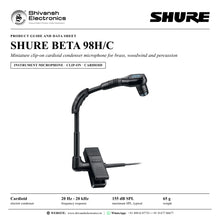

SHURE BETA 98H/C
PRICE ON ENQUIRY
Shure Beta 98H/C clip-on cardioid condenser instrument mic for brass, woodwind and percussion, with gooseneck, swivel joint, angle brace and RPM626 preamp. Available in India from Shivansh Electronics, Kolkata, West Bengal, India.
VISUAL GUIDE — See Every Photo, Spec & Setup Step (PDF)
PRICE ON ENQUIRY. For the price, exclusive offers, delivery timelines, or any other information, please Contact / WhatsApp +91 89818 07755 / +91 91477 00677. We will gladly share a personalised quotation for Shivansh Electronics, Kolkata, West Bengal, India. All payments are processed securely through Razorpay, our trusted payment gateway.
Acoustics
| Type | Electret condenser |
| Frequency response | 20 to 20,000 Hz |
| Polar pattern | Cardioid |
| Sensitivity (at 1 kHz, open circuit voltage) | -56 dBV/Pa (1.6 mV) |
| Maximum SPL (1 kHz at 1 % THD, 1 kΩ load) | 155 dB SPL (typical) |
| Equivalent output noise (A-weighted) | 31 dB SPL (typical) |
| Signal-to-noise ratio (referenced at 94 dB SPL at 1 kHz) | 63 dB |
| Dynamic range (at 1 kHz, 1 kΩ load) | 124 dB |
Electrical
| Output impedance | 150 Ω |
| Preamplifier output clipping level (1 % THD) | 3 dBV (1.4 V) |
| Power requirements | 11-52 V DC phantom power (IEC-61938), 1.2 mA |
| Polarity | Positive pressure on diaphragm produces positive voltage on pin 2 with respect to pin 3 |
| Connector | XLR on the RPM626 in-line preamplifier |
Physical
| Weight | 65 g |
| Cable | 3 m (10 ft) high-flex cable with attached preamplifier |
| Mount | Integrated clamp, gooseneck, ratcheting swivel joint, angle brace, isolation shock-mount |
| Colour | Black |
Version
| BETA 98H/C-X | Condenser microphone, cardioid, preamp included, black, 3-pin XLR connector |
Product overview
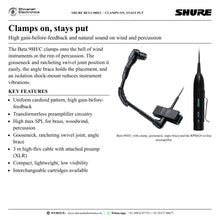
The Shure Beta 98H/C is a miniature clip-on cardioid condenser instrument microphone that clamps onto the bell of wind instruments or the rim of percussion instruments, with high gain-before-feedback and excellent rejection of unwanted noise.
The integrated gooseneck and ratcheting swivel joint let the microphone be positioned easily and secured in place, and an isolation shock-mount reduces the transmission of instrument vibrations. A gooseneck angle brace is included for better retention of the chosen placement, even during active performances, and the compact, lightweight construction keeps visibility low.
Transformerless preamplifier circuitry improves linearity across the full frequency range, and the tailored 20 Hz to 20 kHz response gives open, natural sound reproduction. Its ability to handle extremely high sound pressure levels makes it ideal for live sound reinforcement on brass, woodwind and percussion, on stage or in the studio.
The Beta 98H/C comes with a 3 m (10 ft) high-flex cable attached to the RPM626 in-line preamplifier, which needs phantom power and connects to a mixer via XLR. Interchangeable cartridges with different polar patterns are available, and snap-fit foam windscreens stay in place to minimise wind noise.
| Electret condenser | Cardioid |
| Frequency response | 20 Hz - 20 kHz |
| Maximum SPL, typical | 155 dB SPL |
| Weight | 65 g |
Key features
- Clip-on design clamps to the bell of wind instruments or the rim of percussion
- Uniform cardioid pick-up pattern for maximum gain-before-feedback and rejection of off-axis sound
- Transformerless preamplifier circuitry improves linearity across the full frequency range
- High maximum SPL for the extreme demands of brass, woodwind and percussion
- Tailored frequency response for open, natural sound reproduction
- Gooseneck, ratcheting swivel joint and gooseneck angle brace for optimum, fixed positioning
- Isolation shock-mount reduces transmission of instrument vibrations
- 3 m (10 ft) high-flex cable with attached preamplifier (XLR connection)
- Compact, lightweight construction with a low degree of visibility
- Interchangeable cartridges with different polar patterns available
Made for
- Brass instruments such as trumpet and trombone
- Woodwind and reed instruments such as saxophone
- Percussion instruments, clamped to the rim
- Live sound reinforcement and studio recording
In the box
- Beta 98H/C microphone with clamp, gooseneck and angle brace
- 3 m (10 ft) high-flex cable with attached RPM626 in-line preamplifier (XLR connection)
- RK183WS windscreen
- 95A2314 zippered carrying bag
Connections
- RPM626 in-line preamplifier output: XLR, balanced
- Use a balanced XLR-to-XLR or XLR-to-TRS cable to a phantom-powered input
Shure Beta 98H/C: frequently asked questions
Which instruments is the Beta 98H/C made for?
It is a premium instrument microphone for brass, woodwind and percussion, either on stage or in the studio. It clamps onto the bell of wind instruments or onto the rim of percussion instruments.
How do I connect it to a mixer?
The 3 m high-flex cable is attached to the RPM626 in-line preamplifier. The preamplifier needs phantom power and connects to the mixer with a balanced XLR cable.
Where should I place it on a saxophone?
For reed instruments Shure suggests placing the microphone a few inches from the bell and aiming into it, for a bright sound that minimises feedback and leakage. With the bell 90° off-axis from the front of the microphone the sound is softer and more mellow.
How do I keep the position during an active performance?
The ratcheting swivel joint and the included gooseneck angle brace hold the chosen placement, and the isolation shock-mount reduces instrument vibrations.
Is there a wireless version?
Yes. The Shure WB98H/C is the wireless version, terminated in a TA4F connector for Shure bodypack transmitters.
Where can I buy the Shure Beta 98H/C in India?
The Shure Beta 98H/C is available from Shivansh Electronics, Kolkata, West Bengal, India, with delivery across India.
Workflow 1: Saxophone on a live stage
Sax players and live engineers.
Connections
| Connect | To |
|---|---|
| Beta 98H/C | Saxophone bell |
| RPM626 preamplifier | Mixer input with 48 V phantom |
Setup
- Clamp the microphone to the bell.
- Set the capsule a few inches from the bell, aiming into it.
- Lock the position with the ratcheting joint and angle brace.
- Connect the preamplifier with an XLR cable and switch on phantom power.
Tip: Aiming into the bell gives a bright sound and minimises feedback and leakage.
Workflow 2: Trumpet and trombone
Brass sections in bands and orchestras.
Connections
| Connect | To |
|---|---|
| Beta 98H/C | Bell of the brass instrument |
| RPM626 | Console channel |
Setup
- Clamp the microphone to the bell rim.
- Position the capsule on-axis with the bell.
- Place monitors directly behind the microphone.
- Set the gain.
Tip: A cardioid microphone rejects most sound at its rear, so put monitors there.
Workflow 3: Woodwinds for a mellow tone
Clarinet, flute and other woodwind players.
Connections
| Connect | To |
|---|---|
| Beta 98H/C | Woodwind instrument |
| RPM626 | Phantom-powered input |
Setup
- Clamp the microphone to the instrument.
- For a softer, mellow sound turn the bell 90° off-axis from the front of the microphone.
- Test the placement before the performance.
Tip: On-axis gives a bright, clear sound; 90° off-axis gives a softer one.
Workflow 4: Percussion rims
Percussionists on stage.
Connections
| Connect | To |
|---|---|
| Beta 98H/C | Rim of the percussion instrument |
| RPM626 | Mixer input |
Setup
- Clamp the microphone to the rim.
- Bend the gooseneck to aim at the playing surface.
- Connect and set the level.
Tip: High max SPL handles the extreme demands of percussion.
Workflow 5: Studio horn section
Recording engineers tracking brass and woodwind.
Connections
| Connect | To |
|---|---|
| Beta 98H/C on each instrument | RPM626 preamplifiers |
| RPM626 | Recording interface inputs with phantom |
Setup
- Fit one microphone per player.
- Use fewer microphones for better gain before feedback in live rooms.
- Follow the three-to-one rule between microphones.
- Record each instrument on its own track.
Tip: The clip-on mount keeps the distance constant while the player moves.
Workflow 6: Outdoor performances
Wind players at open-air events.
Connections
| Connect | To |
|---|---|
| Beta 98H/C with RK183WS windscreen | Instrument bell |
| RPM626 | Stage box input |
Setup
- Fit the snap-fit foam windscreen.
- Clamp and position the microphone.
- Connect and set the gain.
Tip: Snap-fit foam windscreens stay in place and minimise wind noise.


