

SHURE KSM141
PRICE ON ENQUIRY
Shure KSM141/SL Stereo-X: two dual-pattern (cardioid/omni) condenser instrument mics with Class A preamp, pad, low-cut and A27M stereo bar. Available in India from Shivansh Electronics, Kolkata, West Bengal, India.
VISUAL GUIDE — See Every Photo, Spec & Setup Step (PDF)
PRICE ON ENQUIRY. For the price, exclusive offers, delivery timelines, or any other information, please Contact / WhatsApp +91 89818 07755 / +91 91477 00677. We will gladly share a personalised quotation for Shivansh Electronics, Kolkata, West Bengal, India. All payments are processed securely through Razorpay, our trusted payment gateway.
Acoustics
| Cartridge type | Electret condenser |
| Polar pattern | Cardioid, omnidirectional (selectable, mechanical switch) |
| Frequency response | 20 to 20,000 Hz |
| Sensitivity (open circuit voltage, 1 kHz, typical) | -37 dBV/Pa (14.1 mV); 1 Pa = 94 dB SPL |
| Maximum SPL (1 kHz, 1 % THD), pad off | 145 dB (5000 Ω load); 139 dB (2500 Ω); 134 dB (1000 Ω) |
| Maximum SPL (1 kHz, 1 % THD), pad on | 170 dB (5000 Ω load); 164 dB (2500 Ω); 159 dB (1000 Ω) |
| Signal-to-noise ratio | 80 dB (94 dB SPL minus self noise, A-weighted) |
| Dynamic range (1 kHz) | 131 dB (5000 Ω load); 125 dB (2500 Ω); 120 dB (1000 Ω) |
| Clipping level (20 Hz to 20 kHz, 1 % THD) | 15 dBV (5000 Ω load); 9 dBV (2500 Ω); 3 dBV (1000 Ω) |
| Self noise (equivalent SPL, A-weighted, typical) | 14 dB SPL-A |
Switches
| Polar pattern switch | Rotating knurled collar with detents: cardioid / omnidirectional |
| Attenuator switch | 0, -15, -25 dB |
| Low-frequency filter switch | Flat; -6 dB/octave below 115 Hz; -18 dB/octave below 80 Hz |
| Subsonic filter | Eliminates rumble below 17 Hz |
Electrical
| Output impedance | 150 Ω |
| Common mode rejection | ≥50 dB |
| Connector | Three-pin professional audio (XLR), male, balanced |
| Polarity | Positive pressure on diaphragm produces positive voltage on pin 2 with respect to pin 3 |
| Power requirements | 11-52 V DC phantom power (IEC-61938), 4.7 mA maximum; specifications measured at 48 V DC |
| Recommended load | Minimum preamplifier input load impedance 1000 Ω |
Physical
| Net weight | 156 g (5.5 oz) per microphone |
| Dimensions (shure.com) | 20 × 146 × 20 mm |
| Finish | Champagne |
Versions
| KSM141/SL Stereo-X | Condenser microphone stereo set, dual polar pattern (cardioid / omnidirectional), champagne, 3-pin XLR |
Product overview
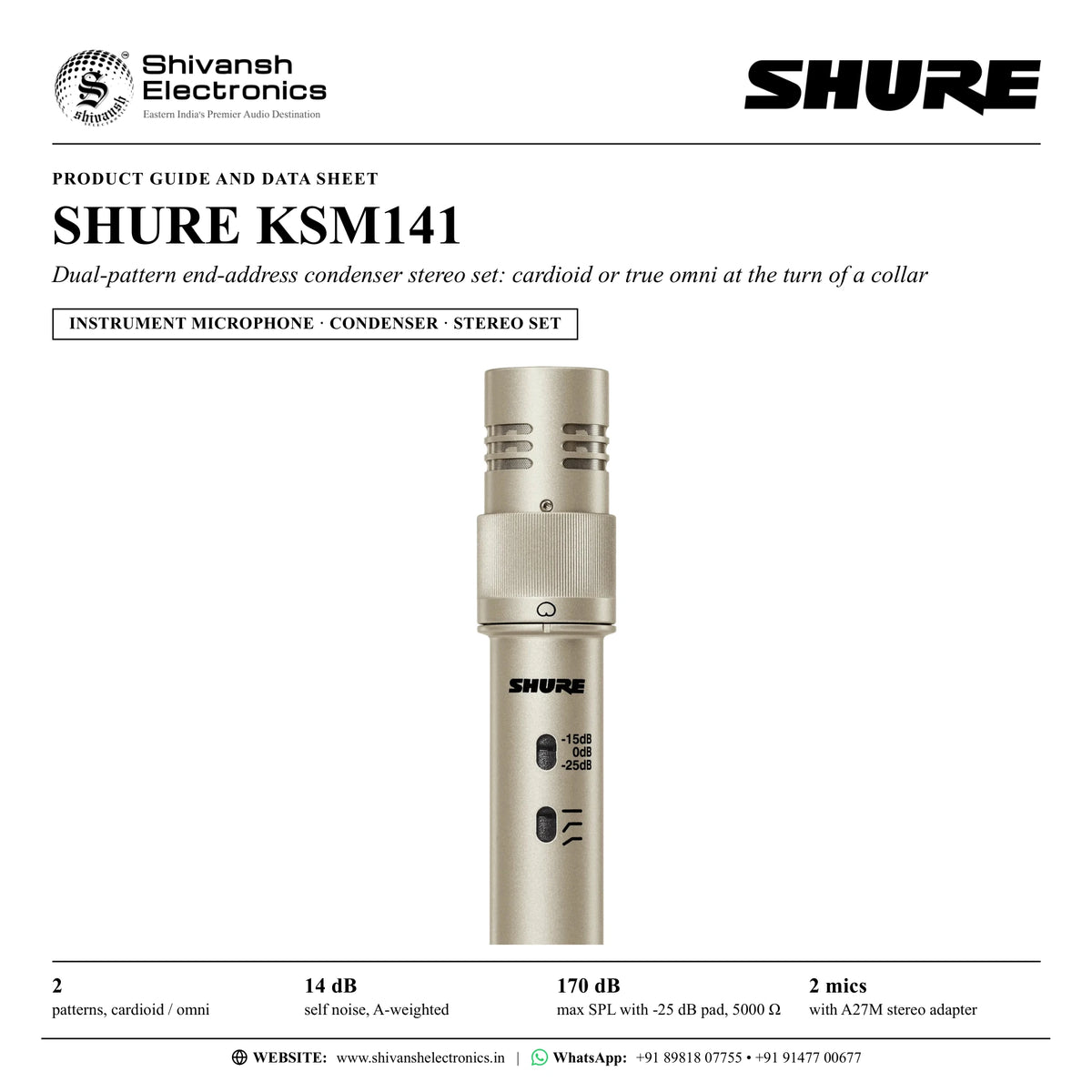
The Shure KSM141 is a premium dual-pattern, end-address condenser instrument microphone whose rotating collar switches mechanically between a consistent cardioid and a true omnidirectional pattern; this store item is the KSM141/SL Stereo-X stereo set of two microphones.
The unique rotating collar gives easy switching between a highly consistent cardioid or true omnidirectional polar pattern for smooth and extremely focused sound reproduction. Because the switch is mechanical, both patterns stay highly consistent, giving flexibility in a wide variety of recording and performance applications. Cardioid picks up sounds in front and is least sensitive to those behind, the most common choice in studio and live sound; omnidirectional picks up from all directions, best for room ambience and for several sources at once, and exhibits no proximity effect.
An ultra-thin, 2.5 μm, 24-karat gold-layered, low-mass diaphragm gives superior transient response, and the Class A, discrete, transformerless preamplifier captures an extremely transparent sound with extremely fast transient response, no crossover distortion and minimal harmonic and intermodulation distortion. Premium components include gold-plated internal and external connectors.
A three-position attenuation switch (0, -15, -25 dB) and a three-position low-frequency filter (flat, -6 dB/octave below 115 Hz, -18 dB/octave below 80 Hz) handle extremely high SPLs and control the bass response, and a subsonic filter removes rumble below 17 Hz. Designed for studio use yet rugged enough for the most demanding live applications, the KSM141 combines 14 dB self noise with a 20 Hz to 20 kHz response.
In India the KSM141 is offered as the KSM141/SL Stereo-X: a condenser microphone stereo set, dual polar pattern (cardioid / omnidirectional), champagne finish, 3-pin XLR, with two microphones, two microphone clips, two windscreens, the A27M stereo microphone adapter and the A141SPC stereo pair case.
| Cardioid / omni, mechanical switch | 2 patterns |
| Self noise, typical | 14 dB SPL-A |
| Max SPL pad off / on, 5000 Ω load | 145 / 170 dB |
| Net weight, each microphone | 156 g |
Key features
- Mechanical polar pattern switch (rotating collar): highly consistent cardioid and true omnidirectional
- Ultra-thin 2.5 μm, 24-karat gold-layered, low-mass diaphragm for superior transient response
- Class A, discrete, transformerless preamplifier: transparency, extremely fast transient response, no crossover distortion
- Minimal harmonic and intermodulation distortion
- Premium components, including gold-plated internal and external connectors
- Three-position attenuation switch: 0, -15 and -25 dB
- Three-position low-frequency filter switch reduces stand vibration noise and counteracts proximity effect
- Subsonic filter eliminates rumble below 17 Hz caused by mechanical vibration
- Extended frequency response, exceptional low-frequency reproduction, high output level
- Superior common-mode rejection and suppression of radio frequency interference (RFI)
- Stereo set with the A27M stereo microphone adapter for two microphones on one stand
Made for
- Brass and woodwind instruments
- Orchestras, choirs and wind ensembles
- Overhead miking of drums and percussion
- Close-miking of piano, guitar, violins, drums and percussion
- Low-frequency instruments such as double bass and kick drum
- Electric guitar and bass amplifiers
- Vocals and speech
- Room ambience
- Stereo recording, broadcasting and sound reinforcement
In the box
- 2 x KSM141 microphone
- 2 x A57F microphone clip
- 2 x A100WS windscreen
- 1 x A27M stereo microphone adapter
- 1 x A141SPC case (KSM141 stereo pair)
Connections
- Three-pin professional audio (XLR), male, balanced, on each microphone
- Requires 11-52 V DC phantom power (IEC-61938), 4.7 mA maximum; performs best at 48 V DC
- Use a balanced microphone cable, XLR-to-XLR or XLR-to-TRS; minimum preamplifier input load of 1000 Ω recommended
Shure KSM141: frequently asked questions
How do I change the polar pattern?
Rotate the knurled ring in either direction until you feel a detent, with the symbol of the desired pattern directly above the notch at the base of the ring. Turn down the loudspeakers or mute the channel first, because rotating the switch makes mechanical noise; never use the microphone between detents.
Cardioid or omnidirectional: which should I choose?
Cardioid picks up sound in front and rejects sound from behind, the most common choice in studio and live sound. Omnidirectional picks up from all directions: best for room ambience and for several sources such as an ensemble or multiple singers, with no proximity effect.
What comes in the KSM141/SL Stereo-X?
Two KSM141 microphones, two A57F microphone clips, two A100WS windscreens, the A27M stereo microphone adapter and the A141SPC stereo pair case.
Which pad setting should I use?
0 dB for quiet to normal levels; -15 dB for extremely loud sources such as drums, horns or loud guitar cabinets; -25 dB when closer than 10 cm to such sources. The pad lowers the level without altering the frequency response.
Does it need phantom power?
Yes: 11-52 V DC phantom power, best at 48 V DC. At lower voltages it works with slightly decreased headroom and sensitivity.
Where can I buy the Shure KSM141 in India?
The Shure KSM141 is available from Shivansh Electronics, Kolkata, West Bengal, India, with delivery across India.
Workflow 1: Acoustic guitar in stereo
Guitarists and studios recording acoustic instruments.
Connections
| Connect | To |
|---|---|
| 2 x KSM141 | A27M stereo microphone adapter on one stand |
| Each microphone (XLR) | Its own preamp or interface input with 48 V phantom |
Setup
- Mount both microphones on the A27M with the 5/8"-27 thread stand adapters.
- Set the vertical separation and angle with the knurled knob and its 45 degree marks.
- Select the same pattern on both microphones at a detent.
- Switch on phantom power, match the gains and pan left and right.
Tip: The A27M allows a variety of coincident and closely-spaced stereo configurations.
Workflow 2: Choir or orchestra
Engineers recording orchestras, choirs and wind ensembles.
Connections
| Connect | To |
|---|---|
| KSM141 pair on the A27M | Tall stand in front of the ensemble |
| XLR cables | Console or recorder inputs with phantom power |
Setup
- Set omnidirectional to capture the ensemble and the room, or cardioid to focus on the group.
- Leave the low-frequency filter flat for the most natural sound.
- Experiment with height and distance.
- Match the gains on both channels.
Tip: Omnidirectional exhibits no proximity effect and suits several sources at once.
Workflow 3: Drum overheads
Drummers and engineers miking a kit live or in the studio.
Connections
| Connect | To |
|---|---|
| KSM141 in A57F clips | Two overhead boom stands |
| XLR cables | Console inputs with phantom power |
Setup
- Select cardioid and aim each microphone at the kit.
- Set the pad to -15 dB for loud drums and cymbals.
- Use the 80 Hz cutoff to remove stand vibration and rumble if needed.
- Set the gains and pan left and right.
Tip: Overhead miking of drums and percussion is one of Shure's listed applications.
Workflow 4: Brass and woodwind on stage
Live engineers reinforcing horn sections.
Connections
| Connect | To |
|---|---|
| KSM141 (cardioid) | Stage box input with phantom power |
Setup
- Select cardioid to reject sound from behind.
- Set -15 dB for horns, -25 dB when closer than 10 cm.
- Use the 115 Hz rolloff to counteract proximity effect.
- Mute the channel before changing the pattern during a show.
Tip: Rotating the pattern switch makes mechanical noise: turn down the loudspeakers first.
Workflow 5: Room ambience for amps and drums
Studios adding room sound to guitar amplifiers or drums.
Connections
| Connect | To |
|---|---|
| 2 x KSM141 (omnidirectional) | Stands placed in the room |
| XLR cables | Interface inputs with phantom power |
Setup
- Select omnidirectional on both microphones.
- Place them at a distance from the source.
- Set the pad if the room is very loud.
- Blend the room tracks with the close microphones.
Tip: Omnidirectional is best for picking up room ambience.
Workflow 6: Piano and strings
Engineers close-miking piano, violins and other acoustic instruments.
Connections
| Connect | To |
|---|---|
| KSM141 pair | Preamp or interface inputs with phantom power |
Setup
- Select cardioid for close-miking.
- Place the microphones close to the instrument.
- Use the 115 Hz rolloff if the sound gets dull or muddy.
- Set the gains and record.
Tip: The gold-layered, low-mass diaphragm gives superior transient response.