
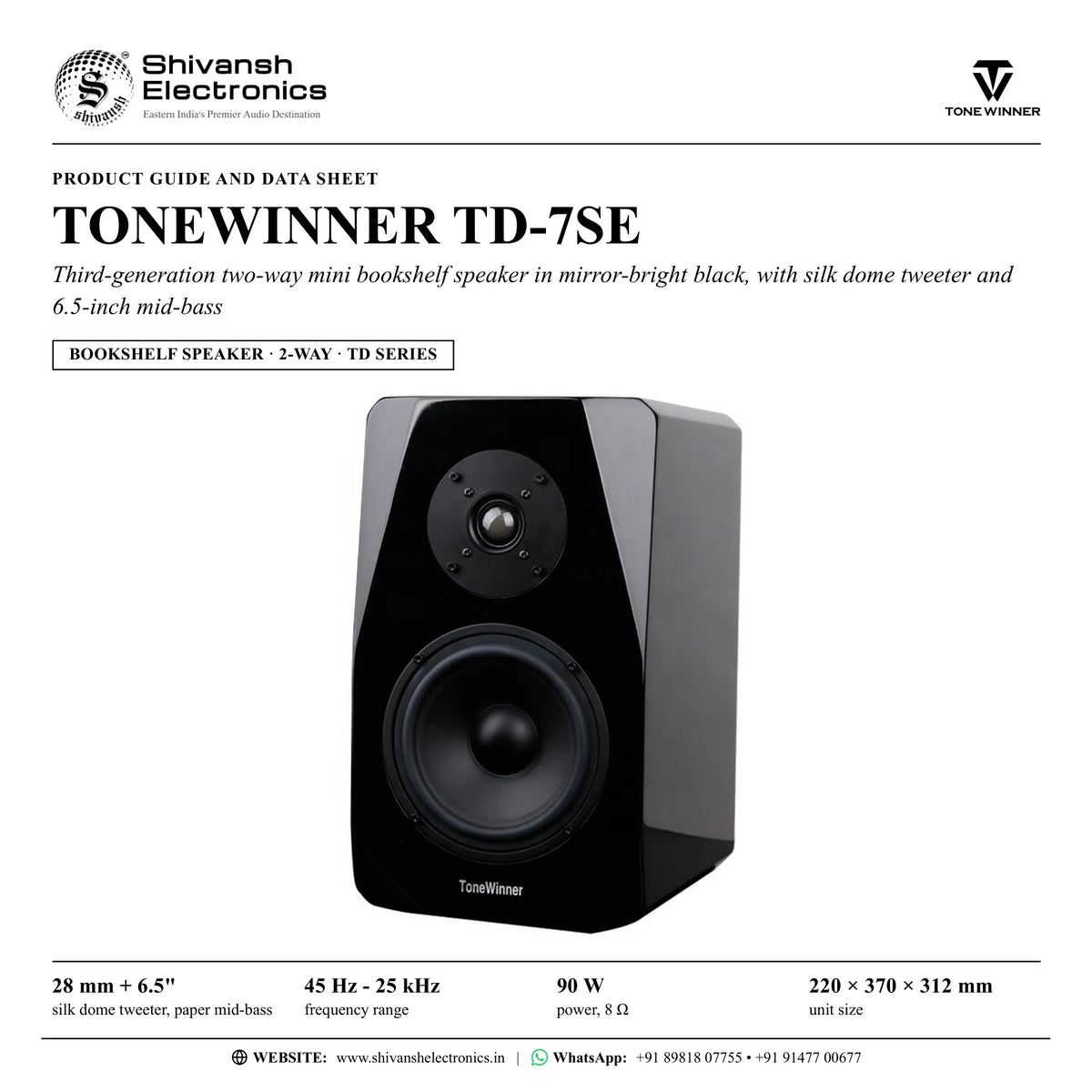


TONEWINNER TD-7SE
PRICE ON ENQUIRY
Tonewinner TD-7SE two-way mini bookshelf speaker: 28 mm silk dome tweeter, 6.5" paper cone mid-bass, mirror-black baked paint, 45 Hz - 25 kHz. Available in India from Shivansh Electronics, Kolkata, West Bengal, India.
VISUAL GUIDE — See Every Photo, Spec & Setup Step (PDF)
PRICE ON ENQUIRY. For the price, exclusive offers, delivery timelines, or any other information, please Contact / WhatsApp +91 89818 07755 / +91 91477 00677. We will gladly share a personalised quotation for Shivansh Electronics, Kolkata, West Bengal, India. All payments are processed securely through Razorpay, our secure payment gateway.
General
| Model | TD-7SE |
| Series | TD series |
| Type | Two-way mini bookshelf speaker, bass reflex |
Drivers
| Tweeter | Silk soft dome, 28 mm voice coil |
| Mid-bass | 6.5" paper cone, cast aluminium frame, dual magnet |
| Crossover | Butterworth two-way, 12 dB slope, 3.5 kHz |
Acoustic performance
| Frequency range | 45 Hz - 25 kHz |
| Sensitivity | 85 dB |
| Rated impedance | 8 Ω |
| Power | 90 W |
Physical
| Material | Wood: 25 mm MDF |
| Unit size | 220 × 370 × 312 mm |
| Gross weight | 26 kg |
Finishes
| Finish | Black baked paint |
Warranty
| Warranty | 1 year |
Product overview
The Tonewinner TD-7SE is the third upgraded version of the TD-7 mini bookshelf speaker: a two-way bass reflex design with a 28 mm silk soft dome tweeter and a 6.5-inch paper cone mid-bass unit in a 25 mm MDF cabinet finished in mirror-bright black baked paint.
The TD-7SE leaves the classic red rosewood look of the earlier versions behind for a bright, pure black finish that is dignified and exquisite and blends into modern or classical interiors alike. The baked paint is built up with care: putty is applied and levelled, the primer is sprayed three to five times with wet sanding between coats, one to three bright topcoats follow, and high-temperature baking cures the layers. Without mechanical damage, the surface stays as bright as a mirror for many years.
The cabinet is made of 25 mm medium-density fibreboard, with no sharp right-angled edges anywhere: every edge is rounded. The front panel has a chamfered bevel that improves the look and the acoustics, helping to stabilise the acoustic structure, reduce colouration and improve imaging. A bass reflex enclosure supports the low end.
The tweeter is a silk soft dome with a 28 mm extra-large voice coil and a non-resonant rear chamber. Its lower response limit allows a lower crossover point, which improves the midrange, so it sounds clear, full and transparent, with beautiful, sweet treble rich in overtones. The 6.5-inch mid-bass has a large, long-throw voice coil, a very rigid cast aluminium frame that reduces resonance and a high-strength dual magnet with a lightweight paper cone for high efficiency and large dynamics, with a warm, mellow, delicate tone, low distortion and good transients.
A Butterworth two-way crossover with a 12 dB slope in the mid-high section, metallised resistors, oxygen-free copper inductors and high-quality MKP capacitors joins the drivers at 3.5 kHz. Computer-assisted testing and tuning keep phase distortion very small and the response within ± 2 dB across the effective band, with good low-end extension, a clear texture, a mellow, warm tone and delicate treble.
| silk dome tweeter, paper cone mid-bass | 28 mm + 6.5" |
| frequency range | 45 Hz - 25 kHz |
| power, 8 Ω | 90 W |
| crossover point, 12 dB slope | 3.5 kHz |
Key features
- Third upgraded version of the TD-7 mini bookshelf speaker
- Silk soft dome tweeter with 28 mm extra-large voice coil and non-resonant rear chamber
- 6.5-inch long-throw paper cone mid-bass with cast aluminium frame and dual magnet
- Butterworth two-way crossover, 12 dB slope, crossover point 3.5 kHz
- Metallised resistors, oxygen-free copper inductors and MKP capacitors
- Response within ± 2 dB across the effective band
- 25 mm MDF cabinet with all edges rounded and a chamfered front panel
- Bass reflex enclosure
- Mirror-bright black baked paint finish built up in many coats
- Frequency range 45 Hz - 25 kHz, sensitivity 85 dB, 8 Ω
Made for
- Stereo music in living rooms, studies and bedrooms
- Modern and classical interiors alike
- Compact hi-fi systems with an integrated amplifier
- Front or surround speakers in a home theatre
In the box
- TD-7SE bookshelf speaker
Tonewinner TD-7SE: frequently asked questions
What is new in the TD-7SE?
It is the third upgraded version of the TD-7 mini bookshelf speaker, with a bright, pure black baked-paint finish in place of the earlier red rosewood look.
Which drivers does it use?
A silk soft dome tweeter with a 28 mm voice coil and a 6.5-inch long-throw paper cone mid-bass unit with a cast aluminium frame and dual magnet.
Where is the crossover point?
At 3.5 kHz, with a 12 dB slope in the mid-high section of the Butterworth crossover. The response stays within ± 2 dB across the effective band.
What amplifier suits it?
A stereo amplifier that works with 8 Ω speakers. The TD-7SE is rated at 90 W with 85 dB sensitivity.
How durable is the finish?
The baked paint is built up from putty, three to five primer coats and one to three bright topcoats, then cured at high temperature. Without mechanical damage the surface stays mirror-bright.
Where can I buy the Tonewinner TD-7SE in India?
The Tonewinner TD-7SE is available from Shivansh Electronics, Kolkata, West Bengal, India, with delivery across India.
Workflow 1: Living-room stereo
Families who want elegant speakers that suit any décor.
Connections
| Connect | To |
|---|---|
| Streamer or CD player | Integrated amplifier input |
| Integrated amplifier L / R outputs | Two TD-7SE |
Setup
- Place the speakers on stands either side of the cabinet, tweeters near ear height.
- Leave some space behind them for the bass reflex enclosure.
- Connect them to the amplifier with matching polarity.
- Toe them in slightly towards the sofa and fine-tune for a focused image.
Tip: Wipe the black paint with a soft, dry cloth to keep its mirror shine.
Workflow 2: Study or bedroom hi-fi
Music lovers with a smaller room.
Connections
| Connect | To |
|---|---|
| Compact amplifier outputs | Two TD-7SE |
| Phone, computer or streamer | Amplifier input |
Setup
- Put the speakers on firm furniture or stands.
- Connect them to a compact amplifier that handles 8 Ω speakers.
- Play music at moderate levels.
- Adjust distance from the wall to balance the bass.
Tip: The rounded edges and bevelled front keep the sound image tidy even close to walls.
Workflow 3: TV sound upgrade
Homes that want clear TV dialogue and music from one pair.
Connections
| Connect | To |
|---|---|
| TV optical output | Amplifier digital input |
| Amplifier outputs | Two TD-7SE beside the TV |
Setup
- Place one speaker each side of the TV.
- Connect the TV's digital output to an amplifier with a matching input.
- Wire the speakers to the amplifier.
- Set the TV audio output to the external device.
Tip: The black finish matches most TV furniture.
Workflow 4: Vinyl corner
Record listeners.
Connections
| Connect | To |
|---|---|
| Turntable | Phono stage or amplifier phono input |
| Amplifier outputs | Two TD-7SE |
Setup
- Keep the turntable on its own stable shelf.
- Connect it through a phono stage to the amplifier.
- Wire the speakers and set the level.
- Enjoy the warm, mellow mid-bass of the 6.5-inch unit.
Tip: Keep the speakers off the turntable's shelf to avoid feedback.
Workflow 5: Home theatre front pair
Homes using bookshelf speakers as front channels.
Connections
| Connect | To |
|---|---|
| AV receiver front L / R terminals | Two TD-7SE |
| AV receiver subwoofer pre-out | Powered subwoofer |
Setup
- Place the speakers either side of the screen.
- Connect them to the receiver's front channels.
- Set them in the receiver and add a subwoofer if wanted.
- Calibrate levels and distances.
Tip: The 8 Ω load suits most AV receivers.
Workflow 6: Home theatre surrounds
Existing home theatres that need quality rear speakers.
Connections
| Connect | To |
|---|---|
| AV receiver surround L / R terminals | Two TD-7SE on stands |
Setup
- Place the speakers beside or slightly behind the seating.
- Connect them to the surround outputs.
- Set distances and levels in the receiver.
- Check with surround test tones.
Tip: Matching tonal character between fronts and surrounds keeps effects seamless.


