

ALLEN & HEATH PRIME Input Module
PRICE ON ENQUIRY
Allen & Heath PRIME Input: premium 8-channel mic/line preamp module for DX32, with DC-coupled gain stage and 32-bit/96 kHz ADC. Available in India from Shivansh Electronics, Kolkata, West Bengal, India.
VISUAL GUIDE — See Every Photo, Spec & Setup Step (PDF)
PRICE ON ENQUIRY. For the price, exclusive offers, delivery timelines, or any other information, please Contact / WhatsApp +91 89818 07755 / +91 91477 00677. We will gladly share a personalised quotation for Shivansh Electronics, Kolkata, West Bengal, India. All payments are processed securely through Razorpay, our trusted payment gateway.
General
| Part number | M-DX32-INPR |
| Type | Premium 8-channel mic/line preamp module for the DX32 modular expander |
| Inputs | 8 x mic/line, balanced XLR |
| Systems | DX32 with dLive, Avantis and SQ |
| Firmware | dLive V1.71 / SQ V1.4.0 or higher |
| Design | DC-coupled gain stage; full metal shielding; preamps trimmed by hand |
| Processing core | Optimised for the 96 kHz XCVI FPGA core |
Inputs
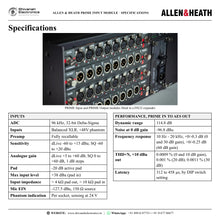
| ADC | 96 kHz, 32-bit Delta-Sigma |
| Mic/line XLR inputs | Balanced XLR, +48V phantom power |
| Mic/line preamp | Fully recallable |
| Input sensitivity (dLive) | -60 to +15 dBu |
| Input sensitivity (SQ) | -60 to +20 dBu |
| Analogue gain (dLive) | +5 to +60 dB, 1 dB steps |
| Analogue gain (SQ) | 0 to +60 dB, 1 dB steps |
| Pad | -20 dB active pad |
| Maximum input level | +38 dBu (pad in) |
| Input impedance | > 4 kΩ (pad out), > 10 kΩ (pad in) |
| Mic EIN | -127.5 dBu with 150 Ω source |
| Phantom power indication | Per socket, internal or external phantom power sensing, triggered at 24 V |
Audio performance
| Measured | PRIME in to AES out, 20 Hz - 20 kHz, minimum gain, pad out |
| Full signal dynamic range | 114.8 dB |
| Noise at 0 dB gain | -96.8 dBu |
| Frequency response to AES output, 0 dB gain | 10 Hz - 20 kHz, +0/-0.3 dB |
| Frequency response to AES output, 30 dB gain | 10 Hz - 20 kHz, +0/-0.3 dB |
| Frequency response to AES output, 60 dB gain | 10 Hz - 20 kHz, +0/-0.25 dB |
| THD+N (analogue in to AES out), 0 dB gain | 0.0009 % @ +10 dBu out |
| THD+N, 10 dB gain | 0.0009 % @ +10 dBu out |
| THD+N, 20 dB gain | 0.001 % @ +10 dBu out |
| THD+N, 30 dB gain | 0.0011 % @ +10 dBu out |
ADC filter (DIP switches)
| SW1 | Roll-off: On (switch down) = sharp, Off (switch up) = slow |
| SW2 | Latency: On (switch down) = normal, Off (switch up) = low |
| Default factory setting | Normal latency, slow roll-off |
| Latency, sharp roll-off, normal latency | 458 μs |
| Latency, sharp roll-off, low latency | 312 μs |
| Latency, slow roll-off, normal latency | 333 μs |
| Latency, slow roll-off, low latency | 312 μs |
| Latency measured | Direct Out routed to a DX32 PRIME output, default switch settings |
System capacity
| DX32 slots | 4 x 8-channel slots, labelled A, B, C, D |
| dLive S Class | Up to 92 PRIME I/O modules |
| dLive C Class | Up to 44 PRIME I/O modules |
| Avantis | Up to 48 PRIME I/O modules |
| SQ | Up to 32 PRIME I/O modules |
Product overview
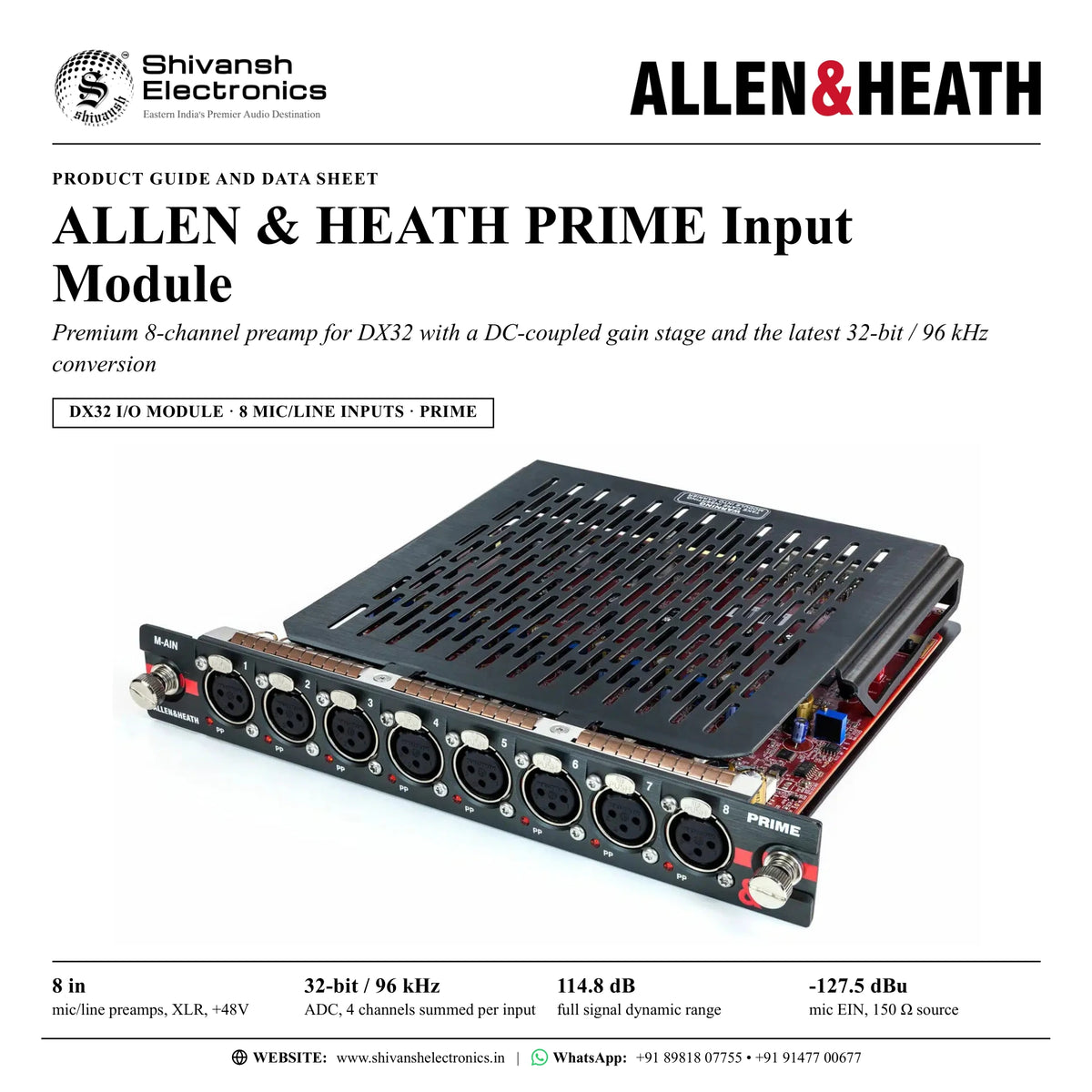
The Allen & Heath PRIME Input Module is a premium 8-channel mic/line preamp module for the DX32 modular expander, created for those looking to get the highest levels of audio performance from their dLive, Avantis or SQ.
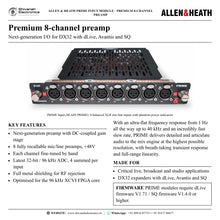
PRIME is the next generation of I/O for DX32. The PRIME Input module (M-DX32-INPR) provides eight fully recallable mic/line preamps on balanced XLR inputs with +48V phantom power and a phantom power indicator for each socket. With an ultra-flat frequency response from 1 Hz all the way up to 40 kHz and an incredibly fast slew rate, it delivers detailed and articulate audio to the mix engine at the highest possible resolution, with breath-taking transient response and full-range linearity.
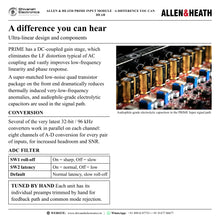
PRIME has a DC-coupled gain stage rather than an AC-coupled one, which eliminates the LF distortion typical of AC coupling and vastly improves low-frequency linearity and phase response. Because linearity was paramount in the design, several innovations improve high input level handling: a super-matched low-noise quad transistor package on the front end dramatically reduces thermally induced very-low-frequency anomalies, and audiophile-grade electrolytic capacitors are used in the signal path. Grounding and power supply are meticulously designed to minimise noise and distortion.
PRIME employs the very latest 32-bit / 96 kHz analogue-to-digital converters, with several devices in parallel on each channel to reduce distortion and optimise noise and dynamic range: eight channels of A-D conversion for every pair of input channels, or four channels of summed ADC per input, for increased headroom and SNR. The anti-aliasing roll-off of the ADC can be user configured with two DIP switches, for sharp or slow roll-off and normal or low latency, so the sound engineer can pick the optimal settings for particular applications or music.
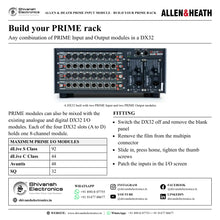
The circuitry is encased in full metal shielding for increased RF rejection throughout the signal path, and before a PRIME Input module leaves the factory, each unit has its individual preamps trimmed by hand to meet exacting requirements for feedback path and common mode rejection. PRIME modules are designed for critical live, broadcast and studio applications. Any combination of PRIME Input and Output modules can be installed in a DX32 and mixed with the existing analogue and digital DX32 I/O modules, up to 92 PRIME I/O modules in a fully expanded dLive S Class system, 44 with dLive C Class, 48 with Avantis and 32 with SQ.
| Mic/line preamps on XLR, +48V | 8 |
| ADC, 4 channels summed per input | 32-bit / 96 kHz |
| Full signal dynamic range | 114.8 dB |
| Mic EIN, 150 Ω source | -127.5 dBu |
Key features
- Next-generation preamp design with a DC-coupled gain stage
- Ultra-flat frequency response from 1 Hz up to 40 kHz and an incredibly fast slew rate
- 8 fully recallable mic/line preamps on balanced XLR with +48V phantom power
- Phantom power indicator per socket, with internal or external phantom power sensing
- Each individual channel fine-tuned by hand for optimum common mode performance
- Super-matched low-noise quad transistor front end and audiophile-grade electrolytic capacitors
- Meticulous design of grounding and power supply to minimise noise and distortion
- The very latest 32-bit / 96 kHz ADC
- 4 channels of summed ADC per input for extended dynamic range and increased SNR
- User-configurable ADC filter: sharp or slow roll-off, normal or low latency
- Full metal shielding for increased RF rejection throughout
- Optimised for the 96 kHz XCVI FPGA core; use with DX32 for SQ, dLive and Avantis
Made for
- Critical live sound
- Broadcast
- Studio applications
- dLive, Avantis and SQ systems built for the highest levels of audio performance
- DX32 expanders, together with PRIME Output and standard DX32 modules
In the box
- PRIME Input module (M-DX32-INPR)
Connections
- 8 x mic/line inputs on balanced XLR, +48V phantom power, phantom power indicator per socket
- Multipin connector into a DX32 slot (A, B, C or D), secured with two thumb screws
- Two DIP switches (SW1, SW2) on the right side of the PCB for the ADC filter
Allen & Heath PRIME Input Module: frequently asked questions
Which systems can use the PRIME Input Module?
PRIME Input fits the DX32 modular expander for dLive, Avantis and SQ. PRIME modules require dLive firmware V1.71 / SQ firmware V1.4.0 or higher, and the inputs are patched from the dLive / SQ I/O screen.
How many PRIME modules can a system take?
In fully expanded systems: up to 92 PRIME I/O modules with dLive S Class, 44 with dLive C Class, 48 with Avantis and 32 with SQ. Each DX32 has four 8-channel slots.
Can PRIME modules be mixed with other DX32 modules?
Yes. Any combination of PRIME Input and Output modules can be installed in a DX32 modular expander, and PRIME modules can also be mixed with the existing analogue and digital DX32 I/O modules.
What do the DIP switches do?
Two DIP switches on the right side of the PCB customise the converters' digital filter, and the settings interact: SW1 sets the roll-off (On = sharp, Off = slow) and SW2 the latency (On = normal, Off = low). The default factory setting is normal latency, slow roll-off. Latency is 312 μs to 458 μs depending on the setting, measured routing Direct Out to a DX32 PRIME output.
How is the module fitted?
Switch the DX32 off, loosen the two thumb screws and remove the blank panel, remove the film protection from the module's multipin connector, then slide the module into the slot, press it firmly into the mating connector and tighten the thumb screws.
Where can I buy the Allen & Heath PRIME Input Module in India?
The Allen & Heath PRIME Input Module is available from Shivansh Electronics, Kolkata, West Bengal, India, with delivery across India.
Workflow 1: dLive: premium inputs on stage
Engineers who want the highest levels of audio performance from a dLive system.
Connections
| Connect | To |
|---|---|
| Stage microphones and line sources | PRIME Input XLR inputs in the DX32 |
| DX32 DX port | dLive MixRack or Surface DX port, touring-grade CAT5e up to 100 m |
| Second DX32 DX port (dLive S Class) | Redundant DX connection |
Setup
- Fit PRIME Input modules in the DX32 slots, alone or with PRIME Output and standard DX32 modules.
- Connect the DX32 to a DX port on the dLive MixRack or Surface with touring-grade CAT5e, up to 100 m; with dLive S Class a second cable gives redundancy.
- Make sure the dLive runs firmware V1.71 or higher.
- Patch the PRIME inputs in the dLive I/O screen.
- Set the gain from +5 to +60 dB in 1 dB steps, with the -20 dB active pad and +48V as needed.
Tip: A fully expanded dLive S Class system can take up to 92 PRIME I/O modules.
Workflow 2: Avantis: a PRIME expander on SLink
Avantis users adding premium preamps for critical inputs.
Connections
| Connect | To |
|---|---|
| Microphones and line sources | PRIME Input XLR inputs |
| DX32 DX port | Avantis SLink port, touring-grade CAT5e up to 100 m |
Setup
- Build a DX32 with PRIME Input modules, alone or with other DX32 modules.
- Connect the DX32 to the Avantis SLink port with a single cable, up to 100 m.
- Patch the PRIME inputs to Avantis input channels.
- Set gain, pad and +48V from the console: the preamps are fully recallable.
Tip: A fully expanded Avantis system can take up to 48 PRIME I/O modules.
Workflow 3: SQ: PRIME preamps on SLink
SQ users who want premium preamps on stage or in the rack.
Connections
| Connect | To |
|---|---|
| Microphones and line sources | PRIME Input XLR inputs |
| DX32 DX port | SQ SLink port, touring-grade CAT5e up to 100 m |
Setup
- Fit PRIME Input modules in the DX32.
- Connect the DX32 to the SQ SLink port with a single cable, up to 100 m.
- Make sure the SQ runs firmware V1.4.0 or higher.
- Patch the DX32 inputs in the SQ I/O screen.
- Set the gain from 0 to +60 dB in 1 dB steps; input sensitivity is -60 to +20 dBu with SQ.
Tip: A fully expanded SQ system can take up to 32 PRIME I/O modules.
Workflow 4: Build your PRIME rack
Rental companies, venues and studios configuring DX32 expanders for the job.
Connections
| Connect | To |
|---|---|
| DX32 slots A to D | PRIME Input, PRIME Output, analogue or AES modules |
| DX32 | dLive, Avantis or SQ |
Setup
- Plan the I/O: each of the four DX32 slots holds one 8-channel module.
- Combine PRIME Input with PRIME Output modules, and with existing analogue and digital DX32 modules where needed.
- Fit the modules with the DX32 switched off.
- Connect the DX32 to the mixer; DX32 firmware updates are handled automatically by the mixer.
Tip: Two PRIME Input and two PRIME Output modules give a DX32 16 premium inputs and 16 premium outputs.
Workflow 5: Fitting a PRIME Input module
Technicians installing PRIME in a DX32 expander.
Connections
| Connect | To |
|---|---|
| PRIME Input multipin connector | DX32 slot A, B, C or D |
Setup
- Switch the DX32 off.
- Loosen the two thumb screws and remove the blank panel.
- Remove the film protection from the module's multipin connector.
- Slide the module into the slot, press it firmly into the mating connector and tighten the thumb screws.
- Patch the new inputs in the dLive or SQ I/O screen.
Tip: PRIME modules require dLive firmware V1.71 / SQ firmware V1.4.0 or higher.
Workflow 6: Choosing the ADC filter for the application
Engineers matching the converter filter to particular applications or music.
Connections
| Connect | To |
|---|---|
| SW1 (roll-off) | On = sharp, Off = slow |
| SW2 (latency) | On = normal, Off = low |
Setup
- Before fitting the module, find the two DIP switches on the right side of the PCB.
- Set SW1 for sharp or slow roll-off and SW2 for normal or low latency; the settings interact.
- Leave the default (normal latency, slow roll-off, 333 μs) or choose a low latency setting (312 μs).
- Fit the module and listen to the result with the material it is used for.
Tip: The ADC system can be user configured, so the sound engineer can pick optimal settings for particular applications or music.


