




RME Digiface AES
MRP - Rs. 2,56,461
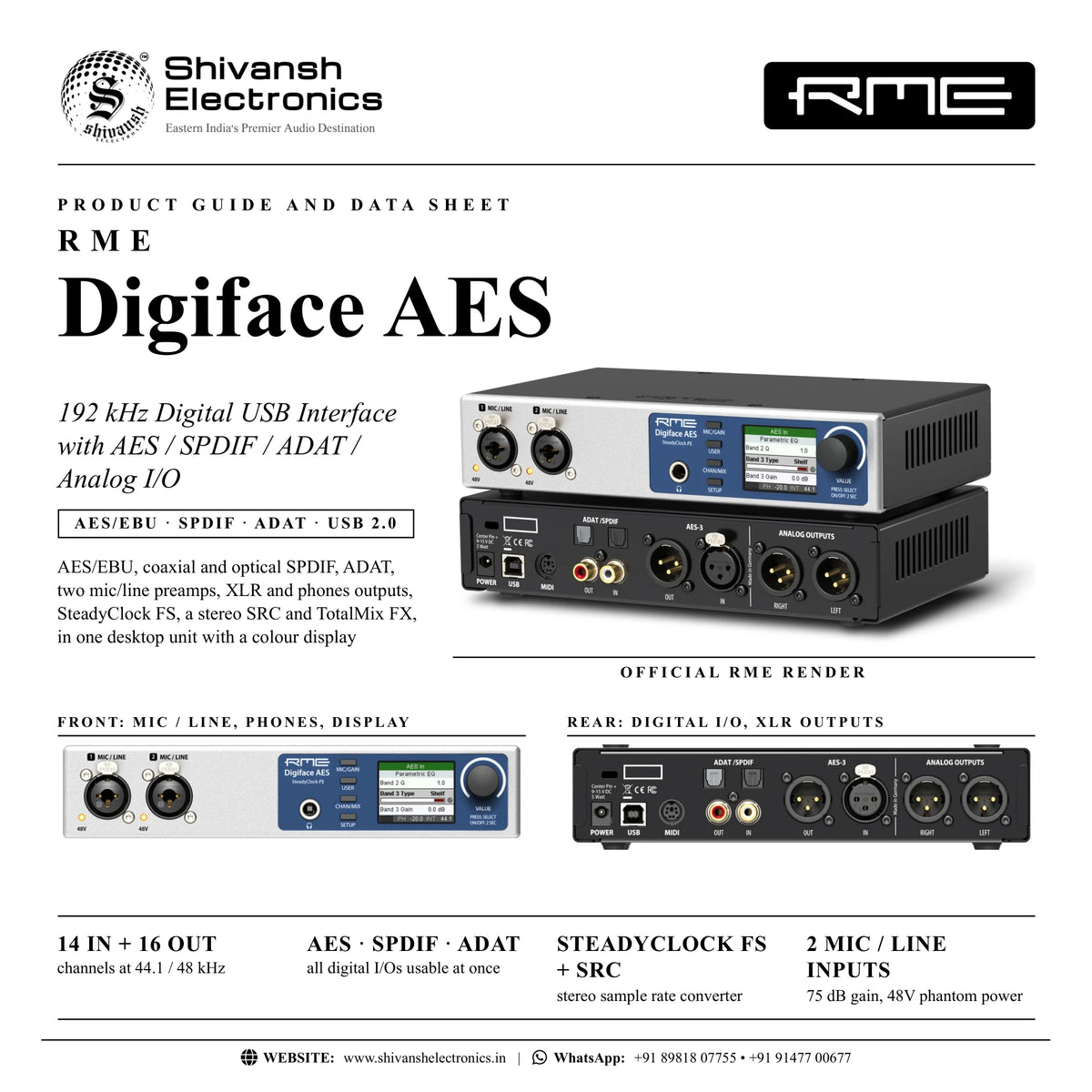
RME Digiface AES 192 kHz USB interface: AES/EBU, SPDIF, ADAT, 2 mic preamps, XLR outputs, built-in SRC, SteadyClock FS, stand-alone, bus-powered. Available in India from Shivansh Electronics, Kolkata, West Bengal, India.
VISUAL GUIDE — See Every Photo, Spec & Setup Step (PDF)
The price shown is the MAXIMUM RETAIL PRICE (MRP), inclusive of all taxes. For the best price, exclusive offers and discounted rates, delivery timelines, or any other information, please DM us or call +91 89818 07755 / +91 91477 00677. We will gladly share an exclusive coupon code that you can apply at checkout. All payments are processed securely through Razorpay, our trusted payment gateway partner.
General
| Type | 192 kHz digital USB interface with AES/SPDIF/ADAT/analog I/O |
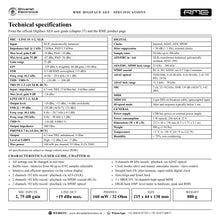
| Channels | 14 inputs / 16 outputs at 48 kHz (2 analog, 2 AES, 2 SPDIF coaxial, 8 ADAT in; plus 2 phones out) |
| Computer connection | 1 x USB 2.0 (works with USB 2.0 and USB 3.0 ports) |
| Supported sample rates | 28 kHz up to 200 kHz; up to 192 kHz |
| Buffer sizes | 48 to 8192 samples |
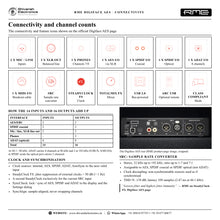
| Clock sources | Internal, AES, SPDIF, ADAT |
| Clock technology | SteadyClock FS; jitter suppression of external clocks > 50 dB (> 1 Hz) |
| Mixer | TotalMix FX: 480‑channel mixer, 46‑bit internal resolution; 3‑band EQ and Low Cut |
| Modes | Driver‑based USB 2, Class Compliant, stand‑alone (6 Setups) |
Inputs and outputs
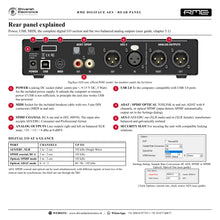
| Mic/line inputs 1‑2 | 2 x XLR/TRS combo (front), 48V, relay‑driven PAD |
| Line outputs 1‑2 | 2 x XLR, electronically balanced (rear) |
| Headphone output (7‑8) | 1 x 6.3 mm TRS stereo (front) |
| AES/EBU | 1 x XLR I/O, transformer‑balanced, galvanically isolated |
| SPDIF coaxial | 1 x RCA I/O |
| Optical | 1 x TOSLINK I/O, ADAT or SPDIF |
| SRC | Assignable to AES, SPDIF coaxial or SPDIF optical input |
| MIDI | 1 x MIDI I/O via breakout cable |
Audio performance
| Mic in 1‑2 | |
|---|---|
| Connector | XLR, balanced |
| SNR / dynamic range (A‑weighted) | 115 dB |
| THD+N | < -106 dB |
| Max level | +8 dBu (gain 0 dB) +19 dBu with PAD |
| Line in 1‑2 | |
| Connector | 6.3 mm TRS, balanced |
| SNR / dynamic range (A‑weighted) | 115 dB |
| THD+N | < -106 dB |
| Max level | +24 dBu (gain 0 dB) |
| Line out 1‑2 | |
| Connector | XLR, balanced |
| SNR / dynamic range (A‑weighted) | 123 dB |
| THD+N | -110 dB |
| Max level | +19 dBu |
| Phones 7‑8 | |
| Connector | 6.3 mm TRS stereo |
| SNR / dynamic range (A‑weighted) | 122 dB |
| THD+N | -108 dB (32 Ohm) |
| Max level | +13 dBu (High) |
Analog details
| Mic gain range | 75 dB in 1 dB steps, incl. relay‑driven PAD |
| Mic EIN (A‑weighted) | -129 dBu (60 dB gain, 150 Ohm, 20 Hz - 20 kHz) |
| Mic input impedance | 2 kOhm balanced (5.3 kOhm with PAD) |
| TRS input impedance | 12 kOhm balanced, 6 kOhm unbalanced |
| Mic THD | < -110 dB (< 0.0003 %) |
| Line output levels | +19, +13, +4 dBu switchable; 300 Ohm |
| Phones | +13 dBu (High) / +7 dBu (Low); 5 Ohm; 160 mW per channel into 32 Ohm |
| Frequency response | Mic: 16 Hz - 20.4 kHz (-0.1 dB, 44.1 kHz); line out: 0 Hz - 20.7 kHz (-0.5 dB, 44.1 kHz) |
| Crosstalk | > 110 dB |
Digital
| AES/EBU | AES3‑1992; input accepts Consumer and Professional; output 5 Vpp Professional; 28 - 200 kHz |
| SPDIF coaxial | IEC 60958; output 0.7 Vpp Consumer; 28 - 200 kHz |
| ADAT | 8 channels at 48 kHz; 4 at 96 kHz (S/MUX); 2 at 192 kHz (S/MUX4) |
| SRC | 2 channels, 32 - 192 kHz; ratio up to 1:7 and 7:1; THD+N -139 dB; 142 dB SNR (A‑weighted); latency 109 samples |
Physical
| Dimensions (W x H x D) | 21.5 x 4.4 x 13.0 cm |
| Weight | 880 g |
| Power | USB bus power or external power supply (12 V DC, included) |
| Typical power consumption | 3 W |
| Operating temperature | +5 to +50 °C |
System requirements
| Windows | RME driver for Windows |
| Mac | RME driver for macOS 11 or higher (Intel and ARM) |
| Computer port | 1 x USB 2.0 or USB 3.0 port, at least Intel Core i5 CPU |
Included software
| Mixer | TotalMix FX |
| Remote | TotalMix Remote |
| Analysis | DIGICheck |
Product overview
The RME Digiface AES is a 192 kHz digital USB interface with AES/SPDIF/ADAT/analog I/O: 14 inputs and 16 outputs over USB 2.0, built around AES/EBU on XLR, with two mic/line preamps, SteadyClock FS, a built-in sample rate converter and full stand-alone operation.
The digital section offers AES/EBU on XLR, coaxial SPDIF, optical SPDIF or 8-channel ADAT, all usable at the same time. Two digitally controlled mic/line preamps on XLR/TRS combo sockets, two balanced XLR outputs and a high-quality headphone output complete the analog side. An integrated SRC can be assigned to the AES, coaxial or optical input to solve clocking issues and adapt other sample rates. A colour display, four keys and an encoder give direct access to every function, and the unit runs on USB bus power or the included power supply.
| Inputs / outputs at 48 kHz | 14 / 16 |
| Max sample rate | 192 kHz |
| Mic EIN (A‑weighted) | -129 dBu |
| XLR output dynamic range (A‑weighted) | 123 dB |
Key features
- AES/EBU I/O on XLR, transformer-balanced, galvanically isolated
- SPDIF coaxial I/O (RCA) and optical I/O as SPDIF or 8-channel ADAT, all usable simultaneously
- Built-in SRC assignable to the AES, coaxial or optical input, 32 to 192 kHz
- 2 x mic/line preamps on XLR/TRS combo sockets: 75 dB gain range in 1 dB steps incl. relay-driven PAD, individually switchable 48V
- 2 x balanced XLR outputs, switchable +19, +13 and +4 dBu, 123 dB dynamic range (A-weighted)
- Headphone output, 160 mW into 32 Ohm, 5 Ohm output impedance
- SteadyClock FS clock and jitter-suppression technology
- TotalMix FX with 3-band parametric EQ and Low Cut
- Full stand-alone operation: colour display, encoder, four keys, six memory Setups, MIDI control
- USB bus-powered or external supply; Class Compliant mode; MIDI I/O; ARC USB support
Digital connectivity
Centred on an AES/EBU input and output on XLR, the Digiface AES also includes coaxial SPDIF and an optical port for SPDIF or 8-channel ADAT. All I/Os work at the same time, so the unit receives and sends every common digital audio format. AES, coaxial and optical SPDIF carry two channels at up to 192 kHz; ADAT carries 8 channels at 48 kHz, 4 at 96 kHz and 2 at 192 kHz.
Sample rate converter
The integrated SRC can be switched to any of the three stereo digital inputs. This lets the Digiface AES clock from its main AES source while listening to an SPDIF device running at a different rate. The SRC converts up to 1:7 and 7:1 with 139 dB dynamic range and THD+N of -139 dB.
Analog inputs and outputs
The two digitally controlled preamps offer 75 dB of gain including a relay-driven PAD, with an EIN of -129 dBu (A-weighted), line overload protection and enough gain for low-level microphones. The rear XLR outputs drive power amps or active monitors with up to 123 dB dynamic range (A-weighted), and the headphone output drives both high- and low-impedance headphones.
Stand-alone and TotalMix FX
Six device Setups stored in internal memory turn the Digiface AES into a different device at the click of a button, ideal for stand-alone use. TotalMix FX gives fully independent routing and mixing of all inputs and playback channels, with stereo submixes, a Control Room section, parametric EQ and remote control via TotalMix Remote or MIDI.
In the box
- RME Digiface AES
- USB 2.0 cable, 1.8 m
- MIDI breakout cable
- External switched power supply, lockable connector, 12 V DC, 24 W
- Power cord
Free RME software: TotalMix FX, TotalMix Remote and DIGICheck. Drivers for Windows and macOS (Intel and ARM).
RME Digiface AES: frequently asked questions
Which digital formats does the Digiface AES support?
AES/EBU on XLR, coaxial SPDIF on RCA, and optical SPDIF or ADAT on TOSLINK, all usable at the same time.
What is the SRC for?
The built-in sample rate converter adapts one digital input (AES, coaxial or optical) to the unit's clock, so you can monitor or record sources running at different sample rates.
Does it need the power supply?
It can run on USB bus power or on the included external power supply.
Can it work without a computer?
Yes. All functions are available from the front panel, and six Setups can be stored for stand-alone use.
Where can I buy the RME Digiface AES in India?
The RME Digiface AES is available from Shivansh Electronics, Kolkata, West Bengal, India, with delivery across India.
Workflow 1: Broadcast AES/EBU recording and playback
Record and play AES/EBU signals from broadcast equipment, with analog monitoring.
Connections
| Connect | To |
|---|---|
| AES/EBU source | AES IN (XLR) |
| AES/EBU destination | AES OUT (XLR) |
| Studio monitors | XLR line outputs 1‑2 |
| Headphones | Phones output |
| Computer | USB 2.0 |
Setup
- Install the RME driver and set AES as clock source.
- Record and play the AES channels in your software.
- Monitor on the XLR outputs; set their level to +19, +13 or +4 dBu.
- Use TotalMix FX EQ to adjust monitoring if needed.
Workflow 2: Mixed-rate digital monitoring with SRC
Clock from the main AES source while listening to an SPDIF device at a different sample rate.
Connections
| Connect | To |
|---|---|
| Main AES/EBU source (house clock) | AES IN |
| SPDIF device at another sample rate | SPDIF coaxial IN |
| Monitors | XLR line outputs |
| Computer | USB 2.0 |
Setup
- Set AES as clock source.
- Assign the SRC to the SPDIF coaxial input.
- Check sync status on the display.
- Record or monitor both sources together.
Tip: The SRC can also be assigned to the AES or optical input.
Workflow 3: Format conversion hub
Convert between AES/EBU, coaxial SPDIF, optical SPDIF and ADAT.
Connections
| Connect | To |
|---|---|
| AES/EBU device | AES I/O |
| Coaxial SPDIF device | SPDIF coaxial I/O |
| ADAT or optical SPDIF device | Optical I/O |
| Power | USB or external supply |
Setup
- Set up the routing between digital ports in TotalMix FX.
- Store it as one of six Setups.
- Disconnect the computer: the unit keeps working stand-alone.
- Recall Setups from the front panel.
Workflow 4: Voice-over and mic recording
Record voice-over or acoustic instruments with two preamps and AES output to a digital console.
Connections
| Connect | To |
|---|---|
| Condenser mic | Mic/line input 1, 48V on |
| Second mic | Mic/line input 2 |
| Digital console or recorder | AES OUT |
| Headphones | Phones output |
| Computer | USB 2.0 |
Setup
- Set gain with the MIC/GAIN key and encoder.
- Engage the PAD for loud sources.
- Send the mics to AES and to the computer at the same time.
- Monitor on headphones with EQ from TotalMix FX.
Workflow 5: Expand with ADAT
Add eight channels of an ADAT preamp or converter to the analog and AES I/O.
Connections
| Connect | To |
|---|---|
| ADAT preamp output | Optical IN (ADAT) |
| ADAT converter input | Optical OUT (ADAT) |
| Computer | USB 2.0 |
Setup
- Set the optical port to ADAT.
- Make the ADAT device clock slave, or clock from ADAT.
- Record up to 14 inputs at 44.1/48 kHz.
- Route outputs freely in TotalMix FX.
Workflow 6: Mastering and critical listening
Play high-resolution mixes through digital and analog paths with clean clocking.
Connections
| Connect | To |
|---|---|
| Digital DA converter | AES OUT |
| Active monitors | XLR line outputs 1‑2 |
| Headphones | Phones output |
| Computer | USB 2.0 |
Setup
- Play back at up to 192 kHz.
- Use SteadyClock FS for low-jitter conversion.
- Set XLR output level to +19 dBu for the highest dynamic range.
- Compare listening on monitors and headphones.


